Stainless Steel vs Aluminum Fabrication Cost: What Drives the Difference
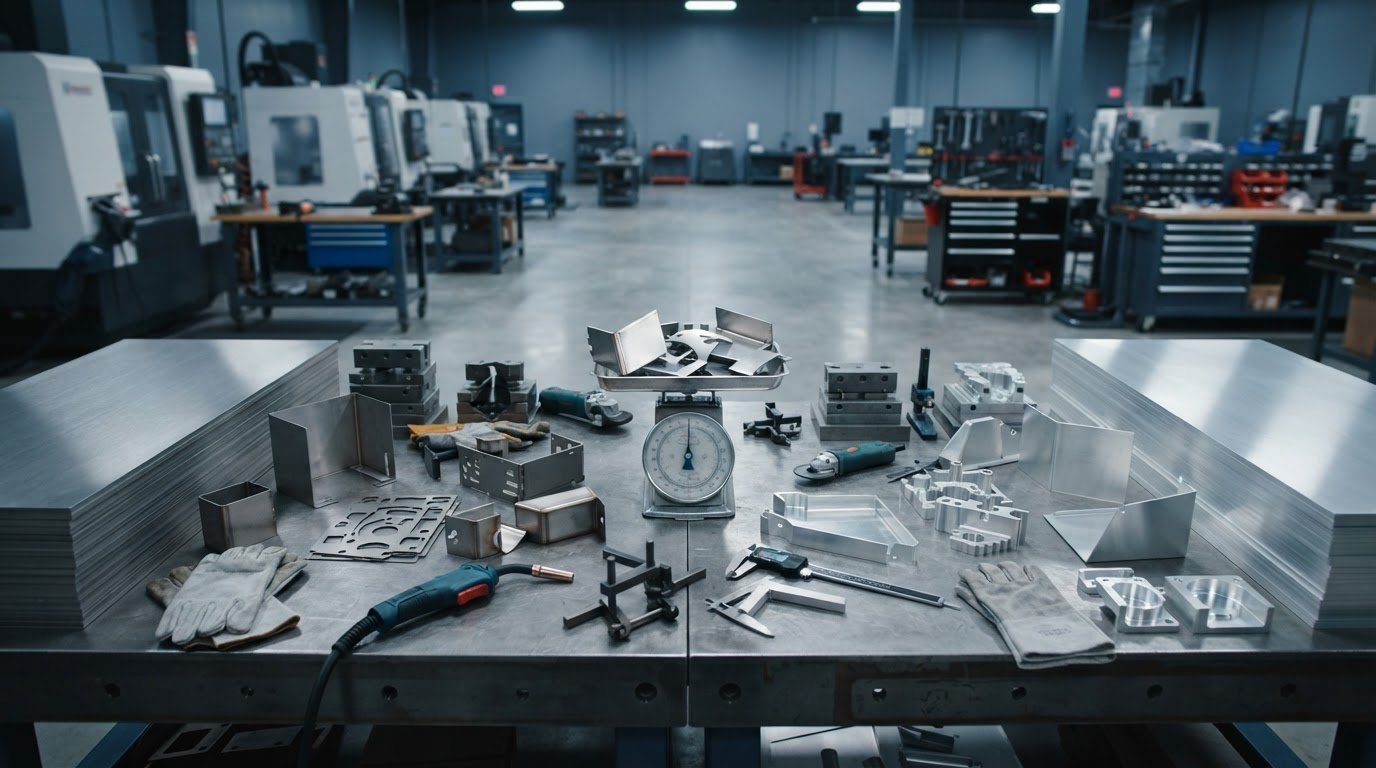
Aluminum usually starts at a lower material cost, but it does not always produce the lower-cost finished part. Fabrication time, finishing, tool wear, weight, and maintenance all affect the comparison.
Choosing between the materials is a trade-off, not simply a matter of comparing prices. This guide explains how each cost driver affects the total, so you can weigh the options against the part’s use, production requirements, and service life. Aluminum may save through lower weight and easier forming, while stainless steel’s durability and corrosion resistance may justify its higher starting cost.
We’ll compare the materials, finishing and maintenance needs, and fabrication speed, then provide a practical decision guide. The goal is to help you specify the part clearly and compare costs before it moves from drawing to production.
Key Takeaways
- Compare the full cost of the finished part, not just the price of the sheet. Material grade, fabrication effort, and finishing can shift the balance.
- Match corrosion resistance and surface treatment to the part’s environment to avoid paying for unnecessary finishing or maintenance.
- Factor in weight, strength, and service life together. A lighter option may simplify handling and shipping, while a more durable one may better suit demanding use.
- Account for forming and machining time, as well as tool wear, when estimating production costs.
- Use the decision guide to align material choice with the part’s load, exposure, appearance, and production requirements.
Aluminum vs Stainless Steel: Which Sheet Metal Material Is Better?
Aluminum usually costs less than stainless steel as a raw material, but the grade, design, and processing can change the comparison. Choose a material based on the application’s requirements, then compare the material and fabrication inputs together.
Raw Material Prices by Alloy and Grade
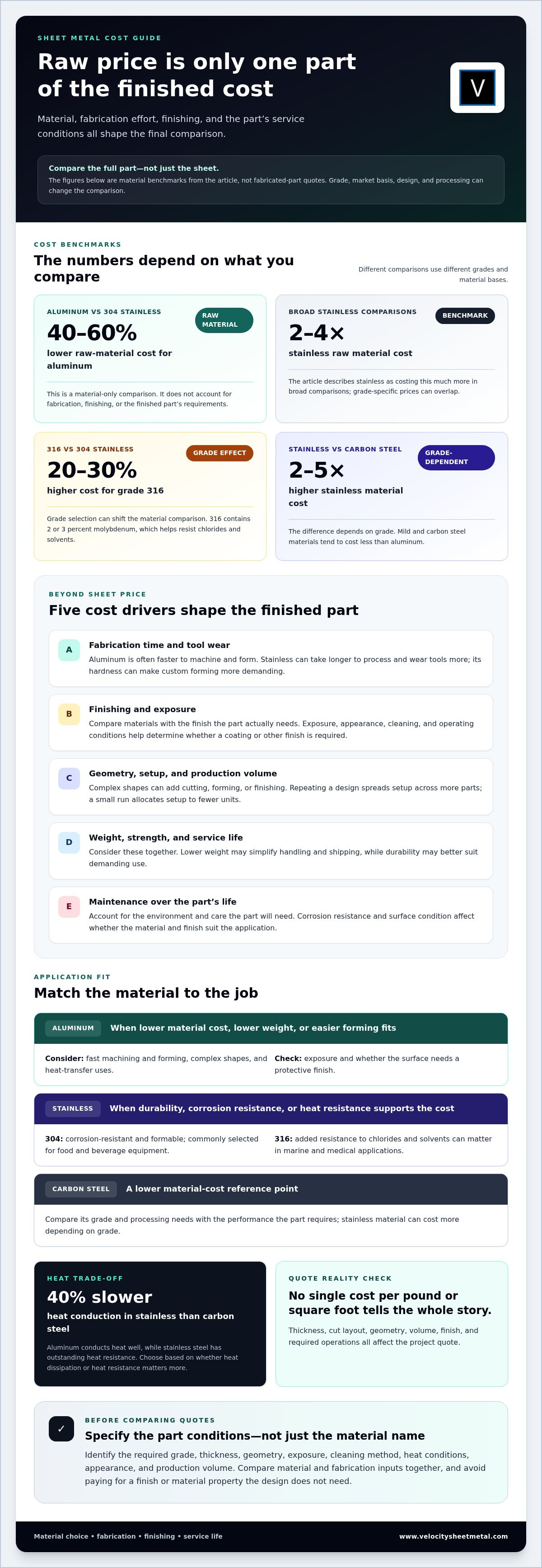
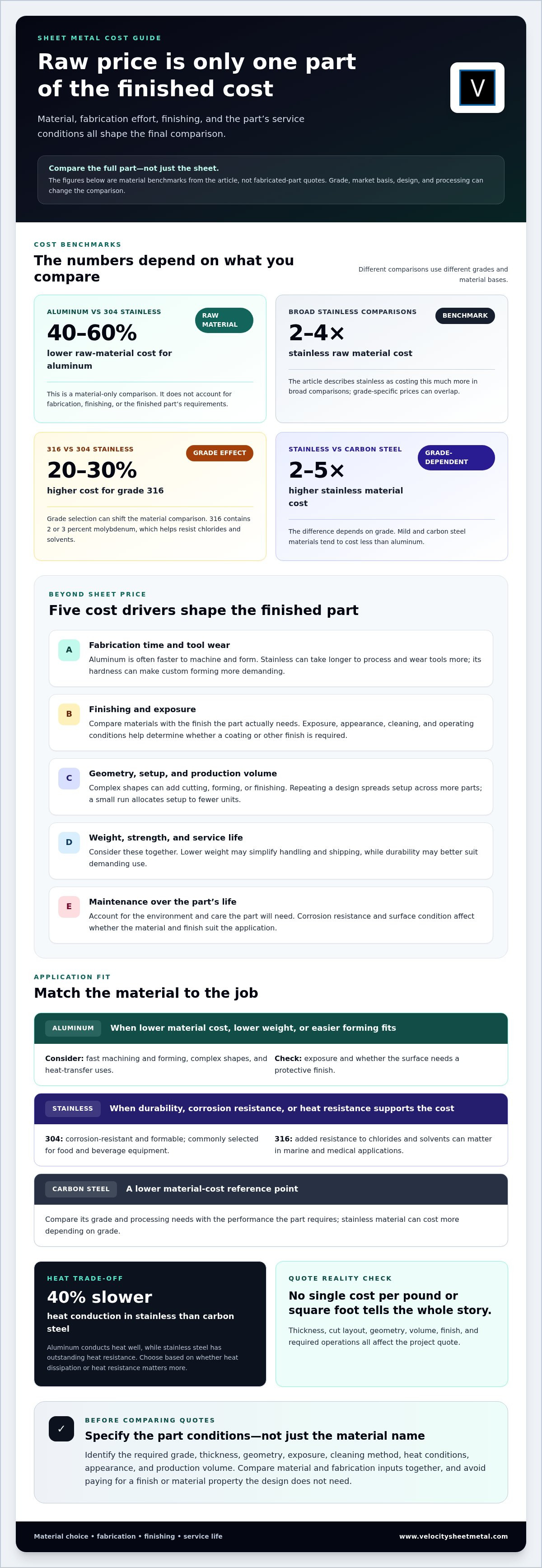
Those ranges show why the alloy matters: 316 costs 20-30% more than 304, while grade-specific aluminum and stainless prices can overlap.
Raw-material comparisons also vary by the grade and market basis. Aluminum is 40-60% cheaper than 304 stainless steel on raw material cost alone; broad comparisons describe stainless as costing 2-4 times more. Treat these as material benchmarks, not a fabricated-part quote.
Aluminum and Steel Material Costs
Stainless steel typically costs more than aluminum, while mild and carbon steel materials tend to cost less than aluminum. Stainless material can also cost 2-5 times more than carbon steel, depending on grade. Supply, demand, fuel costs, and ore availability influence metal prices, so a comparison depends on the selected material and purchasing conditions.
Aluminum is often faster to machine and form, while stainless steel can take longer to process and wear tools more. Aluminum’s malleability can help with complex shapes; stainless steel’s hardness can make custom forming more demanding. Weigh any material savings against the operations needed to produce the finished part.
Fabrication Costs by Weight and Sheet Area
There is no single fabrication cost per pound for either material. The grade, thickness, part geometry, finish, and production steps all affect the quote.
Fabrication cost per square foot also depends on sheet thickness, cut layout, forming, and finishing. Neither a per-pound nor a per-square-foot figure tells the whole story: material, complexity, volume, and required operations all affect the project quote.
Project Scale, Complexity, and Production Volume
Project size affects how material and setup costs are spread across parts. Complex geometry can require extra cutting, forming, or finishing, while simpler designs can reduce processing. Volume matters too: repeating a design spreads setup across more parts, while a small run allocates setup to fewer units.
At Velocity Sheet Metal, we help you reduce avoidable costs by nesting parts efficiently, removing unnecessary bends, and choosing a grade suited to the application. Avoid paying for a finish or material property the design does not need. These choices can reduce waste and extra operations while preserving the part’s required function.
| Material | Raw sheet cost | Grade comparison | Fabrication consideration |
|---|---|---|---|
| Aluminum | Lower than stainless | Alloy affects cost and suitability | Often faster to machine and form |
| Stainless steel | Higher raw cost | 316 costs more than 304 | Can take longer to fabricate and wear tools more |
| Carbon steel | Typically less than aluminum | Stainless costs 2-5 times more, depending on grade | Compare grade and processing needs |
Choose aluminum when its lower material cost and easier forming suit the application. Choose stainless steel when its grade and performance justify the higher material cost.
Corrosion resistance and finishing needs
Corrosion behavior affects both material selection and finishing. Before choosing aluminum or stainless steel, consider the part’s exposure, cleaning needs, and operating temperature. A coastal enclosure, food-processing surface, and heat-exposed component each face different conditions.
Stainless steel grades 304 and 316 offer excellent corrosion resistance, but stainless steel can still rust. Grade 304 is corrosion-resistant and formable. Grade 316 contains 2 or 3 percent molybdenum, helping it resist chlorides and solvents in marine and medical applications. That added resistance can matter where salt exposure drives the specification.
Aluminum also resists corrosion, but its surface responds differently to the environment. Coastal conditions can affect aluminum surfaces, so consider the exposure when selecting a finish. Aluminum’s surface can change over time with exposure to the environment. Exposure conditions help determine whether an untreated surface is suitable.
Finishing adds to the cost. Include it when comparing materials, rather than comparing coated aluminum with untreated stainless steel. The required appearance, exposure, and service conditions determine whether a coating is needed.
Chromium helps stainless steel resist corrosion, while iron in steel can oxidize and form flaky rust when exposed to oxygen. Stainless steel is not immune to damage: grade, surface condition, and environment still matter. A scratched or contaminated surface can behave differently from a clean, well-maintained one.
Heat can also change the decision. Stainless steel has outstanding heat resistance, while aluminum has moderate heat resistance. Aluminum conducts heat well, making it useful in heat sinks and thermal-transfer units. Stainless steel conducts heat about 40% more slowly than carbon steel, so it may be less suitable where rapid heat dissipation matters.
Use the application to guide the finish, not habit. For a chloride-exposed part, compare 316 with aluminum and its protective coating needs. For a heat-transfer component, aluminum’s conductivity may matter more than stainless steel’s higher heat resistance. For food and beverage equipment, stainless steel is commonly selected for hygiene and corrosion-control needs.
Before releasing a design, identify its exposure, cleaning method, heat conditions, and required appearance. Then compare the selected grade and finish together. Aligning the cut geometry with the intended coating or surface treatment can also simplify the production route; sheet metal part planning helps keep those design decisions connected.
Weight, strength, and durability comparison
Aluminum has a density of 2.7 g/cm³, approximately one-third that of stainless steel. That difference changes more than handling: it affects part weight, shipping loads, and the structure needed to carry force. Compare the material’s strength in the finished geometry, not by weight alone.
Stainless steel generally offers greater hardness, tensile strength, and durability. In some situations, aluminum’s higher strength-to-weight ratio makes it useful when reducing mass matters. A lightweight enclosure may suit aluminum, for example, while a rigid support exposed to repeated mechanical stress may favor stainless steel.
Design geometry can change the comparison. Replacing a steel tube with an aluminum tube of the same size may require greater thickness or a larger profile to account for aluminum’s lower strength. That change can add material and affect fit, so evaluate load, stiffness, and available space together before switching metals.
Start by identifying the load path: where the part carries tension, compression, bending, or impact during operation. Then compare the alloy’s strength with the part’s shape and support points. A thin aluminum panel and a stainless bracket have different structural roles, even if their dimensions look similar.
Weight can affect costs beyond the part itself. Aluminum’s lower mass can reduce freight costs for shipped products and make components easier to handle during assembly. For repeated parts, compare the total load and packaging requirements, not just the weight of one piece. Lighter components may also reduce demands on moving equipment.
Durability depends on both material and use. Stainless steel is generally more durable, while aluminum’s lower weight can benefit transport and equipment efficiency. A component exposed to impact may need stainless steel’s hardness; a movable structure may benefit more from aluminum’s lighter mass. Choose based on the duty cycle.
Chromium in stainless steel contributes to corrosion resistance, but the structural choice still depends on loads and exposure. Aluminum alloys also vary: 2024 is known for fatigue resistance, while 7075 is a very high-strength alloy used in aircraft structures. Alloy selection matters as much as the broad material label.
Before approving a substitution, compare the original part’s load, dimensions, environment, and shipping route. Keep the same geometry only if it meets the required strength and rigidity. If aluminum needs added thickness, weigh the additional material against freight and handling benefits. If stainless steel adds unnecessary mass, consider whether the application needs its durability.
Long-term maintenance and lifecycle costs
The lowest-cost material at purchase may not stay lowest-cost through service. Compare the initial part cost with finishing, inspection, cleaning, repair, and replacement needs. For an outdoor aluminum panel, recurring coating maintenance can close or reverse stainless steel’s initial cost gap over a 10-15-year service life.
Start with the operating environment. An aluminum surface exposed to outdoor conditions may need anodizing or powder coating for durability. That finish adds an upkeep task: inspect the coating, clean the surface, and address damage before corrosion progresses. Stainless steel grades 304 and 316 have excellent corrosion resistance, but stainless can still rust, so grade and exposure remain important.
Maintenance needs depend on the part’s use, not just its material. A sheltered indoor panel faces different demands from equipment exposed to coastal humidity. Aluminum can develop white rust in salty air, and stainless steel can also corrode in unsuitable conditions. Match the material and finish to actual exposure rather than assuming either surface is maintenance-free.
Build a lifecycle comparison in clear steps. First, identify the service environment and cleaning routine. Next, list the finish and inspections required for each material. Then account for repairs, recoating, downtime, and replacement. For example, compare a custom outdoor panel with a coating schedule against a stainless alternative over the same operating period.
Separate routine care from failure-related costs. Regular cleaning may preserve a surface, while coating damage can require repair or refinishing. If maintenance requires equipment removal, it can also interrupt operations. Stainless steel may reduce coating upkeep in some applications, while exposed aluminum may need more attention. The service conditions determine which costs matter most.
Use the same basis for both options. Evaluate each over the same service life, exposure, appearance requirements, and cleaning schedule, and include the initial finish in both estimates. Do not compare coated aluminum with untreated stainless steel or assume stainless needs no inspection just because chromium improves its corrosion resistance.
A practical decision record can help prevent overlooked costs. Document the selected alloy, surface treatment, exposure, inspection tasks, and repair approach. For outdoor aluminum, include recurring coating maintenance in the lifecycle calculation. For stainless steel, select a grade suited to the environment and include checks for corrosion or surface damage.
There is no universal winner for maintenance. Stainless steel is often described as low-maintenance, while aluminum may need moderate maintenance in some environments. The lifecycle result depends on exposure, coating needs, service duration, and the cost of accessing or replacing the part. Consider these factors before treating the lower initial quote as the lower total cost.
Fabrication speed and tool wear
Fabrication time affects the finished part’s cost as well as material price. Aluminum is typically faster to machine and form, while stainless steel is slower to fabricate and harder on tools. The difference depends on the alloy, part geometry, tolerances, and required operations.
Aluminum’s properties generally allow faster cutting and forming, potentially shortening production time for parts with repeated features or complex profiles. Stainless steel’s hardness increases tool demands and may slow operations. Account for cutting, drilling, bending, and finishing separately: a material may move quickly through one step but require more work in another.
Tool wear is a production cost, not just a maintenance detail. Stainless steel can put more strain on cutting tools, leading to more frequent tool changes or slower machining. This affects both machine availability and labor. For a design with many holes or detailed cuts, include tool contact and process time in the comparison rather than relying only on sheet price.
Welding introduces different preparation demands. Aluminum forms an oxide layer that typically needs removal within 8 hours of welding a joint. That timing adds a preparation step and requires coordination between cleaning and welding. A stainless steel weld also needs a suitable process and handling, but aluminum’s oxide layer makes surface preparation a distinct consideration.
Part design can reduce avoidable production time. Review the drawing for unnecessary contours, tight internal corners, and features that require extra tool changes. Consolidating repeated dimensions or simplifying a profile can make cutting and forming more straightforward. Keep functional tolerances where needed, but avoid adding precision requirements without a performance reason.
Production volume also affects the time calculation. A one-off component may carry setup and programming across a single part, while a repeat run can spread that preparation across more units. Compare the same design and quantity in each material. Otherwise, the estimates may reflect different setups rather than a genuine difference in fabrication speed.
Compare the processes step by step. List each operation in sequence and note where tool changes, surface preparation, or extra forming steps occur. Then compare the total workload for each material, including welding and finishing. This shows whether aluminum’s faster machining offsets its preparation needs, or stainless steel’s durability justifies slower processing.
For a project moving from drawing to production, review your fabrication workflow and identify operations that can be simplified before the material is finalized.
Velocity Sheet Metal: Coil-line automated rectangular duct
Velocity Sheet Metal is a practical option for fabricated ductwork and sheet metal parts. Its coil-line automated rectangular duct serves projects requiring rectangular duct production. For round systems, the company also offers spiral and round duct and fittings.
Bring the material, finish, and design requirements into the production conversation. BIM Coordination & Spool Drawings can support coordination from project plans, while Custom Laser Cutting and CNC Press Brake Bending address sheet metal part needs. These offerings connect design and fabrication without treating material cost as the only decision. If you’re planning ductwork or custom components, contact Velocity Sheet Metal to discuss your project.
Turn the Material Decision Into a Production Plan
Make the next step a clear, buildable specification. Record the part’s function, required geometry, finish, and production needs in one design package. This gives the fabrication team a practical basis for turning the stainless steel vs aluminum fabrication cost comparison into a production decision, rather than a material-only choice.
For ductwork and custom sheet metal components, Velocity Sheet Metal offers coil-line automated rectangular duct, spiral and round duct and fittings, and custom laser cutting. Share your project details and intended application to help define a fabrication path that fits the design.
Contact Velocity Sheet Metal to discuss your project and move from material selection toward production. A well-defined specification gives the work a stronger starting point. Your next decision can be a practical one: clarify what the part must do, then set the design in motion.
Frequently Asked Questions
How do raw material prices for stainless steel and aluminum compare in the U.S.?
These figures provide a raw-stock baseline for the stainless steel vs aluminum fabrication cost comparison. Supply, demand, fuel costs, and ore availability can all affect material prices.
How do stainless steel and aluminum differ in cutting, welding, bending, and machining costs?
Aluminum is typically faster to machine and form, while stainless steel can take longer and wear tools more. The cost impact depends on the operations in the part’s route: cutting complexity, bends, machining features, and weld preparation. Aluminum welding adds a specific preparation step because its oxide layer typically needs removal within 8 hours of welding a joint. Compare the full sequence, not one operation alone.
Which stainless steel and aluminum grades are most commonly used for fabrication, and how do their costs compare?
Common sheet comparisons include aluminum 5052 and 6061, and stainless steel 304 and 316. 304 is widely used and formable, while 316 resists chlorides and solvents. Aluminum 6061 has good weldability and is used in automotive and marine applications.
How do stainless steel and aluminum compare in strength, weight, corrosion resistance, and service life?
Stainless steel generally offers greater hardness and durability, while aluminum is much lighter and can have a higher strength-to-weight ratio in some applications. Grades 304 and 316 provide excellent corrosion resistance, while aluminum’s performance depends partly on its environment and finish. Service life follows the application’s loads, exposure, and maintenance needs. Stainless steel and aluminum can also be combined in hybrid systems to balance strength, cost, and performance.
What finishing costs apply to stainless steel and aluminum fabrication, such as polishing, passivation, anodizing, and powder coating?
Finishing cost depends on the process, surface condition, appearance requirements, and part geometry. Polishing adds work to achieve the specified appearance, while passivation is a finishing option for stainless steel. Compare treatments against the part’s actual exposure and finish requirements, rather than adding processes the application does not need.