Questions to Ask a Potential Fabricator for Project Fit
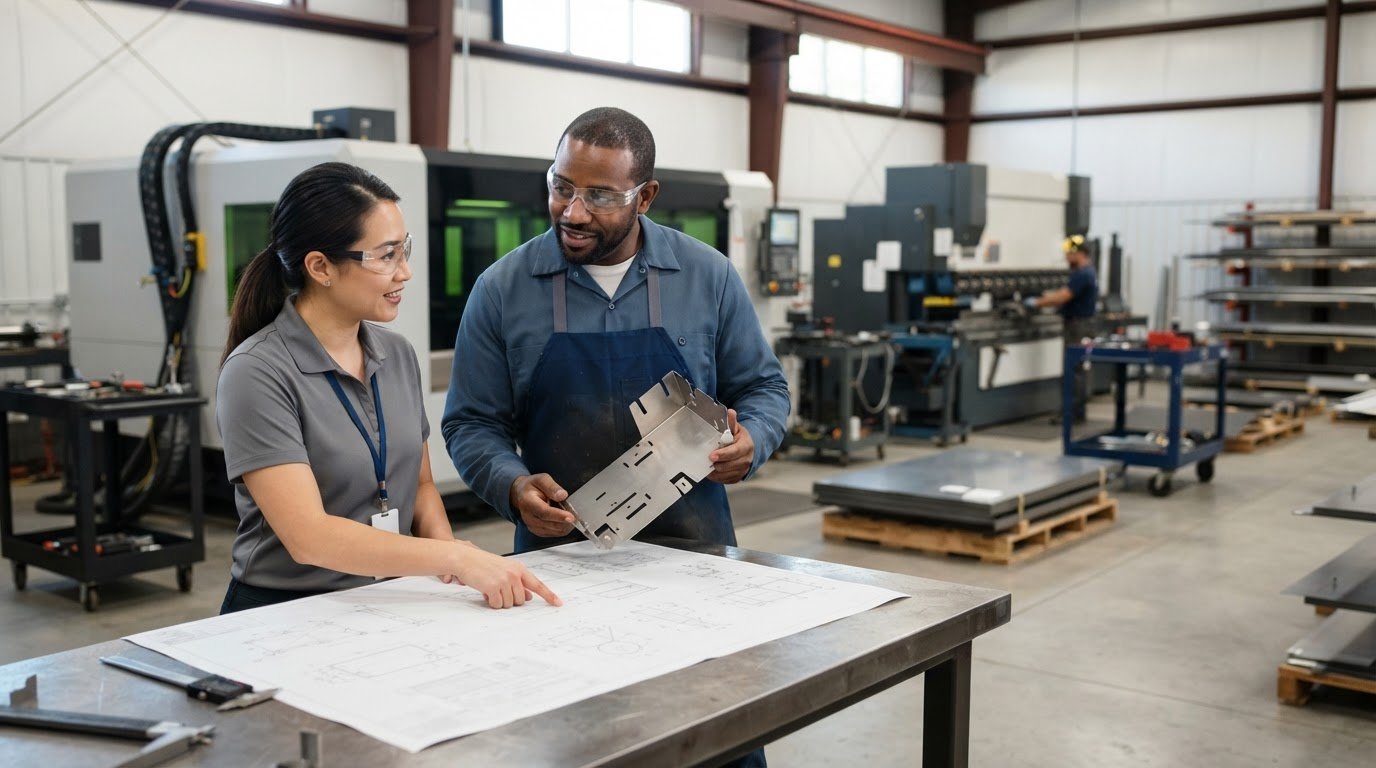
The most important questions to ask a potential fabricator are about whether its capacity fits your project, not simply whether it can make the part. Ask about relevant experience, equipment, production workload, quality controls, and how it manages engineering changes. Clear answers show whether the shop can take your design into production and meet your requirements.
It’s easy to focus on a quote or a list of machines. But project fit depends on the entire process, from interpreting drawings and refining designs to managing production and communicating issues. The right questions help you assess practical capability before committing time and resources.
This guide explains how to assess fabrication capacity, qualifications, engineering support, equipment, timelines, and project coordination. Compare the answers with your specifications to identify gaps and choose a fabrication partner suited to the work.
Key Takeaways
- Match a fabricator’s process and material experience to the parts your project requires.
- Assess quality practices by asking how inspections, process controls, and documentation support consistent results.
- Define specifications, tolerances, deadlines, and communication needs before comparing proposals.
- Explore how engineering support and design-for-manufacturability input can resolve production issues early.
- Compare equipment capability and available production capacity with your project’s size, precision, and schedule demands.
1. Question 2: What is your fabrication capability and capacity?
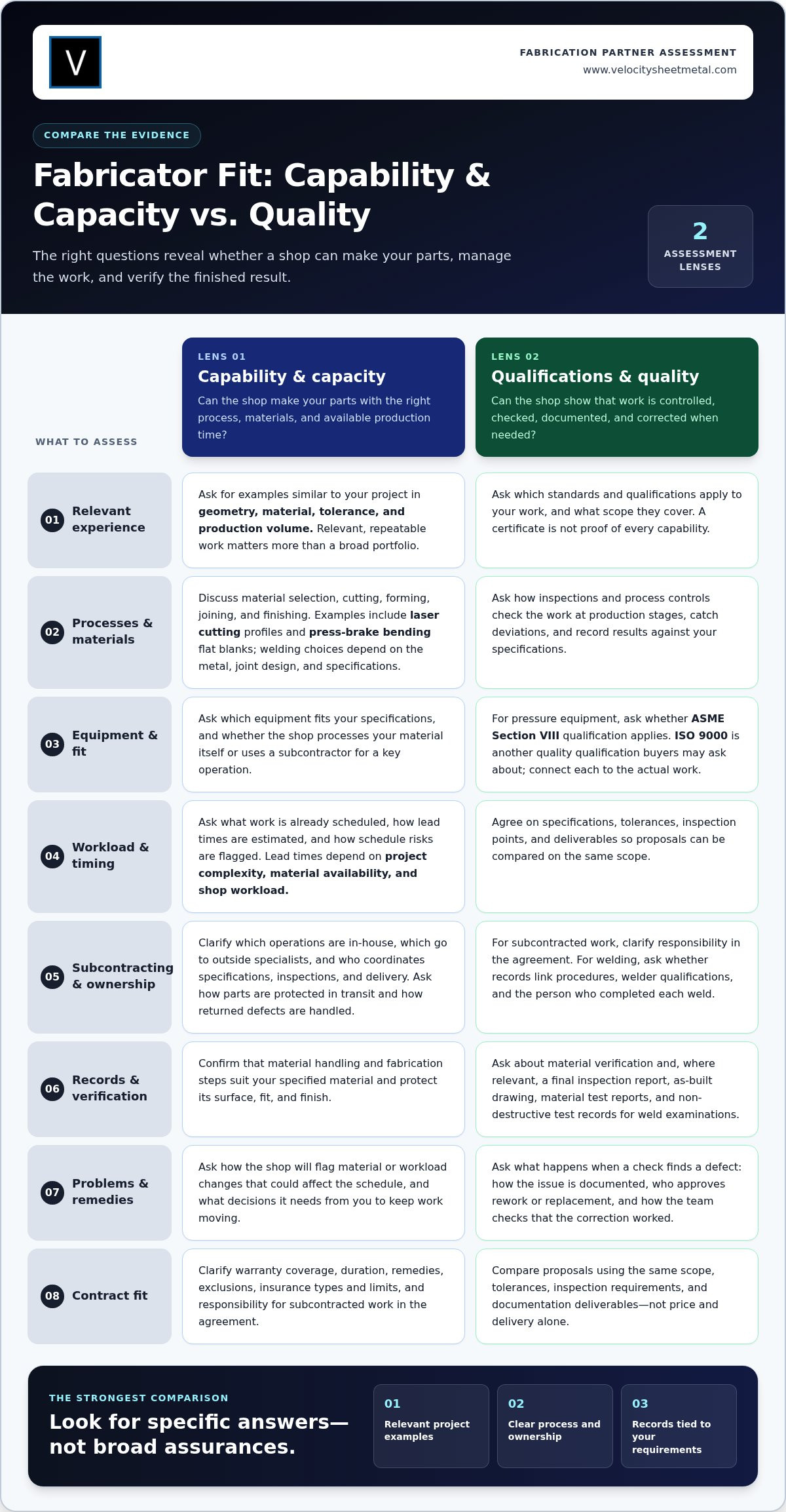
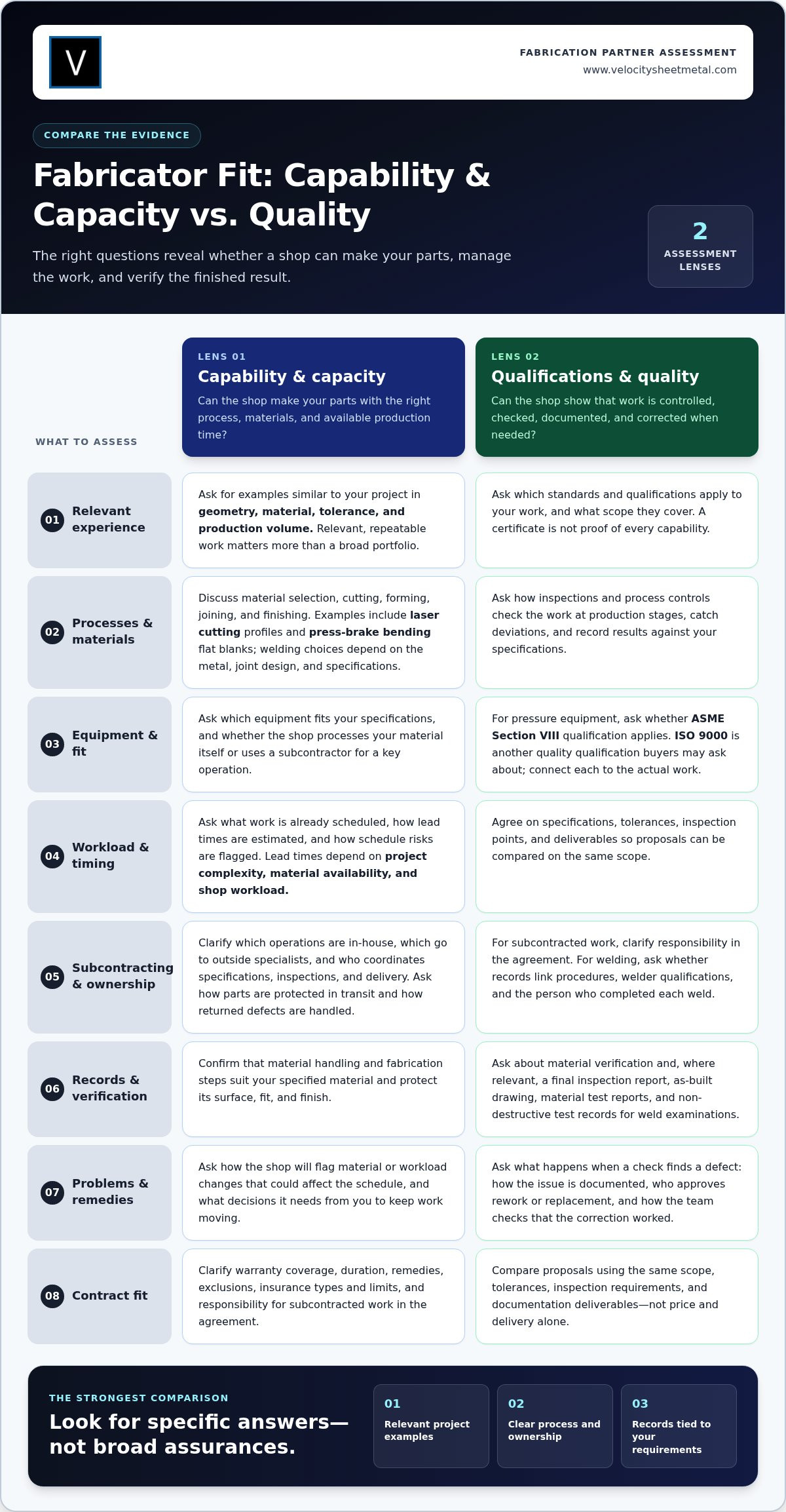
Ask what parts the shop makes, which materials it processes, and how its equipment fits your specifications. A shop that regularly produces sheet-metal enclosures, for example, may work differently from one focused on structural assemblies. Request examples with geometry, material, tolerance, and production volume similar to your project. A broad portfolio matters less than relevant, repeatable experience.
To evaluate experience, certifications, and past projects, compare the fabricator’s industry history with your project’s requirements, then review relevant examples and references. Ask which standards its work follows and whether qualifications such as ASME Section VIII or ISO 9000 apply to your application. These credentials address different contexts, so connect each one to the work rather than treating a certificate as proof of every capability.
Look beyond the finished part. Ask how the shop manages material selection, cutting, forming, joining, and finishing. For custom metal components, laser cutting can produce profiles from digital drawings, while press-brake bending forms flat blanks into angles or channels. Welding can join assemblies, but the right process depends on the metal, joint design, and specifications. Ask for examples of how the fabricator controlled these variables.
Material expertise is more than a list of metals. Ask how the team handles your specified material, protects its surface, and manages fabrication steps that could affect fit or finish. A stainless-steel panel and an aluminum bracket, for example, can call for different handling and joining decisions. Confirm whether the shop processes your material itself or relies on a subcontractor for a key operation.
Subcontracting is not automatically a problem, but unclear handoffs can complicate schedules and accountability. Ask which operations are done in-house, which go to outside specialists, and who coordinates specifications, inspections, and delivery. If finishing is subcontracted, clarify how the shop protects parts in transit and handles a defect found after the work returns. A specific process is more useful than a general assurance.
Assess capacity as well as capability. Ask what work is already scheduled, how the shop estimates lead times, and how it responds to changes in material availability or workload. Lead times depend on project complexity, material availability, and shop workload. Ask how the fabricator will flag schedule risks and what decisions it needs from you to keep the work moving. This makes capacity a project-specific discussion.
Warranties, insurance, and liability coverage should fit your contract, scope of work, and project risks. Ask what defects a warranty covers, how long coverage lasts, what remedy applies, and which exclusions matter. Clarify the fabricator’s insurance types and limits, as well as its responsibility for subcontracted work in the agreement. Don’t assume one standard policy or warranty suits every fabrication project.
Among the questions to ask a potential fabricator, prioritize those that connect demonstrated experience to your specifications. A relevant portfolio example, a clear material-handling process, and an accountable subcontracting plan give you concrete evidence to compare before choosing a partner.
2. Question 3: What qualifications do you have?
Ask how the fabricator’s quality system controls work from drawing review through final inspection. A useful answer explains which checks are performed, what records are created, and who reviews the results. A shop might use visual inspections, dimensional checks, and process controls at different production stages. Ask how these steps catch deviations before parts move forward and how results are recorded against your specifications.
Certifications matter when they match the work. For pressure equipment, ask whether ASME Section VIII qualification applies to the project; ISO 9000 is another quality qualification buyers may ask about. Neither label replaces a clear explanation of the shop’s actual quality practices. Ask which scope the qualification covers and how its quality management system supports consistent custom metal fabrication, from receiving materials to releasing finished parts.
Welding documentation offers another practical test. For relevant projects, ask whether the data package records weld procedures and qualifications, including which welder completed each weld. Ask how the fabricator verifies that materials meet the required specifications. If your design includes welded assemblies, a precise answer should link the procedure, material, and inspection record to the part being made.
Inspection should lead to action, not just a report. Ask what happens when a dimensional check finds a part outside tolerance or a visual review identifies a defect. A sound corrective process identifies the issue, determines its cause, documents the disposition, and checks whether the correction worked. Ask who approves rework or replacement and how the team prevents the same problem in later parts.
For finished equipment, ask whether the data package includes a final inspection report confirming compliance with specifications and an as-built drawing showing the shipped configuration. If the project includes pressure equipment, ask about material test reports and non-destructive test records for weld examinations. These documents link quality claims to the actual materials, tests, and finished unit, rather than relying on a general assurance.
Evaluate quality alongside price and delivery. A low quote may omit inspection records, process controls, or documentation your project requires. Compare proposals using the same scope, tolerances, inspection points, and deliverables. Then ask how specification changes affect production and quality checks. This makes trade-offs visible without treating speed, precision, or cost as the only measure.
For sheet-metal parts, define the required profile, material, and dimensional checks before requesting a quote. Custom Laser Cutting is one fabrication option for parts made to project specifications; the drawing and inspection criteria should guide the quality review.
3. Defining project requirements and comparing fabrication partners
Compare fabrication quotes using the same scope, material, tolerances, finishing requirements, order quantity, and delivery expectations. Weigh quality, price, and delivery together, since a lower quote may leave out work included elsewhere.
Start with a clear request package. Include current drawings, material grade, dimensions, critical tolerances, finish requirements, quantity, and required delivery date. Identify dimensions that affect fit or function, and mark optional features separately. A sheet-metal panel drawing, for example, should show its profile, hole locations, bend details, and finish. If specifications change, issue a revised drawing and identify the changes. This gives every fabricator the same basis for estimating cutting, forming, inspection, and completion.
A facility visit can show how the proposed work moves through the shop. Ask to meet the people responsible for your project and follow the relevant production steps, from material handling to finished parts. Look for clear handoffs between operations and ask how work in progress is tracked. A visit can also help you discuss practical constraints, such as where parts are inspected and how finished assemblies are prepared for shipment. Focus on the work you need, not general impressions of the building.
Past projects provide evidence of fit. Request case studies or references involving comparable materials, part complexity, tolerances, and order needs. When checking references, ask for customers from the past year, which can reflect current staff and performance. Ask those customers whether the fabricator met specifications, communicated issues, and delivered the agreed scope. A project portfolio is most useful when examples explain the challenge, the work performed, and the completed result.
Clarify how each proposal handles price changes before choosing a partner. Ask whether pricing is fixed or based on time and materials, and identify assumptions about material, quantity, finishing, and inspection. Material costs, project complexity, tolerances, finishing requirements, and order quantity can affect the final price. Ask how the fabricator documents change requests, prices additional work, and gets approval before proceeding. This helps prevent a drawing revision from becoming an untracked scope change.
Include delivery and communication in your comparison. Ask how progress updates are shared, who reports production issues, and how schedule changes are communicated. Some fabricators may expedite work for an additional fee, while others follow strict scheduling policies. Ask how shipping is arranged and whether delivery is included in the proposal or handled through a carrier. Record each answer beside the relevant quote item to compare like with like.
For metal fabrication projects, a short comparison table can reveal gaps in scope, specifications, completion schedule, change process, communication, and delivery. Use the same headings for every proposal. If a bid leaves a requirement unclear, mark it as an open item instead of assuming it matches another quote. This final review turns your project requirements into a consistent basis for selection.
4. Engineering services and design for manufacturability
Ask how engineering support takes your design from drawing review to production release. Design for manufacturability means shaping a part so it can be made efficiently without compromising its required function. A formed sheet-metal component, for example, may need an adjustment to a bend or feature to suit the available processes. A useful review identifies potential issues before cutting or forming begins, while changes are easier to coordinate.
Ask which CAD file formats the fabricator accepts and what information engineers need to refine specifications. A 3D model can show geometry, while a 2D drawing may define dimensions, tolerances, and notes. If the files conflict, establish which document governs. This is crucial to meeting requirements: a clear file hierarchy helps the engineering team resolve differences before a machine uses the wrong revision.
Depending on the project, engineering staff may support approval drawings, as-built drawings, pressure calculations, or certifications. Ask which deliverables apply to your design and when you’ll review them. An approval drawing lets your team review a proposed configuration before fabrication. An as-built drawing records the final configuration. Define review responsibilities and approval timing in the project plan.
Ask how the fabricator manages design changes, defects, rework, and delays. Each design change should go through a documented revision, a review of its production impact, and approval before affected work proceeds. For a defect, ask how the team records the issue, assigns corrective work, verifies rework, and reports schedule effects. Clear ownership helps prevent an outdated drawing or unapproved repair from reaching the next operation.
Use a design review meeting to work through a real feature, such as a hole near a bend or a tight assembly interface. Ask the engineer to explain how that detail affects tooling, sequence, fit, or inspection. The discussion should connect the drawing to fabrication steps, not merely mark up dimensions. Record agreed revisions and open decisions so production can follow the design intent.
Ask how engineering input is coordinated with manufacturing when specifications change during production. A revised hole pattern, for example, can affect cutting instructions, later forming, and part fit. Agree on who issues the updated file, how the revision reaches production, and how affected parts are handled. This connects digital design decisions to physical work and reduces confusion across the project team.
Before release, confirm that approved drawings, specifications, and manufacturing instructions align. Ask what triggers another review, such as a material substitution or a change to a critical dimension. A simple revision log can record each change, approval, and affected document. This structured handoff keeps engineering intent connected to every production step, from the first review through completed parts.
5. Fabrication equipment and machine capabilities
Ask which machines will perform the critical operations on your parts. A laser cutter, press brake, and welding station each serve different production steps. Match the equipment to your material, geometry, tolerances, and order requirements. For a formed panel, cutting capability alone isn’t enough: the shop also needs a suitable way to make its bends and check the finished shape.
Machine age and condition can affect precision and quality on complex or tight-tolerance projects. Ask how equipment is maintained, how operators verify setups, and what inspection follows a changeover. For a repeat part, find out how the shop keeps settings and revisions consistent between production runs. Specific answers connect equipment to your part requirements rather than relying on a machine list.
Capacity involves more than counting machines. Ask about facility size, the weights the shop can handle, and the number of welders available for the work. Discuss current production commitments, estimated lead times, deadline plans, and contingencies for delays. A shop may have the right process but limited space or workload capacity for a large assembly. Relate each answer to your project’s dimensions and schedule.
For welding, ask which methods the team uses and how it chooses a process for your material and joint design. AWS certification among a company’s welders can indicate a rigorous hiring policy. Ask which welders would perform the relevant work and how the process is checked against your specifications. Match the method and qualifications to the actual assembly, not just the shop’s general capability.
In the United States, safety and regulatory requirements depend on the work, materials, equipment, and end use. Identify the applicable requirements in your project specifications and contract, then ask how the fabricator incorporates them into production procedures and documentation. For welding work, clarify which AWS qualifications or requirements apply to your project rather than assuming one credential covers every process.
Ask how the shop responds when equipment produces substandard results. A practical answer should explain how operators stop or adjust the process, inspect affected parts, and document corrective action. If a weld does not meet requirements, for example, ask how the shop identifies affected assemblies and verifies any rework. This shows whether machine capability is backed by a controlled response on the production floor.
Compare equipment against the complete route your part must travel: cutting, forming, joining, and inspection. Ask which steps happen in the facility and how outside operations affect coordination or timing. Then connect available capacity to the project schedule and required delivery plan. Explore fabrication capabilities to see options relevant to sheet-metal production.
Velocity Sheet Metal: Coil-line automated rectangular duct
Velocity Sheet Metal is a natural fit for projects requiring coil-line automated rectangular duct. Its fabrication offerings also include spiral and round duct and fittings, custom laser cutting, and BIM coordination and spool drawings. Choose according to your project’s needs: duct production, custom-cut parts, or drawing coordination.
For HVAC contractors and project teams, a practical next step is to align the fabrication scope with the drawings. Share the relevant specifications and project requirements when discussing the work to keep the scope aligned with the parts you need.
Contact Velocity Sheet Metal to discuss a project involving these fabrication services.
Turn Your Fabrication Review Into a Clear Next Step
Strong project decisions start with a practical handoff: align your drawings, scope, and production needs before work begins. Use the questions to ask a potential fabricator as a working checklist, and apply the same priorities when discussing your next fabrication package. Clear inputs keep technical discussions focused on the parts and coordination your team needs.
For HVAC and sheet-metal work, Velocity Sheet Metal offers coil-line automated rectangular duct, spiral and round duct and fittings, and custom laser cutting. These services support projects ranging from ductwork packages to custom-cut components. Bring the relevant project information to the discussion so the scope can be matched to your requirements.
Ready to move from evaluation to a project discussion? Contact Velocity Sheet Metal to start the conversation. A clear next step can turn your plans into coordinated fabrication work, with your project needs leading the way.
Frequently Asked Questions
Question 2: What is your fabrication capability and capacity?
Confirm that the shop can handle your part’s material, dimensions, process sequence, and expected production volume. Ask which operations it performs in-house and which it assigns to subcontractors. For a sheet-metal assembly requiring cutting, bending, and joining, establish how those steps are coordinated and who is responsible for quality at each handoff. Discuss current workload and how the shop manages schedule conflicts before approving a production date.
Question 3: What qualifications do you have?
Ask which certifications and quality systems apply to the specific work, and what each one covers. ASME Section VIII may be relevant to pressure equipment, while ISO 9000 is another qualification buyers can ask about. Request examples of how documented procedures support production checks and corrective action. A credential matters most when its scope aligns with the materials, processes, and deliverables required for your project.
Question 4: Do you have an engineering staff and resident engineer?
Ask who reviews drawings, resolves technical questions, and approves design changes during production. A resident engineer may help when a project requires frequent on-site coordination, while other projects may rely on scheduled reviews and a designated engineering contact. Clarify who can resolve a drawing conflict, how decisions are recorded, and how quickly updated instructions reach production. Match the arrangement to the project’s complexity and communication needs.
Question 5: Can you provide a user’s list with references?
Ask for references tied to work similar in material, process, and project demands. References from the past year can reflect current staff and performance. Ask each contact whether the fabricator communicated problems early, handled revisions clearly, and delivered the agreed work. A short list without relevant examples gives limited insight, so focus on comparable completed projects and specific experiences rather than broad endorsements.
Question 7: Do you provide a complete data package?
Agree on required project records before fabrication begins. For pressure equipment, a package can include material test reports, non-destructive test records for weld examinations, and an as-built drawing. Weld procedures and qualifications, along with a final inspection report, may also be relevant to the scope. If instrumentation is furnished, define how factory acceptance testing will verify its installation and operation against specifications.
What questions should you ask a sheet-metal fabricator?
Ask how the shop will turn your drawings into finished parts, including how it manages critical dimensions, bends, holes, and assembly interfaces. Clarify which production methods suit the material and design, and how the team flags drawing conflicts before work begins. For duct components, also define how pieces must align with connected sections and project documentation. These details show whether the shop understands the part’s role in the larger system.
What questions should I ask a potential fabricator before hiring them?
Before hiring, clarify who owns decisions, revisions, inspection records, and delivery coordination. Ask how project updates are shared, who contacts you when an issue affects scope, and how approval is documented before changed work proceeds. Review the agreement for defined specifications, deliverables, and responsibilities, including subcontracted operations. A named point of contact and a clear decision path help keep production questions from stalling the project.
How do fabricators price jobs, including setup, materials, labor, and finishing?
Fabrication quotes can reflect setup, material, labor, finishing, order quantity, tolerances, and project complexity. Ask whether the proposal uses fixed pricing or time and materials, and request a clear breakdown of included operations and assumptions. Compare quotes against the same drawing revision and scope. Changes to material, finish, or quantity can affect the work, so establish how revised requirements are documented and approved.