Outsourcing Sheet Metal Fabrication: Costs and Tradeoffs
The lowest quote can become the most expensive choice. The best fabrication partner is one whose experience, equipment, quality practices, communication, and capacity match your parts and schedule. To weigh the pros and cons of outsourcing sheet metal fabrication, compare the full production impact, not just the quoted fabrication charge.
Outsourcing can free up capital and internal capacity, but it also means less direct control over production. The right decision depends on your part volume, complexity, deadlines, and in-house capabilities. Consider how outsourcing affects total costs, flexibility, equipment and staffing needs, and quality oversight. Then assess potential fabrication partners to decide whether to outsource, keep work in-house, or combine the two.
Key Takeaways
- Compare a fabricator’s equipment, technical experience, and ability to improve part design against your production needs.
- Use outside capacity to absorb demand spikes, while accounting for supplier schedules and keeping critical work close when rapid changes matter.
- Weigh equipment, staffing, training, maintenance, and facility demands before deciding whether to build in-house capability.
- Compare the full cost of outsourcing, including shipping and quality oversight, with the ongoing costs of internal production.
- Assess a potential partner’s relevant experience, capabilities, quality practices, communication, and ability to meet your technical requirements.
How do I choose the best metal fabrication company for outsourcing?
Compare a fabricator’s equipment, skilled workforce, relevant experience, quality practices, and total cost. The right match depends on your parts’ complexity, annual volume, and required production capacity.
Specialized Equipment and Expertise
Outsourcing gives your team access to fabrication equipment and experienced workers without building every capability in-house. This can be useful when a part requires a process your shop cannot perform efficiently or precisely.
For example, a fabricator experienced in formed enclosures may spot a practical way to simplify a difficult bend. Skilled sheet metal workers can also identify drawing details that affect fit, finish, or repeatability. Ask how the supplier’s equipment and experience relate to your actual parts, rather than relying on broad product categories.
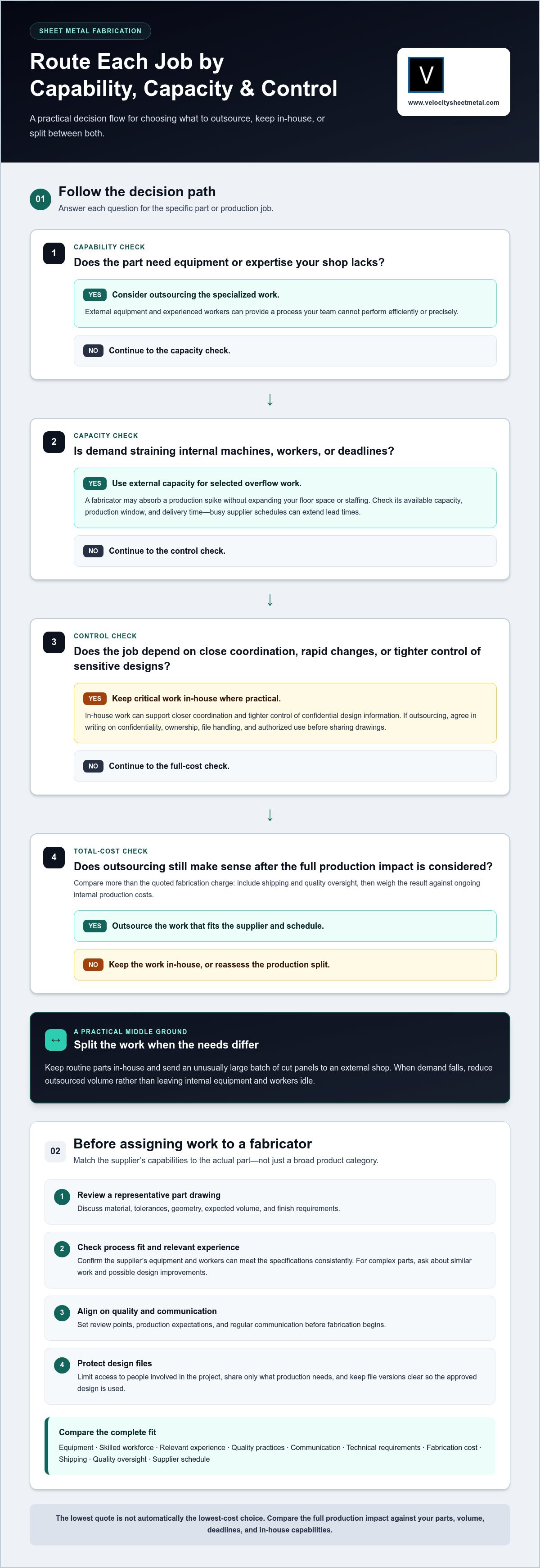
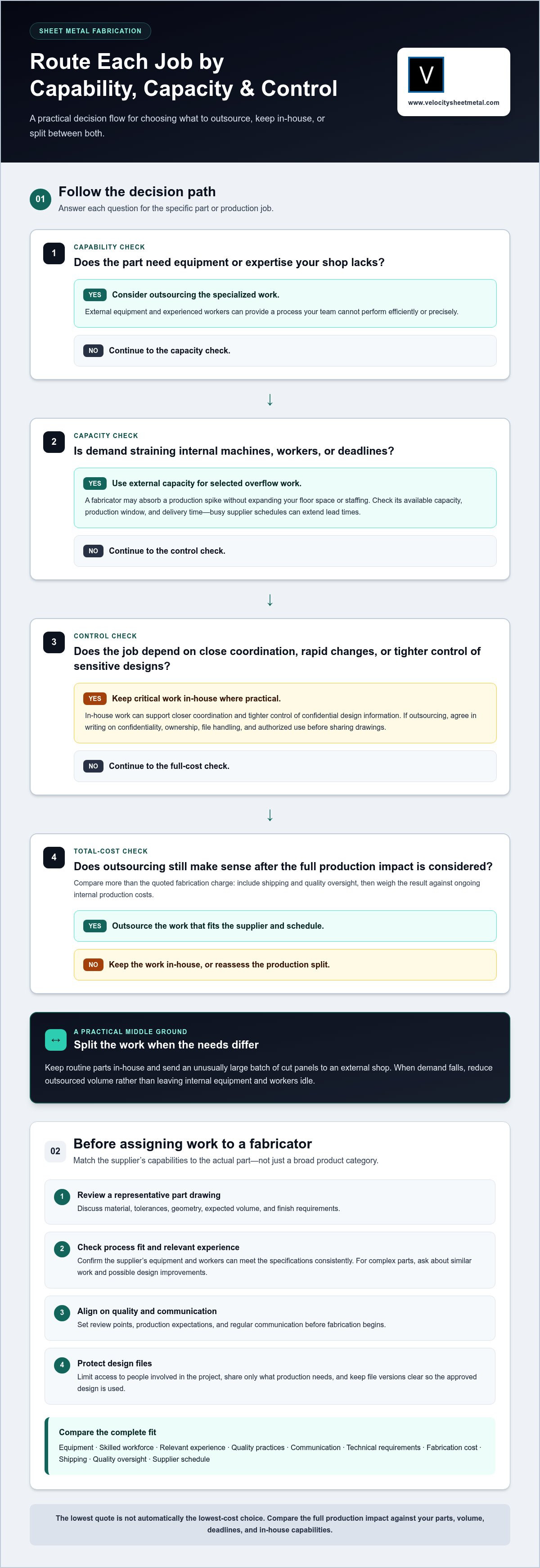
Outsourcing involves identifying critical processes and deciding which could be outsourced, according to the Supply Chain Resource Cooperative. Keep processes that depend on close internal coordination in-house, and consider outsourcing specialized work that requires equipment or expertise your team lacks.
Evaluating Fabrication Capabilities
Evaluate a supplier by matching its equipment, experience, quality practices, and cost structure to your manufacturing process. This helps you avoid choosing on price alone.
Review a representative part drawing with the fabricator. Discuss material, tolerances, geometry, expected volume, and finish requirements. Then assess whether its equipment and workers can meet the specifications consistently. For complex parts, ask about similar work and whether previous production experience could inform design improvements.
A sheet metal fabricator may use specialized machinery, software, and material suppliers to improve yield or production efficiency. Compare expected part quality and process fit alongside the quoted fabrication charge. Include shipping and quality oversight in the comparison, since both affect the total cost of outsourcing.
Outsourcing a project typically involves defining part requirements, sharing drawings, reviewing the proposed process and cost, and aligning on production and quality expectations. Clear communication at each stage reduces misunderstandings before fabrication begins.
- Capabilities: Match processes and equipment to the part’s geometry and specifications.
- Experience: Look for relevant examples, especially for complex designs.
- Quality: Set review points and maintain regular communication during production.
Protecting Designs and Intellectual Property
Design protection means controlling who can access drawings and clarifying how the supplier may use them. This matters when files contain proprietary dimensions, product concepts, or other sensitive information.
Before sharing files, put confidentiality and ownership expectations in writing, and limit access to people involved in the project. Share only the drawings and production details needed for the work. Keep file versions clear so the fabricator uses the approved design, not an outdated one.
Companies with sensitive designs may prefer in-house fabrication to maintain tighter control over confidential information. If you outsource, agree on file handling, authorized use, and communication channels before transferring design data. These steps help protect the work while giving the external team the information needed to produce it.
Flexibility for fluctuating production volumes and deadlines
External capacity can absorb production peaks without expanding your floor space or staffing. The tradeoff is that supplier schedules, part complexity, and delivery coordination affect how quickly work progresses.
Adjusting to Volume and Deadline Changes
Outsourcing flexibility means shifting selected fabrication work outside your plant as demand changes. This can help when a production spike would otherwise strain internal machines, workers, or deadlines.
A fabricator can provide overflow capacity while your team keeps core production moving. For example, a manufacturer can make routine parts in-house and send an unusually large batch of cut panels to an external shop. When demand falls, it can reduce outsourced volume rather than leave internal equipment and workers idle.
That flexibility depends on the supplier’s available capacity. A busy schedule can extend lead times, so outsourcing does not automatically solve an urgent deadline. Build the supplier’s production window and delivery time into your plan, particularly if one late component could hold up assembly.
In the 2024 ISG Market Lens study on business process outsourcing, 33% of surveyed decision-makers cited capacity as a motivator, while 28% cited variable demand. Those findings concern business process outsourcing, not sheet metal specifically, but they illustrate why companies use external capacity to respond to changing workloads.
Order Complexity, Lead Times, and Logistics
Order volume and part complexity shape the production work a supplier must schedule and perform. Setup, cutting, forming, material handling, and inspection requirements can vary from job to job.
Higher volumes can spread setup work across more parts, while a complex one-off component may require additional programming, handling, or quality review. For example, a repeat flat panel and a formed part with several bends involve different production steps. Compare the full scope, not just the quantity, when assessing an outsourcing quote.
There is no single typical lead time for outsourced sheet metal parts. A supplier’s current workload, part complexity, and production sequence affect when fabrication can start and finish. Shipping adds cost and coordination, so include it in the total comparison and align delivery with your receiving and assembly schedules.
Quality also depends on clear specifications and timely feedback. Agree on the drawing revision, acceptance criteria, and review points before production. If cutting or forming reveals a practical design improvement, a prompt discussion can address it before the issue recurs across a larger batch.
For a mixed production plan, keep time-sensitive core work close and use external capacity for suitable overflow or specialized parts. Reviewing production options for changing demand can help frame that decision.
In-house fabrication equipment, labor, and facility requirements
In-house fabrication requires more than buying a machine. Equipment, skilled staff, floor space, maintenance, and utilities all affect whether internal production suits your demand.
Equipment and Facility Investment
Equipment and facility investment means building the physical infrastructure needed to cut, bend, and weld metal. Each process adds space, setup, upkeep, and operating demands beyond the initial purchase.
A shop adding laser cutting, for example, must plan for the machine, material movement, operator access, and maintenance work. Press brakes and welding equipment bring their own setup and staffing needs. Modern fabrication equipment investments can reach six- or seven-figure sums, so expected part volume and machine utilization matter before committing.
Facility planning also affects workflow. A crowded layout can complicate movement between cutting, forming, and inspection. Map each part’s route through production, then account for storage, utilities, maintenance access, and incoming material. Those requirements remain even when demand drops.
Labor and Staffing Requirements
Labor investment includes hiring and training workers to operate equipment and maintain consistent production. A machine adds capacity only when skilled people can run it safely and effectively.
For example, a shop adding bending work needs operators who understand the equipment, drawings, and part requirements. Supervisors coordinate schedules, while maintenance staff keep machines available. Hiring and training also take management time, and staff wages continue even when production slows.
Staffing needs can change as the product mix shifts. A run of simple parts may need different oversight than parts requiring several forming steps. Estimate the experience each process requires, then compare that workload with available staff and production priorities. Overtime or hiring can address a bottleneck, but both affect operating costs.
Avoiding In-House Expenses
Avoiding in-house expenses means paying for external fabrication rather than owning all the equipment, facility capacity, and specialist labor. This can make sense when internal demand is too low to keep those resources productively occupied.
An external fabricator may already have advanced machinery and experienced workers. This can let a business produce a specialized part without buying equipment for occasional use. Outsourcing can also reduce expenses related to machine upgrades, maintenance, utilities, facility overhead, training, and production downtime.
Weigh those advantages against the impact on communication and production control. In-house work can make schedule changes and design discussions easier to coordinate. A hybrid approach can keep frequent, closely managed processes internal while assigning specialized or overflow work outside. Review actual demand and equipment use regularly. If outsourced work becomes a lasting production need, compare cumulative costs with investment in internal infrastructure.
Outsourcing manufacturing cost management
Outsourcing shifts fabrication spending from internal equipment and labor toward supplier charges. Compare the full cost of finished components, not just the quoted production charge.
Cost Savings from Outsourcing
Cost savings can come from avoiding some fixed manufacturing expenses and paying for external production as needed. This matters when internal equipment or staff would otherwise be underused.
For example, a business that needs formed panels occasionally can avoid maintaining dedicated equipment for that work. Its comparison should include supplier charges, shipping, quality oversight, and additional coordination. Outsourcing can convert fixed costs into variable costs, which may support cash-flow flexibility as production demand changes.
The 2024 ISG Market Lens study reported a 16% cost reduction from outsourcing among surveyed decision-makers. That finding covers business process outsourcing, not sheet metal fabrication, so it should not be treated as a fabrication savings estimate. The useful takeaway is to measure results against your own production costs.
Make-or-Buy Cost Comparisons
A make-or-buy comparison weighs internal production costs against the full cost of purchasing fabricated parts. A supplier’s quote alone does not show the total cost to your business.
For an in-house part, include materials, labor, machine time, utilities, maintenance, training, and facility overhead. For an outsourced part, include the supplier’s charge, shipping, receiving, and the effort required for quality review. Use the same part specifications and order volume for both estimates.
Also account for waste and production interruptions. Poor quality can increase scrap, slow downstream work, and lead to customer complaints. A lower initial charge may not be the lower-cost option if parts need correction or delay assembly.
Long-Term Cost Comparisons
A long-term comparison tracks cumulative outsourcing costs against the investment and operating expenses of internal capability. This matters when recurring orders make external production a lasting part of manufacturing.
Review actual orders over time, including changes in volume, supplier charges, shipping, and quality oversight. Fabricators may adjust prices as demand, material costs, or capacity constraints change. In-house costs also shift with equipment repairs, upgrades, utilities, and staffing needs.
For example, a process outsourced occasionally may become frequent enough to justify internal investment. Compare cumulative external spending with equipment, infrastructure, and workforce costs, then revisit the decision as production requirements change.
Cost-Benefit Analysis
Cost-benefit analysis compares financial costs with operational value, including capacity and time freed up for other work. The cheapest production route may not best support your company’s priorities.
List the costs and benefits of each option using the same part, specifications, and production period. Include internal resources freed for design, engineering, or assembly, alongside external charges and logistics. Then consider whether outsourcing improves flexibility or eases pressure on a constrained process.
Reassess the comparison as the business changes. A short project, recurring component, and fluctuating production schedule can produce different results. Updating the analysis with actual quality, volume, shipping, and overhead data keeps the make-or-buy decision aligned with current operations.
Choosing a reliable fabrication partner
A fabrication partner affects part quality, delivery, and how much production control stays in-house. Before moving work outside, evaluate its machinery, relevant experience, quality practices, communication, and fit with your technical requirements.
Match Capabilities to the Work
Start with the part, not the supplier’s broad capability claims. Compare the drawing, material, tolerances, geometry, and production volume with the partner’s equipment and experience. A shop that cuts flat blanks may not be equipped for every forming or assembly requirement.
Ask for examples of similar work and discuss how the manufacturing process would meet your specifications. For a formed enclosure, for instance, review the bend sequence, fit, and inspection process. The partner’s answers show whether its experience applies to your actual components.
Certifications can indicate that a supplier follows defined quality or industry processes. Assess whether each certification applies to the work you’re outsourcing, and review the quality standards used for your parts. A certificate alone does not prove that every job will meet your requirements.
Assess Quality and Communication
Agree on how the supplier will verify parts before production starts. Define the drawing revision, acceptance criteria, inspection records, and communication points. Regular quality reviews can identify a mismatch before it affects a larger batch.
For example, if a first article shows a hole or bend out of position, a clear review process helps both teams resolve the issue before the next production run. Open communication also matters when specifications change. Confirm how revised files and approvals will be shared so production does not continue from an outdated drawing.
Evaluate reliability through demonstrated performance, references, and the supplier’s ability to meet technical requirements. Discuss production capacity and scheduling directly. The partner’s priorities and processes should align with your quality expectations and delivery needs.
Use a Pilot to Reduce Exposure
A pilot order is a limited production run used to evaluate a partner’s process before transferring more work. A real part can reveal issues that a capability discussion alone may miss.
Choose a representative component and evaluate its fit, finish, documentation, communication, and delivery against agreed expectations. Record any discrepancies and how they were resolved. Use the results to decide whether the process is ready for broader production or needs adjustment.
Protect supply continuity by documenting production requirements and maintaining communication about changes. Established providers with demonstrated reliability can reduce supply-chain vulnerabilities, while a backup option can help manage disruption. Balance that resilience against the effort of maintaining multiple supplier relationships.
For a partner assessment grounded in real project requirements, share your fabrication requirements.
Velocity Sheet Metal: Coil-line automated rectangular duct
Velocity Sheet Metal provides coil-line automated rectangular duct for projects that need fabricated ductwork without adding that production process in-house. Its spiral and round duct and fittings support projects requiring those configurations, while BIM Coordination & Spool Drawings connect fabrication planning with project documentation.
Consider these offerings when assessing which ductwork processes to outsource, balancing internal capacity against project requirements, or coordinating fabrication information. For other sheet metal needs, Custom Laser Cutting and CNC Press Brake Bending provide options for cut and formed components. The right fit depends on your project’s parts and scope.
Contact Velocity Sheet Metal to discuss your fabrication requirements, or visit www.velocitysheetmetal.com.
Set the Next Production Decision in Motion
Turn the comparison into a defined production decision. Select a part or process that could benefit from outside capacity, then document the drawing revision, required outcome, delivery needs, and quality criteria. This creates a clear basis for evaluating results and deciding whether the work belongs with a supplier, your internal team, or both.
The pros and cons of outsourcing sheet metal fabrication are most useful when applied to a real project, not a general assumption. Use your next production requirement to assess how an external partner fits your workflow, communication needs, and manufacturing priorities. A focused scope helps your team move forward with clarity.
Velocity Sheet Metal can discuss fabrication requirements for your project. Contact Velocity Sheet Metal to start the conversation and identify a practical next step.
Frequently Asked Questions
What Does it Mean to Outsource Manufacturing?
Outsourcing manufacturing means paying an external company to perform production work instead of using your own staff and equipment. The arrangement can cover one operation, such as cutting blanks, or a broader production scope. It does not necessarily mean sending work overseas. A U.S. manufacturer can outsource to another domestic supplier, while offshoring specifically means moving work to a manufacturer in another country.
Outsourcing Metal Services: Is It Worth It?
Outsourcing can be worthwhile when external production solves a specific constraint more effectively than expanding your own operation. Consider a product team launching a new enclosure: outsourcing early production can avoid buying equipment before demand is established. Compare that flexibility with supplier charges, communication needs, and delivery schedules. The decision is strongest when outsourcing meets a clear business need rather than shifting an unresolved production problem elsewhere.
What Are the Pros and Cons of Outsourcing?
The main advantage is access to external resources without building every capability in-house. A supplier may bring machinery, experienced workers, and production knowledge your team does not use regularly. The tradeoff is less direct control over scheduling and process changes. To weigh the pros and cons of outsourcing sheet metal fabrication for a specific job, consider how much supplier expertise matters compared with the control your team needs over revisions and timing.
What are the main pros of outsourcing sheet metal fabrication?
Key advantages include access to specialized cutting and forming equipment, skilled production workers, and additional capacity without expanding your facility. Outsourcing can also let engineers focus on product design or assembly instead of managing fabrication equipment. For example, a company developing a new machine can source a custom bracket externally while its internal team concentrates on testing how it fits with other components.
What are the cons and risks of outsourcing sheet metal fabrication?
Risks include less immediate control over production, communication delays, supplier schedule conflicts, and quality problems that disrupt downstream work. Sharing detailed designs can also raise confidentiality concerns. Reduce these risks by documenting approved drawings, acceptance criteria, change approvals, and file access before production starts. A clear escalation process helps both teams address a dimension or fit issue before it affects assembly or reaches a customer.
How does outsourcing compare with in-house sheet metal fabrication in cost and lead time?
Outsourcing replaces some internal operating expenses with supplier charges, while in-house fabrication gives your team closer control over daily scheduling and adjustments. Compare total costs, including labor, machine upkeep, shipping, and inspection. Lead time depends on workload, production steps, and delivery coordination. An internal process may handle a last-minute revision faster, while an external supplier may provide equipment your plant does not have.
How do I choose and vet a sheet metal fabrication supplier?
Start by matching the supplier’s equipment and past work to your part’s material, geometry, tolerances, and production needs. Review its quality procedures, communication practices, and ability to manage drawing revisions. Then run a representative first order and inspect the delivered parts against your specifications. This practical evaluation reveals whether the documentation, workmanship, and coordination suit your process before you assign more work.
When does it make sense to outsource versus fabricate sheet metal in-house?
Outsource when production requires equipment or expertise your team lacks, demand exceeds available capacity, or buying machinery would leave substantial unused capability. Keep work in-house when frequent design changes, sensitive files, or close coordination make direct control valuable. A hybrid model can separate routine production from specialized work: your team handles recurring operations, while external capacity supports unusual parts or temporary workload increases.