National Sheet Metal Fabrication Supplier for Custom Projects

A national footprint alone doesn’t make a supplier the right fit. A national sheet metal fabrication supplier should match its capabilities to your project’s design, engineering, assembly, finishing, quality, and industry-specific requirements, then coordinate fabrication and delivery across the United States. Compare the full production scope, not geography alone.
One supplier can simplify a complex project, but only if its capabilities match the work. Understand which stages it can support, how design choices affect manufacturability, and what requirements shape the finished parts.
This guide explains how to assess supplier capabilities, from design-for-manufacture support and fabrication processes to assembly, finishing, quality systems, and logistics. You’ll also see how to compare providers against your project’s needs and where a focused fabrication partner fits when custom cutting, ductwork, or coordinated production is the priority.
Key Takeaways
- Bring design and fabrication teams together early to spot manufacturability issues before they disrupt production.
- Assess quality systems and certifications alongside how a supplier documents and controls its work.
- Match fabrication capabilities to your industry’s part requirements, production workflow, and project scope.
- Compare suppliers on engineering support, fabrication, finishing, assembly, quality, and delivery coordination, not reach alone.
- For ductwork projects, understand how automated duct production, BIM coordination, and custom laser cutting can support the work.
Collaborative design and design-for-manufacture support
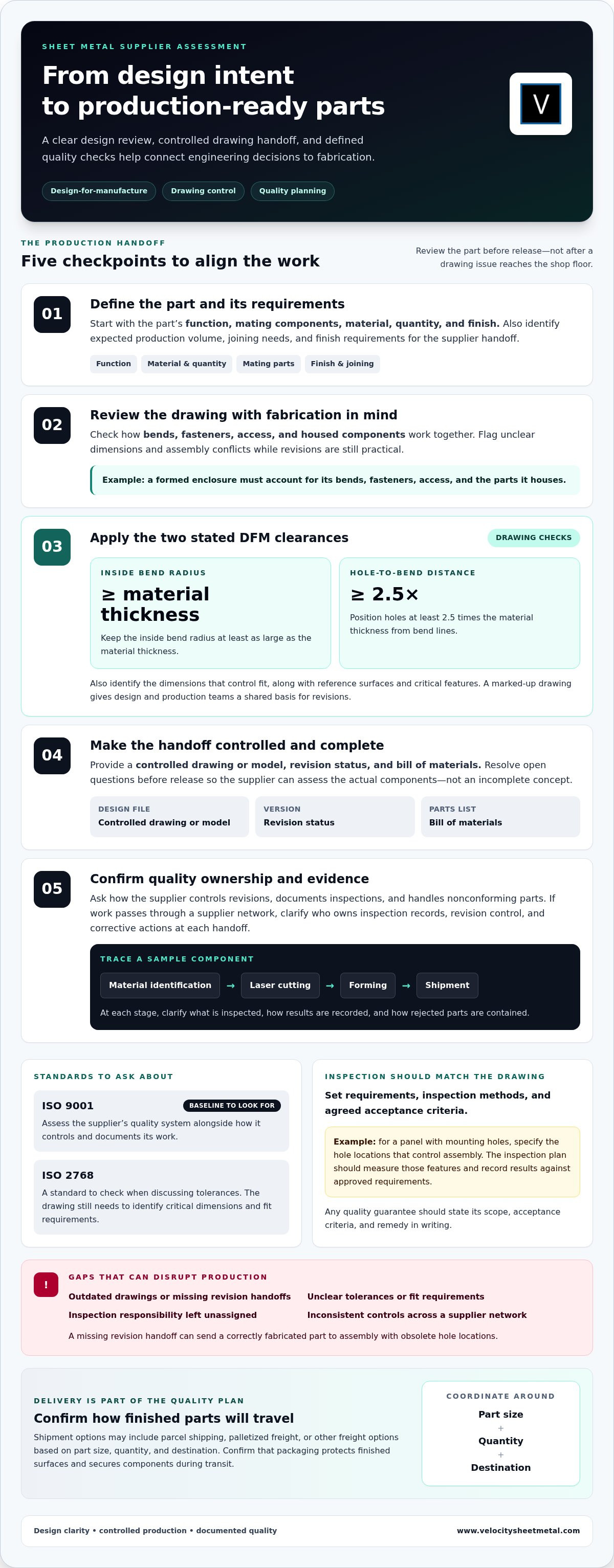
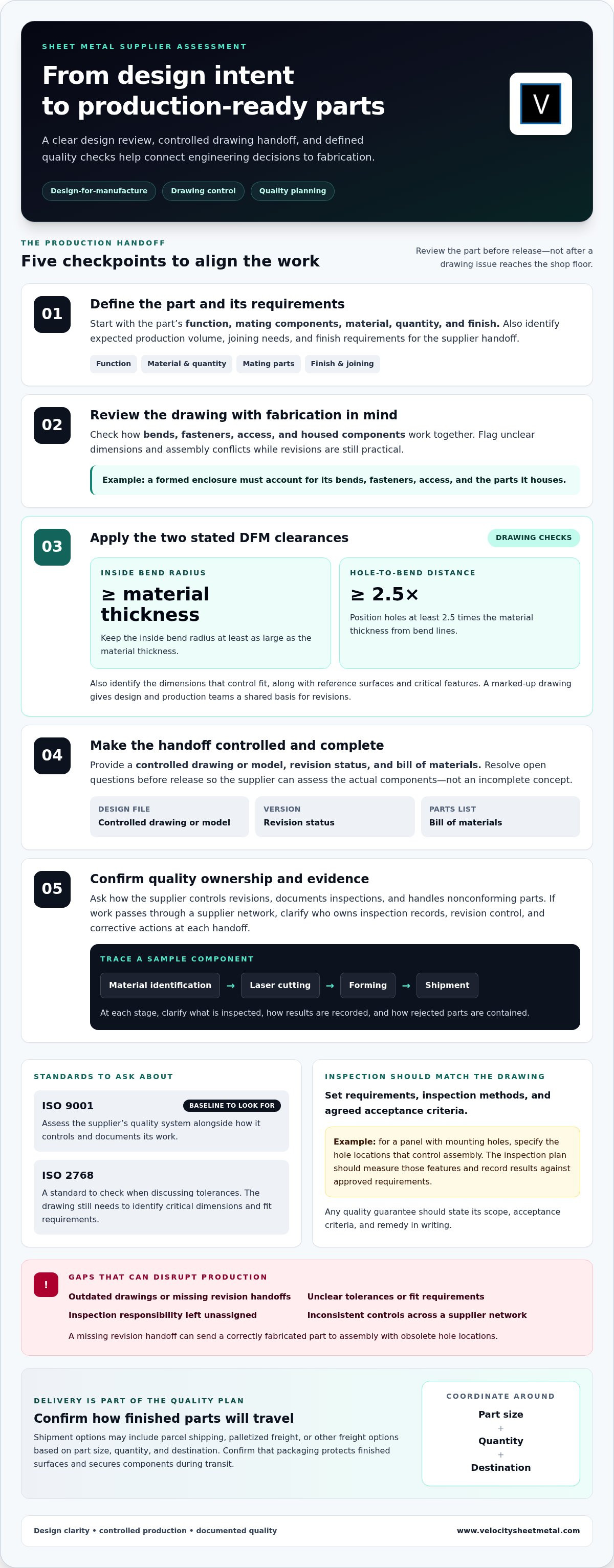
Collaborative design connects engineering decisions to manufacturing before a drawing becomes a production order. Start with the part’s function, mating components, material, quantity, and finish. Then review the drawing with fabrication in mind. A formed enclosure, for example, must account for bends, fasteners, access, and the parts it houses. Early review can flag unclear dimensions and assembly conflicts while revisions are still practical.
Design-for-manufacture checks turn that review into specific drawing decisions. Keep the inside bend radius at least as large as the material thickness. Position holes at least 2.5 times the material thickness from bend lines. Those clearances help avoid designs that interfere with forming. Confirm which dimensions control fit, and identify reference surfaces and critical features. A marked-up drawing gives design and production teams a shared basis for revisions.
Use a clear handoff to connect engineering intent with metal fabrication. Provide a controlled drawing or model, its revision status, and a bill of materials. Identify the quantity, expected production volume, joining needs, and finish requirements. Resolve open questions before release so the supplier can assess the actual components, rather than an incomplete concept.
Manufacturing scholarships and student programs can help build the talent pipeline behind engineering and production. A practical program might pair a scholarship with a shop visit, CAD exercise, or mentor reviewing a student’s design. Students could compare a flat pattern with its formed part and explain how bend placement affects fit. Employers can define the skills they need and support training in fabrication, drafting, or production planning.
Domestic and global manufacturing partners involve different sourcing and coordination considerations. A domestic partner may simplify communication across U.S. project teams; a global partner may offer production capacity through a different manufacturing network. Compare drawing control, revision handoffs, shipping coordination, and how design changes reach production. For a multi-location project, consistent documentation matters as much as where each component is made.
Industry policy can also shape manufacturing economics and investment decisions. The U.S. Inflation Reduction Act includes the Section 45X advanced manufacturing production credit and the Section 48C qualifying advanced energy project credit. The CHIPS and Science Act authorizes USD 52 billion for domestic semiconductor manufacturing and related initiatives. Separately, the CHIPS for America Fund includes USD 39 billion for incentives supporting domestic semiconductor-facility construction and supply-chain capacity, according to the U.S. Department of Commerce.
Copper and aluminum bus bar manufacturing requires a design review that connects electrical function with physical fabrication. Specify the material, cross-section, hole locations, bend geometry, and connection points on the drawing. A bus bar with holes near a bend, for example, needs a clearance review before release. Aligning that review with the intended assembly helps identify constraints before cutting and forming.
Supplier certifications and quality systems
Quality starts with a defined process, not a certificate displayed on a wall. ISO 9001 is a baseline certification to look for when assessing a sheet metal supplier. Ask how the supplier controls drawing revisions, documents inspections, and handles nonconforming parts. For example, a revised laser-cut panel should be built from the approved drawing, not an outdated file. These checks connect engineering intent to repeatable production.
A supplier network raises an important quality question: do the same requirements follow each component through every production step? Map which operations happen in the supplier’s facility and which involve network partners. Identify who owns inspection records, revision control, and corrective actions at each handoff. If one partner cuts a part and another forms it, both need the same drawing revision and acceptance criteria. Clear responsibility reduces gaps between processes.
Set part accuracy through drawing requirements, inspection methods, and agreed acceptance criteria. ISO 2768 is a standard to check when assessing sheet metal supplier tolerances. It can inform a tolerance discussion, but the drawing still needs to identify critical dimensions and fit requirements. For a panel with mounting holes, specify the hole locations that control assembly. The inspection plan should measure those features and record results against the approved requirements.
Quality systems should connect incoming material, fabrication, and final inspection. Trace a sample component from material identification through laser cutting, forming, and shipment. At each stage, clarify what is inspected, how results are recorded, and how rejected parts are contained. Part accuracy depends on defined requirements and controlled processes. Any quality guarantee should clearly state its scope, acceptance criteria, and remedy in writing.
Nationwide suppliers may arrange parcel shipping, palletized freight, or other freight options based on part size, quantity, and destination. Packaging should protect finished surfaces and secure components during transit. Confirm how the shipment will be prepared and handled.
Check for risks such as outdated drawings, unclear tolerances, unassigned inspection responsibility, and inconsistent controls across a supplier network. A missing revision handoff, for example, can send a correctly fabricated part to assembly with obsolete hole locations.
For a project that needs cut sheet metal components, align the drawing, critical dimensions, and inspection expectations before release. Custom Laser Cutting can support projects requiring parts produced from supplied design information, while the agreed requirements guide quality review.
Industries served
Industry experience matters because automotive, aerospace, defense, and industrial production place different demands on sheet metal components. Compare a supplier’s capabilities with the part’s use, documentation needs, assembly process, and expected production volume.
Industry-Specific Supplier Experience
Look for experience with parts and workflows similar to yours, not just a broad list of markets. An automotive bracket may need repeatable geometry for assembly, while an aerospace panel may require detailed drawing control and traceable inspection records. For defense work, review the project’s documentation and handling requirements. Ask about relevant examples and how engineering changes move through prototype and production.
Industry experience should be evident in the production process. An industrial equipment enclosure, for example, may need formed panels, mounting features, and openings aligned with electrical components. A supplier familiar with that application can explain how part geometry affects forming and assembly. Check whether the team can interpret your drawings, identify process constraints, and coordinate changes while maintaining the approved revision.
Automotive, aerospace, defense, and industrial customers should assess suppliers against their project requirements. An industrial machine prototype may prioritize design iteration, while a repeat automotive component may depend on stable production controls. For aerospace or defense programs, determine which customer-specific records and approvals apply. Don’t assume that a supplier’s industry experience means every facility or production line is certified for your project.
Regional and Industry Coverage
Which national sheet metal suppliers serve specific U.S. regions or industries? Look for providers whose production capabilities and shipping coverage match the destination and application. Compare regional capacity, relevant industry experience, and the ability to coordinate deliveries to each project location. A supplier serving multiple regions may still specialize in particular components or production steps, so match its work to your requirements.
For projects spanning several U.S. locations, map where components must arrive and how each shipment supports assembly. An industrial equipment maker supplying plants in different regions, for instance, may need consistent parts and drawing revisions across deliveries. Check whether the supplier ships to the required destinations and whether packaging suits the part’s shape and finish. Regional coverage is useful only when it aligns with production and receiving schedules.
Use a simple comparison before selecting a partner:
- Application: Identify whether the part serves automotive, aerospace, defense, electrical, or industrial equipment.
- Production stage: Separate prototype needs from repeat production and assembly requirements.
- Capabilities: Match cutting, forming, and documentation needs to the supplier’s actual workflow.
- Coverage: Confirm that the delivery network reaches every project destination.
A certified supplier may suit a project with specific approval requirements, but certification alone doesn’t establish fit. Compare the certification’s scope with the work, facility, and production process involved. A supplier’s general manufacturing credentials, for example, won’t automatically satisfy customer-specific aerospace or defense requirements. Clear requirements help align supplier selection with the project’s acceptance criteria.
Sheet metal fabrication supplier comparison
Compare suppliers against the work your parts require, not a broad capability list. A useful comparison connects materials, processes, production volume, delivery needs, and order requirements.
Nationwide Supplier Coverage
U.S. suppliers serving customers nationwide vary in production capacity, shipping reach, and fabrication services. Check whether a supplier can support the project’s destinations and required processes, such as cutting, bending, or enclosure fabrication. The best fit is the supplier whose actual capabilities match the parts and delivery plan.
To request a quote and place an order, submit a current drawing, material and finish requirements, quantity, and delivery destination. Review the quotation and production details, resolve drawing questions, then issue the purchase order against the approved scope.
Lead Times and Minimum Order Quantities
Simple sheet metal prototype parts from domestic U.S. suppliers typically ship in 3-7 business days. Complex or high-volume orders typically take 2-4 weeks or longer when finishing, assembly, or hard tooling is involved.
Minimum order quantities depend on setup needs, material sourcing, part complexity, and production volume. Compare the supplier’s efficient production quantity with your demand, including repeat orders. A one-off prototype and an automated production run may require different planning.
Build your comparison around the part itself. An aluminum enclosure with formed sides and mounting openings, for example, needs different process capabilities than a flat steel panel. Check how each supplier handles the required materials, cutting, bending, assembly, and finishing. Compare the complete scope, not just the first operation.
Use the same project information for each supplier. That makes differences easier to spot:
- Process fit: List the operations each component requires, from cutting through bending and assembly.
- Materials: State the specified metal and any requirements tied to the finished part.
- Volume: Separate prototype quantities from expected production demand.
- Delivery: Include destinations, packaging needs, and the sequence parts must arrive.
- Scope: Compare what each quote includes, such as fabrication steps and finishing.
Automated production can suit repeat parts, while a prototype may need closer coordination around design changes. Ask how drawing changes affect quoted scope, scheduling, and production release. Compare the answers with your priorities. A supplier with broad reach may not offer every process your design needs, while a focused fabricator may fit a particular component or production stage.
For a clear decision, rank essential requirements first. If bending accuracy controls assembly, prioritize that process and its drawing requirements. If components must reach multiple sites, weigh shipping coordination alongside production capacity. This turns a general supplier search into a direct comparison of fit, scope, and delivery.
Which U.S. sheet metal fabrication suppliers serve customers nationwide?
Nationwide service can mean shipping across the country, operating facilities in multiple states, or coordinating production through a supplier network. These models aren’t interchangeable. Compare where fabrication happens, which processes are performed there, and how finished components reach each destination. A supplier shipping from one facility may serve distributed projects without operating a plant in every region.
Start with your delivery map. List every destination, receiving requirement, and part needed at each location. Then compare each supplier’s shipping reach with its production capabilities. A manufacturer delivering sheet metal components to several U.S. plants may need consistent drawings, revision control, packaging, and shipment coordination. National reach matters most when the supplier supports the project’s actual production and receiving workflow.
Distinguish national shipping from nationwide production capacity. A single facility can ship broadly, while a multi-location network may divide work across plants or partners. Ask how production assignments, drawing changes, and quality records stay aligned when multiple locations are involved. If a bracket is fabricated in one facility and its matching panel elsewhere, shared specifications help maintain fit during assembly.
Compare supplier fit using the same project details. A clear scope lets you assess service coverage without relying on broad claims:
- Coverage: Match stated shipping reach to every delivery destination.
- Production location: Identify where each required fabrication operation occurs.
- Part scope: Compare the supplier’s processes with the components on your drawings.
- Coordination: Review how revisions and production information move across facilities.
- Delivery plan: Align packaging and shipment sequence with receiving and assembly needs.
For projects spanning multiple states, compare the delivery plan across all destinations. Nationwide shipping can support dispersed work, but shipment details must still suit the part’s dimensions, handling needs, and project schedule. These details show whether a supplier’s coverage supports the work in practice.
A practical comparison also distinguishes a specialist from a broad-service manufacturer. If the project requires custom-cut components, check whether that operation is part of the supplier’s production scope. If parts need bending or assembly, compare those steps separately. One supplier may fit a defined component package; another may better match a wider production scope. Choose based on the work, not the label “national.”
For custom sheet metal work that needs shipping across the country, explore nationwide fabrication support and compare it with your project’s destinations and component requirements.
Velocity Sheet Metal: Coil-line automated rectangular duct
Velocity Sheet Metal is a practical option for projects requiring coil-line automated rectangular duct. Its offerings also include spiral and round duct and fittings, helping contractors coordinate duct components with project requirements. BIM Coordination & Spool Drawings support planning, while Custom Laser Cutting and CNC Press Brake Bending address custom sheet metal components.
Turn to Velocity Sheet Metal when your scope centers on fabricated ductwork, coordinated drawings, or custom-cut and bent parts. Nationwide shipping supports projects across the United States, and the company also serves customers throughout Texas. Share your drawings and project requirements to start a focused discussion about the fabrication scope.
Contact Velocity Sheet Metal to discuss your project.
Move Your Project Toward Production
Choosing a national sheet metal fabrication supplier is only the start. Next, turn project requirements into a clear fabrication scope: identify the components, drawings, delivery destinations, and processes your team needs. This gives engineering and production a practical basis for moving from design review to order release.
Velocity Sheet Metal offers coil-line automated rectangular duct, spiral and round duct and fittings, and custom laser cutting. Match the work to the right capability, whether your project centers on ductwork or custom-cut components. Clear drawings and a defined scope help make the next conversation specific.
Bring your project requirements together and contact Velocity Sheet Metal to discuss the fabrication work. A focused starting point helps your team move forward with clarity.
Frequently Asked Questions
What is a national sheet metal fabrication supplier?
A national sheet metal fabrication supplier produces custom metal components and serves customers across the United States, often through shipping or coordinated production. National coverage doesn’t necessarily mean factories in every region. A buyer with facilities in several states, for example, may work with one fabricator and send orders to each destination. The key is whether the supplier’s production scope and delivery network fit the project.
What sheet metal fabrication services do national suppliers offer?
Service scopes vary and may include cutting, bending, forming, assembly, finishing, engineering support, and shipping. HVAC projects may need ductwork and fittings, while an equipment maker may need laser-cut panels or formed enclosures. Compare the operations your drawings require with the supplier’s actual scope. A supplier handling several stages can simplify coordination, while a focused provider may suit a particular component or production step.
What materials, thicknesses, and part sizes can national sheet metal fabricators handle?
Capabilities depend on the fabricator and production equipment. Velocity Sheet Metal lists carbon steel, stainless steel, aluminum, copper, brass, galvanized steel, and specialty alloys, with thicknesses from 24 ga to ½ in. Part-size limits depend on the operation and equipment used. For example, a large formed panel and a small laser-cut bracket may require different machines, handling, and inspection approaches.
How much does custom sheet metal fabrication cost in the United States?
Custom fabrication pricing depends on the part and the work required, so request a quote for your specific project. Key factors include material, thickness, geometry, quantity, tolerances, finishing, assembly, and shipping destination. A flat laser-cut component and a formed, finished enclosure, for example, involve different production steps. Submit current drawings and quantities so the quote reflects the parts you need.
How do national sheet metal fabrication suppliers compare on capabilities, pricing, and delivery?
Compare suppliers using the same drawing package, quantities, material requirements, and delivery destinations. Review which fabrication steps each quote covers, how drawing revisions are handled, and whether finishing or packaging is included. Then assess the quoted price and delivery terms against your requirements. A low-cost quote may exclude a finishing step your assembly needs, so align the scope before placing an order.
What certifications and quality standards should a sheet metal supplier have?
ISO 9001 is a baseline certification to look for, but its relevance depends on the work and the certified operation. Also review how inspection records, drawing revisions, and nonconforming parts are controlled. ISO 2768 can guide discussions about general tolerances, while critical dimensions should be clear in the part drawing. For a component that must fit an assembly, connect acceptance criteria to the features that control fit.