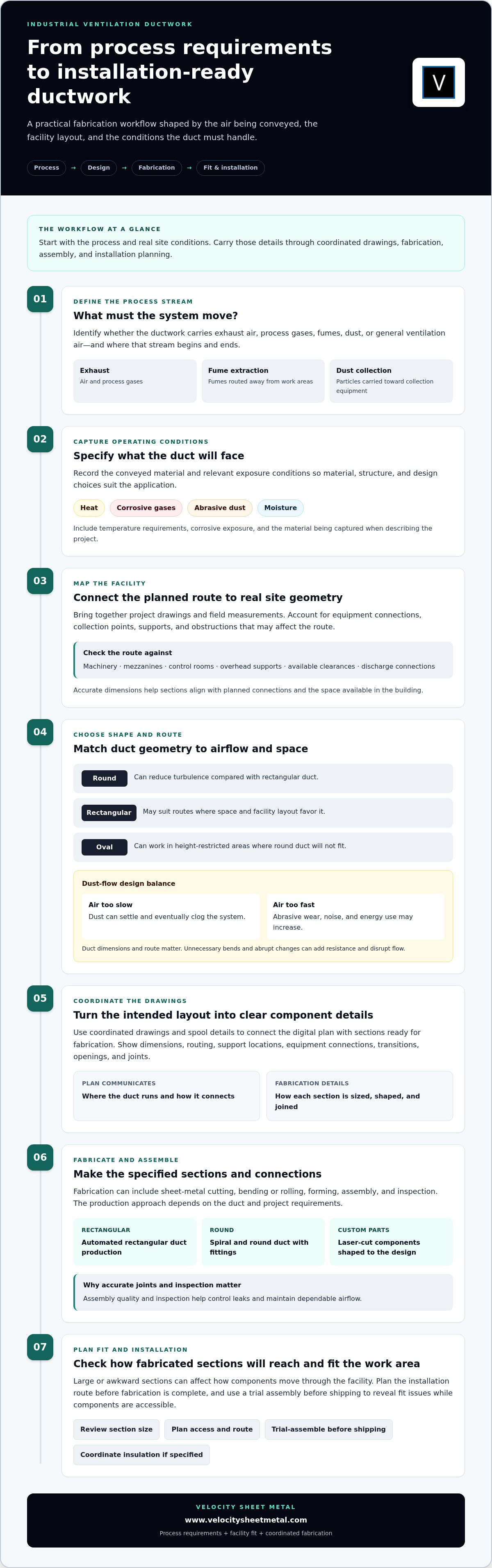
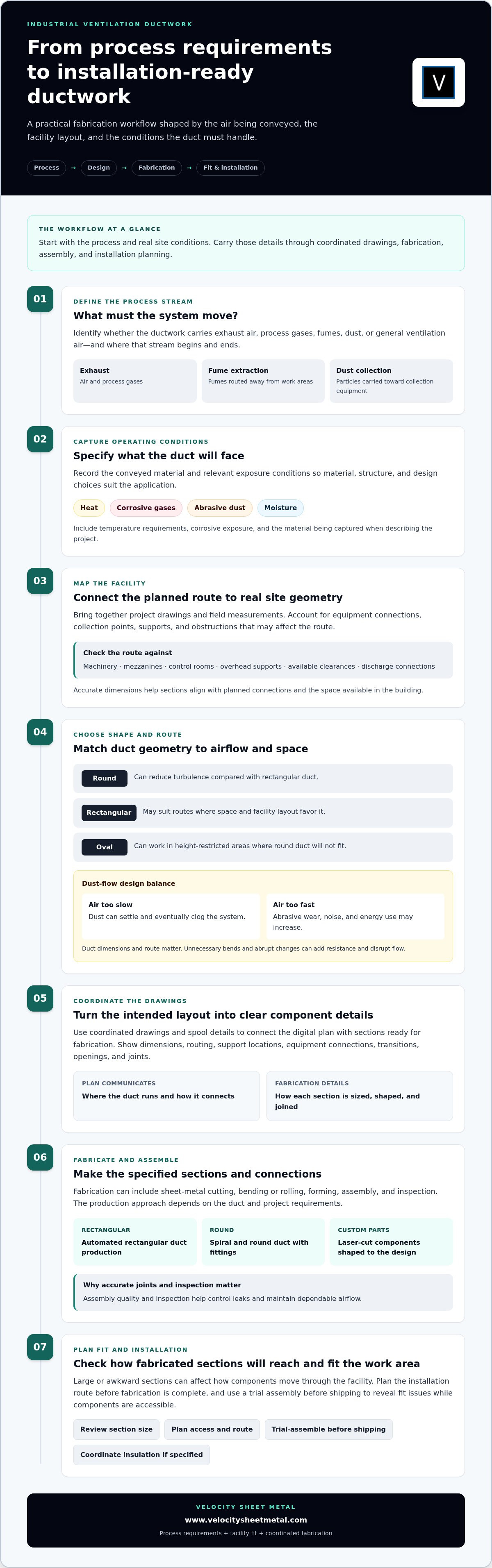
How Custom Industrial Ductwork Is Designed and Fabricated
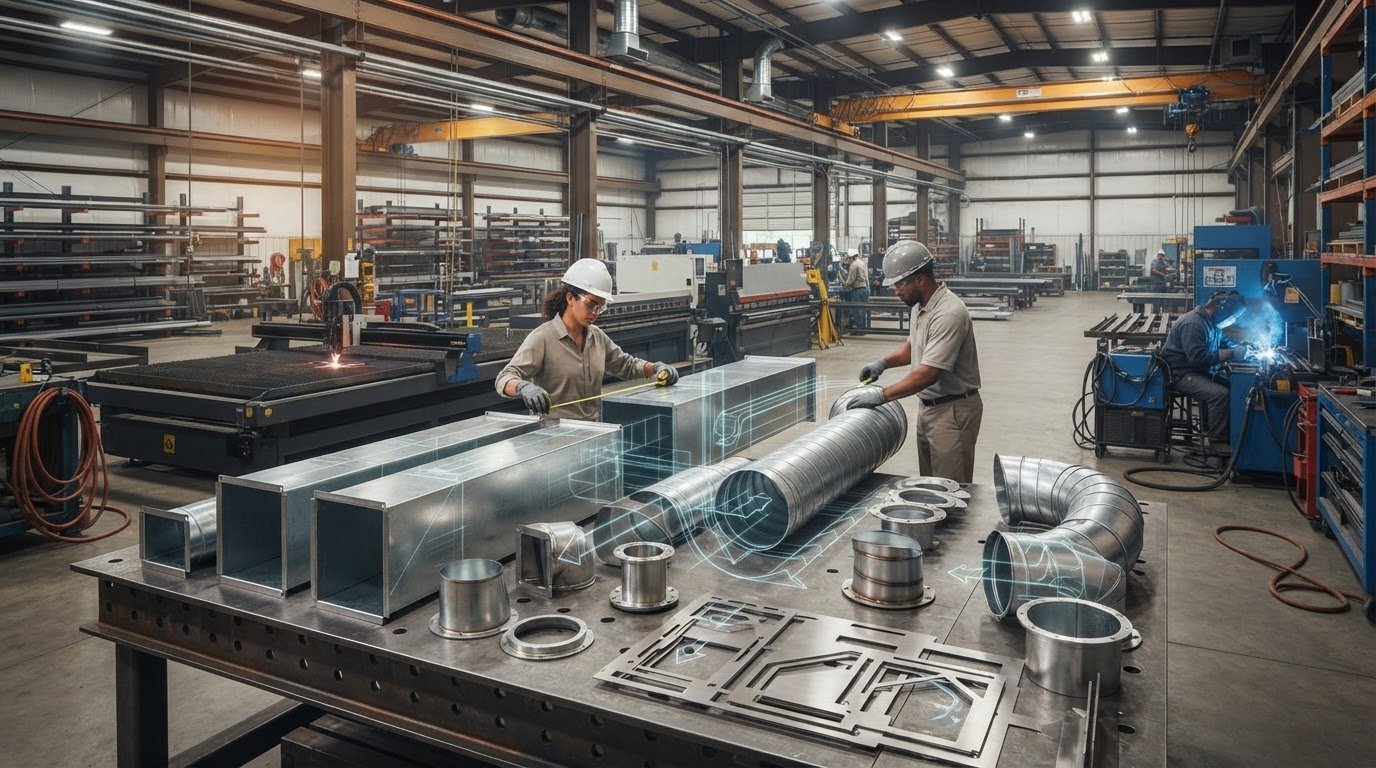
A dependable industrial ventilation ductwork fabricator turns a facility’s airflow requirements and physical constraints into custom metal ductwork. The work can include design coordination, sheet-metal cutting and forming, assembly, and inspection. The finished system routes exhaust, fumes, dust, and other industrial air through demanding environments.
Choosing a duct shape is only part of the job. Material, dimensions, joints, and routing all affect how the system fits the process and the building. A design for corrosive gases or abrasive dust may differ from one intended for general ventilation.
This article explains what industrial ductwork fabrication involves, how material and fabrication choices address demanding conditions, and what design, production, and installation planning can encompass. It also compares rectangular and round ductwork for different layouts and explains how coordinated drawings and accurately fabricated components connect the digital plan to the finished system.
Key Takeaways
- Assess the process the duct will serve, then align its route and geometry with airflow needs and facility constraints.
- Compare exposure to heat, corrosive gases, abrasive dust, and moisture when selecting duct materials and protective finishes.
- Look beyond cutting and forming: accurate joints, assembly, and inspection help control leaks and maintain dependable airflow.
- Use coordinated drawings and spool details to connect the planned duct layout with components ready for fabrication.
- Match the production approach to the system: automated rectangular duct, spiral and round duct with fittings, and custom laser-cut parts address different project needs.
What Is Industrial Ductwork Fabrication?
An industrial ventilation ductwork fabricator can produce rectangular, round, and custom-shaped ducts for a facility. These systems move exhaust, dust, fumes, and ventilation air between process equipment and collection or discharge points.
Custom Industrial Duct System Fabrication
Custom fabrication turns project plans and facility measurements into duct sections designed for a specific route and application. The design accounts for machinery, mezzanines, control rooms, and support structures that may constrain the duct path. Components made to fit the building can help reduce the risk of leaks and energy loss compared with generic duct systems.
Exhaust, Dust Collection, and Fume Extraction
These systems capture and carry airborne material from a process to a collection or exhaust point. Exhaust ductwork handles air and process gases; fume extraction moves fumes away from work areas; and dust-collection ductwork carries particles toward collection equipment. Planning the route and duct dimensions around the process helps address the facility layout and airflow requirements.
Industrial ventilation can also support air-pollution control. Ductwork may capture and remove particulates, volatile chemicals, and combustion byproducts generated by industrial processes. Some processes release corrosive gases, so the duct route and material need to suit the air being conveyed. The aim is to move the process stream through the facility using a system designed for that application, rather than relying on general-purpose building ductwork.
Dust collection requires particular attention to airflow. If air moves too slowly through a duct, dust can settle and eventually clog the system. If it moves too quickly, abrasive particles can wear duct surfaces, while noise and energy use may increase. The design therefore needs to account for the process, duct diameter, and route. Unnecessary bends and abrupt changes can add resistance and disrupt flow.
Fabricators can produce rectangular and round duct sections, as well as shapes tailored to a project. Round ducts can reduce turbulence compared with rectangular ducts, while rectangular sections may suit routes where space and layout favor them. Oval duct can work in height-restricted areas where round duct will not fit. Each shape addresses different routing constraints, so clearances and process requirements should guide the choice.
Industrial ductwork serves air-pollution control, mechanical ventilation, and exhaust systems. Unlike standard commercial HVAC ducting, it may need to handle higher capacities and more rugged operating conditions. Project plans connect the equipment, collection points, and discharge route. The fabricator translates those requirements into sections sized and shaped for the facility, including runs for dust collection and fume extraction.
Custom industrial ductwork for corrosive and high-temperature environments
To request a useful quote, provide project drawings, duct dimensions, routing, and process conditions. Include the conveyed material, temperature requirements, corrosive exposure, and facility constraints so the design reflects the application.
Heat, corrosive gases, abrasive dust, and moisture can all affect duct performance. Custom metal fabrication begins by matching the duct’s structure and material to these conditions. High-temperature processes require ductwork with suitable strength and resistance for the operating environment. Corrosive process gases also call for an appropriate route and duct material to move them out of the facility.
A custom-fit system depends on measurements as well as design intent. Plans can show equipment connections, support locations, and obstructions, while field measurements capture the building’s actual geometry. A mezzanine, overhead support, or control room may change the route. Accurate dimensions help fabricators form sections that align with planned connections and available space.
Plan installation before fabrication is complete. Duct sections may be large or awkward to move, so their size and route affect how they reach the work area. A trial assembly before shipping can reveal fit issues while components are accessible. If insulation is part of the design, including it in fabrication planning helps coordinate the finished assembly.
A facility’s location alone does not define its duct specification. The quote still needs the building layout, process stream, exposure conditions, and connection points. These details help the design account for site constraints without assuming that every plant or process needs the same configuration.
Custom fabrication turns project inputs into cut, formed, and assembled sections. Laser cutting produces sheet-metal parts to project-specific dimensions; bending and rolling then shape components to the required duct geometry. Each transition, opening, and connection affects how the sections fit together. Clear drawings reduce ambiguity between the intended layout and the parts made for installation.
For dust collection, include the material being captured and the route from collection points to the system connection. Air moving too slowly can allow dust to settle; excessive speed can increase abrasion, noise, and energy use. These factors help shape decisions about duct dimensions and routing. If your project needs accurately cut sheet-metal components, custom laser cutting can support the fabrication scope. Discuss the operating conditions and drawings together to keep design decisions tied to the actual process.
Material selection for harsh industrial conditions
Choose duct material to suit the process stream and operating environment. Heat, corrosive gases, abrasive dust, and moisture place different demands on ductwork. The material needs to provide the strength and resistance required for those conditions. For example, an exhaust line carrying corrosive gases raises different material considerations from ventilation ductwork in a dry area.
Industrial ductwork can be made from hot- or cold-rolled steel, galvanized steel, stainless steel, or aluminum. These materials are not interchangeable by default. The choice depends on the air or particles conveyed, exposure conditions, and intended use. Steel coatings can slow corrosion, but they do not prevent all corrosion, so the process environment remains central to material selection.
Stainless steel is used in demanding environments, including fume exhaust and kitchen air ducts. Food processing adds an important requirement: sanitary fabrication from food-grade stainless steel. This specification concerns both the material and how the duct is fabricated. A system handling food-process air or particles needs a design that supports the facility’s sanitary requirements, not simply a familiar metal.
The conveyed material also affects duct design. A system moving particles must account for contact between the material and duct surfaces. Abrasive dust can wear ductwork, while moisture or corrosive gases can affect the material. Assessing the process stream alongside temperature and exposure helps narrow suitable materials before fabrication. The same review applies to specialized exhaust runs, where process gases define the service conditions.
Diameter and shape should suit the application, not a one-size-fits-all template. Dust-collection ductwork can be fabricated in diameters as small as one inch. That is a possible minimum for a specific application, not a general size recommendation. The required diameter depends on airflow and the material being conveyed. A fabricator uses project dimensions and process requirements to form sections for the intended route.
- Galvanized steel: a steel option used in industrial ductwork, with coatings that can slow corrosion.
- Stainless steel: used in harsh environments and for applications such as fume exhaust and kitchen air ducts.
- Aluminum: another material used for industrial ductwork, selected according to environmental demands.
- Hot- or cold-rolled steel: steel forms used in ductwork projects, with suitability tied to process conditions.
Before fabrication, connect each material choice to a defined use, such as dust collection, food processing, material conveyance, or exhaust. Then consider operating exposure, duct dimensions, and required shapes. This keeps material selection tied to the actual system instead of choosing a metal first and forcing the design around it.
Cutting, shaping, welding, and finishing sheet metal ducts
Fabrication turns sheet metal into duct sections through measurement, cutting, forming, assembly, and inspection. Each operation affects how the sections fit and how well the joints contain moving air.
Laser Cutting and Sheet-Metal Forming
Laser cutting follows project dimensions to produce the shapes needed for duct sections and fittings. The cut pieces are then bent or rolled into rectangular, round, or other specified forms. Accurate profiles help components align during assembly, while suitable forming creates the geometry required by the duct route.
For example, a flat sheet can be cut into a panel, bent into a rectangular section, and prepared for connection to adjoining pieces. A round duct component may be rolled to create its curved profile. Drawings and measurements guide these operations so each part matches its intended location, rather than requiring improvised changes during assembly.
Cutting, Welding, and Finishing Ducts
Fabricators cut sheet metal to project-specific dimensions, assemble formed parts, and weld joints where the design calls for them. Welding can create airtight and watertight seals. At duct connections, this matters because gaps can cause air loss or temperature degradation. Finishing may include smoothing surfaces, removing sharp edges, and applying primer or paint when the application requires it.
Sandblasting can smooth fabricated ductwork and remove sharp edges or stray metal pieces. Priming and painting may follow, although some projects do not require paint. The choice depends on the duct material and project needs. Galvanized steel, for example, already has a coating that slows corrosion, so additional finishing should suit the intended use.
Fabrication is a connected sequence, not a set of isolated shop tasks. Measurements and drawings first define dimensions. Cutting produces the required blanks, then bending or rolling forms them. Assembly brings the sections together, followed by inspection of the finished work. An inaccurate early cut can affect a later connection, so checking dimensions and fit at each stage helps catch alignment problems before shipment.
Weld quality also affects the finished duct system. Fabricators inspect duct welds before shipment as part of quality assurance. Smooth, leak-free joints can help prevent dust from accumulating in seams or escaping. In a dust-collection run, seam and connection quality matter for containment and airflow. Inspection checks the fabricated components before they leave the shop.
The Sheet Metal and Air Conditioning Contractors’ National Association, known as SMACNA, is identified as the body governing industrial HVAC requirements and standards. Its standards are a relevant reference when project specifications call for them. A fabrication review can compare drawings, specified construction details, and completed duct sections, keeping requirements visible from design through inspection.
Each fabrication step answers a different question: do the cut parts match the drawings, do bends and rolls create the required shape, do joints seal as designed, and does the finish suit the material? Reviewing these points throughout production connects precision cutting and forming with assembled ductwork ready for the next project stage.
Ductwork design, fabrication, and installation services
A complete ductwork project connects design decisions, fabricated components, and installation planning. Each stage needs to reflect the process, facility layout, and equipment connections. Coordination helps the planned system move from drawings to a working arrangement of ducts, supports, and junctions.
Design begins with the system’s purpose and route. A dust-collection line, for example, needs to carry particles from pickup points to collection equipment. The designer considers duct dimensions, junctions, bends, and the path around machinery. Unnecessary bends and offsets can impair airflow and increase wear on mechanical systems.
Airflow details affect equipment and the people working nearby. Poorly sized or ill-fitting ducts can create turbulence and pressure losses, making fans and blowers work harder. Balanced airflow and well-engineered junctions can reduce noise and vibration. Duct routing should account for work areas, access routes, and nearby equipment.
Drawings connect design decisions to fabrication. Blueprints help engineers and fabrication teams visualize the ductwork, identify connection points, and coordinate components. BIM coordination and spool drawings can clarify how sections fit together before production. This is especially useful when a route passes through a crowded facility or connects to existing equipment.
Fabrication turns the coordinated design into physical duct sections. Rectangular and round duct, fittings, and custom-cut parts must match the intended dimensions and connections. Larger systems may require multiple sections because of component size. Production and shipment can then follow the planned sequence instead of treating every component as one oversized assembly.
Installation planning connects fabricated sections to the work sequence at the facility. Delivery order, access to the route, and connection-point locations affect how components reach their final positions. Since industrial ductwork is typically shipped in phases because the pieces are bulky, a phased plan helps align delivered sections with installation.
The final handoff should maintain the connection between drawings and fabricated parts. Spool details can show how sections fit together, while pre-shipment inspection checks fabrication quality. For an exhaust system, clear component identification helps keep the intended route and connections visible during assembly. Treat design, fabrication, and installation as connected project stages.
For a project that needs coordinated drawings or custom-cut components, discuss your ductwork project and its layout requirements.
Velocity Sheet Metal: Coil-line automated rectangular duct
Velocity Sheet Metal fabricates ductwork and coordinated components for projects with defined requirements. Its coil-line automated rectangular duct supports rectangular runs, while spiral and round duct and fittings suit layouts that call for circular sections.
BIM coordination and spool drawings connect a planned duct layout with the components required for fabrication. Custom laser cutting and CNC press brake bending support project-specific sheet-metal parts and formed components. These services suit contractors and engineers coordinating ductwork from drawings through production.
For a rectangular, round, or custom-component project, contact Velocity Sheet Metal to discuss your ductwork requirements.
Move Your Ductwork Project Toward Production
Turn the project’s operating requirements into a clear fabrication scope. Define the process, routing constraints, and component needs before production begins. This gives an industrial ventilation ductwork fabricator a practical basis for aligning drawings and parts with the facility layout.
Velocity Sheet Metal supports projects requiring coil-line automated rectangular duct, spiral and round duct and fittings, or custom laser cutting. Match the production approach to the components in your plans, whether the scope calls for rectangular runs, round sections, or custom-cut parts.
Bring your drawings and project requirements together to start a focused discussion about the fabrication scope. Contact Velocity Sheet Metal to discuss your ductwork project and its next steps.
A clear scope creates a stronger starting point for the work ahead. Move your design forward with the right components in view.
Frequently Asked Questions
How Can You Find the Best Metal Fabricator for Your Job?
Choose a fabricator whose equipment and engineering support suit the parts your project needs. For ductwork, assess its ability to produce the required shapes, fittings, and custom components, then review how drawings and revisions move into production. Confirm that documented material and thickness capabilities suit the application. A clear scope, including dimensions, connections, and operating conditions, makes it easier to assess fit.
What does an industrial ventilation ductwork fabricator do?
An industrial ventilation ductwork fabricator turns project requirements into custom duct components. The work can include interpreting drawings, cutting and forming sheet metal, assembling sections, and inspecting finished parts. For example, a system connecting a process exhaust outlet to a collection point needs components that match the specified route and connections. The fabricator produces those components for the system; process requirements must be defined in the project scope.
How to find industrial ventilation ductwork fabricators near me?
Decide whether proximity matters for delivery, coordination, or physical installation. Then match a fabricator’s capabilities to your drawings, materials, component types, and shipping needs. A nearby shop may be convenient, but location alone does not establish whether it can produce the required ductwork. When components can be shipped, compare fabrication scope and delivery coverage as well. Fabricating duct sections and installing them on-site are distinct services.
What materials and gauges are used for industrial ventilation ducts?
Industrial ducts can use galvanized steel, stainless steel, aluminum, or hot- and cold-rolled steel. Material choice depends on the process stream and exposure, such as corrosive gases, moisture, heat, or abrasive particles. Gauge also depends on project requirements rather than one universal selection. Velocity Sheet Metal lists fabrication thicknesses from 24 ga to ½ in. That range describes its stated capability, not a recommendation for every duct application.
What standards and codes apply to industrial ventilation ductwork in the United States?
Applicable requirements depend on the project specifications, application, and governing jurisdiction. SMACNA is an industry body associated with industrial HVAC requirements and standards, making its guidance a relevant reference for ductwork projects. Project documents should identify the requirements for the system and its construction. Treat standards as part of the design and fabrication scope, not as a substitute for details about materials, dimensions, connections, and intended operation.
How to compare industrial ductwork fabricators by capabilities, certifications, and lead time?
Compare documented capabilities with the actual component schedule: duct shapes, fittings, materials, drawing coordination, and production methods. Review certifications only against the project’s stated requirements, distinguishing documented credentials from general experience. Lead time depends on scope, design readiness, material selection, production load, and delivery sequencing. Compare estimates based on the same drawings, revisions, and deliverables so differences reflect the work itself.
What is the process for designing, fabricating, and installing industrial ventilation ductwork?
The process typically moves from requirements and drawings to design coordination, component fabrication, inspection, delivery, and field assembly. Keep drawing revisions aligned with the component schedule so production does not follow outdated information. Before installation, confirm that delivered sections can be identified against the planned route and connection points. The installer then assembles components according to project documents and coordinates site-specific work.
What are common risks and quality issues with fabricated industrial ductwork?
Common project risks include outdated drawings, mismatched connection orientations, damaged components during handling, and duct sections that conflict with supports or equipment. These issues can delay assembly even when individual parts appear well formed. Revision control, clear component identification, and checking parts against current drawings help catch mismatches early. Packaging and delivery sequencing also matter for bulky sections, which may arrive in phases and need to remain traceable to their intended locations.