Fiber laser cutting for reflective metals: power needs and limits
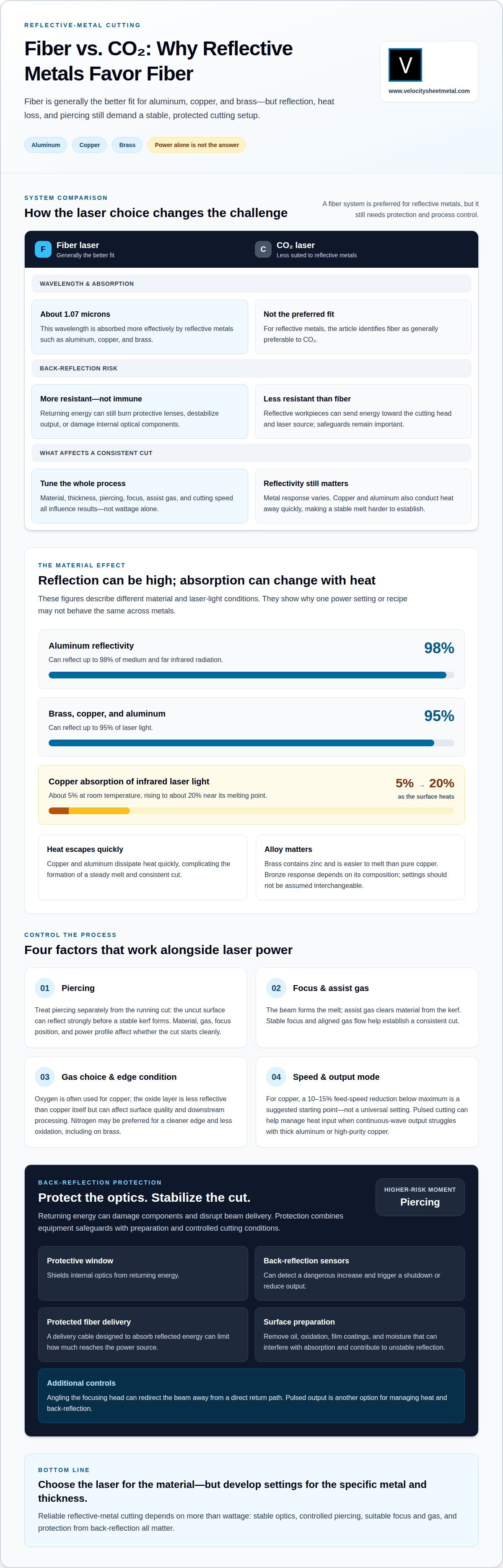
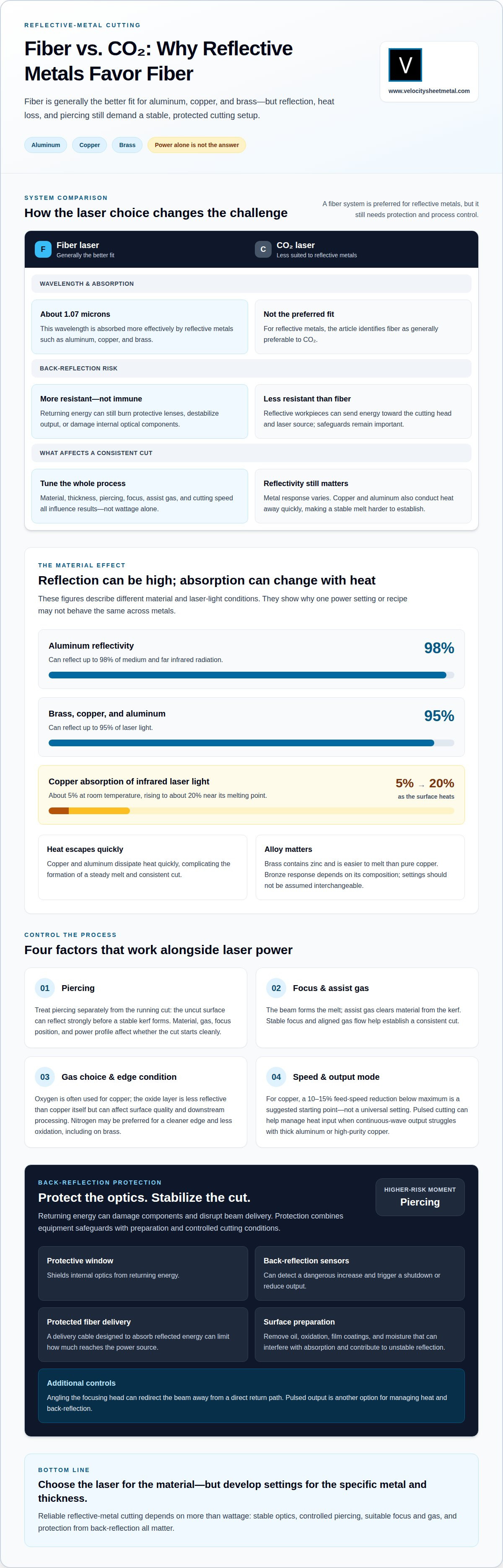
More power alone won’t solve reflective-metal cutting. Fiber laser cutting for reflective metals is generally preferred over CO₂ cutting because fiber’s wavelength of about 1.07 microns is absorbed more effectively by metals such as aluminum, copper, and brass. Yet these metals can reflect laser energy back toward the cutting head, while copper and aluminum dissipate heat quickly, making a stable melt and consistent cut harder to achieve.
It’s reasonable to focus on wattage when a cut struggles, but power is only part of the equation. Material, piercing, focus, assist gas, and protection from back-reflection all affect how reliably a system cuts.
This guide explains why reflective surfaces challenge laser cutting, how fiber and CO₂ systems compare, and what power can and can’t solve. It also covers the effects of optical and assist-gas stability, and why settings must match the metal and its thickness. Assess the complete cutting system, not wattage alone, especially when reflective material pushes equipment toward its limits.
Key Takeaways
- Reflective metals differ in how they absorb laser energy, and heat loss can make a steady cut harder to establish.
- Fiber systems are generally better suited than CO₂ systems to reflective metals, but back-reflection can still threaten optics and laser components.
- Choose power and cutting settings around the specific metal and its thickness; wattage alone won’t determine cut quality.
- Stable optics, aligned assist-gas flow, and a controlled piercing stage all contribute to more consistent cutting results.
- Learn how Velocity Sheet Metal’s custom laser cutting can support metal-part production when these factors matter.
Can You Cut Reflective Materials With a Laser?
Yes, fiber lasers can cut aluminum, copper, and brass, but reflection and heat loss complicate the process. In the United States, applicable laser-product and workplace safety requirements depend on the system and installation. Cutting performance figures alone don’t establish regulatory compliance.
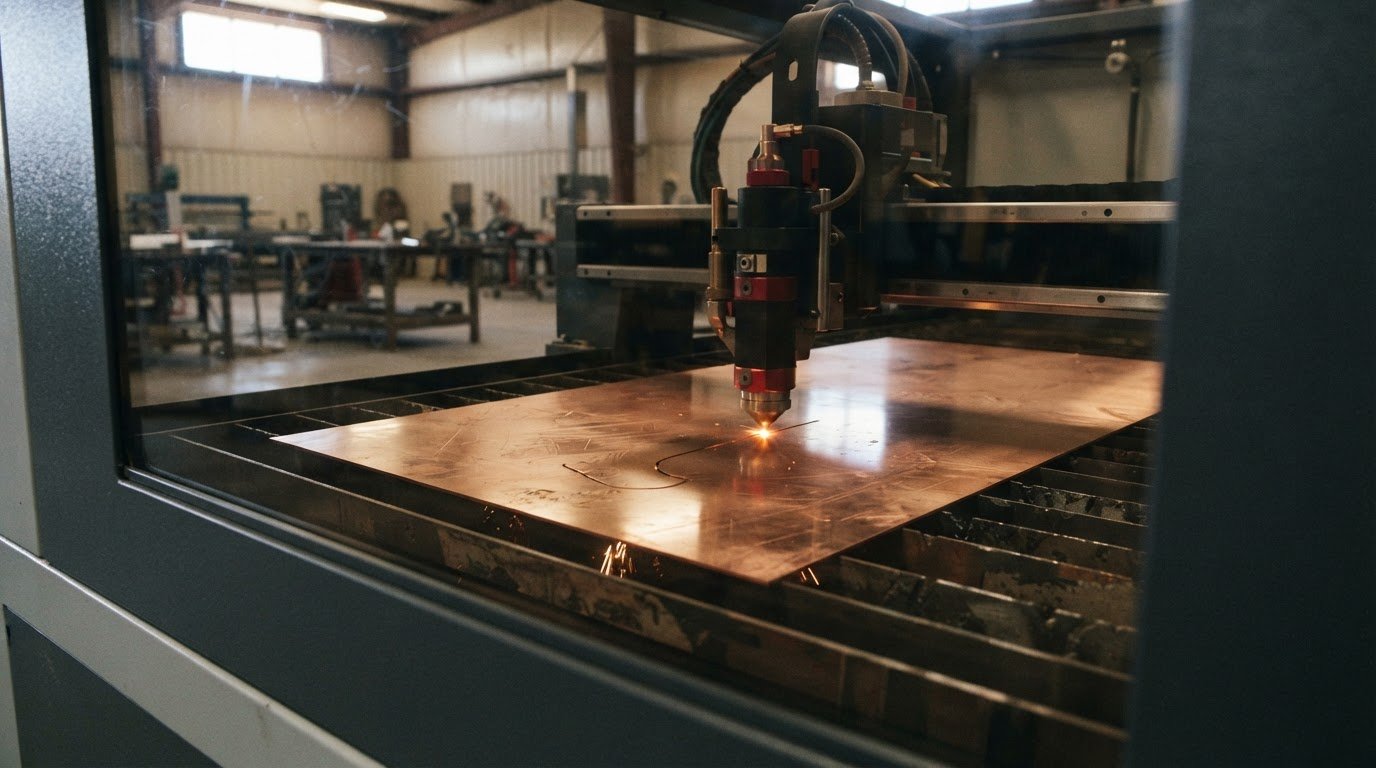
A fiber laser directs energy into the metal to form a melt, then assist gas clears material from the kerf. With copper, brass, and aluminum, the challenge is absorbing enough energy at the cut while managing reflected light and heat flow.
Reflectivity and Laser Absorption
Reflectivity describes how much laser energy a metal sends away rather than absorbs. The absorbed portion is available to heat and melt the material. That balance matters because the same power setting can behave differently on aluminum, copper, and brass.
Aluminum can reflect up to 98% of medium and far infrared radiation, while brass, copper, and aluminum can reflect up to 95% of laser light. Copper absorbs about 5% of infrared laser light at room temperature, rising to about 20% near its melting point. As the surface heats, absorption can improve, but copper and aluminum also conduct heat away quickly.
Brass contains zinc, which makes it easier to melt than pure copper, but its surface can still reflect enough energy to complicate cutting. Bronze is a copper-based alloy, so its response depends on its composition. Don’t assume settings that work for one copper alloy will suit another.
Cutting Copper and Brass
Fiber lasers cut copper and brass by concentrating energy until the surface melts, then using assist gas to clear the molten metal. A fiber laser wavelength near 1.06 µm can be used for copper, but the metal’s changing absorption means power, focus, gas, and cutting speed must work together.
Oxygen is often used for copper because the oxide layer it forms is less reflective than copper itself. This oxidation can affect surface quality and downstream processing, so nitrogen may be preferred when a cleaner edge and less oxidation are priorities. For brass, nitrogen can also help produce a cleaner edge and limit oxidation.
Cutting speed should match the metal’s response, not just the machine’s maximum capacity. For copper, reducing feed speed by 10-15% below maximum is a suggested starting point, not a universal setting. Thick aluminum and high-purity copper can be difficult to cut with continuous-wave output; pulsed cutting delivers energy in controlled bursts and can help manage heat input.
Give piercing separate attention when cutting reflective materials: it begins before a stable kerf exists. The surface may reflect strongly at this stage, so material, assist gas, focus position, and power profile all affect whether the cut starts cleanly. Brass, bronze, copper, and aluminum require material-specific parameter development, not one shared recipe.
What type of laser is best for cutting through metal?
For reflective metals, a fiber laser is generally the better fit than a CO₂ system, but it can still suffer back-reflection. In US shops, follow the safety requirements applicable to the specific laser system and workplace; reflection controls alone don’t replace a complete safety program.
Back-Reflection Equipment Damage
Back-reflection occurs when the laser beam bounces off a reflective workpiece toward the cutting head and laser source. Returning energy can burn protective lenses, destabilize laser output, and damage internal optical components.
Aluminum, copper, and brass can send energy back toward the machine, especially during piercing, before a stable cut path forms. Fiber lasers resist back-reflection better than CO₂ systems, but they aren’t immune. High-power equipment can be particularly vulnerable without appropriate safeguards.
Damage can affect more than the lens. A reflection spike may disrupt beam delivery and compromise cut consistency, while repeated exposure can shorten the life of optical components. Piercing is a distinct risk point, not simply the first moment of an ordinary running cut.
A stable setup pairs a suitable fiber laser with safeguards designed to manage returning energy. Protective windows shield internal optics. Back-reflection sensors can detect a dangerous increase and trigger a shutdown or reduce output. A fiber delivery cable designed to absorb reflected energy can also limit how much reaches the power source.
Preventing Reflected-Beam Damage
Prevention combines clean sheet preparation, machine safeguards, and controlled cutting conditions. Before cutting, remove oil, oxidation, film coatings, and moisture from the reflective surface. Contaminants can interfere with absorption and contribute to unstable reflection.
Next, use the system’s designed protection features. A protective window shields internal optics, while detection sensors can respond to excessive returning energy. Some systems automatically shut down when they detect dangerous reflection. Angling the focusing head can also redirect the beam away from a direct path back into the laser.
Pulse control offers another option. Pulsed cutting can be one way to manage heat and back-reflection during reflective-metal cutting. Pulsed output can also reduce the heat-affected zone. This may help when continuous-wave cutting struggles, including with thick aluminum or high-purity copper.
Preparation involves more than cleaning. Keep piercing separate from the running cut because the initial interaction with an uncut reflective surface can create a concentrated return. Correct focus, suitable gas flow, and stable output help establish the kerf without relying on power alone. Monitor the cut and adjust settings methodically, changing one variable at a time.
Fiber equipment is often a practical choice for reflective work, but system protection and sheet condition determine how safely and steadily it operates. The best setup manages the path from the workpiece through the optics to the source.
Laser power requirements for different metal thicknesses
Common reflective-metal cut quality problems include rough edges, incomplete cuts, and inconsistent kerfs. Match power, cutting speed, focus, and assist gas to the metal and its thickness, then adjust one parameter at a time.
Fiber lasers used for metal cutting typically range from 1 to 12 kW, depending on material and thickness. Thin metal sheets typically need 1 to 2 kW, while 2 mm aluminum is listed at 1 to 2 kW. These are starting points, not universal settings: alloy, surface condition, cutting speed, and assist gas also affect the result.
Thickness changes the energy needed to sustain the cut. Reflective-metal sheets up to 5 mm are described as effective for fiber laser cutting; above that, cut roughness and speed can deteriorate considerably. That limit isn’t a promise of failure or a hard machine boundary. It signals that thicker work can demand different parameters and may produce slower, rougher cuts.
Power alone doesn’t determine how much energy the metal absorbs. Absorbed power equals incident laser power multiplied by instantaneous absorptivity. As the surface heats and begins to melt, absorptivity can change, shifting how the beam couples with the workpiece. If coupling is unstable, raising power immediately can cause reflection spikes rather than a cleaner kerf.
Start with moderate power, then increase it gradually while reviewing cut evidence. Change one variable at a time, such as power or feed rate, so the effect is clear. For copper, reducing feed speed by 10-15% below the machine’s maximum is a suggested starting point. Aluminum often cuts best with high power and a high feed rate, but the combination must suit its thickness.
Focus position shapes how energy enters the workpiece. Keep the focal point close to the material surface during piercing and cutting. For reflective surfaces, placing it slightly below the top surface is also recommended. Treat piercing as its own process gate, then assess the running cut separately. A setting that starts a hole cleanly may not produce the best edge along the full path.
Excessive power can destabilize a reflective cut, while insufficient power may leave the material incompletely severed. Focus errors, gas pressure, and cutting speed can also contribute to roughness or inconsistent edges. Balance these factors with material type and thickness. Validate the process under production conditions, since a short test cut may not reveal whether the beam stays steady throughout a full run.
Optical and assist-gas path stability
A stable cut depends on more than laser power: clean optics and correctly directed assist gas must work together. For reflective aluminum and copper, gas flow, pressure, and oxidation control all affect how consistently the system clears the kerf.
Assist-Gas Pressure and Flow
Assist-gas pressure and flow determine how gas reaches the cut and clears molten metal from the kerf. Consistent delivery matters: misaligned flow can cause irregular melt patterns, uneven reflectivity, and reduced cutting efficiency. A smooth edge depends on keeping the gas path aligned with the cut, not simply increasing pressure.
During setup, align the gas flow with the laser path and assess the resulting cut. If the melt pattern becomes irregular, correcting flow alignment is more useful than assuming power is the only problem. Material type, thickness, and cutting speed also affect how gas clears the molten zone.
Optical condition also affects stability. Contamination on a lens can create hot spots and disturb the beam delivered to the workpiece. Regular inspection and cleaning with non-abrasive wipes and approved solvents help keep the optical path clear, supporting consistent energy delivery along the full cut.
Gas Choice and Oxidation Control
Assist-gas choice affects both molten-metal removal and oxidation at the cut edge. Nitrogen can support clean cuts and limit oxidation; high-pressure nitrogen is recommended for reflective metals such as aluminum and copper. For brass, nitrogen can help produce a cleaner edge and reduce oxidation, supporting downstream finishing.
Air may be an economical assist-gas option for certain material thicknesses, but its suitability depends on the cut and finish requirements. Nitrogen or argon can clear molten metal while reducing oxidation during reflective-metal cutting. Choose gas to suit the required edge quality rather than treating every alloy and thickness alike.
Copper presents a distinct tradeoff. Oxygen can improve cutting efficiency, but excessive oxidation may affect surface quality and later processing. Choose gas based on whether cutting efficiency or oxidation control matters more for the part. For aluminum or brass, nitrogen can produce cleaner edges without relying on oxygen-driven cutting.
Review gas and optics together. If the kerf shows uneven melt or edge quality changes along its length, assess flow alignment and optical cleanliness as well as pressure. A controlled review helps identify whether gas delivery, beam condition, or material response is disrupting a stable cut.
Fiber lasers compared with CO₂ lasers for reflective metals
For reflective materials such as aluminum, copper, and brass, fiber lasers are generally better suited than traditional CO₂ systems. The key difference is wavelength: fiber lasers emit at about 1.07 microns, while CO₂ lasers emit at wavelengths up to 10.6 μm.
That difference affects how the workpiece absorbs the beam. Reflective metals absorb fiber-laser energy more effectively, helping establish a melt and sustain cutting. This doesn’t eliminate back-reflection risk, so the system still needs protection and stable operating parameters.
CO₂ lasers can process metal, including aluminum up to 10 mm thick, but reflective surfaces can make the process less efficient. Fiber lasers are commonly recommended for reflective aluminum, brass, copper, and bronze up to 10 mm. CO₂ cutting is recommended for these materials at 10-15 mm, though the best process depends on the particular alloy, thickness, and required finish.
Those ranges aren’t a simple machine-selection rule. A fiber system may handle thinner reflective stock effectively, while greater thickness can reduce cutting speed and worsen roughness. A CO₂ system may suit a different thickness range, but its longer wavelength interacts differently with reflective metals. Assess material and thickness together, then validate the cut under production conditions.
Beam size also informs the comparison. Fiber-optic laser beams are about 0.003 to 0.004 inches wide, while CO₂ beams are about 0.006 to 0.008 inches wide. A narrower beam can support a finer kerf, but it doesn’t guarantee part accuracy by itself. Focus, machine condition, material response, and cutting parameters still affect the finished edge and dimensions.
Surface condition matters with either technology. Oil, oxidation, moisture, or a film coating can change how the beam interacts with metal. Stainless steel may come with plastic coating on the cutting side to reduce risk. Don’t treat this as a universal coating method for copper or aluminum: the coating must suit the material and cutting process.
The practical takeaway: choose fiber when reflective-metal absorption is the main challenge, then match power, speed, focus, and protection to the specific job. Compare the required material thickness and finish against the system’s capabilities, not wavelength alone. For parts that need a production-ready cut, discuss your reflective-metal part requirements.
Velocity Sheet Metal: Custom Laser Cutting
Velocity Sheet Metal provides custom laser cutting for parts that need to move from a design file to fabricated sheet metal. It’s a practical next step when reflective-metal cutting calls for a production review of material, thickness, geometry, and finish requirements.
Share the part drawing and project requirements so the cutting work can be assessed in context. Material behavior, piercing, assist gas, and cut quality all influence how a reflective-metal part is produced. Clear requirements help align the process with the component’s intended use, rather than assuming one setting suits every job.
For projects that also involve ductwork, Velocity Sheet Metal offers coil-line automated rectangular duct and spiral and round duct and fittings. Contact Velocity Sheet Metal to discuss your custom laser-cutting project.
Move Your Reflective-Metal Project Forward
The next step is to turn a material challenge into a clear production decision. Before committing to a design, connect the part’s geometry and intended finish with its material and thickness. This gives the cutting discussion a practical starting point, especially when the surface reflects energy or the edge must meet specific downstream requirements.
For fiber laser cutting for reflective metals, a useful project brief identifies the metal, part drawing, thickness, and required finish. These details frame the discussion around the component rather than an assumed one-size-fits-all setting. If the design is still evolving, sharing its current version can help clarify what needs to be resolved before production.
Velocity Sheet Metal provides Custom Laser Cutting for fabricated parts. Contact Velocity Sheet Metal to discuss your part and its requirements. A focused conversation can help move the project from design intent toward a workable next step.
Frequently Asked Questions
Why Are Reflective Metals Difficult to Cut?
Reflective metals can return much of the laser energy instead of absorbing it, while copper and aluminum also conduct heat away quickly. Together, these properties make it harder to establish and maintain a melt. For example, copper’s infrared absorption changes as it heats, so the same beam may couple differently during piercing and the running cut. Material composition and surface condition also affect how steadily the laser cuts.
What thicknesses of reflective metals can fiber laser cutters cut?
Fiber lasers are described as effective for reflective sheets up to 5 mm thick; above that, cutting speed and edge quality can deteriorate. Guidance also recommends fiber cutting aluminum, brass, copper, and bronze up to 10 mm, illustrating how the material and system affect the working range. Thickness alone doesn’t determine the outcome. Alloy, power, focus, assist gas, and the required finish all influence whether a cut remains practical.
What fiber laser power is recommended for cutting copper, brass, and aluminum?
There’s no single wattage for all three metals. Thin sheets typically use 1-2 kW, and 2 mm aluminum is listed at 1-2 kW. A separate cutting example uses a 12 kW multimode laser on 4 mm copper at 10 m/min with oxygen; 4 mm brass is listed at 15 m/min with nitrogen. These examples show why power must be considered alongside alloy, thickness, speed, and gas.
How do fiber lasers compare with CO2 lasers for cutting reflective metals?
Fiber lasers generally suit reflective metals better because their wavelength, about 1.07 microns, is absorbed more effectively than CO₂ laser light, which can reach 10.6 μm. That advantage supports cutting metals such as copper, aluminum, and brass, but doesn’t eliminate reflected energy or the need for equipment protection. CO₂ systems can still process metal; the better fit depends on material, thickness, finish, and production requirements.
What settings and assist gases are used for fiber laser cutting reflective metals?
Settings for fiber laser cutting for reflective metals depend on the material and thickness. Operators tune power, pulse frequency and width, cutting speed, gas pressure, and focus position, then assess the cut before changing another variable. Nitrogen can support a clean edge with reduced oxidation; oxygen may improve copper cutting efficiency but affect surface quality. For brass, nitrogen can help limit oxidation. Match gas choice to the alloy and required downstream finish.
What safety risks arise when fiber laser cutting reflective metals, and how can back-reflection be prevented?
In fiber laser cutting for reflective metals, back-reflected energy can burn protective lenses, destabilize laser output, and damage internal optics. Preparation and system safeguards help manage this equipment risk: remove oil, oxidation, film, and moisture; use protective windows and reflection detection; and control piercing. Some systems can reduce output or shut down after detecting dangerous reflection. These measures support safer operation but don’t make a fiber laser immune to reflected energy.
Which fiber laser features protect against reflected beams when cutting copper and brass?
Useful protections include protective windows, back-reflection sensors, and fiber delivery cables designed to absorb returning energy before it reaches the power source. Sensors may trigger an automatic shutdown or reduce laser output when reflection spikes. An angled focusing head can also direct the beam away from a direct return path. These features are especially relevant during piercing, when the beam first meets an uncut copper or brass surface.