Custom Laser Cutting and Bending Services for Sheet Metal
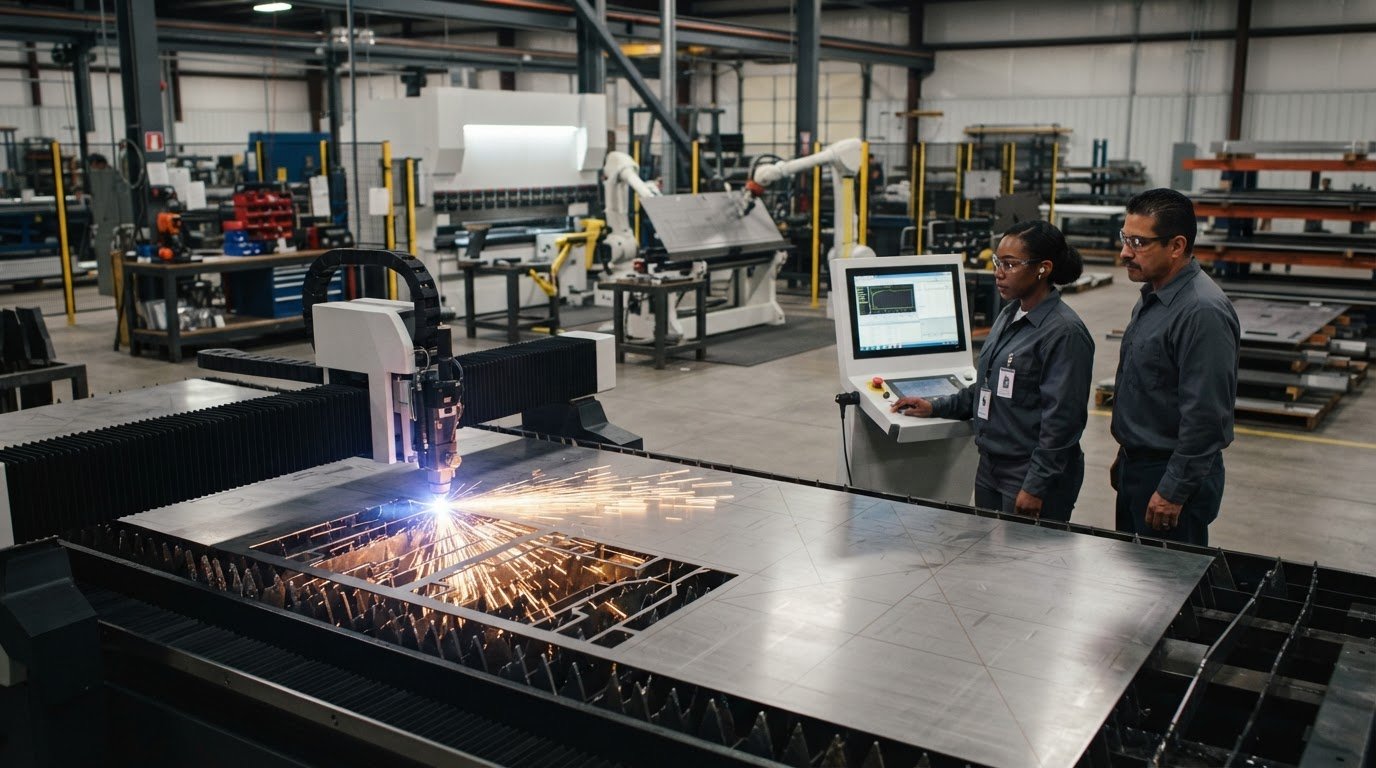
A laser turns a digital part design into a sheet-metal cut by directing focused energy along a programmed path. According to the National Institute of Standards and Technology, laser light can deliver energy to heat, cut, melt, sinter, or weld a workpiece. Custom laser cutting and bending services combine precise flat-part cutting with forming operations that shape metal for its intended use.
A clean cut is only the start. A finished part may also need engraving, bends, tapped holes, or surface finishing, and its design must account for how the material behaves at each step. This guide explains how laser cutting works, what to consider when preparing a part, and how cutting, bending, tapping, and finishing fit together. You’ll also learn what affects fabrication options and how a coordinated process can take a design from digital file to production-ready component.
Key Takeaways
- Laser cutting turns a digital design into a sheet-metal profile, with the best process depending on the material, thickness, part geometry, and production needs.
- Designing holes at least as large as the material is thick can help avoid common laser-cutting constraints; beam radius can also slightly round sharp inside corners.
- Cutting can be combined with bending, tapping, engraving, and finishing to bring a flat blank closer to a ready-to-use component.
- Plan the full production sequence around fit and function, since edge draft, heat effects, bend geometry, and finishing choices can influence the finished part.
What is laser cutting?
Laser cutting uses a focused laser beam and a digital path to cut sheet metal into parts. According to the National Institute of Standards and Technology, laser light can heat, cut, melt, sinter, or weld a workpiece. The method suits jobs where accurate profiles and repeatable production matter.
Applications and Production Volumes
Laser-cut sheet metal becomes enclosures, brackets, panels, equipment covers, and custom components. Because the process follows a programmed design, the same profile can be repeated across a prototype or a larger production batch. To plan volume, consider part complexity, material thickness, nesting efficiency, and whether pieces need engraving or finishing. These details shape the path from sample to repeat production.
Cutting Method Comparisons
Laser cutting uses focused light for a controlled cut. Waterjet cutting, which uses a high-pressure water stream, is a standard alternative for thicker metal. Plasma cutting uses a high-temperature, electrically conductive arc and is commonly suited to conductive metals. Compare the material and thickness, edge requirements, part geometry, and downstream operations. A detailed profile may call for a different method than thick plate intended for less intricate fabrication.
Laser cutting systems use four main laser types: CO2, fiber, neodymium (Nd), and Nd:YAG. The process choice affects how a material responds, while design details affect production time. Closely nested profiles can use sheet area efficiently; intricate contours, small features, or added engraving can require more processing. Include finishing needs in the initial scope, since a cut edge may need additional work before assembly or use.
Production costs depend on material, thickness, geometry, quantity, nesting, and requested finishing. The price is determined by the specific job and provided after a quote request. A simple profile repeated across a batch, for example, may use production time differently from a one-off part with detailed contours and extra operations. Quantity matters, but it is not the only cost driver.
Minimum order quantities depend on how a part is prepared and produced, including setup, nesting, and batch size. A prototype can test fit and function before a repeat run. For production, stabilize the design first and specify the quantity needed per release. Share the expected repeat pattern too, since recurring batches can be planned differently from a single sample.
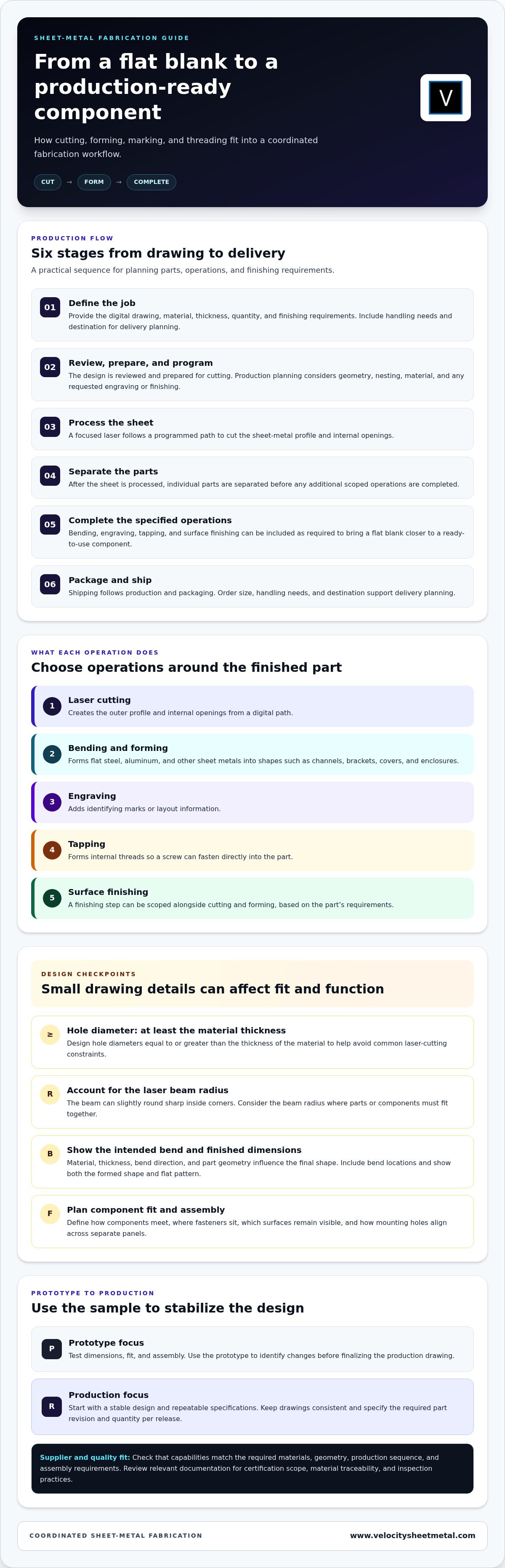
A practical workflow starts with a digital drawing and the material, thickness, quantity, and finishing requirements. The design is reviewed, prepared for cutting, and programmed; the sheet is processed, parts are separated, and finishing is completed as scoped. Shipping follows production and packaging. Include order size, handling needs, and destination in the job requirements to support delivery planning.
Prototype and production parts have different priorities. A prototype tests dimensions, fit, and assembly, while production depends on a stable design and repeatable specifications. Use the prototype to identify changes before finalizing the production drawing. This can prevent revisions from carrying into a full batch, especially when a part has close-fitting holes, mating edges, or multiple components.
Sheet metal laser cutting, engraving, bending, and tapping
Sheet metal parts can move from a flat blank to a formed, marked, and threaded component through coordinated fabrication steps. Choose documented safety, material, and quality certifications that match the work, and ensure their scope covers the processes and materials your project requires.
Metal Bending and Forming
Bending forms flat steel, aluminum, and other sheet metals into channels, brackets, covers, and enclosures. Material, thickness, bend direction, and part geometry influence the final shape, so include bend locations and finished dimensions in the drawing. For example, a bracket with two flanges needs bend lines positioned to preserve hole alignment after forming. Show both the intended formed shape and the flat pattern.
Custom Components and Assemblies
Custom fabrication can combine cut panels, formed brackets, and other sheet-metal parts into an assembly. Define how components meet, where fasteners sit, and which surfaces remain visible. A housing, for example, may need mounting holes aligned across separate panels. Clear assembly details help production focus on fit, function, and volume. Include the required part revision so every component follows the same design.
Each operation serves a different purpose. Laser cutting creates the outer profile and internal openings; engraving adds identifying marks or layout information. Tapping forms internal threads so a screw can fasten directly into a part. Plan hole positions before production, and design hole diameters equal to or greater than the material thickness. Laser beams can slightly round sharp inside corners, so account for the beam radius where components must fit together.
For a custom component, compare a fabricator’s capabilities with your material, geometry, volume, and delivery requirements. A flat aluminum panel may need cutting and engraving, while a formed steel enclosure may require bends and tapped holes. If considering waterjet cutting, assess how the method suits the material and the required edge and feature details. Keep drawings and specifications consistent across every production operation.
Choose a supplier based on the finished component, not just a machine list. Review whether the fabricator can handle the required materials and production sequence, interpret drawings, and make parts that meet assembly requirements. Request relevant documentation showing certification scope, material traceability, and inspection practices. Compare these records with the project’s safety, quality, and customer requirements rather than assuming a certification name covers every process.
Before releasing a production run, define the part revision, material, thickness, quantity, bend details, hole requirements, engraving, and finishing. A prototype can reveal fit or assembly issues before the design moves into repeat production. For a project combining cut profiles and press-brake bends, custom laser cutting can be a practical starting point for coordinating those fabrication steps.
Laser cutting combined with bending and finishing
A flat cut becomes a functional component through forming and finishing. Plan the material, thickness, bend geometry, edge requirements, and final surface before production begins.
Fabrication and Finishing Capabilities
Coordinate each operation around the finished part, not just the cut profile. A carbon-steel equipment panel, for example, may need cutouts, bends, deburred edges, and a coating-ready surface. Stainless steel may need a different surface treatment to meet appearance or assembly requirements. Select materials and finishing steps together, since machining and handling can affect visible surfaces.
Bending and Finishing Services
A hydraulic press brake can form laser-cut parts, turning flat blanks into channels, flanges, or enclosures. Bend location, material thickness, and part geometry influence the result. List bends and finished dimensions on the drawing. Specify any follow-up, such as edge deburring or a protective coating, so each operation supports assembly and use.
Cutting Tolerances and Edge Finishes
Laser-cutting precision can reach up to ±0.005 inches. Treat that value as a process capability, not a universal guarantee for every feature or material. The actual result depends on the machine, material, thickness, and geometry. Laser-cut edges may have some draft, and heat can affect the cut edge. Mark critical dimensions and functional edges clearly on the drawing.
Let fit requirements guide the design review. A tab that slides into a slot needs enough clearance for both the cut profile and bend location. A sharp internal corner can become slightly rounded because the laser beam has a radius. Account for that radius where parts meet, and avoid placing a critical mating surface directly at a corner.
Finishing choices affect more than appearance. A coating can change how surfaces fit together, while burrs or sharp edges can complicate handling and assembly. Identify visible faces, edges that contact other parts, and whether the component needs a uniform appearance. For prototypes, use the production material and finish plan when those details affect fit.
Use a clear production sequence: cut the flat pattern, inspect critical features, form the bends, then complete the specified finishing. Cutting before bending keeps the laser path accessible to the flat sheet. The part can then move to a press brake for forming. Review the formed component against its final dimensions, since a flat pattern alone doesn’t show the completed shape.
Drawings should connect tolerances to function. Use tighter requirements only for dimensions that control fit, alignment, or assembly. A mounting-hole pattern, for example, may need closer control than an outer edge hidden inside a housing. This directs inspection toward the features that matter while keeping the rest of the design practical to manufacture.
Laser cutting process and manufacturing advantages
Laser-based manufacturing starts with a digital part profile and a selected sheet material. The machine directs a focused beam along programmed paths, separating each cut part from the sheet. According to the National Institute of Standards and Technology (NIST), laser light can heat, cut, melt, sinter, or weld a workpiece. For cutting, the beam’s energy and movement create the profile, openings, and contours specified in the design.
Four main laser types are used for cutting: CO2, fiber, neodymium (Nd), and Nd:YAG. Each type has different process characteristics, so material and thickness help guide selection. Nd:YAG lasers are not ideal for cutting steel over 20 millimeters thick. For thicker metal, waterjet cutting is a standard alternative; plasma cutting is another method used for conductive metals. Compare the required cut geometry and edge condition, not just the machine name.
Laser cutting supports manufacturing jobs that need defined profiles or repeated features. An industrial equipment maker might cut mounting plates with repeated holes, while an HVAC fabricator may need shaped panels and brackets. Electrical enclosures, machinery guards, and transportation components also rely on cut sheet metal. Nesting several profiles on one sheet can organize production and reduce unused material, especially when a batch includes different part shapes.
Manufacturers across the United States use cut parts in machinery, building systems, transportation equipment, and industrial enclosures. Production needs vary by facility and application. A plant making equipment panels may prioritize hole placement and clean assembly edges; a contractor producing duct-related components may focus on consistent profiles and coordinated dimensions. The drawing, material, volume, and downstream operations determine the capabilities a project needs.
Laser cutting supports both prototypes and repeat production because the profile comes from a digital design. A prototype helps test fit, clearance, and hole alignment before a design moves into a larger run. Once the drawing is stable, production can repeat the same programmed geometry. This helps manufacturers manage changing demand, such as a machine builder testing an initial sample before ordering recurring replacement panels.
Plan inspection around the part’s function. Identify critical holes, mating edges, and dimensions that affect assembly, then compare them with the finished cut part. Laser-cut edges may show some draft, and heat can affect the edge. These factors matter if a component must sit flush or meet another part precisely. Reviewing the drawing, material, thickness, and required finish helps align the cutting method with the job.
Choose a process that fits the whole manufacturing sequence. If a cut profile later needs forming, tapping, or finishing, include those steps in the production plan. A steel bracket, for example, may need an accurate profile before bending and assembly. Coordinating the cut geometry with each downstream operation keeps production focused on the completed component, not just the first cut.
Laser cutting process and service options
Laser cutting and sheet metal bending work in sequence: a digital drawing guides the cut, then a press brake forms the flat part. The result can be a formed metal component ready for assembly, such as a bracket with a cut profile and bent flanges.
Start with the part file, material, thickness, quantity, and required operations. The cutting process converts the drawing into a machine path, positions the sheet, and directs the laser along the specified contours. A cut panel might include mounting holes, slots, and a shaped perimeter. After cutting, the flat blank moves to bending if the design calls for formed edges or channels.
Service options depend on the geometry. Flat-sheet cutting suits panels, brackets, and plates; tube laser cutting processes hollow sections such as round or rectangular tubing. A tube machine rotates and positions the workpiece so the beam can cut features around its surface. A frame component, for example, may need angled ends and intersecting openings. Tube bending is a separate forming operation, so specify the finished shape and fabrication steps in the drawing.
Material selection shapes the process. Stainless steel, for example, may be specified for a visible equipment panel, while another metal may suit a concealed support bracket. Thickness and profile influence the cutting setup, and bend locations affect final dimensions. If a part needs both operations, show the flat pattern and intended formed geometry in its drawing. This gives production a clear path from sheet to finished shape.
Plan orders around a prototype, a production batch, or recurring parts. A prototype checks fit and clearances before the drawing is released for repeat production. For a production order, keep the part revision, material specification, quantity, and finishing requirements consistent. A formed enclosure, for instance, may depend on aligned holes across multiple panels, so cut and bend details need to match the assembly drawing.
Before production, organize the job information in one package: drawing, material and thickness, quantity, critical dimensions, bend locations, and finishing requirements. Identify which edges or holes control fit. Consider a slot that receives a tab alongside the final bend, not as an isolated cut feature. Clear inputs connect equipment setup, cutting, forming, inspection, and shipment.
For a project that needs flat profiles or formed sheet-metal parts, explore custom laser cutting options as a practical next step.
Velocity Sheet Metal: Coil-line automated rectangular duct
Velocity Sheet Metal is a practical next step for custom-cut sheet metal components or coordinated HVAC ductwork. Its coil-line automated rectangular duct supports ductwork projects, while spiral and round duct and fittings suit systems designed around those products.
For fabrication projects, Custom Laser Cutting produces parts from digital designs, and CNC Press Brake Bending forms sheet metal into specified shapes. BIM Coordination & Spool Drawings helps align ductwork details with project plans. These services fit scopes that include both fabricated components and ductwork coordination.
Share your drawings and project requirements with Velocity Sheet Metal, or visit the website to discuss the next step.
Move Your Sheet Metal Design Toward Production
Turn the design into a manufacturing-ready plan. Before releasing a part, align its drawing with how it will fit, form, and work alongside surrounding components. Clear decisions about material, dimensions, bends, and finishing keep the design focused on its intended function.
For projects combining custom parts with HVAC ductwork, Velocity Sheet Metal offers Custom Laser Cutting, coil-line automated rectangular duct, and spiral and round duct and fittings. CNC Press Brake Bending can also form sheet metal parts. The right mix depends on the project, from a single component to coordinated ductwork and fabricated parts.
Bring the drawing and project requirements together before production begins. This gives fabrication a clear target and connects the digital design to the finished component. If you’re planning custom laser cutting and bending services, move forward with a focused project scope and clear part requirements.
Contact Velocity Sheet Metal to discuss your sheet metal project. Your design is ready for its next step.
Frequently Asked Questions
How is it fabricated?
Fabricating a sheet-metal part means translating its design into a sequence of production operations. The shop prepares the drawing, assigns material and thickness, and programs the cut path. After cutting, parts may be deburred, bent, tapped, or finished. For an enclosure, separate panels can be cut, formed, and prepared for assembly. Inspection then focuses on dimensions and features that affect fit.
What materials and thicknesses can custom laser cutting and bending services handle?
Velocity Sheet Metal lists carbon steel, stainless steel, aluminum, copper, brass, galvanized steel, and specialty alloys among its materials. Its stated thickness range is 24 ga to ½ in. Material choice should reflect the part’s function: stainless may suit a visible component, while galvanized steel may fit another application. The specified range is a useful starting point for scoping parts, but material and thickness affect cutting and forming differently.
What file formats and design specifications do custom metal shops require?
Velocity Sheet Metal accepts STEP, STL, DXF, DWG, IGES, and PDF files. A useful drawing package identifies units, material, thickness, part revision, quantity, and critical dimensions. Add bend lines, thread details, finish requirements, and surfaces that must remain visible. An assembly drawing, for example, can clarify which holes must align across separate panels. Keep file and drawing revisions consistent to avoid manufacturing from mismatched instructions.
How much does custom laser cutting and bending cost per part or project in the US?
Price depends on the specific project and is provided after a quote request. Cost factors include material type and thickness, part geometry, cut-path complexity, quantity, bending, tapping, and finishing. A simple flat plate and a formed enclosure require different operations, even if they use similar material. Provide the part file, quantity, and required processes together so the quote reflects the intended finished component.
What factors affect laser cutting and bending lead times?
Lead time depends on drawing readiness, material selection, order quantity, machine scheduling, and the number of required operations. A part needing only a flat cut follows a different production path from one requiring bending, tapping, and finishing. Revisions can also affect the sequence if they arrive after programming begins. Include packaging and delivery requirements in the project scope, since they shape the final steps after fabrication.
How accurate are laser cutting and sheet metal bending services?
Velocity Sheet Metal states a tolerance capability down to ±0.005 inches. Treat tolerance requirements as part of the design, not an afterthought: identify which dimensions control fit, alignment, or fastening. Bending also affects the final geometry because material behavior and tooling influence the formed angle. For an assembly with mating panels, specify critical dimensions clearly and evaluate the finished part in its assembled position.
What minimum order quantities and prototype services do metal fabrication shops offer?
Run sizes at Velocity Sheet Metal range from single parts to 10k+ part runs, so a project can start with a prototype or move into a larger batch. A first article can help test installation, clearances, and assembly sequence before releasing repeat orders. Use the prototype to document approved dimensions and revision details. That record gives subsequent production runs a consistent reference.
How should parts be designed to avoid bending and laser cutting defects?
Design around the finished shape, not just the flat pattern. Allow space for bend relief at corners, keep critical holes clear of bend zones, and show bend direction on the drawing. Match mating clearances to the assembly’s function, and avoid placing fragile features close to an edge. Review the flat and formed views together so a slot, tab, or hole remains usable after forming.