Cost of In-House Fabrication vs Outsourcing: Which Costs Less
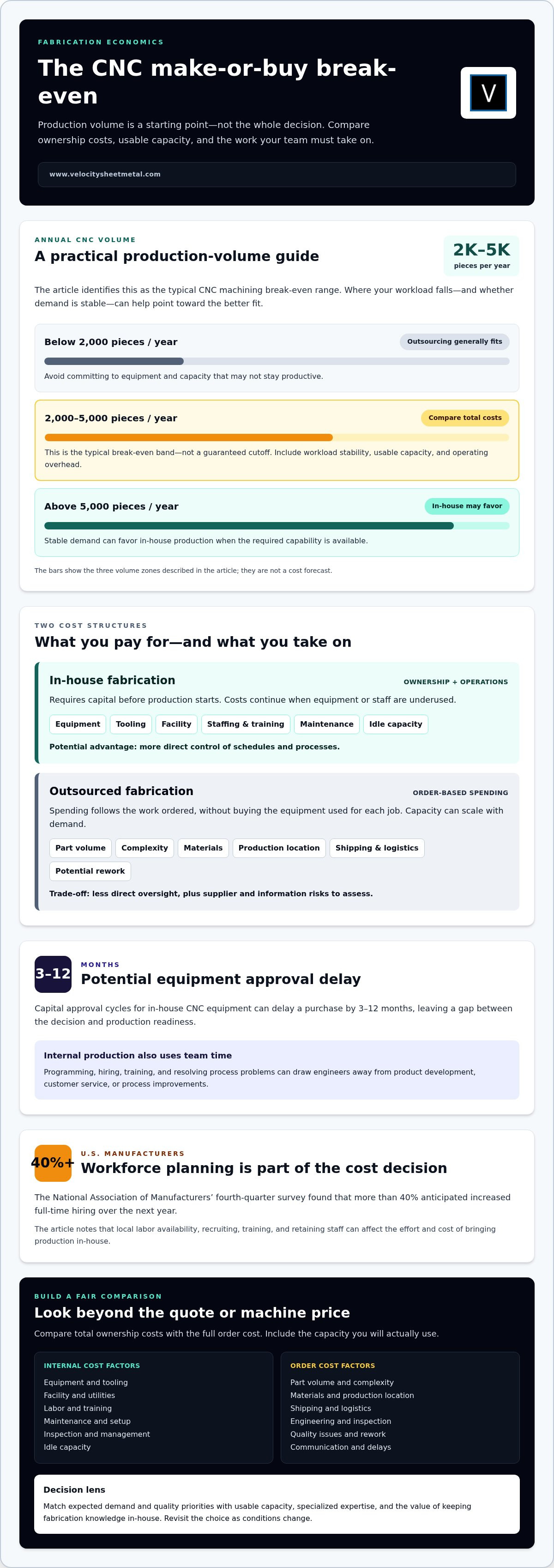
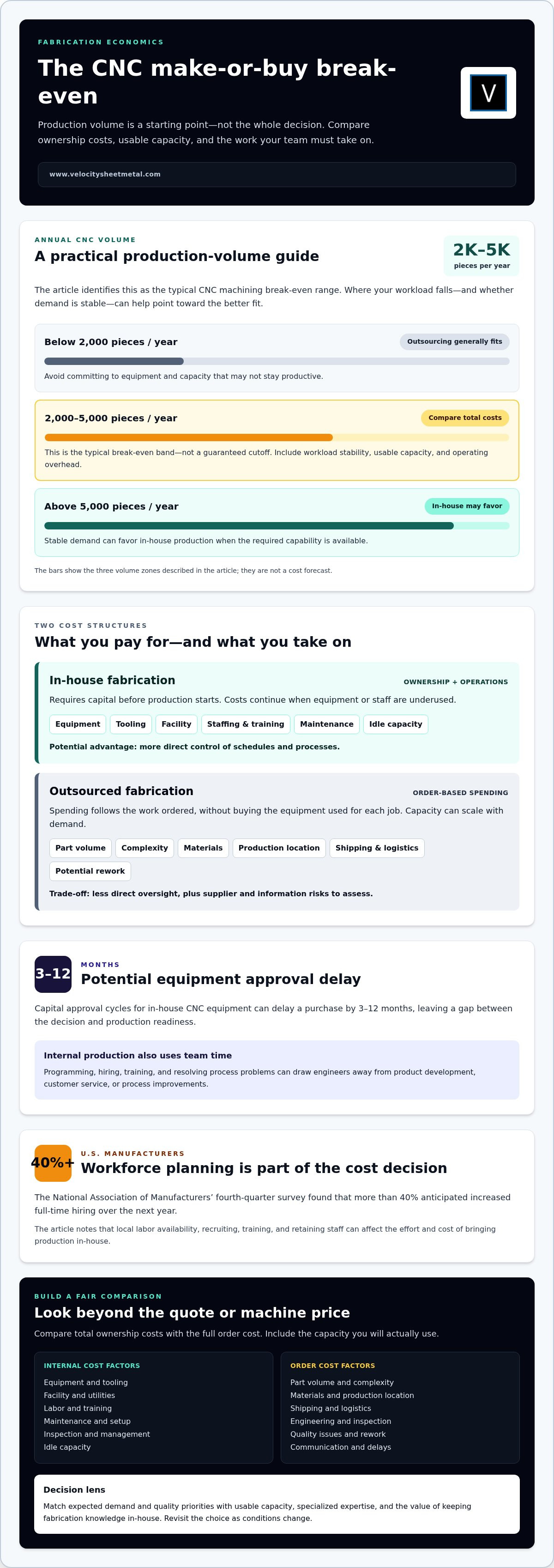
The cheaper fabrication option may be the one you don’t own. The cost of in-house fabrication vs outsourcing depends on volume, equipment, labor, and overhead; for CNC machining, the typical break-even point is 2K-5K pieces per year. Below 2,000 pieces per year, outsourcing is generally the better fit, while stable demand above 5,000 pieces per year can favor in-house production when the required capability is available.
It’s easy to focus on a supplier’s quote or a machine’s purchase price. But a fair comparison also includes staffing, training, maintenance, setup, inspection, shipping, and the cost of idle capacity. A low quote can bring added expenses, while owning equipment makes sense only if it stays productive.
This guide explains how investment, production volume, specialized expertise, and operating overhead shape the decision. Learn how to compare total costs, when in-house control may justify the investment, and when outsourcing offers more flexibility. The goal is a practical make-or-buy decision based on your workload and priorities, not a single cost line.
Key Takeaways
- Compare the full cost of ownership, not just a machine’s purchase price or a supplier’s quote. Include the capacity you’ll actually use.
- Account for the internal time required to hire, train, maintain equipment, and stabilize production before bringing work in-house.
- Outsourcing can provide access to specialized machinery and expertise without building those capabilities internally.
- Include engineering, inspection, shipping, rework, and management effort in your cost model to uncover less visible expenses.
- Choose the production approach that fits your demand, quality priorities, and strategic needs, then revisit the decision as those conditions change.
Outsourcing’s lower investment costs and variable capacity spending
Outsourcing shifts fabrication spending toward purchased production rather than owned equipment, facilities, and staffing. A sound comparison includes both the initial investment and the ongoing cost of keeping equipment productive.
Outsourced Variable Costs
Outsourced fabrication costs vary with part volume, complexity, materials, and production location. Larger orders can spread setup work across more parts, while complex geometries or demanding materials may require more machining, programming, or inspection. Location also affects shipping and logistics, so compare the full order cost rather than the unit quote alone.
Unlike in-house fabrication, outsourcing doesn’t require you to buy the equipment used for each job. Instead, spending follows the work ordered, with potential extra costs for shipping, quality issues, late shipments, communication gaps, or rework.
Outsourced Capacity Flexibility
Outsourcing lets manufacturers scale production with demand. A business can send work out during a production peak without carrying the same full-time workforce and equipment capacity through slower periods. That flexibility can leave more cash available for product development and innovation.
In-house fabrication gives you more direct control over schedules and processes, but costs continue when equipment or staff are underused. Outsourcing trades some direct oversight for adjustable capacity, making it useful when demand changes or specialized work is occasional.
Bringing fabrication in-house requires capital investment before production starts. These investments make sense only when the expected workload can keep equipment in use over time.
Ownership also carries recurring expenses.
Outsourcing carries different risks. Buyers may have less direct oversight of quality and consistency, and supplier problems can lead to defects or delays. Sharing sensitive designs also creates intellectual-property and security risks. Assess a supplier’s reliability, information safeguards, capacity, and supply-chain vulnerabilities before shifting production.
| Option | Investment | Capacity | Oversight and risk |
|---|---|---|---|
| In-house | Equipment, tooling, facility | Owned, may be underused | More direct process control |
| Outsourced | Order-based production costs | Can scale with demand | Supplier and information risks |
Choose by comparing total ownership and order costs with expected demand, usable capacity, quality priorities, and the value of keeping fabrication knowledge in-house.
What in-house hurdles do engineers overlook when planning to bring manufacturing internal?
In-house manufacturing means producing parts with company-owned equipment, staff, and facilities. The decision commits internal time and capital, not just engineering control.
Opportunity Cost of Internal Manufacturing
Opportunity cost is the value of work your team can’t do while setting up and running internal production. Engineers may spend time programming, training operators, and resolving process problems instead of advancing product development, customer service, or process improvements. Outsourcing can free those resources for higher-value work, while in-house production keeps expertise and scheduling control closer to the business.
Plan the transition as a sequence: estimate demand, identify the skills required, and compare those needs with current team priorities. Capital approval cycles for in-house CNC equipment can delay a purchase by 3-12 months, creating a gap between the decision and production readiness.
Local Fabrication Cost Factors
In the United States, tax incentives, applicable regulations, and local costs can affect fabrication economics. Their impact depends on the location, facility, equipment, and production process. For each proposed site, compare equipment-related tax treatment, facility requirements, utility expenses, labor availability, and compliance workload. These factors can change ownership costs even when the production plan stays the same.
Local conditions also affect the effort needed to recruit, train, and retain staff. The National Association of Manufacturers’ fourth-quarter survey found that more than 40% of U.S. manufacturers anticipated increased full-time hiring over the next year. That expectation makes workforce planning part of the internal production decision, not an afterthought.
Hiring is only one hurdle. In-house manufacturing requires the company to build and maintain production capability, including operator training and equipment upkeep. New employees need time to onboard, and training can slow output while a process stabilizes. Production managers also take responsibility for workplace accidents, equipment maintenance, and quality problems.
Low-volume, high-margin work needs a closer look. Outsourcing’s added costs can matter more when each unit carries a higher dollar margin, while an internal setup may leave equipment underused between orders. Consider whether the fabrication process is strategically important, demand is steady, and internal capacity already exists. Idle capacity can make in-house production more practical than buying a new machine.
Demand changes the opportunity-cost calculation. A team serving unpredictable orders may value flexibility more than direct control over every production step. A business with repeatable work can plan staffing and equipment use more effectively, but must still account for training and maintenance. Compare expected workload with available engineering hours before assigning internal resources.
Use a simple decision sequence: map the work, identify the expertise and capacity it requires, then compare those demands with the value of keeping production internal. If the work pulls engineers away from product development or customer priorities, outsourcing may preserve their focus. If fabrication protects a core capability or uses existing idle capacity, internal production may justify the commitment.
Access to specialized expertise and machinery
Fabrication depends on more than machine access. It also requires people who can program, set up, produce, and inspect each part.
Specialized Talent Requirements
Specialized talent may include engineers who prepare part programs, operators who set up equipment, and inspectors who assess finished work. A complex part can require all three roles, even if production runs only occasionally. Outsourcing can provide access to specialists as needed, while in-house production requires the business to recruit, train, and retain employees with the right skills.
For each part, map the skills needed from design review through inspection. Then compare your team’s experience with the task’s tolerances, material, and process requirements. This can reveal skill gaps before they cause production delays or inconsistent quality control.
Specialized Equipment Requirements
Equipment requirements depend on the part and fabrication process. A manufacturer may need specialized machinery, software, tooling, and workholding to produce a component consistently. Outsourcing can provide access to equipment and technologies that would be costly to buy for occasional production. In-house equipment gives the company more direct control over its production schedule and process.
For example, a part requiring a process your team rarely uses may need dedicated equipment and trained operators. Compare how often that work occurs with the machine’s other potential uses before investing in internal capability.
Outsourcing can make sense when a part is complex, demand is low, or internal expertise is limited. A fabrication provider may bring the required equipment and specialist knowledge without the manufacturer having to establish a new process. This can keep employees focused on core production, product development, and design improvements.
That access comes with tradeoffs. External production can reduce direct oversight of workmanship and consistency. You also share design information with another organization, which can create proprietary-information and security risks. Define drawing access, revision control, inspection criteria, and approval steps before production begins.
In-house work can support close collaboration between engineering and production. Engineers can observe a process directly, discuss changes with operators, and use production feedback in product development. That advantage matters when designs change frequently or fabrication knowledge is strategically important. It also requires internal employees to maintain the expertise and equipment needed to act on those changes.
Use this comparison before assigning a part:
- Skill: Identify programming, setup, operating, and inspection knowledge the part requires.
- Equipment: Match the process to available machinery, tooling, and software.
- Frequency: Compare recurring demand with occasional or specialized production needs.
- Control: Weigh direct quality oversight against access to external expertise and technology.
Outsource when specialist capability is needed only occasionally or is unavailable internally. Keep work in-house when close process control and retained expertise matter more.
Labor, engineering, inspection, and management overhead
Labor overhead extends beyond wages to benefits, training, supervision, and facilities. Compare these recurring demands with external labor and inspection costs.
Specialized Labor and Expertise
In-house staffing requires employees with the right production skills, plus time for training and retention. Deloitte’s US Global Outsourcing Survey found that 62% of executives reported difficulty retaining employees. Outsourcing can reduce labor overhead and provide specialist talent as needed, while a dedicated internal workforce can build process knowledge and support long-term company growth.
Seasonal demand creates another staffing challenge. A manufacturer facing a temporary production peak can use outsourced labor rather than carry full-time wages, benefits, and training costs through slower periods. This adds flexibility but requires clear oversight of quality and handoffs. An internal team offers direct coordination; an external workforce can scale with production needs.
Build the labor comparison around a defined workload. Include wages, benefits, training, and overhead, then account for time spent on setup, production, and routine support. Internal staffing provides dedicated capacity, but that capacity still costs money when demand falls.
Engineering, Inspection, and Management Overhead
Engineering time starts before the first part runs. Programming and fixturing for a new in-house part is estimated at 5-20 hours of engineering time. Track that effort by part, especially when designs change or production runs vary. External production can shift some specialized work away from internal engineers, while internal fabrication keeps process adjustments closer to the design team.
Inspection adds workload to both models, but in different places. In-house teams must account for inspection labor, measurement equipment, documentation, and management oversight. Compare the inspection plan for each part, including acceptance criteria, review time, and how defects or rework will be handled.
Use a simple cost worksheet before choosing a staffing model. For in-house production, list operator hours, engineering programming, training, inspection, supervision, and facility support. For outsourced work, capture supplier charges, order verification, communication, and any temporary labor coordination. A hybrid approach can keep employees focused on core operations while outsourcing specialized or temporary tasks, balancing internal process knowledge with flexible access to talent.
Worked in-house versus outsourcing cost comparisons
Compare total costs over the same production period, not just a machine purchase or supplier quote. In-house schedules can avoid external shipping steps, while outsourced work may add shipping, inventory, and supplier-related costs. Break-even analysis compares fixed internal costs with per-part costs at expected volume.
Lead-Time, Shipping, and Inventory Costs
In-house production gives a business more direct control over schedules and reduces dependence on shipping lanes, customs, and overseas partners. Outsourcing adds transport and coordination to the production timeline, and late shipments can disrupt planned work. The tradeoff depends on the part’s required timing, where production takes place, and how much inventory the business holds to protect against delays.
Include shipping, inventory, and productivity gains in both models. In-house production may let a company consolidate material needs across production lines and negotiate bulk discounts. External production can avoid carrying some internal capacity, but incoming shipments still require receiving, planning, and inventory control.
Break-Even Cost Calculations
Calculate break-even by comparing internal fixed costs with the outsourced cost per part across expected annual demand. Add equipment, facilities, staffing, training, maintenance, engineering, and inspection to in-house costs. Include supplier charges, shipping, order verification, and expected rework in the external model. The break-even volume is where the two totals match.
For CNC machining, the guide estimates a typical annual break-even volume of 2K-5K pieces. Below 2,000 pieces per year, outsourcing is generally better; stable demand above 5,000 pieces per year can favor in-house production when capability is available. Treat these as decision markers, then calculate using your own parts and workload.
Run the comparison for each part family, not just the whole facility. A company may have stable demand for one component and occasional orders for another. Separate those volumes to see whether internal equipment would stay productive or sit idle. Include setup time, scrap, and productivity gains so the calculation reflects actual output, not theoretical machine capacity.
Quality and strategic value also affect the decision. In-house production offers more direct control over quality, cost structure, and scheduling. Outsourcing can support flexibility but creates supplier risks, including defects, late shipments, communication gaps, and rework. Sharing sensitive designs also creates intellectual-property and security risks. Include these exposures in the make-or-buy review alongside measurable costs.
Revisit the model when demand, supplier reliability, or market conditions change. For example, a new production forecast can shift annual volume across the CNC break-even range, changing which option fits. Price depends on the part’s design, material, quantity, and production requirements. The exact figure comes from a quote for the specific job.
Use a project-specific comparison to plan your next fabrication run with a fabrication partner.
Velocity Sheet Metal: Coil-line automated rectangular duct
Velocity Sheet Metal provides coil-line automated rectangular duct for projects where outsourcing duct fabrication fits better than investing in internal production capacity. It can be a practical option when demand varies or a project needs fabrication support alongside engineering coordination.
For related ductwork needs, Velocity Sheet Metal also provides spiral and round duct and fittings, plus BIM Coordination & Spool Drawings to support coordination from design through production. Custom Laser Cutting is available for project-specific fabricated parts. These services give contractors and engineers fabrication options without bringing every process in-house.
Use the make-or-buy comparison to identify work that benefits from external fabrication, then align the required parts and drawings with your project scope. Contact Velocity Sheet Metal to discuss your fabrication needs.
Make the next fabrication decision with confidence
The cost of in-house fabrication vs outsourcing is most useful as a project-level decision, not a permanent rule for every part. Start with the next job in your pipeline. Define the required output, production schedule, drawing readiness, and quality checkpoints. Then decide which work needs internal ownership and which can go to an external fabrication partner.
For HVAC and sheet metal projects, match the production need to the right capability. Velocity Sheet Metal offers coil-line automated rectangular duct, spiral and round duct and fittings, and custom laser cutting. These options can support projects that need fabricated components without adding every process to an internal operation.
Bring your drawings, quantities, and project requirements into the discussion. A clear scope helps align fabrication needs with the right next step. Discuss fabrication costs with Velocity Sheet Metal, and move your next project forward with a more informed make-or-buy decision.
Frequently Asked Questions
What Is a Make-or-Buy Decision?
A make-or-buy decision determines whether a business produces a part internally or purchases it from an external fabricator. Compare total costs, required production control, available skills, and the part’s strategic importance. For example, a company might retain a proprietary component in-house while outsourcing a less critical part. The decision can differ by part family rather than applying one production model across the entire operation.
When should I bring a previously outsourced part in-house?
Bring a part in-house when demand is stable, internal capability is available, and the added control justifies the ownership commitment. For CNC machining, stable demand above 5,000 pieces per year can favor in-house production when the required capability is available. Before switching, confirm that internal capacity, trained operators, quality checks, and engineering support can handle the part without disrupting other production work.
What are the typical costs of setting up an in-house fabrication shop in the United States?
There’s no single setup total because fabrication shops need different equipment, staffing, software, and facility arrangements. Build a project-specific budget by listing the processes required, then adding tooling, workholding, software, floor space, utilities, and labor.
How much do fabrication equipment, tooling, and facility costs typically run?
These figures help structure a budget. The processes, equipment requirements, and facility footprint determine which expenses apply.
What are average U.S. labor costs for in-house fabrication, including wages and benefits?
Loaded labor includes more than wages: benefits, training, and overhead also belong in the calculation. For a useful annual estimate, identify the operators needed for each shift and account for the work they’ll perform. Include engineering, inspection, and supervision separately so operator labor doesn’t conceal other staffing demands.
How do material, overhead, maintenance, and quality-control costs affect in-house fabrication costs?
Material use, scrap, machine upkeep, utilities, inspection, and rework all influence the cost per acceptable part. New in-house manufacturing processes commonly have scrap rates of 3-8% of material and labor costs. A process pushed beyond the shop’s demonstrated tolerance capability can result in scrap rates of 15-30% until the process stabilizes. Track scrap and rework alongside maintenance and inspection to see their effect on usable output.