Choosing the Right Material for Metal Fabrication
What if the metal that looks right on a drawing creates problems at the press brake or during finishing? Selecting the right material for metal fabrication means looking beyond the material name. Strength, corrosion resistance, weight, and appearance matter, as do the cutting, bending, joining, and finishing requirements of the part. A material that performs well in service still needs to suit the fabrication process.
It’s easy to focus on one requirement, such as durability, and overlook a trade-off that affects the finished component. Start by identifying what the part must do, where it will operate, and how it needs to be made. Then compare materials against the full project brief rather than a single property.
This article explains how common fabrication metals differ and how to match them to service conditions and production needs. You’ll learn how to define priorities, identify trade-offs, and prepare design files and material requirements for a focused fabrication review. With those details clear, the path from design file to finished component is easier to plan.
Key Takeaways
- Start with the part’s function, exposure, loads, geometry, and appearance before comparing material options.
- Assess how material properties fit the planned laser cutting, CNC bending, joining, and finishing processes.
- Compare carbon steel, stainless steel, aluminum, galvanized steel, copper, brass, and specialty alloys against project requirements.
- Make selecting the right material for metal fabrication more systematic by documenting grade, thickness, tolerances, finish, quantity, and service conditions.
- Prepare design files and material requirements for a fabrication review that can include engineering, laser cutting, CNC bending, welding, finishing, HVAC ductwork, or BIM coordination.
Selecting the Right Material for Metal Fabrication Starts with the Part
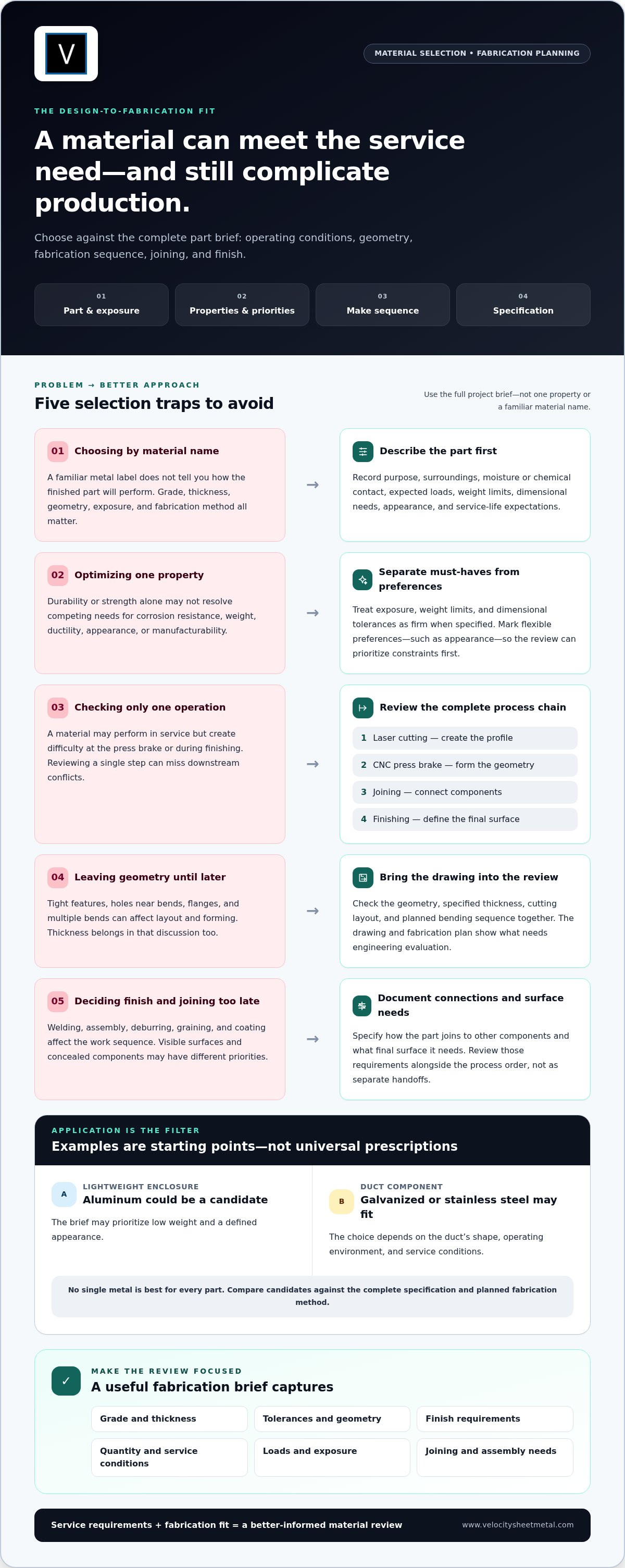
Material selection is a matching exercise: the metal must meet the part’s service requirements and suit the processes needed to make it. Start with the component’s purpose and operating environment, then consider how it will be cut, formed, joined, and finished. This keeps selecting the right material for metal fabrication grounded in the actual job rather than habit or a material name copied from an old drawing.
Before comparing options, separate requirements from preferences. A weight limit, exposure condition, or dimensional tolerance may be a firm constraint. A preferred appearance or familiar material may be flexible. Identifying the difference helps engineering and fabrication teams focus on what affects performance and production. Metalworking processes and materials offers broader context, but the part’s specification and operating conditions should guide the decision.
What requirements should a metal fabrication brief capture?
Build the brief around the part’s purpose and operating environment. Describe expected loads, contact with moisture or chemicals, dimensional limits, appearance, weight, and intended service life. Also record how the part connects to other components and what finishing it needs. These details make material comparisons more useful and help keep requirements consistent across design and fabrication.
- Function and exposure: State what the part does and describe its surroundings, including relevant moisture or chemical contact.
- Performance: Record expected loads, weight limits, dimensional requirements, and service-life expectations from the project specification.
- Production needs: Identify the geometry, joining and assembly methods, and finish requirements that could affect material choice.
Keep essential requirements distinct from preferences. If appearance is flexible but a dimensional limit is fixed, say so in the brief. A fabrication review can then weigh options against the non-negotiable criteria first.
Why does the application matter more than a familiar material name?
A material label alone doesn’t explain how a finished part will perform. Grade, thickness, geometry, exposure, and fabrication method all shape the result. A familiar metal may suit one application but conflict with another because of weight, corrosion resistance, or forming requirements. The same material family can include different grades and finishes, so the complete specification matters.
Consider two parts: a lightweight enclosure and a duct component. The enclosure may prioritize low weight and a defined appearance. The duct component may have different requirements for its shape, operating environment, and service conditions. Aluminum could be a candidate for the enclosure, while a duct design might call for galvanized steel or stainless steel, depending on its requirements. These are starting points, not universal prescriptions.
There’s no single best metal for every part. The right choice balances performance in service with manufacturability. If a material meets the operating requirements but makes bending or finishing more difficult, the design deserves a closer engineering review. Define the part, rank its essential requirements, and compare options against the complete brief.
How Metal Properties Affect Cutting, Bending, Welding, and Finishing
A material’s strength, ductility, corrosion resistance, and weight matter in relation to the part’s job. Strength may be important under load, while weight may be a priority for a moving assembly. Corrosion resistance matters when exposure could lead to deterioration. Ductility affects forming. No single property determines the choice on its own.
Each fabrication step adds another consideration. Laser cutting creates the part profile, and CNC press brake bending forms its geometry. Welding or other joining methods bring components together, while finishing affects the final surface. Review the material against the full sequence, not just one operation. Grade, thickness, geometry, and process order can all affect the result.
How do cutting and forming requirements influence material choice?
Bring the drawing’s geometry into the material discussion early. Tight features, holes near bends, flanges, and multiple bends can affect how a part is laid out and formed. Review those details alongside the specified thickness, not after selecting a material. The chosen option must meet the design intent and fit the planned cutting and bending sequence.
A flat profile with a simple bend raises different design questions from a part with several formed features. Neither geometry points to one universal metal. Instead, the drawing and fabrication plan show what the team needs to evaluate. A precision laser cutting services guide can provide more detail on cutting methods and planning a cut part.
When should joining and finishing requirements shape the decision?
Document the joining method and final surface before narrowing material options. Welding, assembly, deburring, graining, and coating can affect the work sequence and the condition required at each stage. A visible surface may have different priorities from a concealed component. A part that joins to other pieces also needs a material and design plan that accounts for those connections.
Review process requirements together rather than treating them as separate handoffs. This helps catch a selection that meets one property target but conflicts with the intended finish or assembly approach. For more materials context, ASM International’s materials science and engineering resources can support technical research into material behavior.
Before production, align the material specification, drawing, and process requirements. Include the intended grade and thickness, critical features, joining details, and finish expectations. This gives engineering and fabrication teams a shared basis for deciding whether the design works as specified or needs adjustment. Coordinate a drawing and fabrication review with Velocity Sheet Metal once those requirements are assembled.
Compare Common Metal Fabrication Materials by Project Need
Compare material families against the same project criteria rather than searching for a broad “best metal” ranking. For each option, consider the required environment, weight, appearance, shape, and fabrication plan. Then identify what the engineering review needs to resolve, including the exact grade or specification. This keeps selecting the right material for metal fabrication tied to documented requirements rather than assumptions.
Use this comparison to build a shortlist, not as a substitute for a specification. The properties of a particular grade, thickness, finish, and form can change what’s suitable.
- Carbon steel: Consider whether the part’s performance requirements, environment, surface condition, and finish align with the specified steel. Review the grade, thickness, joining, and protection requirements.
- Stainless steel: Compare the required corrosion resistance, surface, and service conditions with a defined grade and finish. “Stainless” alone isn’t a complete material specification.
- Galvanized steel: Assess whether the specified coated material and its surface condition suit the part’s environment and fabrication sequence. Include coating and finishing needs in the review.
- Aluminum: Consider whether weight, appearance, and the required part geometry make it a candidate. Review the specific alloy, thickness, and cutting and forming requirements.
- Copper: Evaluate it against the part’s documented functional and appearance requirements, then review alloy, geometry, joining, and finish needs.
- Brass: Compare its intended function and desired appearance with the specific alloy and production requirements. Don’t choose by color or material name alone.
- Specialty alloys: Start with the property or service condition that calls for a specialized option. Identify the exact alloy and supporting specification during engineering review.
When might steel, stainless steel, or galvanized steel fit the brief?
These options aren’t interchangeable labels for “durable metal.” The required environment, specified performance, and acceptable surface condition should drive the comparison. A coating or stainless designation doesn’t automatically establish suitability for every exposure. Name the required grade or specification when the project calls for one. For projects with defense-specific documentation, the U.S. Department of Defense instruction-manual library is a source of agency manuals, but the part’s material requirements still need to be defined.
When might aluminum, copper, brass, or specialty alloys be considered?
Compare these material families against the job’s weight, appearance, functional, and fabrication requirements. The specific alloy matters: a family name alone doesn’t define performance or manufacturability. For aluminum projects, review cutting considerations alongside alloy, thickness, and part geometry. The custom aluminum laser cutting guide adds context for that part of the evaluation.
Food-grade stainless steel deserves particular precision in the brief. Treat it as a project-specific material specification, not as a synonym for stainless steel in general. Document the required designation and intended use so the material review can assess it against the actual part requirements.
Once you have a shortlist, align the material, drawing, and fabrication plan in one review. Velocity Sheet Metal coordinates engineering support with sheet metal fabrication, including custom laser cutting and CNC bending. Explore sheet metal fabrication support as you prepare the project for review.
Use a Step-by-Step Checklist to Select Fabrication Material
A material decision becomes useful when it’s captured in a fabrication-ready package. Use this sequence to move from project requirements to a focused engineering and production review. If the drawing or specification contains conflicting priorities, resolve them before production planning. A material choice can’t be assessed accurately against incomplete or contradictory requirements.
- Define service conditions. Record the part’s function, operating environment, expected loads, and exposure to moisture or chemicals.
- Set the material specification. Identify the required material family and grade, if specified, along with thickness. Don’t rely on a broad label when the project requires a particular specification.
- Capture dimensional needs. Include overall dimensions, critical features, tolerances, and geometry that may affect cutting or bending.
- Document finish and joining. State the desired surface finish, coating requirements, welding or other joining needs, and assembly details.
- Compare viable options. Evaluate candidate materials against service conditions and fabrication requirements, then flag trade-offs for engineering review.
- Define the production request. Specify quantity, whether the request is for a prototype or production run, and any repeat-order requirements.
What information should go into a fabrication-ready drawing package?
Include dimensioned drawings, material specification and grade, thickness, tolerances, finish, and critical part features. Note which dimensions or surfaces are especially important to fit, function, or appearance. Provide project files in an accepted format: STEP, STL, DXF, DWG, IGES, or PDF. A clear package gives the review team a consistent reference for the part and its requirements.
Before fabrication begins, flag missing details and conflicts. For example, a finish requirement may not align with a stated surface condition, or a tolerance may be unclear on a critical feature. Resolve these questions during engineering review rather than leaving production to interpret them.
How can teams align material choice with production requirements?
Quantity and repeat-order plans help frame the production request alongside the drawing. State whether the part is a prototype or part of a production run, and identify expected repeat needs. A CAD/CAM review can bring the digital geometry and planned fabrication steps into the same discussion to assess design-for-manufacturing questions.
For formed parts, check that bend features and drawing details are ready for review. The CNC press brake services buying guide adds context when bending requirements influence part design. For ductwork projects, the HVAC duct fabrication procurement guide covers duct-specific procurement considerations.
With requirements organized, selecting the right material for metal fabrication can move into a practical drawing and production review. Submit your fabrication files for review with the material specification, quantity, and key requirements included.
Move from Material Selection to Precision Sheet Metal Fabrication
A material decision is ready for production review when it’s tied to a clear drawing, defined requirements, and the intended fabrication sequence. Velocity Sheet Metal supports that handoff with engineering and sheet metal fabrication, coordinating the project across file review, fabrication, finishing, and logistics. This connects the selected material to the part’s design and production needs.
Material options include carbon steel, stainless steel, food-grade stainless steel, aluminum, copper, brass, galvanized steel, and specialty alloys. The available material thickness range is 24 ga to ½ in. These are options across projects, not a statement that every material and thickness combination suits every part. The specification, geometry, and required processes still guide the review.
How does Velocity connect design requirements with fabrication?
Engineering support can review the drawing and project requirements alongside the requested material, thickness, finish, and quantity. This helps surface design-for-manufacturing questions and align the file with the planned work. Depending on the project, Velocity Sheet Metal’s capabilities include custom laser cutting, CNC press brake bending, welding, and finishing, as well as HVAC ductwork and BIM coordination.
Velocity’s tolerance capability extends down to ±0.005", depending on the part and feature requirements. This isn’t a blanket tolerance for every dimension. Identify critical features and tolerances in the drawing so they can be considered in context with the design and fabrication plan.
- Cut and form: Custom laser cutting and CNC press brake bending support sheet metal part production.
- Join and finish: Welding and finishing connect fabrication requirements with the specified final component.
- Coordinate project details: HVAC ductwork and BIM coordination support duct-related project workflows.
Keep the material specification connected to the production request. A drawing that calls out a specific alloy, thickness, finish, or critical tolerance gives the review team a practical basis for evaluating the part. If a requirement is still open, identify it clearly rather than letting an assumption carry into production planning.
What is the next step after narrowing down a material?
Prepare the drawing files and gather the material specification, thickness, finish, quantity, and any critical dimensions or tolerances. Include the intended service conditions and joining needs, too. This gives engineering and fabrication teams useful context for reviewing the project. After file upload, Velocity provides a quote turnaround within 24 hours, from file upload to pricing.
Turn your material decision into a fabrication-ready project. Upload your project files to Velocity Sheet Metal to start the review.
Turn Your Material Decision into a Production-Ready Project
The next step in selecting the right material for metal fabrication is to make the decision clear in the project files. Translate priorities into a usable specification: identify the chosen material and grade, show critical dimensions and tolerances, and document finish, joining, and quantity requirements. If a detail is still open, flag it for review rather than letting an assumption enter the production plan.
A well-prepared file gives the fabrication team a stronger starting point for assessing the design and its requirements together. It also keeps the material decision connected to the component you need, not just the label on the drawing. That clarity supports a more direct handoff from engineering intent to a finished part.
Have your drawings and specifications ready? Upload your project files to Velocity Sheet Metal and put the next review in motion. A clear brief is a practical first step toward turning your design into a component built for its intended application.
Frequently Asked Questions
How do I choose the right metal for a fabrication project?
Start with the part’s operating conditions, then rank its mandatory performance needs before comparing materials. For selecting the right material for metal fabrication, define what failure would look like: excessive deflection, corrosion, unacceptable weight, or poor fit during assembly. Use the highest-risk requirement to narrow the choices. Then review the remaining candidates against the drawing, planned fabrication steps, and specified finish.
Is stainless steel always the best choice for corrosion resistance?
No. Stainless steel’s performance depends on the grade, surface condition, and environment, so the broad material name isn’t enough to establish suitability. Exposure to particular chemicals, salts, or trapped moisture can affect performance, and the wrong specification may still corrode. Identify the actual exposure and required service conditions, then use the project’s material specification to assess whether a stainless option fits the application.
Can aluminum be used for precision sheet metal fabrication?
Yes. Aluminum can be used for precision sheet metal parts when the alloy, thickness, geometry, and required tolerances suit the design and manufacturing plan. For example, a lightweight cover may be a candidate, but its mounting points and formed edges still need to meet assembly requirements. Include critical dimensions and surface expectations in the drawing so the design can be evaluated as a complete part.
How does material thickness affect a fabricated metal part?
Thickness affects a part’s stiffness, weight, formed geometry, and how its edges meet other components. Changing thickness can shift bend dimensions or interfere with a mating part, even if the outside profile stays the same. It can also affect how much support a panel needs in use. Treat thickness as a design input, and update related dimensions and interfaces if it changes.
Can different metals be joined in one fabricated assembly?
Yes, different metals can be joined in an assembly, but the connection needs deliberate engineering. The joining method must suit both materials, and dissimilar metals in electrical contact may corrode in certain moist environments. Specify which materials meet, the service exposure, and the joint’s functional requirements. For assemblies with visible or load-bearing joints, include those details in the drawing review rather than leaving them to interpretation.
What information should I provide when requesting a metal fabrication quote?
Provide the current drawing revision, material and grade if specified, thickness, quantity, and any critical dimensions or tolerances. Add the intended finish, joining or assembly details, and service conditions that influence the design. Identify which requirements are fixed and which are open to discussion. If you’re considering alternate materials, name them as options rather than mixing them into one ambiguous specification.
Should I select the material before or after designing the part?
Consider material early, while the part’s geometry is still being developed, then refine the choice as requirements become clearer. Waiting until the design is complete can create avoidable conflicts with weight, forming, or joining needs. At the same time, don’t lock in a material without checking it against the final operating conditions. Review material and design together before releasing the drawing for production.