Value Engineering for Sheet Metal: 2026 Industrial Guide
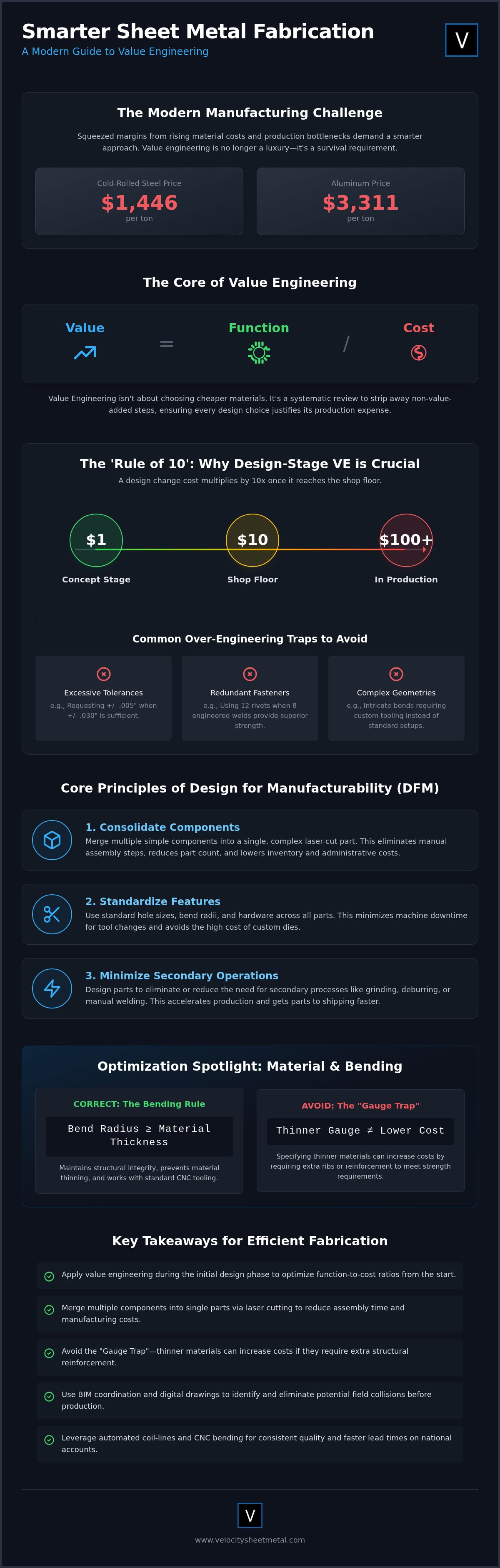
In 2026, value engineering isn't about finding a cheaper material. It's about aligning your digital design with the raw physics of the shop floor. You've likely seen your margins squeezed by cold-rolled steel prices hitting $1,446 per ton while complex CAD files trigger endless production bottlenecks. It's frustrating when a perfect digital model fails the reality of the workshop. Implementing strategic value engineering for sheet metal parts is no longer a luxury for high-volume OEMs. It's a survival requirement.
This guide shows you how to optimize your geometry to slash manufacturing costs without compromising structural integrity or performance. We'll break down the transition from digital concept to physical reality. You'll learn how to leverage BIM coordination to prevent collisions and use automated laser cutting to eliminate secondary operations. We're moving from theory to the floor. We'll ensure your national accounts receive standardized quality with faster lead times and a lower cost per part. It's time to build smarter, faster, and more efficiently.
Key Takeaways
- Learn how to optimize function-to-cost ratios by applying value engineering for sheet metal parts during the initial design phase.
- Reduce assembly time and manufacturing costs by merging multiple components into single, complex parts through precision laser cutting.
- Avoid the common "Gauge Trap" where thinner materials lead to higher costs due to additional structural reinforcement needs.
- Use BIM coordination and digital spool drawings to identify potential field collisions and eliminate waste before production begins.
- Leverage automated coil-lines and CNC press brake bending to achieve consistent quality and faster lead times for national accounts.
The Strategic Role of Value Engineering in Sheet Metal Fabrication
Value engineering (VE) is the structured process of optimizing the ratio between a product's function and its total cost. It's not a simple cost-cutting exercise where you swap high-quality materials for cheaper alternatives. Instead, it's a systematic review of every design choice to ensure it justifies its production expense. Value Analysis (VA) focuses on refining established components already in circulation. In contrast, value engineering for sheet metal parts happens during the initial design phase to bake efficiency into the product's DNA before the first laser hits the plate.
In the 2026 industrial environment, VE has shifted from a best practice to a survival requirement. With cold-rolled steel prices hovering at $1,446 per ton and aluminum exceeding $3,311 per ton, material waste is no longer a localized problem. It's a massive drain on national accounts. Effective value engineering for sheet metal parts strips away 'non-value-added' manufacturing steps, ensuring that every bend, hole, and weld contributes directly to the final performance of the assembly.
The Value Equation: Function vs. Cost
The math behind VE is straightforward: Value = Function / Cost. To drive value upward, you must either increase the component's functionality or decrease its total cost of production. You don't want to sacrifice one for the other. Industrial pragmatism dictates that if a feature doesn't improve the part's performance, it's a candidate for elimination. In the context of HVAC ductwork and OEM parts, function is defined as the component's ability to maintain specific airflow pressures or provide structural support within a mechanical assembly.
Why Design-Stage VE is Non-Negotiable
The 'Rule of 10' is a harsh reality in modern manufacturing. A design change that costs one dollar at the conceptual stage will cost ten dollars once it reaches the shop floor. If you wait until a part is in production to realize it's over-engineered, you've already lost your margin. Early collaboration between engineers and fabricators prevents the 'over-specifying' that plagues many industrial projects. Common over-engineered features include:
- Excessive Tolerances: Requesting +/- .005 when +/- .030 is sufficient for the application.
- Redundant Fasteners: Using twelve rivets where eight engineered welds provide superior strength.
- Complex Geometries: Designing intricate bends that require custom tooling instead of standard CNC press brake setups.
By addressing these issues at the digital stage, you move from concept to physical product with surgical precision. This proactive approach eliminates the administrative delays and production bottlenecks that occur when CAD files don't align with shop floor reality.
Core Principles of Design for Manufacturability (DFM)
Design for Manufacturability (DFM) is the practical application of value engineering for sheet metal parts. While VE focuses on the "what" and "why," DFM addresses the "how" on the factory floor. The goal is simple: simplify the geometry to accelerate production. By merging multiple components into a single, complex laser-cut part, you eliminate manual assembly steps and redundant fasteners. This reduces the total part count, which directly lowers inventory costs and administrative overhead.
Standardization is another pillar of effective DFM. If a part requires three different hole diameters, a technician must stop the machine for tool changes. By standardizing hole sizes and hardware, you keep the machines running. Minimizing secondary operations like grinding, deburring, or manual welding is equally critical. Every minute a part spends in a secondary station is a minute it isn't moving toward the shipping dock. If you want to see how these efficiencies impact your bottom line, consider how streamlined fabrication workflows transform project timelines.
Optimizing Bend Radii and Tooling
Standardizing bend radii across a single part is one of the fastest ways to reduce CNC press brake setup time. When every bend uses the same radius, the operator uses a single tool set. This prevents the need for multiple machine configurations. Choosing radii that match common shop tooling avoids the high cost of custom dies. According to standards from the American Society of Mechanical Engineers (ASME), maintaining a radius at least equal to the material thickness ensures structural reliability. Ignoring these basics often leads to common press brake forming defects like material thinning or fractured corners.
Hole and Slot Placement for Laser Precision
Precision is a hallmark of modern value engineering for sheet metal parts. However, even the most advanced precision laser cutting services must account for material behavior. Always maintain a minimum distance between holes and bend lines, typically 1.5 to 2 times the material thickness, to prevent hole distortion during forming. To further optimize assembly, use "tabs and slots" in your designs. This creates self-fixturing parts that snap together. This technique effectively eliminates the need for expensive welding jigs and reduces labor hours on the assembly line, moving your project from a digital file to a physical result with surgical speed.
Material Selection and Gauge Optimization Strategies
Selecting the right material is a balancing act between raw cost and manufacturability. Many engineers fall into the "Gauge Trap." They assume thinner metal reduces the price per part. However, if a thinner gauge requires additional structural reinforcement or extra welding to prevent oil-canning, the labor costs quickly eclipse any material savings. Strategic value engineering for sheet metal parts involves analyzing the total cost of the assembly, not just the weight of the raw stock. You must account for the reality of the shop floor before finalizing the bill of materials.
Material yield is the next frontier for cost reduction. With hot-rolled coil prices at approximately $1,213 per ton in late 2026, minimizing scrap is essential. Advanced nesting software optimizes part placement on the sheet to maximize yield and reduce waste. This precision directly impacts HVAC duct fabrication lead times by reducing the frequency of material orders and sheet changes. Also, evaluate your surface finishes. Specifying polished stainless steel for a concealed bracket is a common over-specification. Galvanized steel often provides the necessary corrosion resistance at a fraction of the cost, making it the pragmatic choice for most industrial applications.
Standardizing Gauges for National Accounts
Standardizing on "off-the-shelf" gauges is critical for large-scale projects. It eliminates the lead times associated with special material orders. Velocity leverages high-volume purchasing power to maintain a robust inventory of standard gauges. This approach is central to our coil line duct fabrication, where automated systems process massive quantities of rectangular duct with surgical efficiency. For national accounts, this means consistent quality and predictable pricing across every job site, regardless of the project's scale.
Structural Integrity vs. Weight Reduction
You can often achieve the necessary rigidity without increasing material thickness. Geometric stiffening, such as beading or cross-breaking, adds structural integrity to lighter gauges. This is a core tactic in value engineering for sheet metal parts. Reducing weight isn't just about material costs; it's a secondary saver for nationwide shipping logistics. Lighter components mean lower freight costs and easier handling on the shop floor. In commercial HVAC applications, calculating the optimal strength-to-weight ratio ensures the system handles design pressures while remaining cost-effective to transport and deliver.
Executing VE Through BIM and Automated Workflows
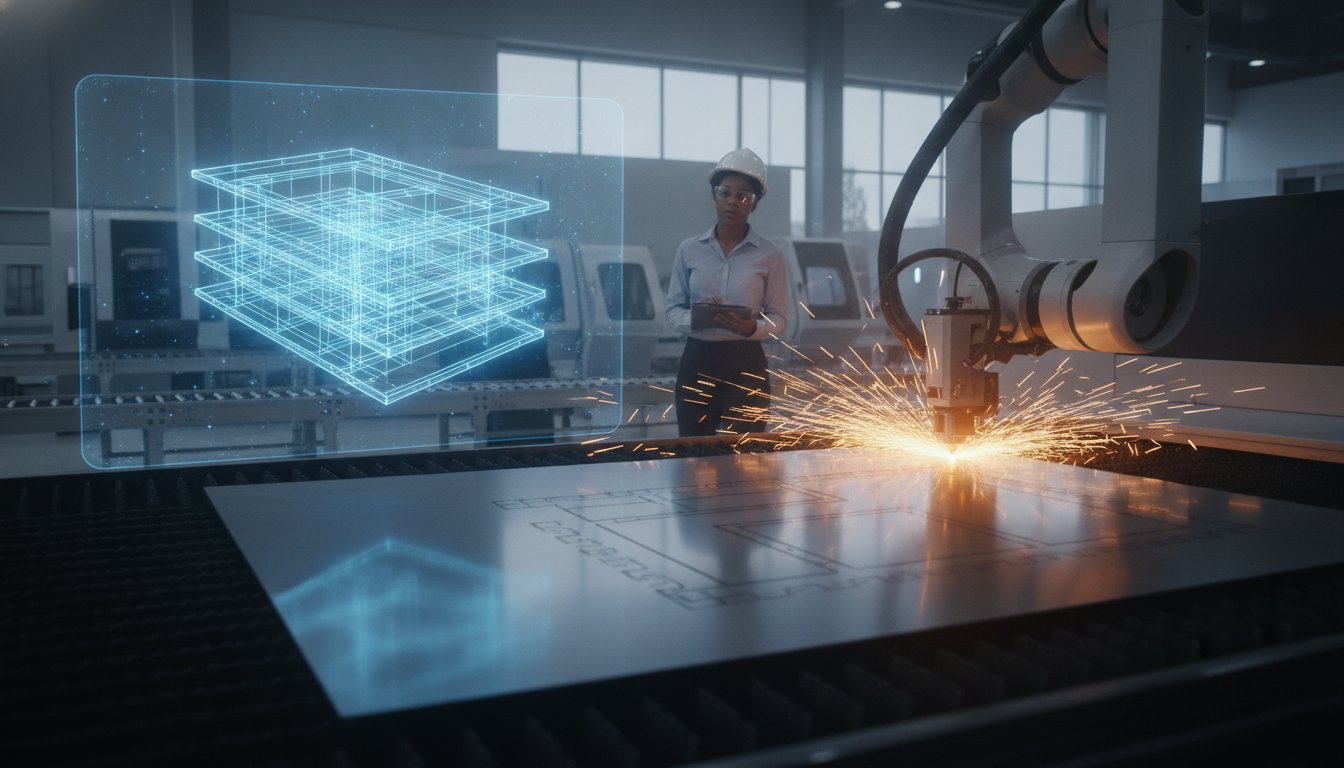
Digital workflows are the primary tool for executing value engineering for sheet metal parts at scale. In the current industrial landscape, the bridge between a CAD file and a finished product must be seamless. Digital spool drawings act as a final pre-fabrication check, ensuring that every dimension is optimized for the specific machinery on the floor. This digital-to-physical integration eliminates the administrative delays and manual re-entry errors that typically stall large-scale projects.
The shift from the traditional Design-Bid-Build model to an Integrated Design-Fabricate approach is essential for a faster ROI. When the design team and the fabricator work from a single source of truth, there is no room for interpretation. This level of coordination allows you to identify cost-saving opportunities long before production begins. If you are ready to optimize your next project, partner with Velocity for precision fabrication today.
Eliminating Field Collisions with BIM
The role of BIM clash detection for HVAC fabrication is to prevent field waste by identifying design flaws before production. In complex mechanical rooms, even a two-inch deviation can cause a cascade of expensive field fixes. 3D coordination ensures that every rectangular duct and spiral fitting fits perfectly the first time. BIM integration shortens the feedback loop between the engineer and the shop, allowing for rapid design iterations that favor manufacturability.
This proactive approach reduces scrap and eliminates the need for on-site modifications. Every component is cut to the exact specifications of the coordinated model. This precision is particularly vital for national accounts where consistency across multiple locations is a non-negotiable requirement. By resolving conflicts in a virtual environment, you protect your project timeline and your bottom line from the unpredictability of field reality.
The Speed of Automated Coil-Line Production
Automated coil lines represent the pinnacle of value engineering for sheet metal parts in the HVAC sector. Manual fabrication of rectangular duct is labor-intensive and prone to human error. Automation solves this by using direct machine-code integration from CAD files. This ensures that every piece of duct is manufactured with surgical precision and consistent quality. It removes the variability inherent in manual processes, moving the product from digital concept to physical reality with unmatched speed.
Scaling production for national accounts requires this level of standardized automation. An automated coil line can process massive quantities of material with minimal intervention, significantly reducing the labor cost per part. This speed doesn't just lower costs; it accelerates delivery schedules. When your project demands high-volume rectangular duct with tight lead times, automated workflows are the only way to maintain a competitive edge in 2026.
Partnering with Velocity for Data-Driven Value Engineering
Velocity operates as the essential bridge between your digital design and a tangible, high-performance product. We don't just execute orders. We interrogate designs to find the most efficient path to production. With over 50 years of combined management experience, our team understands the specific friction points that cause delays and inflate costs. By integrating our expertise early, you leverage a data-driven approach to value engineering for sheet metal parts that prioritizes speed and precision above all else.
Our suite of services is built for the modern industrial workflow. We move you quickly from initial BIM coordination to final CNC press brake services for OEMs. This end-to-end capability ensures that no technical detail is lost in translation between different vendors. We manage the entire process; we provide a single point of accountability for your most complex projects. It's about moving from a digital file to a physical result with surgical speed.
Standardized Quality for National Accounts
Consistency is the baseline for national accounts. Whether you're scaling a new OEM product or managing a multi-state HVAC rollout, you need parts that meet the exact same standards every time. Velocity specializes in high-volume industrial laser cutting and bending. We utilize automated technology to maintain tight tolerances across every run. This level of standardization allows us to support nationwide shipping with absolute confidence in the final result. You get the same quality in every crate.
Our on-demand part production capabilities are designed for both rapid prototyping and full-scale manufacturing. We help you move from a single test component to thousands of units without a drop in quality. By standardizing our production workflows, we ensure that your project remains on schedule. We handle the technical heavy lifting so you can focus on the broader project goals. We're ready to scale when you are.
Start Your VE Project Today
The process begins with your technical drawings. When you upload your files for a production review, our team doesn't just look at the dimensions. We hunt for immediate DFM opportunities to reduce your cost per part. We look for ways to simplify bends, optimize nests, and eliminate unnecessary secondary operations. It's a proactive review that pays dividends before the machines even start.
Engineers and contractors who partner with Velocity gain more than just a fabricator. They gain a technical guide. We cut through the typical administrative delays that bog down the industry. It's time to stop overpaying for complex designs that don't serve your bottom line. Contact us to start your next project and see how precision value engineering for sheet metal parts transforms your production reality.
Future-Proof Your Fabrication Strategy
Success in 2026 requires more than just standard manufacturing. It demands a surgical integration of digital design and physical precision. You've seen how aligning geometry with automated constraints and optimizing material selection can slash production bottlenecks and protect your margins. Implementing value engineering for sheet metal parts isn't just a cost-saving measure; it's a competitive necessity for national accounts. By leveraging BIM coordination and automated coil-line efficiency, you move from a digital concept to a delivered product with unmatched speed.
Velocity brings over 50 years of combined industry experience to every partnership. We provide the standardized quality and nationwide shipping capabilities required to scale your operations across the country. Our automated systems ensure your lead times remain short while maintaining the structural integrity your projects demand. It's time to bridge the gap between your CAD files and the shop floor reality. Optimize Your Production with Velocity's Value Engineering Experts and start building smarter today. We're ready to get to work immediately.
Frequently Asked Questions
What is the difference between Value Analysis and Value Engineering?
Value engineering occurs during the initial design phase to bake efficiency into a new part before production begins. Value analysis focuses on refining and optimizing components that are already established and in use. While both processes aim to improve the function-to-cost ratio, value engineering for sheet metal parts offers the highest ROI because it prevents expensive manufacturing bottlenecks before they happen on the shop floor.
Can value engineering help reduce lead times for HVAC ductwork?
Strategic design optimization directly accelerates production schedules. By standardizing material gauges and simplifying complex geometries, you eliminate the need for custom tooling and specialized setups. These adjustments allow automated systems like coil lines to run at maximum capacity without interruptions. Reducing the complexity of a part minimizes the administrative delays and technical reviews that typically stall high-volume HVAC projects, resulting in significantly faster delivery times.
How does BIM coordination contribute to value engineering?
BIM coordination acts as a digital pre-fabrication check that identifies design flaws in a virtual environment. By detecting collisions between HVAC ductwork and other mechanical systems before a single cut is made, you eliminate the high cost of field modifications and scrap. This 3D coordination ensures that every component fits perfectly upon arrival. It shortens the feedback loop between engineers and fabricators, allowing for proactive adjustments that favor manufacturability.
Is it always cheaper to use a thinner gauge of sheet metal?
Thinner material is not a guaranteed cost saver. While the raw material price per pound might be lower, thinner gauges often lack the structural integrity required for high-pressure systems. This frequently necessitates additional labor-intensive stiffening, such as extra welding or geometric beading, to prevent oil-canning and vibration. You must evaluate the total cost of labor and material together to determine if a slightly heavier gauge might actually be more economical.
What are the most common over-engineering mistakes in sheet metal parts?
The most frequent mistakes include specifying unnecessarily tight tolerances and redundant fasteners. Many designs request a precision of +/- .005 when a standard tolerance of +/- .030 would suffice for the application. Other common errors involve designing intricate bends that require custom dies instead of standard CNC press brake tooling. These choices increase setup time and production costs without adding any functional value to the final component or mechanical assembly.
How does automated coil-line fabrication improve project value?
Automated coil lines maximize project value by drastically reducing the labor hours required for rectangular duct production. This technology uses direct machine-code integration from CAD files to ensure surgical precision across thousands of parts. It eliminates the variability and human error associated with manual fabrication processes. For those implementing value engineering for sheet metal parts, this translates into standardized quality and predictable lead times across every project location.
Does Velocity Sheet Metal offer nationwide shipping for value-engineered parts?
Velocity provides comprehensive nationwide shipping for all our precision-fabricated components. We specialize in supporting national accounts that require standardized production quality across multiple project locations. Our logistics network is optimized for high-volume orders of rectangular duct, spiral fittings, and custom laser-cut parts. Whether you're an OEM scaling production or a contractor managing a large-scale commercial build, we deliver value-engineered solutions directly to your job site or facility anywhere in the country.
Can laser cutting replace secondary machining operations?
Precision laser cutting can effectively eliminate the need for secondary machining like drilling, punching, or deburring. Modern fiber lasers achieve exceptionally tight tolerances and clean edges that are ready for assembly immediately after cutting. By integrating complex hole patterns and self-fixturing tabs directly into the initial laser program, you reduce the number of times a part is handled. This streamlined workflow lowers the total cost per part and accelerates the move from digital concept to physical reality.