The 2026 Spiral Duct Fittings Guide: Engineering Precision and Airflow Efficiency

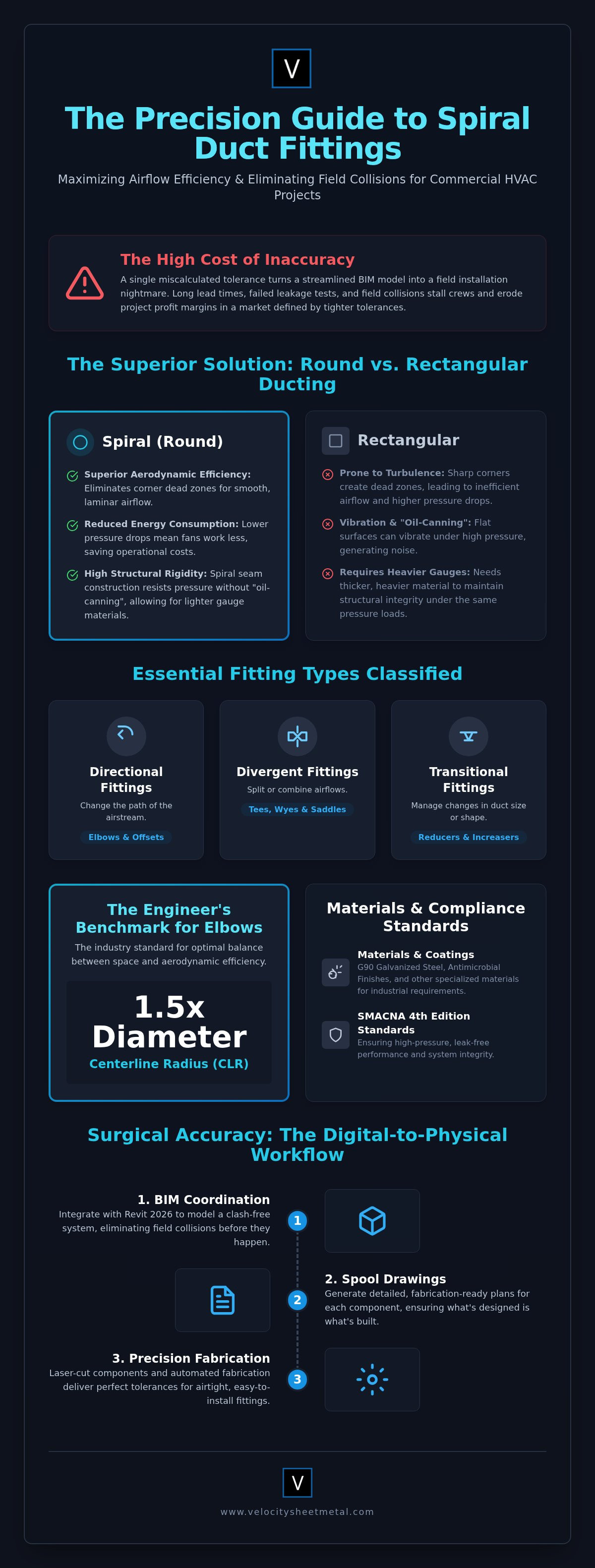
A single miscalculated tolerance in your ductwork can turn a streamlined BIM model into a field installation nightmare. You've likely dealt with the friction of long lead times for custom angles or the headache of rectangular-to-round transitions that fail SMACNA leakage tests. These delays don't just stall your crews; they erode your project's bottom line. Precision is the only way forward in a 2026 market defined by tighter tolerances and rising material costs.
This spiral duct fittings guide provides the technical roadmap you need to eliminate field collisions and maximize airflow efficiency. We'll help you master everything from Revit 2026 integration to the selection of laser-cut components that ensure airtight performance. You'll learn how to move from the initial digital concept to the final physical result with surgical accuracy. It's about building a system that works the first time.
We are breaking down the critical specifications for high-pressure systems, including the latest SMACNA 4th Edition standards and strategies for reducing installation time. This guide covers the essential bridge between your BIM coordination and a leak-free HVAC system. Let's get to work on optimizing your next commercial project.
Key Takeaways
- Understand why round fittings offer superior aerodynamic efficiency over rectangular transitions for high-velocity air distribution.
- Identify essential directional and transitional components using this spiral_duct_fittings_guide to minimize pressure drops and meet SMACNA standards.
- Discover how to leverage BIM coordination and spool drawings to ensure precision tolerances and eliminate costly field collisions.
- Select the right materials and coatings, from G90 galvanized steel to antimicrobial finishes, for specific industrial or architectural requirements.
- Optimize your project timeline by implementing "just-in-time" logistics and standardized procurement for large-scale national accounts.
Understanding Spiral Duct Fittings: Classification and Function
Spiral duct fittings aren't just accessories; they're the critical junctions in high-velocity air distribution. In any commercial HVAC design, these components act as the bridge between straight runs, ensuring air reaches its destination without losing momentum. This spiral duct fittings guide focuses on the engineering reality: round fittings are inherently more efficient than rectangular transitions. The circular profile eliminates the corner dead zones found in square ductwork, which significantly reduces the energy required to move air. By utilizing precision-fit joints, you directly reduce overall fan energy consumption and operational costs.
Maintaining system pressure is the primary function of a well-engineered fitting. Every elbow, tee, and reducer creates a potential point of turbulence. If a fitting is poorly fabricated, that turbulence leads to pressure drops that force fans to work harder. From the initial design phase to the final installation, the goal is a laminar flow that moves air predictably. Precision-cut fittings ensure that the internal diameter remains consistent, preventing the "step" effect that causes air to tumble and swirl. This level of control is essential for modern buildings targeting high-performance efficiency ratings.
The Anatomy of a High-Performance Fitting
Performance starts with the connection. A standard slip-fit design relies on tight tolerance control to ensure a seamless transition between the pipe and the fitting. Most high-volume projects utilize pressed fittings for smaller diameters because they offer a smooth, continuous interior surface that minimizes friction. For larger industrial applications, fabricated or welded alternatives provide the heavy-gauge durability needed for extreme pressures. The spiral seam itself is a masterclass in engineering; it provides immense structural rigidity. This allows for lighter gauge materials without sacrificing the integrity of the HVAC duct systems.
Spiral vs. Rectangular: When to Specify Round Fittings
Rectangular duct often wins on floor-to-ceiling height, but it loses on physics. Spiral ducting maintains its shape under high-pressure loads where rectangular walls would oil-can or vibrate. When space is at a premium, flat-oval transitions offer a compromise. These fittings provide the aerodynamic benefits of round ducting within the low-profile constraints of a tight plenum. Selecting the right geometry is a matter of balancing airflow requirements with physical site limitations. For a deeper look at production methods, consider the industrial efficiency comparison between automated rectangular lines and spiral production.
A Technical Guide to Essential Fitting Types
Understanding the mechanical movement of air requires a strategic breakdown of fitting categories. In this spiral duct fittings guide, we classify components by their primary impact on the airstream: Directional, Divergent, and Transitional. Directional fittings change the path of the air; Divergent fittings split or combine flows; and Transitional fittings manage changes in duct size or shape. Each choice affects the static pressure of the system. Selecting a smooth-radius elbow over a mitered corner isn't just a design preference. It's a requirement for minimizing pressure drop and ensuring the fan operates within its design curve.
Transitional fittings, specifically reducers and increasers, are vital for maintaining constant air velocity across long runs. As air is tapped off to various zones, the duct diameter must decrease to keep the remaining air moving at the correct speed. End treatments also dictate the speed of your field assembly. While raw edges are standard for smaller diameters using couplings, E-Z Flanges provide a superior mechanical connection for larger, high-pressure industrial systems. If you're looking for precision components that simplify the build, you can view our full range of spiral duct fittings to see the difference in fabrication quality.
Directional Fittings: Elbows and Offsets
The industry benchmark for directional changes is the Centerline Radius (CLR) of 1.5 times the duct diameter. This ratio provides the best balance between space conservation and aerodynamic efficiency. You'll typically choose between gored and pleated construction. Gored elbows, assembled from multiple segments, offer greater flexibility for custom angles and larger diameters. Pleated elbows, often stamped or pressed, provide a smoother interior for smaller runs. When structural obstructions like I-beams or plumbing lines interfere with your path, custom-degree offsets allow you to navigate the field without the turbulence of two back-to-back 90-degree turns.
Divergent Fittings: Tees, Wyes, and Laterals
Airflow characteristics vary wildly between a conical tee and a standard boot tee. Conical designs use a flared entry to reduce the "entrance loss" as air enters the branch, making them the preferred choice for high-efficiency systems. For high-velocity exhaust or dust collection, 45-degree laterals are the standard because they minimize the impact of the merging airstreams. Avoid "bullhead" tees where the main flow hits a dead-end T-junction and splits in opposite directions. This configuration creates massive turbulence and pressure spikes. Instead, use a wye or a pair of 45-degree elbows to maintain momentum and system balance.
Material Selection and Sealing Standards for 2026
Material choice determines the lifecycle of your HVAC system. For most commercial applications, G60 or G90 galvanized steel provides the necessary corrosion resistance at a manageable price point. However, industrial environments or coastal projects require the upgrade to 304 or 316 stainless steel to prevent premature oxidation. This spiral duct fittings guide emphasizes that material selection isn't just about durability; it's about compliance. High-performance builds in 2026 now target SMACNA Leakage Class 3 as the baseline. Achieving this standard requires a shift from traditional mastic and tape toward precision-engineered sealing solutions.
Architectural trends have pushed exposed ductwork into the spotlight. Paint-Grip coatings provide a ready-to-finish surface that eliminates the need for complex metal etching on-site. In healthcare and lab settings, antimicrobial coatings are becoming the standard to inhibit mold and bacterial growth within the airstream. These specialized finishes ensure your ductwork meets both aesthetic and hygienic requirements without compromising structural integrity. From standard office builds to high-spec cleanrooms, your coating choice impacts both maintenance schedules and air quality.
Gasketed vs. Non-Gasketed Systems
Factory-installed EPDM gaskets have revolutionized field assembly. These double-lipped seals can reduce field labor by up to 50% because they eliminate the need for manual sealing at every joint. The longevity of EPDM is critical in variable temperature environments where traditional tapes might fail over time. Precision laser cutting is the backbone of this technology. It ensures a perfect gasket seat that maintains an airtight seal even under high-pressure loads. This "self-sealing" approach moves the quality control from the job site back to the fabrication floor, where tolerances are strictly managed.
Insulation and Double-Wall Fittings
Double-wall fittings are the solution for projects requiring strict thermal control or noise attenuation. This "sandwich" construction features a solid outer shell, an insulation layer, and an inner liner. You'll choose between perforated liners for sound absorption or solid liners to prevent any insulation fibers from entering the airstream. This design prevents insulation erosion, ensuring the system remains efficient and the air remains clean over decades of operation. It's the standard for high-velocity systems where acoustic comfort is as important as thermal performance.
BIM-to-Fabrication: Eliminating Field Collisions
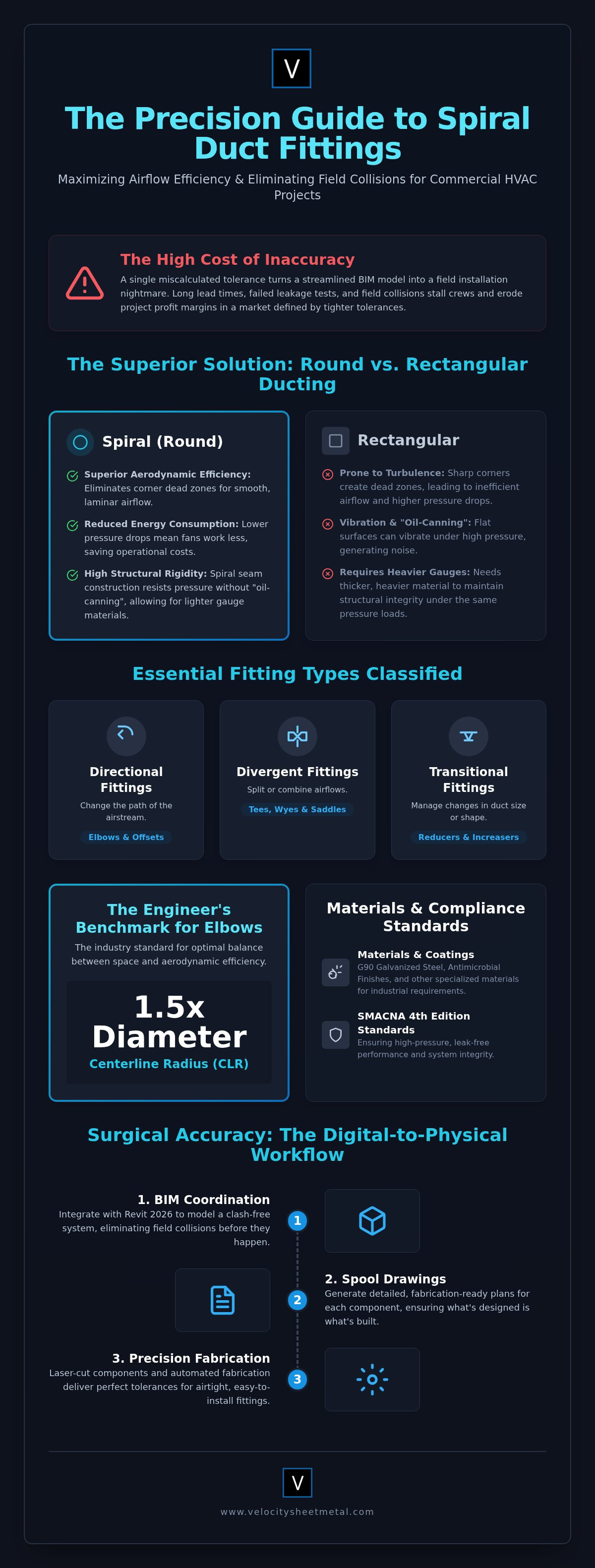
The gap between a digital design and a physical installation is where most project budgets fail. This spiral duct fittings guide highlights why a BIM-to-fabrication workflow is no longer optional for commercial contractors. BIM coordination ensures that every fitting is accurate before the first piece of steel hits the laser cutter. By moving from Revit 2026 models directly to detailed spool drawings, we translate complex engineering data into precise automated fabrication instructions. This process eliminates the "make it fit" culture that leads to costly field modifications and compromised airflow efficiency.
Digital nesting plays a major role in modern cost control. Automated coil lines use advanced algorithms to arrange parts on the metal sheet, which significantly reduces material waste compared to manual layouts. This level of precision ensures that even the most complex transitions arrive on-site exactly as they were modeled. You're no longer relying on field measurements that might be off by a fraction of an inch. Instead, you're installing components designed to fit the first time, every time. If you want to streamline your next build, you should get a quote from Velocity Sheet Metal for your BIM-integrated components.
Collision Avoidance in Complex Mechanical Rooms
Mechanical rooms are the most congested areas of any commercial building. 3D modeling allows us to identify tight-clearance issues with custom transition fittings long before they reach the job site. Mechanical spooling takes this a step further; it allows us to pre-assemble complex fitting clusters off-site in a controlled environment. Industry data shows that firms adopting MEP-specific software report a 30% reduction in design errors. This directly translates to fewer field RFI delays and a faster path to system commissioning. Pre-planning the exact location of every elbow and tee prevents the "clash" that stalls entire crews.
Automated Precision for Custom Geometries
CNC-driven fabrication is the only way to maintain +/- 0.010" tolerances on complex geometries. Automated plasma and laser cutting provide a massive speed advantage, allowing for on-demand parts that keep the project moving forward. For national accounts, this digital-first approach ensures consistency across every project site by utilizing standardized digital libraries. Every fitting produced in our facility matches the digital twin in your model exactly. This repeatability is essential for maintaining brand standards across multiple geographic locations. Precision isn't a luxury; it's a measurable project asset.
Procurement Strategy: National Accounts and Logistics
Standardizing procurement across a multi-state portfolio requires more than just a vendor list; it requires a repeatable fabrication protocol. This spiral duct fittings guide addresses the logistical complexity of high-volume commercial projects where consistency is the primary metric for success. Velocity Sheet Metal serves as a tech-savvy partner for national accounts, ensuring that a fitting produced for one project matches the exact tolerances of another thousands of miles away. By centralizing your fabrication, you eliminate the variability of local shops and maintain a unified quality standard across every job site. We act as the essential bridge between your digital files and a tangible, high-performance product.
Freight optimization is the secret to protecting project margins in 2026. Shipping long runs of spiral pipe is often "air-heavy" and expensive if not managed correctly. We optimize logistics by nesting smaller diameter fittings inside larger ones and coordinating the mix of 10-foot and 20-foot sections to maximize trailer cube. This methodical approach reduces the total number of shipments and lowers your overall freight spend. Combined with "just-in-time" delivery, we ensure components arrive exactly when the crew is ready to hang them. This eliminates the need for on-site storage, which often leads to material damage or inventory loss in unsecured areas.
Specifying for National Consistency
Setting a baseline for quality starts with clear, centralized documentation. National engineering firms benefit from developing a master submittal package that references specific HVAC duct fabrication guides to lock in SMACNA compliance and material grades. This strategy prevents "spec creep," where field contractors might substitute inferior components to save on local costs. A single-source fabricator provides the data continuity needed for multi-state rollouts, from standardized Revit families to uniform labeling systems that simplify the receiving process on the factory floor.
Requesting a Precision Quote
Speed in procurement depends on the quality of the initial data you provide. To deliver an accurate estimate, we require specific inputs: duct pressure class, material type (such as G90 galvanized or 304 stainless steel), and your BIM exports. Providing Revit 2026 files or spool drawings allows us to identify custom laser-cut requirements for curb adapters and transitions immediately. We cut through traditional administrative delays by moving from your digital concept to a physical production slot with surgical precision. You can submit your BIM files for a precision-fabricated fitting quote today to lock in your production schedule and current material pricing.
Optimizing Your Next Commercial Airflow System
Performance in modern HVAC construction depends on the transition from a digital model to a leak-free physical system. This spiral duct fittings guide has outlined how precision tolerances and automated fabrication eliminate the "make it fit" culture on the job site. By prioritizing BIM-integrated workflows and SMACNA Class 3 leakage standards, you ensure your project meets the highest performance benchmarks of 2026. From directional elbows to custom-angled offsets, every component must serve the system's overall efficiency.
Velocity Sheet Metal is ready to act as your tech-savvy partner for large-scale commercial and industrial builds. We combine precision laser-cut tolerances with nationwide shipping capabilities to support your national accounts. Our digital-to-physical workflow moves your project forward with speed and surgical accuracy, cutting through administrative delays and field collisions. It's time to build a more efficient system. Let's get to work.
Request a Precision Fabrication Quote for Your Next National Project
Frequently Asked Questions
What is the standard radius for a spiral duct elbow?
The industry standard for a spiral duct elbow is a 1.5 centerline radius (CLR). This means the radius of the turn is 1.5 times the duct's diameter. While 1.0 short-radius elbows exist for tight plenums, they significantly increase static pressure. Using the 1.5 benchmark ensures a balance between space conservation and aerodynamic efficiency. Our spiral duct fittings guide recommends this standard to keep fan energy consumption low while maintaining system performance.
How do gasketed spiral fittings compare to traditional mastic seals?
Gasketed fittings utilize factory-installed EPDM double-lipped seals to create an airtight joint. This method can reduce field labor by up to 50% because it eliminates the manual application of mastic or tape. Unlike traditional seals, gasketed joints aren't affected by temperature fluctuations during installation. They consistently meet SMACNA Leakage Class 3 standards. This self-sealing technology moves quality control from the job site to our automated fabrication floor for better reliability.
Are spiral duct fittings compatible with rectangular duct systems?
Spiral fittings are fully compatible with rectangular systems through the use of precision-fabricated transitions. We manufacture square-to-round and flat-oval components that allow for a seamless bridge between different duct geometries. These transitions are critical when moving air from a main rectangular trunk into round branch runs. Using automated laser cutting ensures that the transition fits perfectly with both types of ductwork, maintaining the structural integrity and airflow efficiency of the entire system.
What are the most common materials used for industrial spiral fittings?
The most common materials are G60 or G90 galvanized steel for standard commercial applications. For corrosive environments or food processing plants, 304 or 316 stainless steel is required to prevent oxidation. We also provide specialized coatings like Paint-Grip for architectural projects where the ductwork is exposed. Antimicrobial coatings are also available for healthcare settings. Selecting the right material ensures the longevity of the system and compliance with specific industrial air quality standards.
How does BIM coordination reduce the cost of ductwork fittings?
BIM coordination reduces costs by identifying mechanical collisions in a 3D environment before fabrication begins. This digital verification prevents expensive field modifications and reduces RFI delays. By generating accurate spool drawings, we can utilize digital nesting to minimize material waste on our automated coil lines. Precision-fit components arrive on-site ready for installation, which slashes labor hours. It's a methodical process that replaces the "make it fit" approach with surgical manufacturing accuracy.
Can custom-angled spiral fittings be fabricated for unique architectural designs?
Yes, we use CNC-driven laser cutting to produce custom-angled fittings for any architectural requirement. Whether you need a non-standard 32-degree offset or a complex transitional wye, automated precision ensures the part matches your BIM model exactly. This capability is essential for navigating structural obstructions or achieving specific aesthetic goals in exposed designs. Our spiral duct fittings guide emphasizes that automated fabrication allows for these unique geometries without the long lead times of manual layout.
What is the maximum pressure rating for standard spiral fittings?
Standard spiral fittings are typically engineered to handle pressures up to 10 inches water gauge (wg). The specific rating depends on the metal gauge, the reinforcement used, and the sealing method employed. SMACNA standards provide the baseline for these ratings to ensure safety and performance in high-velocity systems. For high-pressure industrial applications, we utilize heavier gauges and reinforced seams to maintain structural integrity and prevent duct failure or excessive leakage under load.
How does nationwide shipping work for large-volume spiral duct orders?
We support national accounts through a logistics strategy focused on freight optimization and "just-in-time" delivery. Large-volume orders are nested, with smaller diameter fittings placed inside larger pipes, to maximize trailer space and reduce shipping costs. We coordinate deliveries to match your project schedule, which minimizes on-site storage risks and material handling. Every shipment maintains consistent fabrication standards, ensuring that projects across different states receive the same high-quality, precision-fit components every time.