Steel Laser Cutting Service: The 2026 Industrial Explainer
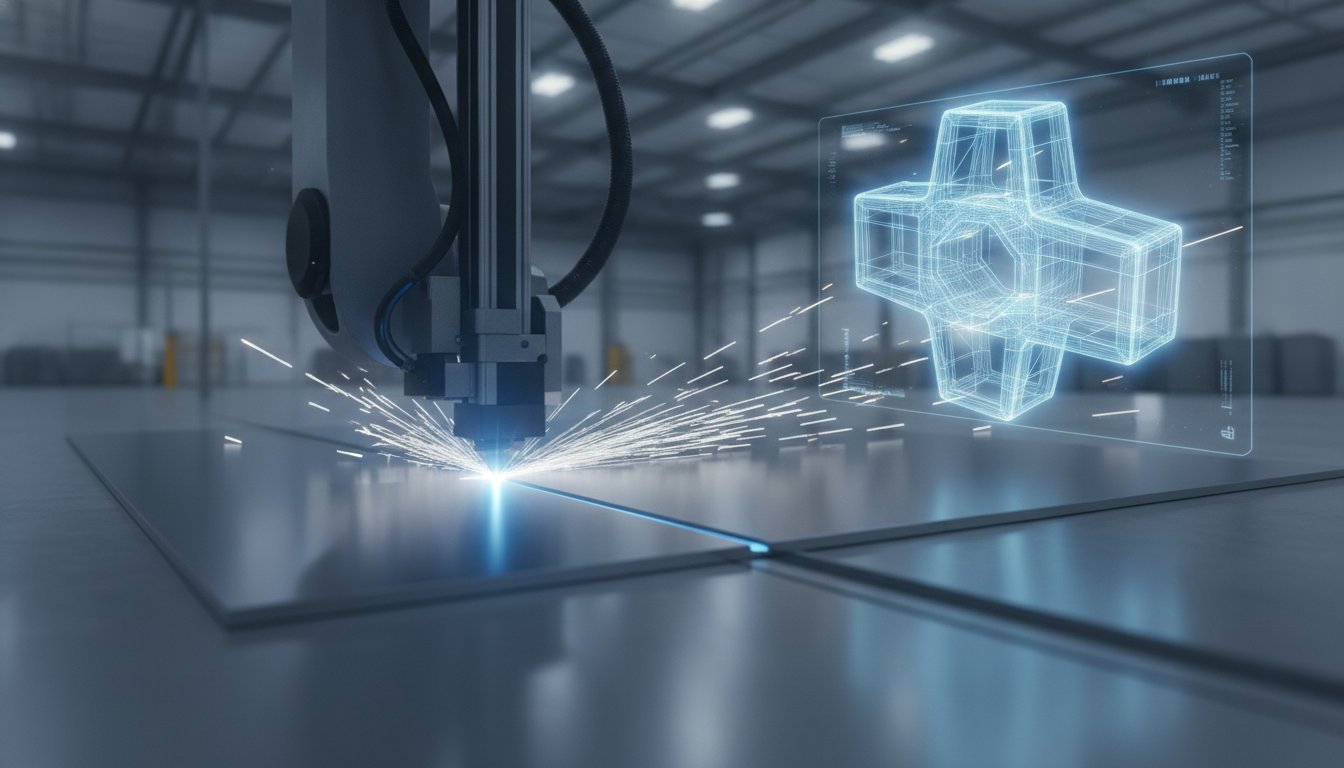
In 2026, a professional steel laser cutting service isn't just a fabrication step; it's the high-speed bridge between your digital BIM model and a finished product. You've likely dealt with the frustration of poor nesting that wastes expensive material or tolerances that shift inconsistently across national projects. Moving from a digital design to a physical part shouldn't feel like a bottleneck in your production schedule. We understand that in a modern industrial environment, precision and speed are the only metrics that matter.
This explainer will show you how to master the technical and strategic essentials of industrial steel laser cutting to optimize your 2026 fabrication workflows. We'll explore the industry shift toward high-power fiber lasers and explain how to integrate digital designs for 100% part repeatability. You'll learn how to reduce lead times and eliminate the gap between complex BIM models and physical fabrication. From intelligent nesting to AI-based path optimization, we're breaking down the tools you need to stay competitive in a global market projected to reach $9.7 billion this year.
Key Takeaways
- Identify why fiber technology is the preferred steel laser cutting service for 2026 industrial projects due to its superior speed and accuracy on thin-to-medium gauge materials.
- Master Design for Manufacturability (DFM) essentials to reduce production waste and lower your custom laser cutting cost per hour.
- Leverage centralized fabrication to maintain consistent tolerances and part repeatability across national-scale OEM and construction projects.
- Bridge the gap between digital design and physical parts by integrating BIM coordination with precision CNC laser schedules to eliminate field clashes.
What is an Industrial Steel Laser Cutting Service?
An industrial steel laser cutting service is a thermal based CNC fabrication process that uses a high density light beam to profile metal parts with extreme accuracy. In the 2026 manufacturing landscape, this technology has largely replaced traditional mechanical shearing and punching. While older methods rely on physical force, which often causes material distortion and edge deformation, laser cutting is a non contact process. It translates digital vector files directly into physical motion, allowing for complex geometries that were previously impossible or cost prohibitive to produce. This capability is the fundamental building block for modern precision laser cutting services that feed into larger assembly lines and construction projects.
The primary goal of industrial laser cutting is achieving zero gap tolerances. In complex industrial assemblies, even a fraction of a millimeter in deviation can cause misalignment during downstream welding or bolting. By utilizing a stabilized, computer controlled beam, fabricators ensure that every part is an exact replica of the digital model. This level of repeatability is essential for OEMs and HVAC contractors who require parts to fit perfectly the first time, every time, without field adjustments.
The Core Mechanics of Laser Fabrication
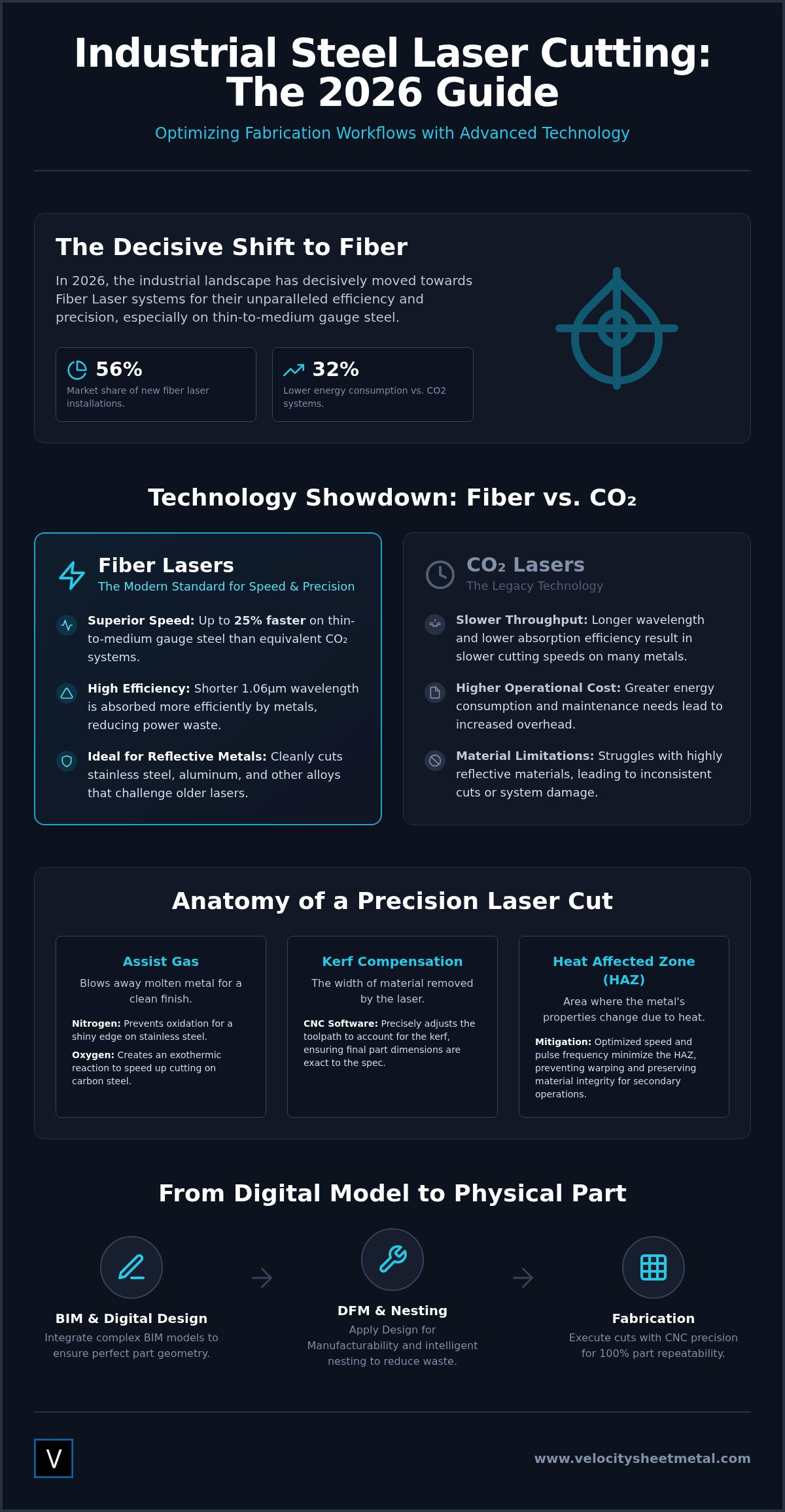
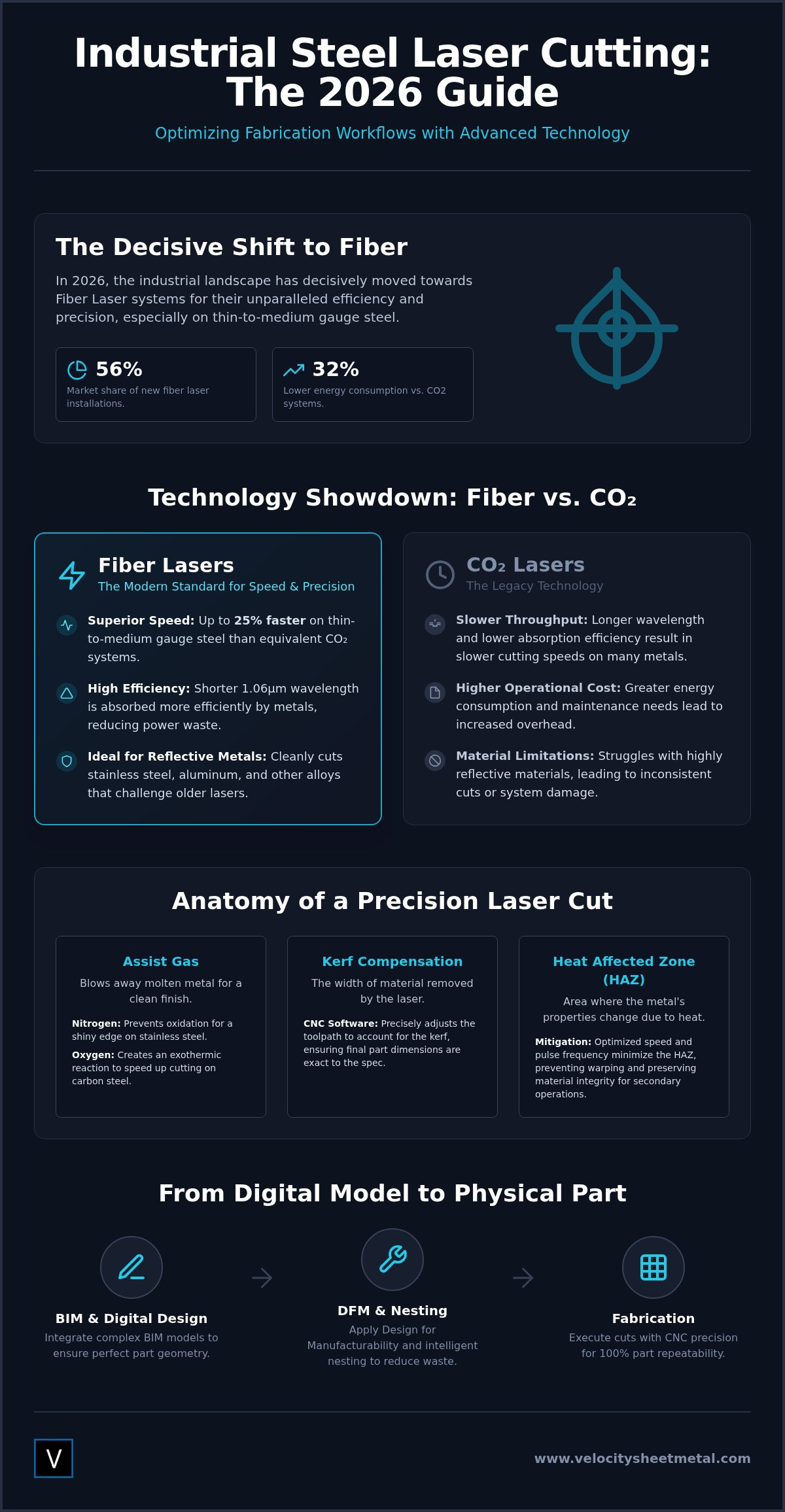
The Laser cutting process works by focusing a high power beam through a nozzle onto the steel surface. The energy density is so high that the material quickly melts, burns, or vaporizes along the programmed path. To ensure a clean finish, the system uses assist gases to blow away the molten metal. Nitrogen is the standard for stainless steel to prevent oxidation and maintain a shiny edge; oxygen is often used for thicker carbon steel to trigger an exothermic reaction that speeds up the cut. Fabricators must also account for the kerf, which is the width of the material removed by the laser. Precise kerf compensation in the CNC software ensures the final part dimensions match the engineering specs exactly.
Why Steel Requires Specialized Laser Calibration
Cutting steel isn't a one size fits all operation. Carbon steel and stainless steel alloys react differently to thermal energy. Stainless steel requires higher wattage and specific nozzle heights to manage its lower thermal conductivity and prevent slag buildup. A critical factor in steel fabrication is managing the Heat Affected Zone, or HAZ. This is the area surrounding the cut where the metal's microstructure changes due to intense heat. Improper calibration can lead to material warping or hardening of the edges, which makes secondary operations like tapping or bending difficult. High end services optimize the cutting speed and pulse frequency to minimize the HAZ, resulting in a smooth, burr free surface finish that is ready for immediate assembly.
Comparing Laser Technologies for Industrial Steel
Choosing the right technology for your fabrication workflow determines your project's total throughput and bottom line. In 2026, the industrial landscape has shifted decisively toward fiber laser systems, which now account for nearly 56% of new installations. This dominance isn't accidental. Fiber lasers offer 32% lower energy consumption compared to traditional CO2 systems, providing a direct impact on operational overhead and sustainability goals. A modern steel laser cutting service leverages these efficiencies to deliver parts faster without sacrificing the tight tolerances required for complex assemblies. While fiber is the clear leader for high speed production, understanding the technical nuances between wavelengths is critical for selecting the right process for your specific material gauge.
Material selection also dictates the technology choice. For projects requiring stainless steel laser cutting services, fiber lasers provide the necessary precision to handle corrosive resistant alloys without compromising material integrity. The high energy density of the fiber beam allows for cleaner cuts on reflective metals, which was a significant limitation for older CO2 technology. If you're unsure which technology fits your specific gauge requirements, you can consult with our technical team to review your project specs and ensure optimal results.
Fiber Lasers: Speed and Precision
Fiber lasers utilize a shorter 1.06 micron wavelength that is absorbed more efficiently by metal surfaces. This physical advantage allows a 6kW or 12kW fiber system to cut thin to medium gauge steel up to 25% faster than a CO2 laser of equivalent power. For high volume industrial parts, this speed translates to significantly reduced lead times. Because fiber lasers are solid state systems, they lack the internal mirrors and bellows found in CO2 machines. This design results in nearly maintenance free operation, eliminating the downtime associated with beam alignment and gas refills. When your schedule depends on consistent part delivery, the reliability of fiber technology is an essential asset for your steel laser cutting service provider.
CO2 Lasers: Versatility in Thickness
CO2 lasers remain relevant for specific heavy gauge industrial applications. While fiber lasers have made gains in thick plate, CO2 technology often provides a smoother edge finish on carbon steel thicker than 25mm. The longer 10.6 micron wavelength creates a wider kerf, which can be advantageous when processing very thick materials that require better gas flow to clear molten slag. However, the trade off is higher operating costs and slower processing speeds on the thin to medium gauges that make up the bulk of HVAC and OEM components. For most 2026 industrial workflows, the cost to performance ratio favors fiber systems unless the project exclusively involves heavy structural plate.
Design for Manufacturability (DFM) in Steel Laser Cutting
DFM is the engine behind a profitable steel laser cutting service. It's not just about making a part; it's about making it efficiently. Every second the laser head spends moving unnecessarily adds to the custom laser cutting cost per hour. To keep these costs down, engineers must follow strict rules of thumb. For instance, hole diameters should never be smaller than the material thickness. If you're cutting 6mm plate, your holes should be at least 6mm wide. Smaller holes cause blow-through and excessive heat, which ruins the part's integrity. Similarly, sharp internal corners act as heat sinks. Adding a small radius helps the laser maintain a consistent speed, preventing melting and ensuring a clean finish.
Material yield is another critical factor in your bottom line. Advanced nesting software analyzes part geometries to fit as many pieces as possible onto a single sheet. This reduces scrap and lowers the per-part price. We also focus on lead-in and lead-out strategies. The laser needs a starting point, known as the pierce, which often leaves a small divot. Placing these entries in non-critical areas or scrap material ensures the visible edges of your part remain perfectly smooth. By following these best practices, you ensure that your digital files translate into physical parts without costly trial and error.
Optimizing CAD Files for the Laser
Clean data drives clean cuts. High-speed production relies on laser cutting design guidelines that prioritize simple geometry. When transitioning from 3D models, export to 2D DXF or STEP files. Ensure you remove all overlapping lines and redundant geometry. If a line is doubled in the file, the laser will cut it twice, wasting time and potentially warping the metal. Keep line weights thin and clear to avoid software misinterpretation during the CNC conversion process. This meticulous prep work is what allows us to move from spool drawings to physical fabrication without delays.
Material Selection and Surface Prep
Your choice of steel grade impacts everything from cut speed to edge quality. A36 is the industrial standard for structural parts, while 1018 offers better machining properties. For corrosive environments, 304 or 316 stainless steel is mandatory. Surface condition matters too. Rust or heavy mill scale can deflect the laser beam or cause inconsistent piercing. Proper surface prep ensures the laser maintains a steady state, which is vital for preventing common press brake forming defects later in the production cycle. Accurate laser profiles provide the precise datum points needed for high-tolerance CNC bending.
Strategic Advantages for National Accounts and OEMs
Centralized production is the cornerstone of reliability for large scale operations. Managing multiple vendors across different regions often leads to tolerance drift and assembly failures in the field. By utilizing a single, high capacity steel laser cutting service, OEMs and national contractors eliminate these variables. Standardized quality protocols ensure that a part delivered to a job site in New York is identical to one delivered in California. This consistency is vital for downstream processes, particularly when integrating with CNC press brake services for OEMs. Precision in the cut translates directly to precision in the bend, reducing scrap and assembly time.
On-demand production models are transforming how OEMs manage inventory. Instead of tying up capital in warehouse space and raw stock, businesses can trigger production runs based on real time project needs. This just in time approach reduces overhead and allows for design iterations without the risk of obsolete stock. It's about moving from a reactive supply chain to a proactive fabrication partnership.
Consistency Across National Distribution
Reliability depends on repeatability. We implement rigorous quality control protocols that verify every batch against the master digital file. Whether you need oversized structural steel components or intricate HVAC fittings, our logistics network handles nationwide shipping to keep your projects on schedule. We manage the complexity of transport so you can focus on installation. If you're ready to streamline your national supply chain, partner with our national accounts team today.
Scaling from Prototypes to Production
Laser cutting offers a unique path from concept to completion. It's the fastest method for rapid prototyping because it requires zero physical tooling. You can test a design on Monday and start a high volume production run on Tuesday. For HVAC specific projects, we leverage coil-line integration to produce high volume rectangular duct parts with unmatched speed. This automated workflow moves you quickly from a single BIM model to thousands of physical components. There is no re-tooling cost, only pure efficiency.
Digital Integration: From BIM Models to Steel Parts
Digital integration is the final frontier of a modern steel laser cutting service. It's no longer just about cutting metal; it's about executing a data-driven plan. BIM for HVAC ductwork fabrication now dictates the production schedule, ensuring every component arrives on-site exactly when the installation crew needs it. This workflow eliminates the traditional lag between design approval and machine operation. By translating Building Information Modeling data directly into CNC instructions, we bypass manual data entry and the errors that come with it.
BIM software identifies potential collisions in a virtual environment. However, that digital foresight is useless without physical precision. A high-end laser service provides the tight accuracy required to turn clash detection into a reality. If a fabricated part deviates even slightly from the spool drawing, coordinate-based installation fails. Precision laser cutting ensures that what you see in the model is exactly what you get on the factory floor. The future of this industry lies in digital twins and real-time production tracking, allowing contractors to monitor fabrication progress from their mobile devices.
BIM Coordination and Laser Accuracy
In complex mechanical systems, 1/16th inch accuracy is the difference between a seamless install and a costly field rework. Integrating BIM for sheet metal fabrication with laser workflows allows for the production of shop-fabricated parts that fit perfectly within dense utility corridors. We use spool drawings as the definitive source of truth. These drawings translate directly into the laser's nesting engine, maintaining the integrity of the design through every stage of the process. This level of coordination is what makes complex, high-density mechanical rooms possible.
Streamlining the HVAC Supply Chain
Mechanical contractors are under constant pressure to reduce on-site labor. A specialized steel laser cutting service supports this by producing custom curb adapters, transition fittings, and complex plenum components with extreme speed. Instead of hand-cutting or using inferior methods, contractors can rely on just-in-time delivery for even the most unique geometries. Leveraging HVAC duct fabrication for mechanical contractors simplifies procurement. It moves the complexity of the build from the field to a controlled, automated environment, resulting in faster installs and higher profit margins for national projects.
Mastering the Digital-to-Physical Bridge
The transition from a complex digital model to a high-tolerance physical part is no longer a luxury; it's a 2026 industrial requirement. Success in this landscape depends on your ability to integrate BIM coordination with advanced fabrication technology. By prioritizing Design for Manufacturability (DFM) and selecting a professional steel laser cutting service, you eliminate the traditional bottlenecks that stall national projects. You ensure that every component, from custom curb adapters to intricate OEM parts, fits perfectly the first time.
Velocity Sheet Metal acts as the essential bridge in this manufacturing ecosystem. We provide a seamless BIM-to-physical workflow integration, backed by national account standardization and reliable nationwide shipping for all industrial components. Whether you're scaling a prototype or managing a multi-site construction rollout, we deliver the precision and speed your schedule demands. Request a Quote for Your National Industrial Laser Cutting Project to secure your production timeline. Let's get to work on your next fabrication challenge.
Frequently Asked Questions
What is the typical tolerance for industrial steel laser cutting?
Standard industrial laser cutting achieves tolerances of ±0.005 inches. High-end fiber systems often reach ±0.003 inches depending on material thickness and machine calibration. This precision is essential for ensuring that parts integrate seamlessly into automated assembly lines or complex mechanical systems. It eliminates the need for secondary machining or field adjustments, keeping your production schedule on track.
Can laser cutting handle galvanized steel without damaging the coating?
Fiber lasers effectively process galvanized steel by utilizing precise gas pressure to clear molten material without stripping the zinc layer. The high-speed, non-contact process minimizes the heat-affected zone; this prevents the coating from peeling or excessive burning. This capability is a primary requirement for HVAC components where long-term corrosion resistance is vital for the system's durability.
How does laser cutting compare to waterjet cutting for steel?
Laser cutting is significantly faster and more cost-effective for thin to medium gauge steel. While waterjet cutting excels at processing extremely thick plates over 2 inches without thermal stress, a steel laser cutting service offers better throughput for the majority of industrial and HVAC applications. Lasers also provide a cleaner, ready-to-weld edge finish that requires less post-processing labor.
What is the maximum thickness of steel that can be laser cut?
Modern high-power fiber lasers can effectively cut carbon steel up to 1 inch and stainless steel up to 1.5 inches. While technology exists to cut thicker materials, edge quality and processing speed often diminish beyond these points. For the vast majority of ductwork, curb adapters, and OEM parts, the laser remains the most efficient choice for materials under 1 inch thick.
Does laser cutting cause significant material warping in thin gauges?
Significant warping is rare when using a properly calibrated fiber laser. Because the laser beam is highly focused and moves at high speeds, the heat input into the material is localized; this minimizes thermal expansion in thin gauge sheets. We use optimized cutting paths and pulse frequencies to ensure flat, dimensionally accurate parts even on light gauge galvanized stock.
How do I provide files for a national account laser cutting project?
National account partners should provide clean 2D DXF or STEP files via our secure project portal. These files should be exported directly from your BIM or CAD software to maintain geometry integrity. Standardizing your file output ensures that your steel laser cutting service can move immediately from technical review to the production floor without administrative delays or manual re-drawing.
What are the typical lead times for custom steel laser cut parts?
Lead times for custom laser cut parts typically range from 3 to 7 business days depending on order volume and material availability. Because our systems integrate with automated nesting software, we can often move prototypes into production within 48 hours. National accounts benefit from prioritized scheduling and standardized shipping routes to ensure consistent delivery across multiple project sites.
Is laser cutting cost-effective for high-volume HVAC production?
Laser cutting is the most cost-effective method for high-volume HVAC production due to its high speed and minimal material waste. Automated nesting maximizes sheet yield, while the speed of fiber technology reduces the labor hours required per component. It's especially valuable for custom fittings and transition pieces that would otherwise require slow, manual fabrication methods in the field.