Steel Ducting Delays in HVAC Projects: Causes and Fixes

A fabrication hold is often the last visible link in a delay that started much earlier. Steel ducting delays in HVAC projects can trace back to incomplete drawings, unresolved approvals, design changes, production coordination, or deliveries that don’t match the field sequence. If you’re searching for “steel ducting delays hvac projects,” the first step is to look beyond shop speed: faster fabrication won’t fix a workflow that’s still changing upstream.
To find out whether the schedule is slipping because of drawings, approvals, fabrication, or shipping, pinpoint where information or materials stop moving. Late duct sections can disrupt installation and put downstream trades at risk, while revisions make dates harder to trust.
This article follows the ductwork workflow from model and drawing review through fabrication, shipment, and field installation. You’ll learn how to identify the stage causing a hold, reduce avoidable rework, and align production with the installation sequence. BIM coordination and spool drawings can help resolve model and fabrication information issues before production. When they fit the project, automated rectangular duct production and phased parts can support a coordinated plan. The goal is a clearer schedule, fewer surprises, and ductwork arriving in step with the work ahead.
Key Takeaways
- Track the ductwork milestone that slipped, from design and approval through material readiness, shop queue, and delivery.
- Use project records and release milestones to find where steel ducting delays hvac projects begin instead of assuming fabrication speed is the cause.
- Match schedule symptoms to likely workflow bottlenecks, then check the relevant drawings, approvals, or delivery details.
- Coordinate drawings, production checks, and delivery around installation zones to reduce rework and sequencing disruptions.
- Use BIM coordination, spool drawings, and phased duct packages to align fabrication information and parts with site readiness.
Why steel ducting delays can stall an HVAC project
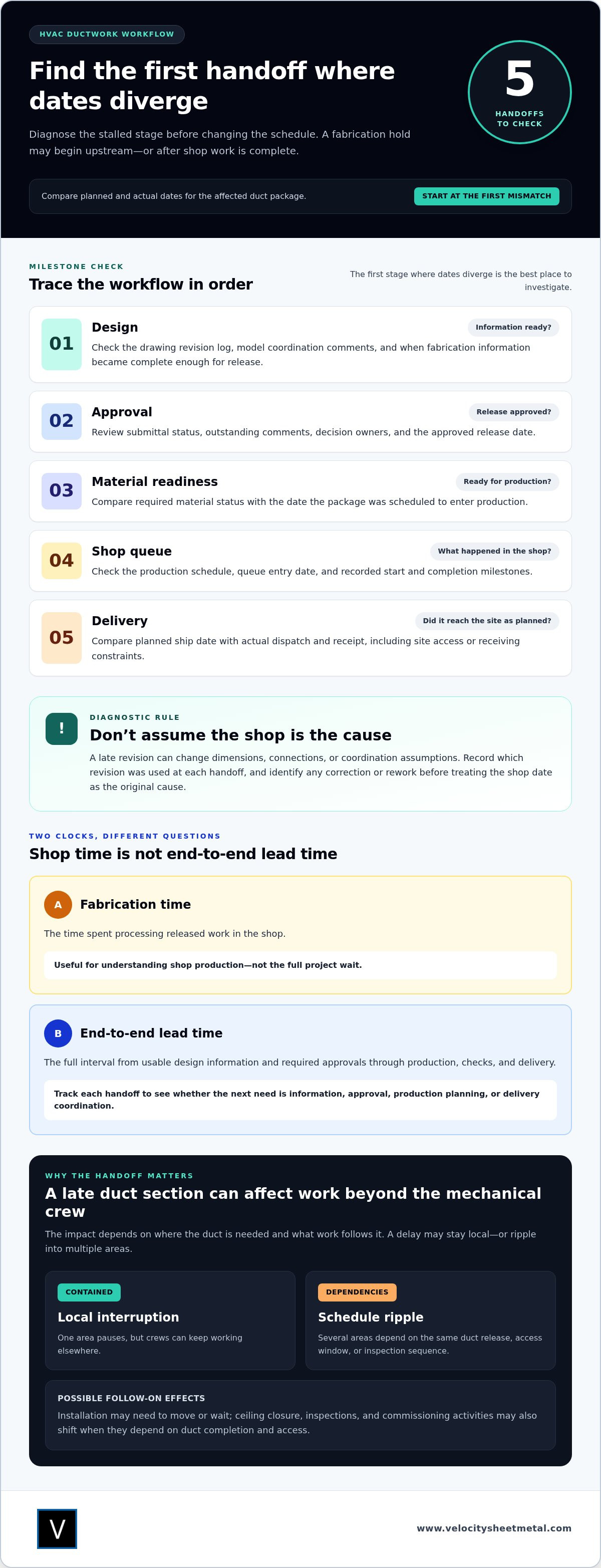
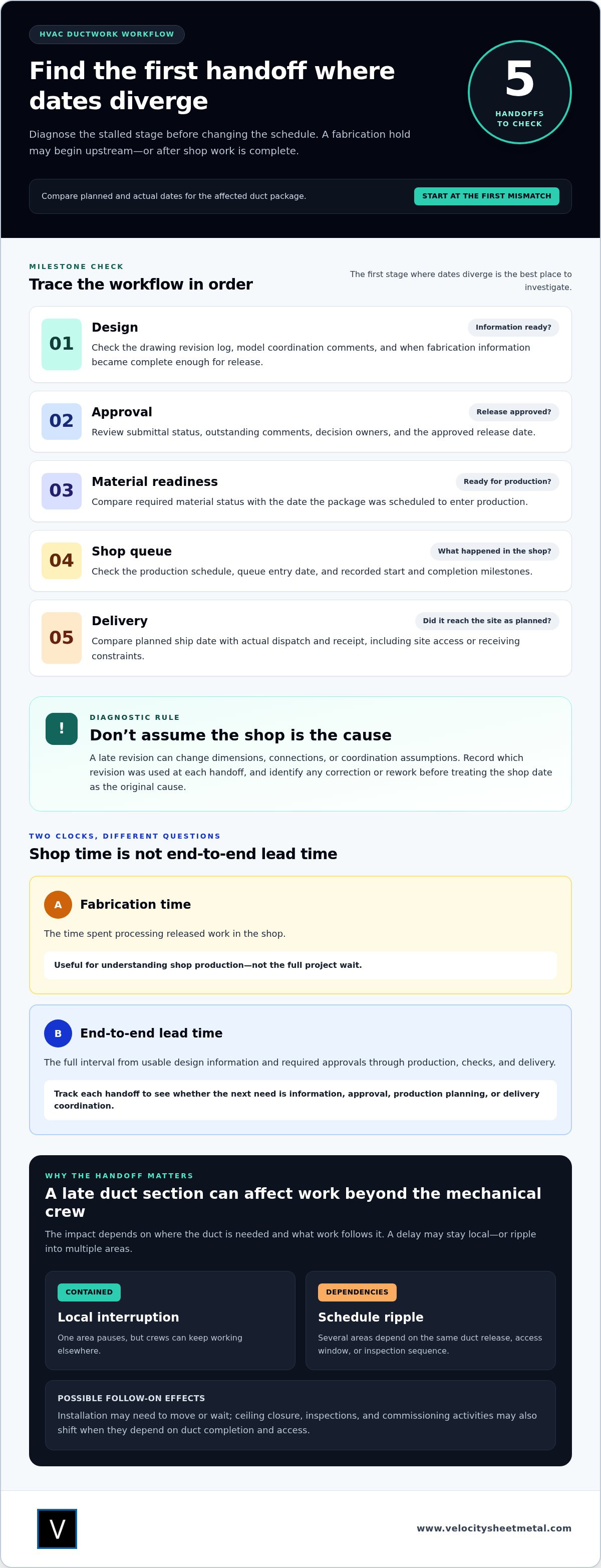
Ductwork timing affects more than the mechanical crew. A missing section can leave an installation area unfinished, hold up ceiling closure, change the order of inspections, and compress the time available for commissioning. The impact depends on where the duct is needed and what work follows it. A delay in one location may be contained; a delay on the critical path can ripple across multiple areas.
A ducting delay is a missed or disrupted project milestone, such as an approved release, completed fabrication, or delivery needed for a planned installation sequence. It doesn’t automatically mean the shop is slow. Drawings may still be changing, approvals may be outstanding, or a shipment may not align with site readiness. Steel ductwork is one part of a connected workflow, not necessarily the sole cause of a delay.
Fabrication time is the time spent processing released work in the shop; end-to-end lead time is the full interval from usable design information and approvals through production, checks, and delivery. That distinction helps teams investigate steel ducting delays hvac projects may face without treating every gap as a manufacturing problem.
How a ductwork delay travels through the construction schedule
Imagine a duct section scheduled for a corridor. If it arrives late, the installation crew may need to move to another area or wait. The open ceiling zone can then hold up follow-on work, including electrical, sprinkler, or fire-protection tasks, depending on the project sequence.
- Local interruption: One area pauses, but crews can keep working elsewhere.
- Schedule ripple: Several areas depend on the same duct release, access window, or inspection sequence.
Ceiling access matters because closing a finished area can make later duct installation harder. Inspections also require the relevant work to be ready and accessible. If duct completion shifts, commissioning activities that depend on installed and checked systems may need to move too.
Why fabrication time is not the same as project lead time
The end-to-end clock starts when the shop has usable design information and required approvals, not when a machine begins processing metal. Before production, the team may need to resolve drawing questions, coordinate dimensions, or wait for a release. After production, quality checks, staging, and transportation still stand between completed duct and the installation area.
Consider a hypothetical sequence: coordinated drawings are submitted Monday, comments are resolved and the release is approved Wednesday, shop work takes place Thursday and Friday, and delivery is arranged for the following Tuesday. Shop work occupies two days, but the full sequence spans longer because review, release, and transportation take time too. These dates illustrate workflow stages, not a standard production or delivery schedule.
Track each handoff separately. This makes it easier to see whether the next useful action is resolving information, completing an approval, planning production, or coordinating delivery with site access.
Where steel ducting delays start: diagnose the project workflow
Start with the handoff history, not an assumption about shop speed. For the affected duct package, compare planned and actual dates at five stages: design, approval, material readiness, shop queue, and delivery. The first stage where the dates diverge is the best place to investigate. This workflow check helps teams pinpoint where steel ducting delays hvac projects begin and choose a response that addresses the cause.
Diagnose the stalled handoff before changing the schedule. Otherwise, the intervention may speed up the wrong stage.
- Design: Check the drawing revision log, model coordination comments, and the date fabrication information became complete enough for release.
- Approval: Review submittal status, outstanding comments, decision owners, and the approved release date.
- Material readiness: Compare the required material status with the date the package was scheduled to enter production.
- Shop queue: Check the production schedule, queue entry date, and recorded start and completion milestones.
- Delivery: Compare the planned ship date with actual dispatch and receipt, including site access or receiving constraints.
A late revision can reset more than a drawing date. It may change dimensions, connections, or coordination assumptions, leaving a released package incomplete or requiring updates after fabrication has started. Record which revision was used at each handoff. This helps distinguish time spent developing the design from time spent waiting for a decision.
Check drawings, approvals, and release readiness first
Gather the current drawing set, revision history, coordination comments, approval record, and release documentation. Look for scope gaps, unresolved clashes, missing details, or conflicting versions. Then compare when the information was ready with when approval or release actually occurred. If fabrication began against outdated information, identify the resulting correction or rework before treating the shop date as the original cause.
Trace material, shop queue, quality, and delivery handoffs
Once release readiness is clear, trace the package through production and shipment. Check when material and production capacity aligned with the approved release, then review queue entry, inspection records, packaging status, shipment scheduling, and site receiving arrangements. Compare planned and actual dates at each handoff. The first unexplained gap narrows the investigation; later gaps show whether the original slip grew or a separate constraint appeared.
Use the findings to assign a specific next action: close a design question, record an approval decision, align a package with the shop schedule, or resolve a delivery handoff. Avoid moving every downstream date until the team knows which milestone is blocked. When model or fabrication information needs coordination before release, BIM coordination and spool drawings can help resolve those details earlier in the workflow.
Steel ducting delay causes: separate real bottlenecks from assumptions
A missed date doesn’t tell you what failed. The package may be waiting on a design decision, material, shop capacity, a quality check, or a delivery window that matches site conditions. Faster fabrication only helps when production is the actual constraint. To diagnose steel ducting delays hvac projects accurately, connect the visible symptom to a record that confirms where the work stopped.
Use this symptom-to-check comparison to narrow the cause before changing dates or resequencing crews:
| Visible symptom | Possible workflow cause | Useful next check |
|---|---|---|
| Repeated drawing updates | Design changes or unresolved coordination | Compare revision history with the fabrication release and model comments. |
| Work hasn’t entered production | Approval, material readiness, or shop queue constraint | Check release approval, material status, and queue entry dates. |
| Only some sections are outstanding | Package split, rework, or differing production readiness | Compare item-level completion and inspection records. |
| Duct is complete but hasn’t reached the site | Packaging, shipment scheduling, access, or receiving constraint | Review dispatch plans alongside site delivery and storage arrangements. |
| Duct arrives before the area is ready | Installation sequence or site-readiness mismatch | Check area access, crew sequence, and space for receiving and storage. |
These are clues, not automatic diagnoses. A package can encounter more than one constraint, and a symptom may have different causes on different projects. Compare dates and records for the affected duct sections rather than applying one explanation to the whole job. Scope, approvals, production capacity, and sequencing vary, so a universal lead-time estimate won’t identify a project-specific bottleneck.
How design changes and coordination gaps create rework
A clash with structure or another system can trigger a dimension or route change. If fabrication information has already been released, that revision may invalidate details and require affected sections to be reviewed or remade. Coordinated BIM models and spool drawings can help teams surface conflicts before release. BIM coordination for sheet metal fabrication connects model review to usable fabrication information.
How supply, production queues, and site readiness differ
A material wait means the package isn’t ready to proceed as planned; a shop queue means it’s waiting for production capacity. A completed, checked package awaiting shipment is a different handoff. If site access, storage, or installation readiness is limited, delivering everything at once may not help. Match the release and delivery sequence to the areas crews can actually work in.
Choose a response only after the evidence points to a constraint. Resolve drawing questions for design churn, coordinate releases around actual shop readiness, or adjust delivery sequencing when the site can’t receive or install the package. A targeted fix is less likely to create new rework or move disruption downstream.
How project teams can reduce steel ducting delays before delivery
Build the schedule around controlled handoffs, not a single estimated shop date. A practical sequence runs from coordinated drawings to an approved release, production, quality checks, and delivery planned against installation readiness. At each step, name the decision owner and record the milestone date. This gives the project team a shared view of what’s ready, what’s waiting, and what could affect the next package.
Use this sequence to reduce avoidable waiting and rework:
- Coordinate the design: Resolve model conflicts and align dimensions, scope, and fabrication details before release.
- Approve a defined package: Identify the current drawing revision, document approved changes, and record the release date.
- Plan production: Align released work with material readiness and the shop schedule, then keep package status visible.
- Check and identify parts: Track completion and quality checks, and label sections so crews can connect packages to their intended areas.
- Coordinate delivery: Match shipment plans to site access, receiving capacity, storage, and the installation sequence.
These steps can’t remove every constraint. They make the work easier to coordinate and help teams respond before a small hold becomes a wider schedule problem.
Prepare a fabrication-ready package and control revisions
Before release, clarify the package scope and confirm the current drawings, approved changes, and release milestone. Assign responsibility for communicating revisions, and make sure decisions reach everyone relying on the information. If a revision arrives after release, document which affected parts need review so production doesn’t continue from superseded details. A structured procurement plan can help teams organize these decisions; see this HVAC duct fabrication procurement guide.
Sequence production, quality checks, and delivery to the field
Where the project and site conditions allow, group duct packages by installation zone or work phase. A phased release can align production and delivery with areas that are ready, rather than sending parts to a location with no access or storage. This is a coordination method, not a promise of faster fabrication. Confirm package contents, part identification, inspection status, and intended delivery sequence with the people planning field work.
Keep a simple status log for every package. Track the drawing revision, approved release date, production and check status, and planned and actual delivery milestones. If a date shifts, record the reason and its effect on the next installation area. This visibility helps teams manage steel ducting delays hvac projects may encounter without treating all packages as one undifferentiated order.
For coordinated duct fabrication supported by BIM coordination and spool drawings, explore Velocity Sheet Metal’s duct fabrication capabilities.
How Velocity Sheet Metal supports coordinated HVAC ductwork delivery
Reducing ductwork schedule risk takes more than production equipment. It takes a clear connection between project information, fabrication, and the field sequence. Velocity Sheet Metal provides automated HVAC ductwork, BIM coordination, and spool drawings for contractors and engineers, connecting project details from digital review to physical parts.
Automated production can support a coordinated plan, but it can’t resolve an outstanding design decision or make an unready site ready to receive duct. Start by matching the project’s information and package sequence to the work ahead.
From coordinated project information to rectangular duct production
BIM coordination and spool drawings help align model information with fabrication details before production. Reviewing that information together can bring conflicts or unclear connections into view while there’s still an opportunity to resolve them upstream. The aim is a more usable path from coordinated model to fabrication release, rather than discovering a mismatch after parts have been produced. See how an automated coil-line duct fabrication workflow fits into rectangular duct production.
Velocity Sheet Metal’s automated coil-line rectangular duct production is one part of that connected process. It’s a production capability, not a set delivery-date promise or a substitute for complete approvals. For teams reviewing steel ducting delays hvac projects, connecting coordination and fabrication helps keep attention on the actual handoffs instead of assuming machinery alone will solve a schedule problem.
What to include when planning a fabrication package
A useful project handoff gives the fabrication team a current, organized view of the work. Include:
- Current drawings and model information: Identify the governing revision and flag unresolved coordination items.
- Scope details: Show which duct sections and related parts belong in the package.
- Revision and approval status: Record approved changes and the release milestone so teams work from the same information.
- Delivery sequence: Note installation zones, site readiness, access, and receiving needs that affect how packages should arrive.
For project-specific requirements, on-demand part production can be part of the fabrication plan. Phasing or releasing parts in sequence may support field planning when it fits the project, and the package should reflect actual scope and readiness. Clear part identification and shared status updates help connect what’s being produced with where and when it’s needed.
Bring your current drawings, scope, revision details, and delivery sequence together to discuss an HVAC ductwork project with Velocity Sheet Metal and plan coordinated duct production around the project requirements.
Turn the next duct release into a schedule-ready plan
Make the duct package’s assumptions visible before they become schedule pressure. Identify which information is final, who owns open decisions, what installation area the package serves, and what must be ready to receive it. Then align those milestones with the wider project schedule. This gives the team a practical basis for responding when conditions change, rather than relying on a delivery date that no longer fits the field sequence.
Preventing steel ducting delays hvac projects isn’t about expecting every handoff to run perfectly. It’s about keeping design, fabrication, and field planning connected, with clear ownership when the plan needs adjustment. A fabrication partner can help turn coordinated project information into a production plan shaped around package requirements.
Bring your project scope and schedule priorities to Velocity Sheet Metal. Discuss your HVAC ductwork project and plan coordinated production around your project requirements.
Frequently Asked Questions
Can steel ducting delays hold up other HVAC project work?
Yes. If a duct section is needed before another system can be tested, inspected, or enclosed, its absence can affect that work’s planned sequence. For example, a ceiling area may need to remain accessible until duct installation and related checks are complete. Project teams can reduce last-minute disruption by treating duct availability as a look-ahead planning item and flagging dependent work before crews are assigned.
What causes steel duct fabrication delays?
Common causes include design revisions, unresolved coordination questions, delayed approvals, material constraints, shop congestion, quality issues, and delivery or receiving restrictions. The same symptom can have different causes: a package that hasn’t started might be awaiting a final drawing decision rather than a production slot. Check dated records for the specific package before deciding what to change. This helps avoid pushing shop teams to accelerate work that isn’t ready.
How long does steel duct fabrication take for an HVAC project?
There isn’t one reliable duration for every project. Fabrication timing depends on package scope, design and approval status, material readiness, production scheduling, required checks, and delivery arrangements. Distinguish shop processing from the full period between release and receipt. For planning, use package-specific milestones and update them when scope or site conditions change, rather than relying on a generic lead-time assumption.
How can contractors reduce HVAC ductwork delays?
Give the fabrication team a stable, clearly identified package, keep a single current drawing revision in circulation, and assign owners to open decisions. Then coordinate delivery with areas that are ready for work. A practical way to address steel ducting delays hvac projects is to review upcoming duct releases during schedule look-aheads, so unresolved information, site access, or receiving constraints surface before they affect planned work.
Does automated duct fabrication guarantee faster project delivery?
No. Automation is a production capability, not a guarantee of earlier project delivery. It can support fabrication when the work is released and the production workflow is ready, but it won’t resolve a design conflict, pending approval, or unavailable delivery window. Evaluate the stage causing the delay first. If the hold is outside production, speeding up machine processing may not change when duct reaches the installation area.
How does BIM coordination help prevent ductwork delays?
BIM coordination can help teams identify model conflicts and clarify fabrication information before parts are produced. For example, reviewing duct routes alongside surrounding building systems may reveal a connection or clearance issue that needs a design decision. Resolving that issue before release can reduce the risk of producing from outdated information. Velocity Sheet Metal provides BIM coordination and spool drawings to support the link between model details and fabrication.
What information should be ready before releasing steel ductwork for fabrication?
Prepare the current drawing set and model details, defined package scope, documented approvals, and a clear record of revisions. Identify which areas the package serves and note delivery or receiving constraints that could affect sequencing. Also establish who communicates changes after release. This gives the team a shared reference for production and helps prevent different participants from planning against different versions of the same duct package.