Standardized Components for National Accounts: 2026 Guide

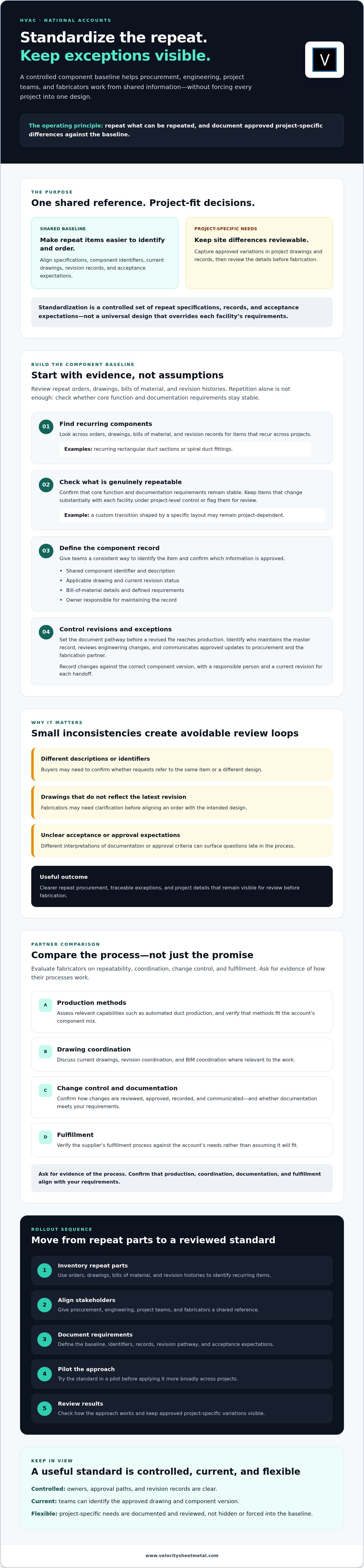
Managing standardized components for national accounts means giving procurement, engineering, project teams, and fabricators a shared way to identify repeat items and control their requirements. The goal isn’t to make every project identical. It’s to make approved common components easier to specify and order while keeping project-specific changes visible.
For HVAC programs, repeatable ductwork and fittings can be easier to coordinate when teams use consistent identifiers, current drawings, and clear revision records. But a standard only helps if it fits the actual component mix and gives teams a reliable way to review exceptions before fabrication.
This guide explains how to choose components for a shared baseline, manage revisions, compare fabrication partners, and roll out a standard across projects. It also covers questions to ask about production methods, BIM coordination, documentation, and fulfillment.
Key Takeaways
- Standardized components for national accounts need a shared baseline for specifications, records, and acceptance expectations, with revisions controlled across sites.
- Identify recurring components first, then document approved project-specific variations so standardization supports fit instead of restricting it.
- Compare fabricators on production methods, drawing coordination, change control, and fulfillment, and ask for evidence of their processes.
- Roll out standards in stages: inventory repeat parts, align stakeholders, document requirements, pilot the approach, and review results.
- Assess relevant capabilities such as automated duct production and BIM coordination, while verifying each supplier’s documentation and fulfillment processes for your needs.
Why standardized components matter for national accounts
Across a national account, the same type of HVAC component may be specified, ordered, and fabricated for multiple projects. If each site describes it differently, teams have to determine whether requests refer to the same item or different designs. Shared specifications, records, and acceptance expectations give procurement, engineering, and fabrication teams a common reference.
Standardization doesn’t mean forcing every facility into one design. It establishes a controlled baseline for repeat components, then records approved differences where site conditions or design requirements call for them. That distinction is central to standardized components for national accounts: repeat what can be repeated, and make exceptions visible.
What does standardization mean for a national account?
A shared component specification defines common requirements for a repeat item. It isn’t a universal design that overrides each project’s needs. For example, an account might standardize how recurring rectangular duct sections or spiral duct fittings are identified and documented, while project drawings capture the configuration required at a particular facility.
Common identifiers, current drawings, and revision records help teams connect a repeat order to the right approved information. This supports the principle of interchangeable parts: components can be substituted when they meet the defined requirements. In practice, project-specific details still need review before fabrication.
Where inconsistent components create procurement friction
Friction often starts with small differences. One site may use a local description, another a different identifier, and a third may submit a drawing that doesn’t reflect the latest revision. Buyers then have to confirm what is being requested. Fabricators may need clarification before they can align the order with the intended design. Those review loops make repeat procurement harder to coordinate.
Unclear acceptance expectations add another layer. If project teams and suppliers interpret documentation or approval criteria differently, questions can surface late in the process. Define the baseline and approval path before repeat orders begin, and record changes against the correct component version.
A standardized component program is a controlled set of repeat specifications, records, and acceptance expectations, with approved project-specific variations documented against the baseline.
The practical aim is to build a repeatable process without erasing project needs. Start by identifying components that recur, establish which requirements stay fixed, and make exceptions traceable. Then procurement and fabrication teams can work from clearer information while each project retains the details needed for its design.
Build a controlled component baseline without blocking project-specific needs
A useful standard library starts with evidence, not assumptions. Review repeat orders, drawings, bills of material, and revision histories to find components that recur across projects. Then check whether their core function and documentation requirements remain stable. Repetition alone isn’t enough: an item that changes substantially with each facility may need project-level control rather than a shared baseline.
Choose which components belong in the standard library
Prioritize repeat items that teams can identify and review consistently. Depending on the project records available, capture:
- A shared component identifier and description.
- The applicable drawing and its current revision status.
- Bill-of-material details and other defined requirements.
- The owner responsible for maintaining the record.
For example, recurring rectangular duct sections may be candidates for a common documentation structure, while a custom transition shaped by a specific layout may remain project-dependent. Mark uncertain or highly customized items for review instead of forcing them into the library. A documented boundary keeps the baseline useful and makes exceptions easier to spot.
Control revisions and approve exceptions
Set the document pathway before a revised file reaches production. Assign an owner to maintain the master record, name who reviews engineering changes, and clarify who communicates approved updates to procurement and the fabrication partner. Roles vary by organization; the key is that each handoff has a responsible person and a current revision to reference.
For a proposed change, route the updated drawing or requirement through the designated review and approval roles. Once approved, update the controlled record and notify affected teams. Keep project-specific variations attached to the relevant project documents, with a clear reference to the baseline they modify. This helps teams distinguish an authorized exception from an outdated file or an unreviewed change.
A standard component follows the approved shared baseline; a project variation is a documented, authorized change for a specific project.
This structure makes standardized components for national accounts manageable without pretending every site has the same constraints. Buyers developing a broader sourcing process can also review this HVAC duct fabrication procurement guide. For ductwork programs that involve drawing coordination, Velocity Sheet Metal’s ductwork and BIM coordination capabilities may be relevant to the supplier review.
Compare national account fabricators on repeatability, coordination, and delivery
Supplier comparisons should look beyond equipment lists. For standardized components for national accounts, the buying team needs to understand how a fabricator handles repeat work, coordinates drawings, communicates revisions, and plans fulfillment. Ask each supplier to explain those steps and provide relevant examples. A stated capability is a starting point, not evidence that the process fits your account.
| Comparison area | What to ask | Evidence to request |
|---|---|---|
| Production method | Which required component categories can the supplier produce, and what production methods apply? | Examples of relevant workflows and how repeat orders are checked against current requirements. |
| Drawing coordination | How are design information, BIM coordination, and spool drawings incorporated into review? | A sample coordination process or documentation example appropriate for your project. |
| Change control | How are proposed revisions reviewed, approved, recorded, and communicated? | A clear explanation of revision ownership and how teams identify the current approved information. |
| Fulfillment | How are orders, shipping arrangements, and delivery communications coordinated across projects? | Defined responsibilities and a description of how the supplier communicates fulfillment status. |
Assess production capability against the component mix
Start with the account’s actual component categories, then match each one to a confirmed supplier capability and documented workflow. Ask how repeat orders are compared with current drawings and revisions, and who resolves a mismatch before production proceeds. For recurring rectangular ductwork, determine whether automated coil-line production fits the account’s needs. The coil-line duct fabrication guide offers related context for evaluating that production method.
Evaluate BIM, quality controls, and fulfillment planning
Find out how BIM coordination and spool drawings fit into your review and approval process. Request details on inspection records and acceptance criteria, then verify specific claims against your project requirements. Don’t assume every supplier uses the same controls. The BIM fabrication workflow guide can help frame questions about the path from design information to fabrication.
Before qualification, confirm nationwide shipping arrangements and who communicates order and delivery updates. Velocity Sheet Metal provides automated rectangular duct production, BIM coordination, and spool drawings, and ships across the United States. These are relevant capabilities to assess against your scope, not a substitute for confirming project-specific requirements. Review Velocity’s fabrication capabilities as part of that evaluation.
Use a step-by-step rollout to standardize components across projects
A controlled rollout makes standards usable in daily procurement and fabrication, not just in a reference document. Start with a limited scope, assign clear owners, and test the process before extending it across projects. This gives teams a chance to catch gaps in records, approvals, or supplier communication while the program is still manageable.
Start with an inventory and a controlled pilot
Gather current drawings, recurring order information, known site variations, and applicable acceptance requirements. Then choose a pilot component or small group of repeat components with enough commonality to test the baseline. Agree on success criteria before orders proceed, such as whether teams can identify the approved drawing, understand its revision, and distinguish baseline requirements from project exceptions.
- 1. Inventory recurring parts. Compare orders and project records to identify candidates for standardization.
- 2. Align stakeholders. Assign engineering approval, procurement recordkeeping, supplier communication, and revision-update responsibilities.
- 3. Document the standard. Establish identifiers, current drawings, requirements, and the process for recording approved deviations.
- 4. Pilot selected components. Use the controlled documents in a defined project scope and capture questions or process gaps.
- 5. Review and refine. Gather feedback, update the baseline, and decide whether it’s ready to extend to more projects.
Make the standard usable across teams and suppliers
Store approved documents where responsible teams and suppliers can access them, and make revision status easy to identify. Retire or clearly mark superseded files so they aren’t mistaken for current instructions. Engineering should own technical approval; procurement should maintain ordering records; designated contacts should communicate approved changes to suppliers and affected project teams.
Use one defined route for requesting, reviewing, approving, and recording deviations. Keep each approved exception tied to the relevant project documents. During the pilot, track practical indicators such as revision questions, incomplete submittals, and whether teams can identify the correct information for repeat orders. These signals can show where instructions or ownership need clarification. They don’t guarantee a particular result, but they help guide the next revision of the process.
With standardized components for national accounts, the goal is a repeatable workflow that still gives project teams a clear path for legitimate variations. Learn more about repeatable fabrication needs through Velocity Sheet Metal.
Select a fabrication partner built for standardized national accounts
The right partner should fit your component mix and support the way your account manages drawings, revisions, approvals, and fulfillment. Equipment matters, but so does the process around it. Before choosing a supplier, confirm what they produce, how they coordinate project information, and how responsibilities are handled from order review through shipping.
When Velocity Sheet Metal may fit your account
Velocity Sheet Metal provides automated coil-line rectangular duct production, along with BIM coordination and spool drawings. These capabilities may suit national accounts seeking repeatable HVAC fabrication workflows and clearer coordination between design information and fabrication. Velocity also ships across the United States, and its management team has more than 50 years of combined industry experience.
Those capabilities are a starting point for evaluation, not a blanket guarantee of fit. Confirm that your component specifications, project scope, and production requirements align with the available capabilities before qualification.
Use a practical supplier checklist
- Production capability: Confirm the supplier can produce the component categories and repeat work your account requires.
- Controlled documentation: Establish how current drawings, revisions, and approved project variations are identified and shared.
- Coordination: Clarify how drawing reviews, BIM coordination, and spool drawings fit into your approval process.
- Fulfillment: Confirm shipping arrangements, delivery communication, and who owns each coordination step.
- Quality expectations: Define project acceptance criteria and request documentation supporting any supplier claims that matter to your qualification.
Prepare for a focused first conversation
Bring representative drawings, a list of expected component categories, your revision practices, and delivery requirements. Identify who approves engineering changes and explain how your team handles site-specific exceptions today. This gives a prospective partner a concrete basis for discussing scope and clarifying what needs further review.
For additional context, read the national sheet metal fabrication overview. Then review Velocity Sheet Metal when assessing component scope, drawings, and account requirements. A clear first discussion can help determine whether its fabrication and coordination capabilities align with your program for standardized components for national accounts.
Put a repeatable fabrication process into motion
Standardized components for national accounts work best when teams share a controlled baseline, keep approved project variations visible, and manage drawings and revisions through a clear review process. A focused pilot can reveal where documentation, approvals, or supplier communication need adjustment before the approach expands to more projects.
Choose a fabrication partner by matching its production capabilities, coordination practices, change controls, and fulfillment approach to your account’s actual requirements. Velocity Sheet Metal offers automated coil-line rectangular duct production, BIM coordination, and spool drawings. The company ships across the United States, and its management team brings more than 50 years of combined industry experience. Confirm fit against your specifications and scope.
Ready to discuss component scope, drawings, and account requirements? Discuss your national account fabrication requirements with Velocity. A clear baseline and the right partner can help your team build a practical, repeatable process while preserving the flexibility each project needs.
Frequently Asked Questions
What are standardized components for national accounts?
Standardized components for national accounts are repeat items managed through shared specifications, identifiers, drawings, revision records, and acceptance expectations. The baseline helps procurement, engineering, and fabrication teams work from consistent information across projects. It doesn’t mean every facility uses an identical design. For HVAC, recurring rectangular duct sections or fittings may follow common documentation rules while their approved configurations still reflect project conditions.
How do national accounts standardize components across multiple projects?
Start by reviewing recurring orders, drawings, and known variations to identify suitable candidates. Align engineering, procurement, project teams, and suppliers on what belongs in the shared baseline. Document identifiers, current drawings, revision ownership, and approval steps. Then pilot selected components, record questions or gaps, and refine the process before expanding it. Clear responsibility for supplier communication helps prevent approved updates from being missed.
Can standardized components still accommodate project-specific requirements?
Yes. Standardization defines a controlled baseline, while approved variations capture project-specific design or site requirements. Record each exception against the applicable project documents and identify who reviewed and approved it. For example, a recurring duct component may use shared identification and documentation practices, while its project drawing specifies a required configuration. This approach supports repeatability without treating distinct facilities as interchangeable.
What should buyers look for in a national sheet metal fabrication partner?
Match the supplier’s confirmed production capabilities to your component categories, then examine its drawing coordination, revision control, and fulfillment processes. Ask how repeat orders are checked against current documents and request evidence for any quality or inspection claims relevant to your requirements. Clarify shipping arrangements and communication responsibilities. Velocity Sheet Metal provides automated ductwork, BIM coordination, and nationwide shipping, capabilities buyers can assess against their project scope.
How can BIM coordination support standardized HVAC components?
BIM coordination can help teams review how HVAC components relate to the project design and communicate design information for fabrication. Spool drawings can also support coordination by presenting component information in a fabrication-focused format. These tools don’t remove the need for engineering review or approved project documents. Buyers should confirm how a supplier’s BIM coordination and spool drawings fit their own review, approval, and revision processes.
What information should a buyer provide when requesting repeat component production?
Provide representative drawings with revision status, component descriptions or identifiers, expected categories, and any available bill-of-material details. Include project-specific requirements, acceptance expectations, and delivery needs. Explain how your team approves changes and records exceptions. If some information is still being confirmed, flag it rather than treating it as final. A clear starting package helps the supplier identify questions before proceeding with the order.
How can a company control drawing revisions across national projects?
Use a shared document process that identifies the current approved drawing, revision status, document owner, and approval responsibility. Route proposed changes through designated reviewers before distributing updated files to suppliers or project teams. Mark superseded versions so they aren’t mistaken for current instructions. Record approved project-specific deviations against the relevant project documents, and assign someone to communicate changes to procurement and fabrication contacts.