Stainless Steel Laser Cutting Services: The 2026 Industrial Guide
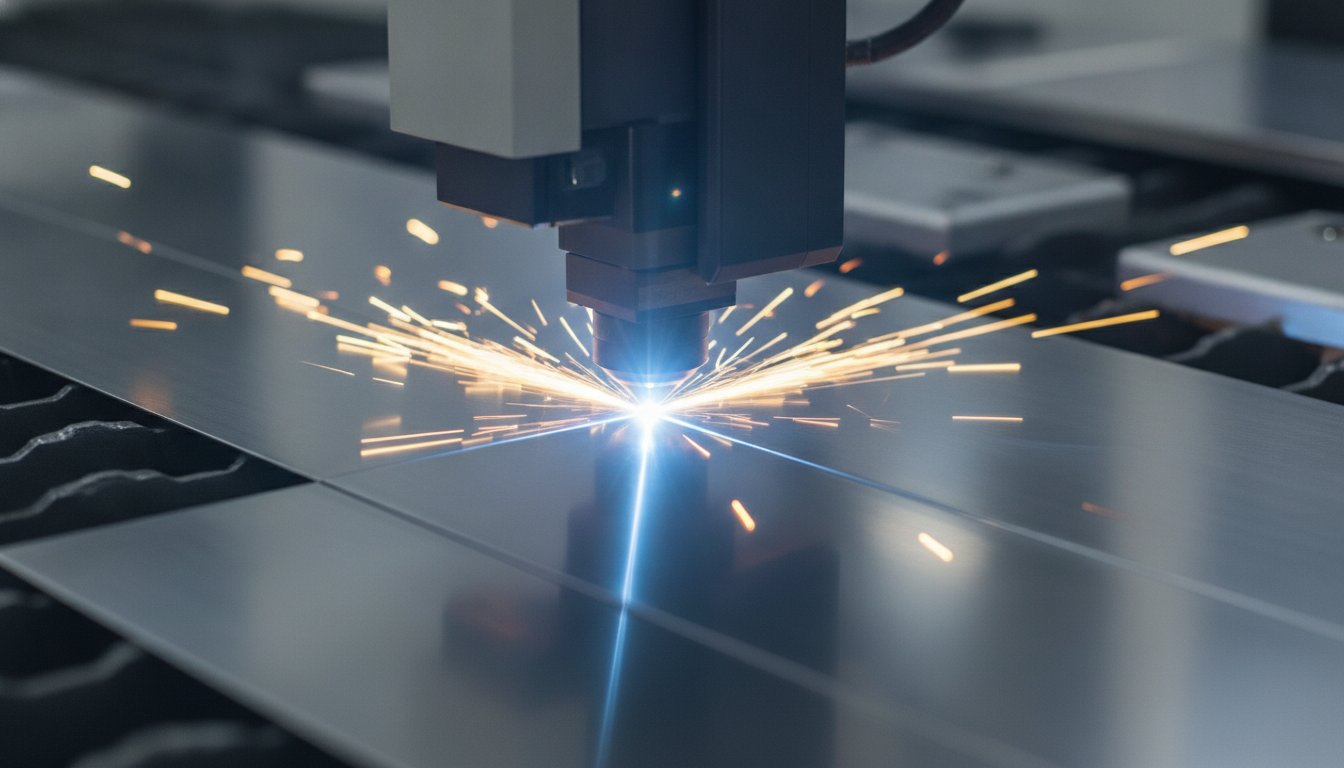
A flawless CAD model doesn't guarantee a perfect physical part. In the industrial sector, the distance between a digital BIM file and a finished component is often measured in wasted material and missed deadlines. If you've struggled with inconsistent edge quality on thick 316 plates or watched project schedules slip due to vendor delays, you aren't alone. You need a partner that treats your technical specs with the same precision you used to design them.
High-precision stainless steel laser cutting services are the essential bridge in modern manufacturing. This 2026 industrial guide helps you master the technical requirements and procurement strategies necessary to streamline your production line. We'll break down the specific tolerances for 304 and 316 grades, explain how automated workflows eliminate manual errors, and show you how to identify a national partner capable of scaling with your OEM or HVAC projects. From initial digital input to final delivery, it's time to bring surgical precision to your supply chain.
Key Takeaways
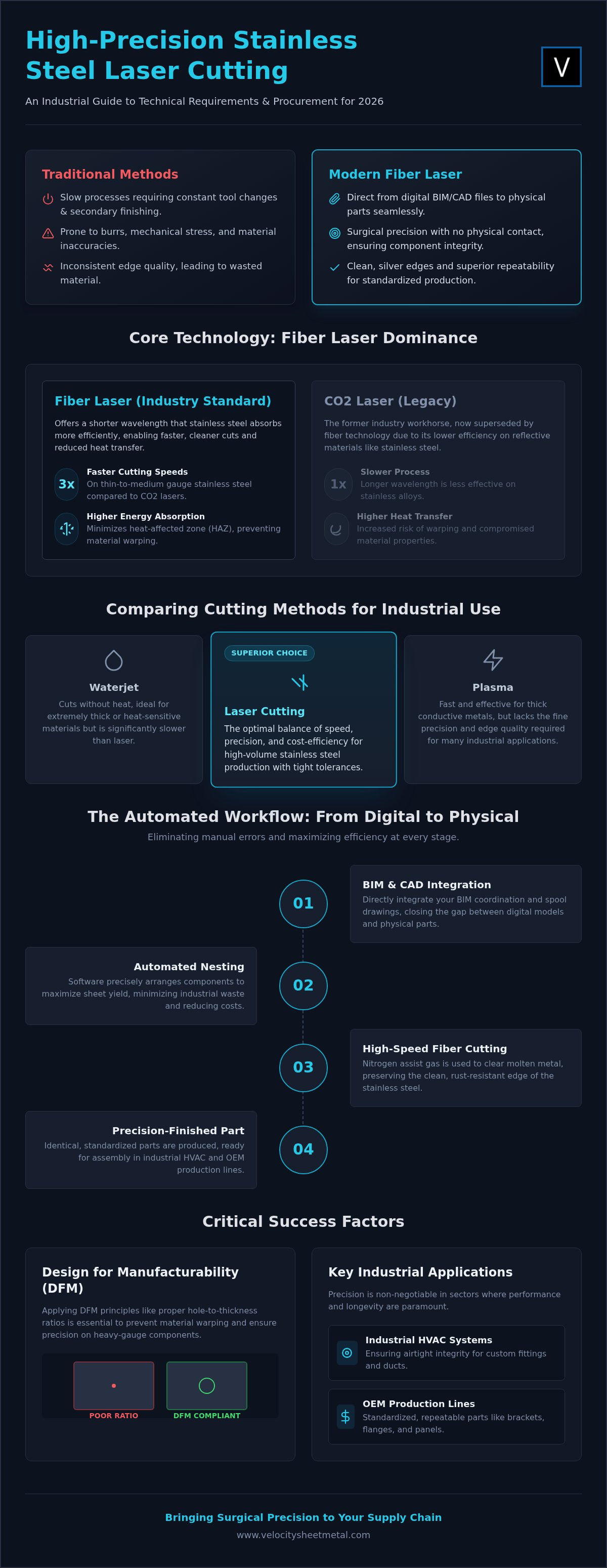
- Understand why fiber laser technology is the industry standard for stainless alloys. It provides higher absorption rates and faster cutting speeds than traditional CO2 methods.
- Integrate your BIM coordination and spool drawings directly with stainless steel laser cutting services. This approach eliminates the gap between digital models and physical parts.
- Apply Design for Manufacturability (DFM) principles like proper hole-to-thickness ratios. These technical specs prevent material warping and ensure precision on heavy-gauge components.
- Evaluate laser cutting against waterjet and plasma options for your specific project. It's the superior choice for high-volume efficiency and tight industrial tolerances.
- Select a national partner that utilizes automated workflows. This ensures your industrial HVAC or OEM production stays on schedule regardless of project scale.
The Role of Precision Stainless Steel Laser Cutting in Industrial Workflows
Precision laser cutting is a CNC-driven thermal process that uses high-powered light to execute complex geometries with surgical accuracy. It doesn't rely on physical contact. Instead, the laser melts or vaporizes the material along a programmed path. In 2026, the industrial sector relies on this technology to transform raw alloys into finished components without the burrs or mechanical stress common in traditional methods. Stainless steel remains the preferred choice for these workflows due to its extreme durability and inherent corrosion resistance. When your project demands longevity in harsh environments, stainless steel laser cutting services provide the necessary speed and repeatability to keep production lines moving.
The shift from traditional mechanical cutting to high-speed laser technology represents a fundamental change in industrial efficiency. Old-school shears and saws are slow. They require constant tool changes and secondary finishing. Laser systems eliminate these bottlenecks. They move directly from digital files to physical parts. This speed is essential for national accounts that manage large-scale projects across multiple states. Standardized quality isn't a luxury; it's a requirement for maintaining project timelines and ensuring that every component fits the first time.
Meeting Industrial Standards for HVAC and OEM Projects
Industrial HVAC systems require airtight integrity to function at peak efficiency. A single millimeter of error in a custom fitting or rectangular duct can lead to significant energy loss. Modern stainless steel laser cutting services support the production of standardized parts for national OEM production lines, ensuring that every bracket, flange, and panel is identical. This level of consistency is vital for contractors who need to replicate results across various job sites. Laser precision ensures that components align perfectly on-site, effectively eliminating field collisions during the assembly of complex industrial systems.
Why Stainless Steel Requires Specialized Laser Handling
Cutting stainless steel requires a higher level of technical control than mild steel or aluminum. The material's high reflectivity can bounce light back into the cutting head, potentially damaging older equipment. This is why modern facilities utilize Fiber Laser Technology to maintain a stable, high-speed beam that penetrates the surface effectively. Managing the heat-affected zone (HAZ) is another critical factor. If the laser dwells too long, it can alter the material's chemical properties and compromise its resistance to rust. Expert operators use nitrogen as an assist gas to clear the molten metal quickly, preserving the clean, silver edge that stainless is known for. For a broader look at how these technical specs impact your bottom line, explore our overview of precision laser cutting services to understand the full scope of modern fabrication.
Technical Capabilities: Fiber Laser Technology for Stainless Alloys
Fiber lasers have fundamentally replaced CO2 systems in high-output environments. While CO2 lasers were the industry workhorse for decades, fiber technology offers a shorter wavelength that stainless alloys absorb more efficiently. This results in cutting speeds up to three times faster on thin-to-medium gauges. Faster speeds don't just save time. They reduce the amount of heat transferred to the part, preventing the warping that often plagues large-format industrial projects.
Efficiency extends to material management. Modern stainless steel laser cutting services utilize automated nesting software to arrange parts with surgical precision. This technology analyzes the geometry of every component, from simple brackets to complex HVAC fittings, to maximize sheet yield. It's a direct path from digital CAD models to physical reality that minimizes industrial waste and lowers total production costs.
The technical evolution of these systems is a core component of modern industrial applications of laser cutting, where speed must be matched by metallurgical integrity. Using nitrogen as an assist gas is critical here. Unlike oxygen, which can cause oxidation and charring on the cut edge, nitrogen creates a clean, weld-ready surface. This eliminates the need for secondary grinding, allowing parts to move immediately from the laser bed to the assembly line.
Managing Tolerances and Edge Quality
Industrial standards demand tight control. Most high-end stainless steel laser cutting services operate within tolerances of +/- 0.005 inches. You can verify quality through visual indicators. A high-quality cut shows smooth striations and minimal dross at the bottom edge. When these parameters are met, secondary finishing becomes unnecessary. This precision is why many national accounts trust our custom laser cutting workflows to deliver assembly-ready parts on tight schedules.
Stainless Steel Grades: 304, 316, and Specialty Alloys
Material selection dictates cutting parameters. Grade 304 is the standard for most industrial HVAC and OEM components. It's versatile and cuts cleanly at high speeds. Grade 316 contains molybdenum for enhanced corrosion resistance in marine or chemical environments, which makes it slightly more "gummy" during thermal processing. Modern 2026 fiber lasers handle these differences by adjusting the beam frequency and gas pressure in real-time. Even on heavy-gauge plates, the tech ensures a minimal edge taper and prevents the material from bowing under thermal stress.
Comparing Stainless Steel Cutting Methods for Industrial Use
Selecting the right fabrication method is a calculation of speed, cost, and material integrity. While stainless steel laser cutting services are the industry standard for precision, comparing them against waterjet and plasma methods reveals why they dominate the production line. The method you choose directly impacts how a part behaves during downstream fabrication. A clean laser cut ensures a seamless transition to CNC bending or high-strength welding without the need for manual rework.
Laser technology provides the most efficient cost-benefit ratio for high-volume industrial production. It delivers finished components at a pace that waterjets can't match and with a precision that plasma can't reach. Because the process is fully automated, part-to-part consistency remains absolute. This reliability is vital for national accounts managing large-scale OEM projects where a single out-of-spec part can halt an entire assembly line. From the first pierce to the final stack, laser cutting provides a level of control that traditional methods lack.
Laser vs. Waterjet: Precision and Thermal Impact
Waterjet cutting uses a cold-cutting process, making it ideal for extremely thick stainless plates where thermal impact is unacceptable. It eliminates the heat-affected zone entirely. However, this comes at a cost. Waterjet is significantly slower and creates a wider kerf. It also leaves a textured edge that often requires secondary finishing. For the vast majority of industrial projects, including HVAC duct fabrication for mechanical contractors, the speed and narrow kerf of a fiber laser are the clear winners. Laser cutting produces a smoother, cleaner edge that's ready for immediate use.
Laser vs. Plasma: Speed and Material Thickness
Plasma cutting is a powerhouse for bulk material removal on very thick stainless steel. It's effective but messy. Plasma-cut edges typically suffer from significant taper and dross accumulation. This requires your team to spend hours on secondary grinding before the parts are weld-ready. In 2026, stainless steel laser cutting services have pushed into thicker gauges, offering a cleaner alternative to plasma. Laser cutting provides a perfectly square edge and eliminates the cleanup phase. By choosing laser over plasma, you cut labor costs and ensure your final assemblies meet the highest industrial standards.
Design for Manufacturability (DFM) in Stainless Steel Laser Cutting
Design for Manufacturability (DFM) is the difference between a theoretical model and a profitable production run. High-performance stainless steel laser cutting services thrive on clean data. When you optimize your digital assets for the factory floor, you eliminate the friction that causes lead times to swell. It's about ensuring your digital intent matches the physical realities of thermal processing and material behavior.
Optimizing CAD files for laser production follows a methodical sequence. Start by purging your DWG or DXF files of all non-cutting data, such as title blocks, dimensions, and hidden layers. Ensure all geometries are closed, continuous polylines. These steps allow automated systems to ingest your files for immediate production scheduling. Technical constraints are equally critical. Maintain a 1:1 hole-to-thickness ratio to ensure edge verticality. If you're cutting 0.25-inch stainless plate, keep your smallest hole diameter at or above 0.25 inches. This prevents nozzle damage and ensures a clean pierce every time.
Assembly speed is another byproduct of smart DFM. Incorporate tab and slot features into your designs for complex industrial components. This creates self-jigging assemblies that snap together, reducing the need for expensive weld fixtures and manual alignment. It turns a complicated fabrication project into a streamlined assembly task. If you're ready to see how these principles apply to your next project, connect with our engineering team for a technical review.
Integrating BIM and Spool Drawings
Modern industrial workflows rely on digital continuity. Integrating BIM clash detection for HVAC fabrication directly into the laser cutting path prevents costly field errors. We move from Revit or SysQue models to CNC-ready laser files in a seamless automated loop. This workflow is essential for mechanical spooling services. By using laser-cut parts for prefabricated assemblies, you ensure that every spool fits perfectly within the coordinated building model, drastically reducing on-site labor requirements.
Material Optimization and Nesting Strategies
Material yield is a primary driver of project profitability. Professional stainless steel laser cutting services use common-line cutting to share a single cut path between adjacent parts. This technique reduces gas consumption and machine run time. You must also account for grain direction if the parts require subsequent CNC bending. Bending against the grain prevents material cracking and ensures structural integrity in high-strength 316 alloys. Proactive DFM reduces lead times for national account orders by eliminating the back-and-forth of file corrections and material waste.
National Solutions: Scalable Stainless Steel Fabrication
Velocity Sheet Metal serves as the critical partner for national accounts requiring standardized, high-precision components. We recognize that national projects demand more than just a local job shop. You need a partner that understands the rigorous requirements of large-scale procurement and national logistics. Our management team brings over 50 years of combined industry experience to every project. This expertise ensures that we anticipate production bottlenecks before they disrupt your schedule. We treat stainless steel laser cutting services as the foundation for a reliable national supply chain that prioritizes speed and technical accuracy.
Nationwide shipping is a non-negotiable part of our service model. We've optimized our logistics to handle everything from small, high-precision OEM parts to large-scale ductwork assemblies. This capability allows national contractors to maintain a single point of contact for their entire fabrication needs. By centralizing your production with a partner that can ship anywhere, you eliminate the variability and administrative burden of managing multiple regional vendors. It's about moving from a digital concept to a physical part delivered exactly where you need it.
Beyond the Cut: Integrated Bending and HVAC Fabrication
The true value of a fabrication partner lies in their ability to move beyond the initial cut. There is a powerful synergy between our laser systems and our CNC press brake services for OEMs. We transition flat laser-cut sheets into finished rectangular or spiral ductwork with surgical precision. This single-source approach ensures that the tight tolerances maintained during the laser process aren't lost during the forming phase. It's a closed-loop system where cutting, bending, and coordination happen under one roof. This provides you with a finished product that's ready for immediate field installation without secondary adjustments.
Standardizing Quality for National Accounts
Automated production is the only way to ensure identical part quality across multiple project sites. Our workflows use the same digital files and automated parameters for every run. This ensures that a part produced today is identical to one produced six months from now. This level of standardization allows contractors to move toward on-demand part production, which significantly reduces the need for expensive field inventory. Stainless steel laser cutting services that are integrated with your project schedule allow for leaner operations and more predictable outcomes. Engineers and procurement managers can now streamline their supply chains with confidence. Contact us today to discuss the specifications for your next national industrial project.
Accelerate Your Industrial Production Line
Industrial manufacturing in 2026 demands more than just a clean cut. It requires a seamless transition from digital BIM coordination to the final assembly line. You've seen how fiber laser technology outperforms traditional methods by delivering superior edge quality on 304 and 316 grades. By applying DFM principles like proper hole-to-thickness ratios, you eliminate the production delays that often stall national projects. Every millimeter matters when you're moving from a digital concept to a physical component.
Choosing the right partner for stainless steel laser cutting services is the final step in securing your production schedule. Velocity Sheet Metal provides the technical depth needed for complex OEM and HVAC projects. We combine over 50 years of industry experience with BIM-integrated workflows to ensure standardized quality across every shipment. Our national shipping capabilities mean your project stays on track regardless of location. We're the essential bridge between your digital files and tangible products. Request an Industrial Laser Cutting Quote from Velocity Sheet Metal to get your project moving today. Let's build your next high-precision assembly together.
Frequently Asked Questions
What is the maximum thickness of stainless steel you can laser cut?
Modern fiber lasers generally cut stainless steel up to 1 inch thick with high precision. While thin-gauge sheets are processed at high speeds, heavy-gauge plates require specialized frequency adjustments to maintain edge quality. We calibrate our equipment based on your specific industrial requirements to prevent edge taper. This ensures every component fits your assembly without secondary machining. Our facility handles both high-volume OEM parts and custom heavy-duty HVAC components for national accounts.
How does laser cutting affect the corrosion resistance of stainless steel?
Laser cutting preserves corrosion resistance when performed with nitrogen assist gas. Nitrogen prevents the formation of a dark oxide layer that can compromise the material's protective properties. By minimizing the heat-affected zone, we ensure the chromium in the stainless steel remains stable. This is crucial for parts exposed to harsh environments. Proper thermal management during stainless steel laser cutting services keeps your components rust-free and structurally sound for long-term industrial use.
Can you cut Grade 316 stainless steel for marine or chemical applications?
We regularly process Grade 316 stainless steel for marine and chemical projects. This alloy's molybdenum content provides superior resistance to chlorides and acidic solutions. While it's slightly more difficult to cut than Grade 304, our high-power fiber lasers maintain the necessary speed to prevent warping. We deliver clean, burr-free edges that meet the strict standards of the chemical processing industry. It's an ideal solution for durable, high-precision industrial assemblies.
What are the typical lead times for high-volume national orders?
Lead times depend on project scale and complexity, but our automated workflows prioritize speed. We move from digital review to production immediately to meet national project schedules. National shipping logistics are integrated into our timeline to ensure prompt delivery across all project sites. Our management team leverages 50+ years of experience to streamline the process, cutting through typical administrative delays. We focus on getting your parts to the field exactly when your team's ready.
Do you provide secondary services like CNC bending or welding for laser-cut parts?
We provide a full range of secondary services including CNC press brake bending and BIM coordination. Our facility is equipped to handle the transition from flat laser-cut sheets to finished rectangular or spiral ductwork. By acting as a single-source partner, we ensure that tolerances are maintained from the first cut to the final bend. This integration reduces the logistics of managing multiple vendors and ensures every prefabricated assembly fits the coordinated building model.
How do I submit my BIM or CAD files for a laser cutting quote?
Submit your DXF, DWG, or Revit files directly through our digital coordination portal. We specialize in bridging the gap between digital BIM models and physical parts. Our team reviews your CAD data for manufacturability, checking hole-to-thickness ratios and nesting efficiency. This digital-first approach allows us to provide accurate quotes quickly. It ensures that the final physical parts match your digital intent with surgical precision across every national account project.
What is the difference between nitrogen and oxygen-assisted laser cutting?
Nitrogen is the standard for stainless steel laser cutting services because it prevents oxidation. It results in a clean, silver edge that's ready for immediate welding. Oxygen-assisted cutting uses an exothermic reaction to cut faster, but it leaves a scaled edge that requires secondary grinding. We primarily use nitrogen to ensure your parts are assembly-ready. This choice eliminates labor-intensive cleanup and maintains the high-end finish required for visible industrial or architectural components.
How do you ensure part accuracy across a national account with multiple project sites?
We ensure accuracy through standardized CNC programming and automated production lines. Every project site receives identical parts because we use the same digital files and calibrated equipment for every run. Our management team oversees the entire workflow from digital input to final shipping. This centralized control eliminates the variability found when using different regional fabricators. We provide the consistency national contractors need to reduce field inventory and avoid costly on-site collisions.