Spiral Duct Fabrication Process: A Guide to Precision HVAC Manufacturing
A single millimeter of deviation in the fabrication shop often translates into thousands of dollars in wasted field labor and compromised system pressure. You've likely dealt with the fallout of inconsistent duct quality, from air leakage in high-pressure systems to field collisions caused by poor fabrication tolerances. It's a bottleneck that stalls projects and drives up overhead. Understanding the modern spiral duct fabrication process is the first step toward reclaiming your project margins and ensuring mechanical integrity.
We'll walk through the entire automated workflow, moving from raw coil decoiling and precision tube-forming to final BIM-coordinated assembly. You'll learn how high-quality lock-seam construction meets SMACNA 4th Edition standards and why synchronized digital-to-machine production is the only way to eliminate field errors. This guide breaks down the technical stages that turn raw galvanized steel into high-performance components. By the end, you'll have the technical knowledge to identify superior manufacturing and choose a fabrication partner that scales with your national project demands.
Key Takeaways
- Master the five-step spiral duct fabrication process that transforms raw metal coils into high-tolerance cylindrical ductwork using automated tube-forming technology.
- Identify the critical structural differences between industrial double seams and snap-lock construction to ensure system integrity in high-pressure environments.
- Understand why round profiles outperform rectangular alternatives by significantly reducing air leakage and optimizing airflow velocity through smooth interior walls.
- Learn how BIM-coordinated workflows and automated fabrication lines eliminate field collisions while maintaining standardized quality for large-scale national accounts.
What is the Spiral Duct Fabrication Process?
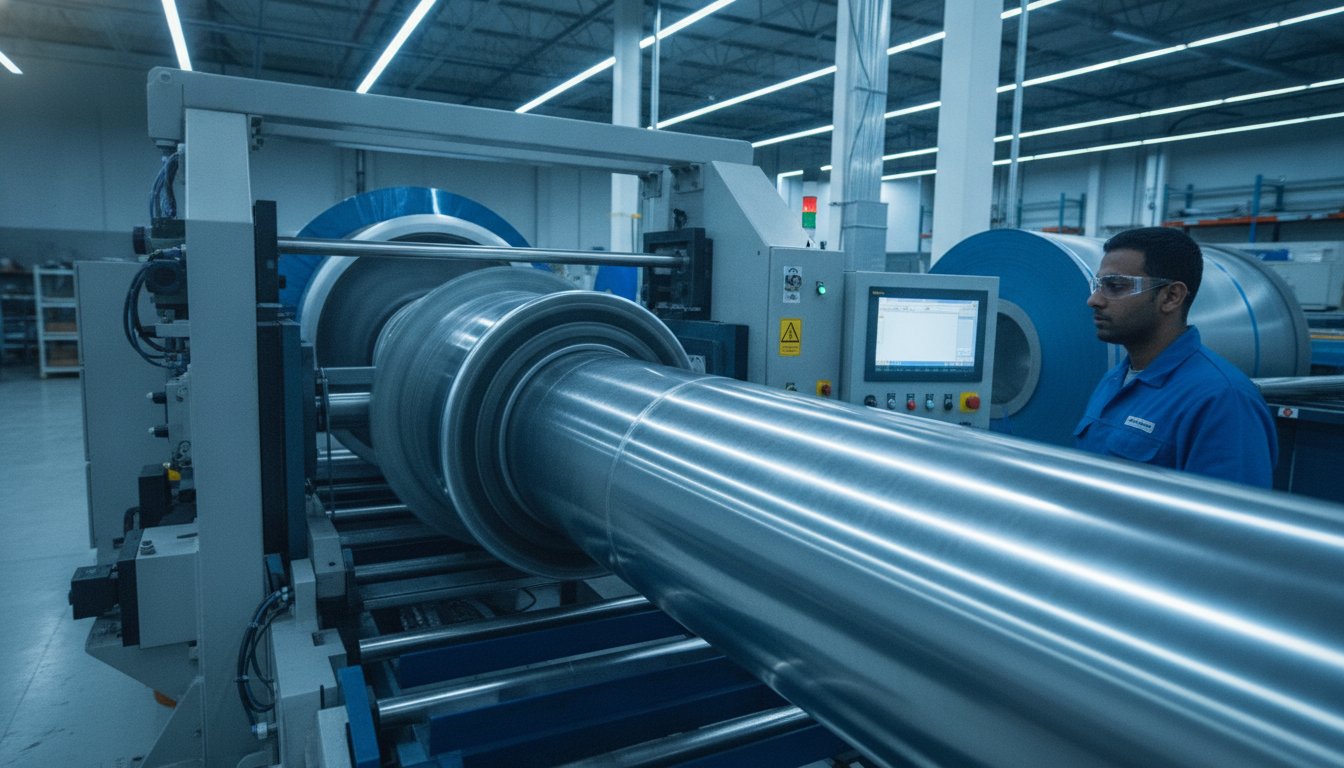
The spiral duct fabrication process is a high-speed manufacturing method that transforms flat metal strips into rigid, cylindrical conduits. It's an exercise in mechanical precision. Unlike manual folding or traditional longitudinal welding, this process relies on a continuous spiral forming machine to create a permanent mechanical lock-seam. This seam winds around the duct body like a thread on a screw. It creates a product that offers superior structural integrity without the unnecessary weight of heavy-gauge sheet metal. It's the backbone of modern airflow management.
Modern production lines utilize three primary components: galvanized steel coils, interchangeable forming heads, and high-speed flying slitters. The coils provide the raw material. The forming heads dictate the specific diameter. The flying slitters cut the finished duct to exact lengths without stopping the production flow. This allows for rapid, continuous output. These systems are essential for high-velocity commercial HVAC, industrial exhaust, and high-pressure dust collection systems where failure isn't an option. Efficiency starts on the factory floor.
The Role of Galvanized Steel in Spiral Production
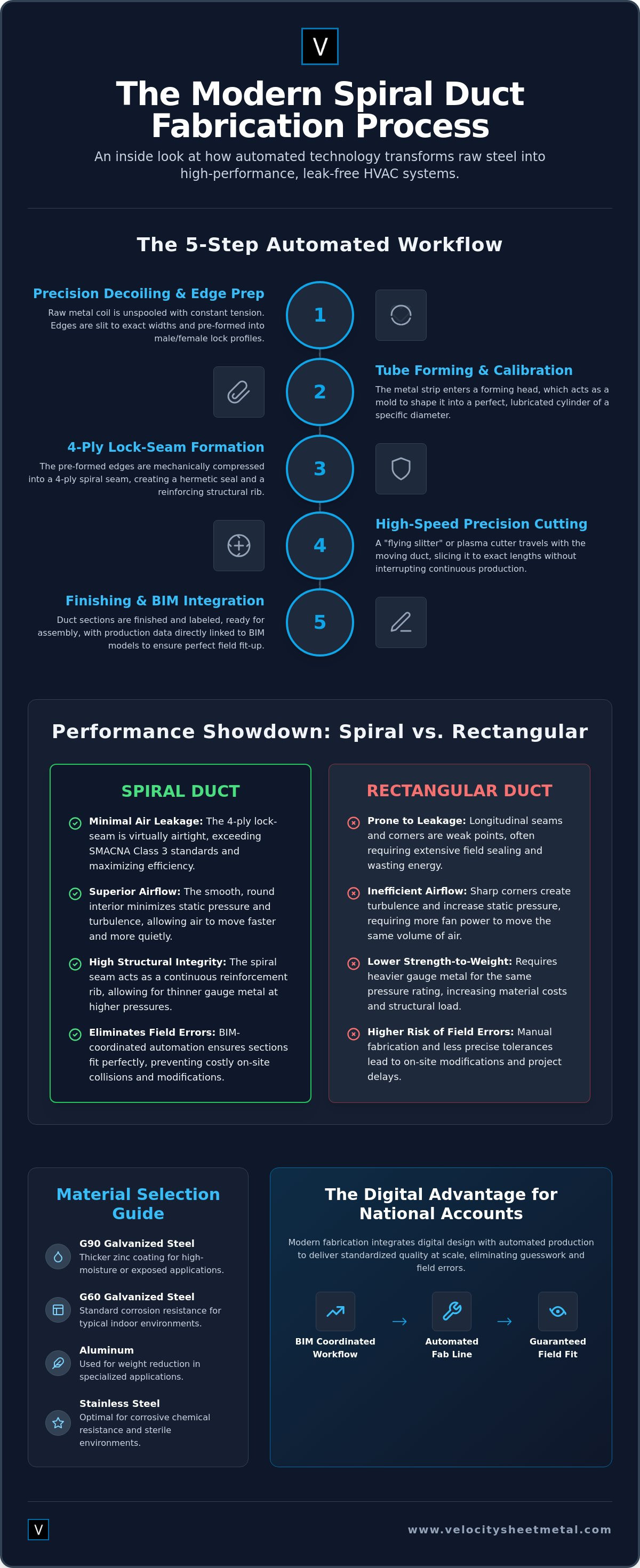
Refining the spiral duct fabrication process requires an obsession with coil quality. Precision begins with the substrate. Most commercial projects utilize G60 or G90 galvanized coatings. G60 offers standard corrosion resistance for typical indoor environments. G90 provides a thicker zinc layer, making it the industry standard for high-moisture or exposed applications. Consistency in coil width is non-negotiable. Even a minor variation in width can compromise the lock-seam's tightness. This leads to pressure loss and system inefficiency. While galvanized steel is the workhorse, specialized environments often require aluminum for weight reduction or stainless steel for corrosive chemical resistance. We match the material to the mission.
Spiral vs. Longitudinal Seams: A Brief Overview
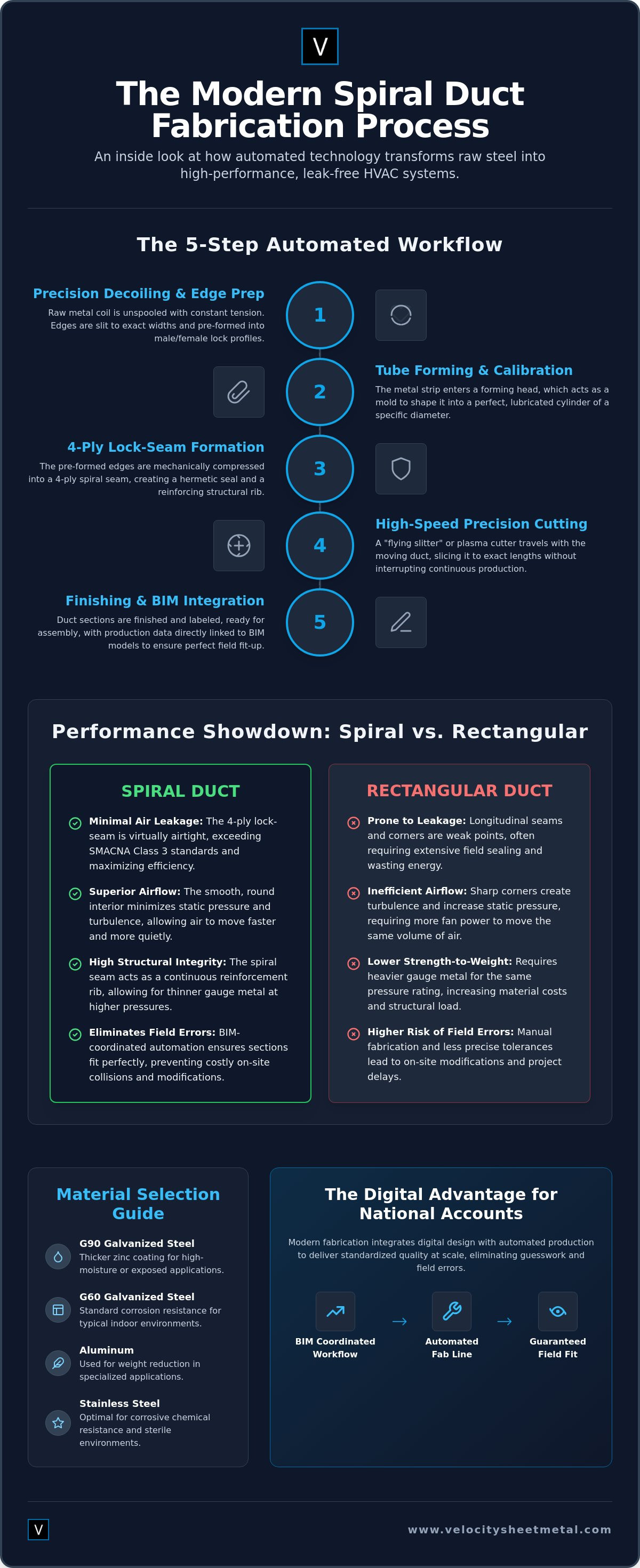
Traditional rectangular ducts rely on longitudinal seams. These seams are often the weakest point of the assembly. In contrast, the 4-ply spiral lock-seam acts as a continuous external reinforcement rib. This structural "spine" allows thinner gauges of metal to handle significantly higher pressures than their rectangular counterparts. It's a massive strength-to-weight advantage. This design minimizes air leakage, often exceeding the strictest SMACNA Class 3 requirements. It ensures that the air you're moving actually reaches its destination. It's the difference between a system that struggles with static pressure and one that operates with surgical efficiency.
The 5-Step Spiral Duct Fabrication Process
The spiral duct fabrication process is a synchronized five-step sequence. It converts flat material into high-performance HVAC components with minimal human intervention. Speed and precision are the primary outputs. This automated workflow ensures that every section of duct meets exact engineering specifications before it leaves the shop floor. It's a methodical transition from raw coil to finished product.
Precision Decoiling and Edge Preparation
Decoiling is the foundation of continuous feed accuracy. It begins with heavy-duty coil cradles that feed raw metal strip into the machine at a constant tension. The slitter plays a critical role here; it maintains exact diameter tolerances by trimming the strip to a precise width. If this width fluctuates by even a fraction of an inch, the final diameter will drift. During this stage, pre-form rollers shape the edges into male and female lock profiles. We calibrate these rollers based on material thickness. Heavier gauges are required as the duct diameter expands. For example, a 48-inch duct often requires 22-gauge steel to maintain structural integrity, while a 10-inch run might only need 26-gauge.
The Forming Head and Diameter Calibration
Once pre-formed, the metal strip enters the heart of the machine. Different forming head sizes dictate the final duct diameter. These heads act as a precision mold, forcing the metal into a perfect cylinder. High-speed metal forming generates significant heat and friction, so an internal lubrication process is required to protect the galvanized coating and the machinery. As the edges meet, they are compressed into a 4-ply lock-seam. This creates a "hermetic" seal that is virtually air-tight. It's the point where raw material becomes a rigid structural component.
The final stages focus on length and assembly readiness. A flying slitter or plasma cutter tracks the moving duct, slicing it into precision lengths without interrupting the spiral duct fabrication process. This ensures zero downtime and consistent output. Finally, we apply finishing touches like beads for added rigidity, crimps for easy joining, or specialized gaskets for high-pressure seals. Our spiral and round duct and fittings are designed for rapid field installation, reducing your labor costs on-site. Every step is optimized for speed and reliability.
Critical Lock-Seam Variations and Structural Integrity
The lock-seam is the structural heart of the pipe. It's the defining feature of the spiral duct fabrication process, separating high-performance conduits from standard longitudinal alternatives. The quality of this seam determines the system's static pressure rating and its acoustic performance. If the seam isn't tight, you get "whistling" at high velocities. This is a catastrophic failure of the fabrication process. We focus on mechanical precision to ensure every seam is a permanent, air-tight bond.
Lock-seam variations are selected based on the specific demands of the project. The Double Seam is the industrial gold standard. It provides a non-releasable mechanical bond essential for high-pressure commercial HVAC where air leakage must be near zero. In contrast, Snap Lock variations offer a balance between convenience and performance. They allow for nested shipping, where smaller diameters are tucked inside larger ones to reduce freight costs. However, Snap Lock requires more attention during field assembly to maintain integrity. Reeves Lock remains a specialized shop variation, though it's less common in high-speed automated production. Choosing the right lock is a trade-off between shipping logistics and ultimate system pressure.
Engineering for High Static Pressure
Spiral seams aren't just for show; they act as continuous external reinforcement. This structural "spine" allows us to use lighter gauges of metal while maintaining higher pressure ratings. For instance, a spiral duct can often utilize 24-gauge steel in applications where a rectangular duct would require 20-gauge to prevent wall deflection. Rigidity is also a function of seam frequency. Increasing the number of spirals per linear foot directly improves the pipe's resistance to collapsing or bursting. This follows SMACNA 4th Edition standards for duct reinforcement, minimizing the need for bulky external stiffeners or internal tie rods that disrupt airflow.
Beading and Crimping for Seamless Field Jointing
Precision manufacturing must translate to field efficiency. This is where beading and crimping become critical. A bead acts as a positive stop for the next length of duct. It ensures the installer doesn't over-insert the pipe, keeping the internal airflow path consistent and predictable. Uniform crimps are equally non-negotiable. We utilize automated crimping to create the "male" end for nested assembly. If a crimp is inconsistent, field labor hours skyrocket as installers struggle to force joints together. A perfect spiral duct fabrication process ensures that every joint fits the first time, every time. It turns a complex installation into a streamlined assembly line.
Efficiency Gains: Why Spiral Outperforms Rectangular
Spiral ducting isn't just a different shape; it's a superior engineering choice. The spiral duct fabrication process produces a conduit with a higher strength-to-weight ratio than any rectangular equivalent. This structural advantage translates directly into project savings. Round duct minimizes air leakage by eliminating the four corners found in rectangular systems. Those corners are notorious for pressure loss and require significant sealing labor. By contrast, a spiral seam is continuous and mechanically locked. It's built for performance.
The physics of airflow favor the circle. Smooth interior walls and a round profile optimize airflow velocity. This reduces the static pressure the fan must overcome. You can move the same volume of air through a smaller round duct than a rectangular one. This geometry results in roughly 20% less metal surface area for the same capacity. You save on material costs. You reduce the weight the ceiling structure must support. Installation speed is the final win. We fabricate sections in lengths up to 20 feet. Fewer joints mean faster hang times and fewer potential leak points in the field.
The Impact on HVAC System Operating Costs
Lower leakage rates aren't just a construction metric; they're a long-term financial benefit. High-efficiency systems rely on maintaining specific pressures. When air stays inside the duct, fan energy consumption drops. This reduces monthly utility bills for the building owner. There's also an acoustic benefit. Round duct is naturally more rigid, which minimizes the "oil-canning" noise common in rectangular systems under high pressure. For projects requiring massive volumes of straight runs, we also provide coil line duct fabrication to handle rectangular needs with similar automated precision.
BIM Coordination: Eliminating Field Collisions
The spiral duct fabrication process now begins in a digital environment. We use BIM models to ensure every fitting is fabricated to the exact project angles required. This bridges the gap between design and the factory floor. Through a process called "spooling," we break down complex 3D models into individual, taggable parts. This 3D coordination prevents costly rework in congested ceiling spaces where mechanical, electrical, and plumbing lines compete for inches. You get a kit of parts that fits the first time. It eliminates the "measure twice, cut once" delays that stall modern job sites. If you're ready to upgrade your next project with precision-engineered components, request a fabrication quote from Velocity Sheet Metal today.
Standardizing Production for National HVAC Accounts
Standardized quality is the only way to protect project margins on a national scale. When you're managing multiple job sites across the country, you can't afford the variance that comes with local, manual fabrication shops. One shop's "standard" might be another's failure. Automated fabrication lines eliminate these variables. They produce exact replicas of every component, ensuring that a fitting delivered to a site in Texas matches the precision of one sent to New York. This consistency is the primary output of a mature spiral duct fabrication process. It turns your mechanical schedule into a predictable, repeatable workflow.
Scaling production requires more than just fast machines; it requires a bridge between digital design and physical delivery. We integrate custom laser cutting into our workflow to handle specialized transitions and complex fittings that standard forming heads can't produce alone. This ensures that even the most difficult project requirements are met with the same automated accuracy as a straight run of pipe. By centralizing your fabrication with a single national partner, you eliminate the administrative delays and quality disputes that stall large-scale commercial developments.
On-Demand Fabrication and National Logistics
Partnering with a fabricator that ships nationwide provides a significant competitive advantage. It allows you to maintain a single point of accountability for your entire mechanical inventory. Our high-volume production capacity is designed to handle large-scale commercial orders without the lead-time bottlenecks typical of regional shops. Speed is useless if the product arrives damaged, so we utilize standardized packaging protocols to prevent transit issues. From heavy-duty crating to secure nesting, we ensure that every piece of ductwork arrives on-site ready for immediate installation. You keep your crews moving and your project on schedule.
Partnering with Velocity for Precision Sheet Metal
Velocity Sheet Metal acts as the essential bridge between your digital BIM files and the finished physical product. We bring 50+ years of combined industry experience to every project, handling complex industrial requirements with surgical precision. Our facility is an extension of your own team, providing the technical expertise needed to navigate the 2026 standards environment and beyond. Whether you need standard spiral runs or specialized components via our precision laser cutting services, we deliver the accuracy your project demands. The spiral duct fabrication process is only as good as the team operating the equipment. We've optimized every stage of the workflow to ensure that your national accounts receive nothing less than industrial-grade perfection. We're ready to get to work on your next spool drawing.
Optimize Your Mechanical Workflow with Precision Fabrication
Precision isn't optional. It's the baseline for project success. Moving from raw coil to a finished, BIM-coordinated product requires a spiral duct fabrication process that's both automated and methodical. You've seen how the right lock-seam and round geometry reduce air leakage while driving down operational costs. Now, it's time to apply that efficiency to your next mechanical schedule. Standardizing your production ensures that every component meets the same high-tolerance requirements, regardless of the job site location.
Velocity Sheet Metal brings 50+ years of combined industry experience to the factory floor. We specialize in BIM-integrated fabrication to ensure zero-error field assembly. We don't just make duct; we deliver a kit of parts that fits the first time. With nationwide shipping for high-volume commercial accounts, we're ready to support your project anywhere in the US. It's about more than metal; it's about maintaining your timeline and protecting your project margins.
Don't let fabrication delays or poor shop tolerances stall your progress. Get a Quote for Precision Spiral Duct Fabrication and experience the speed of a truly automated partner. We're ready to bridge the gap between your digital design and the physical product today.
Frequently Asked Questions
How is spiral duct made in a modern fabrication shop?
Modern shops utilize automated tubeformers to decoil metal strips and feed them through a series of rollers. These rollers shape the edges before the strip enters a forming head, which winds the metal into a cylinder. This spiral duct fabrication process is completed by a 4-ply lock-seam that provides permanent structural rigidity. High-speed flying slitters then cut the moving duct to precision lengths, ensuring the production line never stops.
What is the minimum and maximum diameter for spiral duct fabrication?
Standard industrial spiral machines typically produce diameters ranging from 3 inches to 100 inches. The specific range is determined by the interchangeable forming heads used during the production run. Smaller diameters are ideal for high-velocity branch lines, while the largest diameters handle massive air volumes in industrial plants. We calibrate these machines based on your BIM specifications to ensure every section fits the project's spatial constraints.
Is spiral duct more expensive than rectangular duct?
Spiral duct is generally more cost-effective than rectangular duct when you calculate the total installed cost. It uses approximately 20% less metal to move the same volume of air and requires fewer joints and hangers. While raw material costs are comparable, the speed of installation and the reduced need for external reinforcement often lead to significant savings on large-scale commercial HVAC projects.
Can spiral duct be used for high-pressure industrial exhaust?
Yes, spiral duct is the preferred choice for high-pressure industrial exhaust and dust collection. The continuous mechanical lock-seam acts as an external reinforcement rib, allowing the pipe to handle high static pressures that would cause rectangular duct to fail. For specialized exhaust needs, we utilize heavy-gauge stainless steel or aluminum to resist corrosion while maintaining the structural integrity required for industrial-grade suction.
What materials are commonly used in the spiral duct fabrication process?
The spiral duct fabrication process primarily utilizes galvanized steel in G60 or G90 grades to provide standard corrosion resistance. For specialized environments, we also fabricate using 304 or 316 stainless steel and various aluminum alloys. Some industrial applications may require Galvalume or PVC-coated steel to withstand specific chemical exposures. We match the material gauge and coating to the static pressure and environmental demands of your system.
How do you prevent air leakage in spiral duct joints?
Leakage prevention starts with the mechanical lock-seam, which is formed under high pressure to create a nearly hermetic seal. For field joints, we utilize automated crimping and beading to ensure a tight, nested fit between sections. High-pressure systems often incorporate internal coupling sleeves and specialized gaskets or mastic sealants. These methods ensure the system meets or exceeds SMACNA Class 3 leakage standards for high-performance buildings.
What are the SMACNA standards for spiral duct gauges?
SMACNA 4th Edition standards dictate the minimum metal gauge based on the duct diameter and the system's operating pressure. For instance, a 12-inch duct at a 2-inch water gauge typically requires 28-gauge steel, whereas a 48-inch duct at the same pressure requires 22-gauge. These standards prevent wall deflection and vibration. We adhere strictly to these benchmarks to ensure every component we fabricate is safe, compliant, and durable.
Can spiral duct be fabricated with internal insulation?
Spiral duct is often fabricated with internal insulation using a double-wall construction method. This involves an outer spiral shell, a layer of fiberglass or mineral wool insulation, and an inner perforated metal liner. This configuration provides excellent thermal retention and sound attenuation without sacrificing the airflow efficiency of the round profile. It's an essential solution for theater environments and exposed ceiling designs where acoustics are a priority.