Sheet Metal Shops Near Me: How to Find the Right Fabrication Partner in 2026
The closest result for “sheet metal shops near me” may not be the best fit for your project. A shop’s ability to handle the part, drawings, production volume, coordination, and delivery plan matters more than distance alone.
You need parts that match the design and arrive ready to move the job forward. Start by finding a fabrication partner that can connect project information to production, coordinate details, and support the processes your job requires. Velocity Sheet Metal provides custom laser cutting, CNC press brake bending, BIM coordination, spool drawings, and automated ductwork, with shipping available nationwide.
Use this checklist to identify the capabilities your job requires, prepare a clear fabrication request, and compare local search results with broader manufacturing support. You’ll also see how coordination and delivery factor into the decision, so you can assess the full path from drawing to finished parts.
Key Takeaways
- Choose sheet metal shops near me by project fit, not distance alone. Start with the part type, production volume, drawing requirements, and delivery needs.
- Match the job to relevant capabilities, from automated rectangular duct and spiral or round duct to fittings, curb adapters, and CNC press brake bending.
- Look beyond equipment listings. Drawing coordination and a clear handoff from digital design to fabrication can help teams identify fit issues before production.
- Prepare a stronger fabrication request by defining the part, gathering current project drawings, stating quantities, and outlining coordination needs.
- Consider how fabrication and shipping support your project from files to finished parts, whether you’re a contractor, engineer, maker, or OEM.
Searching for Sheet Metal Shops Near Me? Start With the Job
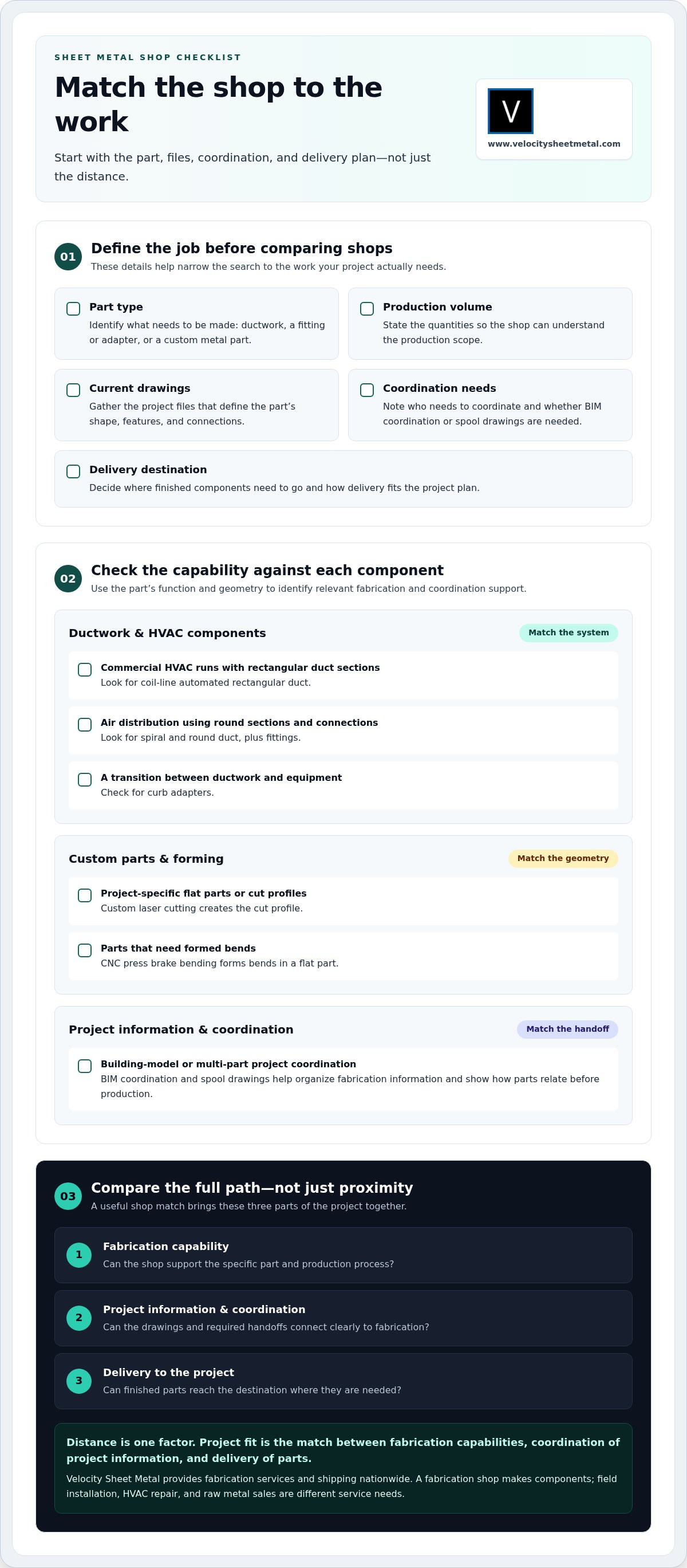
Search results for sheet metal shops near me often put distance first. They don’t tell you whether a shop can make your part, work from your project files, coordinate with the people involved, or ship finished components to the project. Start with the job itself. Identify the part type, production volume, available drawings, coordination requirements, and delivery destination before comparing shops.
These details define the work. A run of ductwork has different production needs from custom laser-cut parts or components formed with a CNC press brake. Drawings may need coordination before fabrication, and quantities help frame the production scope. Clarifying these points helps you search for a specific capability instead of relying on a broad label in a listing.
Also identify the kind of partner you need. A fabricator makes components from project requirements and drawings. That differs from a field installer who fits systems at a job site, an HVAC repair provider who services existing equipment, or a material seller that supplies stock metal. Defining the role helps you avoid a mismatch between the work you need and the business you’re searching for.
What does a sheet metal fabrication shop do?
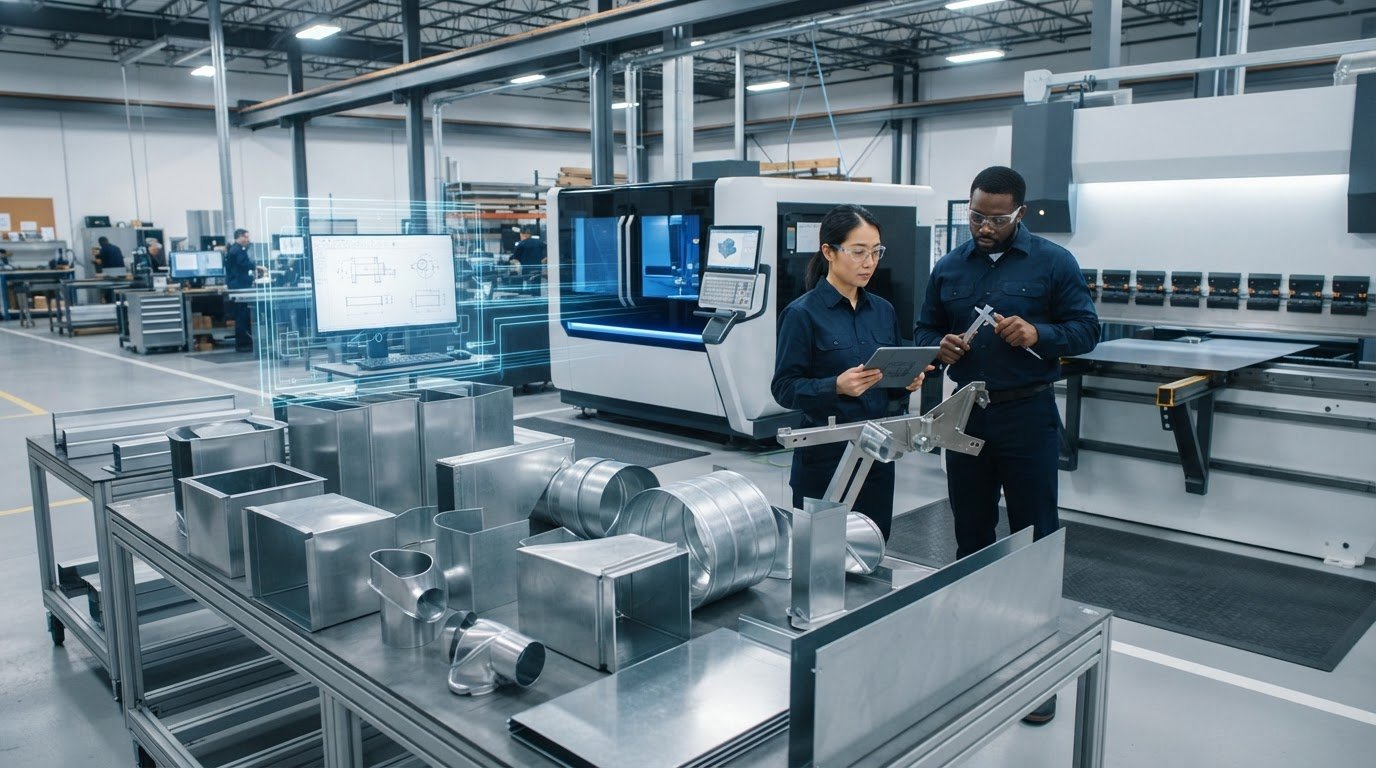
A fabrication shop turns design information into physical metal components. Work can include reviewing drawings, coordinating project details, cutting and forming material, and preparing parts for delivery. For example, HVAC ductwork may include automated rectangular duct or spiral and round duct with fittings. A custom part may instead require laser cutting or press brake bending to create its shape.
Fabrication is the component-production stage, not the full scope of every metal-related service. A shop that makes duct or custom parts isn’t automatically performing field installation, repairing residential HVAC equipment, or selling raw metal stock. Velocity Sheet Metal supports fabrication projects with automated ductwork, custom laser cutting, BIM coordination, spool drawings, curb adapters, and CNC press brake bending.
Does a nearby shop have to be the best fit?
Not necessarily. Physical distance can matter, but it doesn’t show whether a shop’s production capabilities match the part or whether project information can move cleanly into fabrication. Digital files and clear coordination connect teams across distances, while shipping gets finished components to the project. Velocity supports projects nationwide through fabrication services and shipping.
Project fit is the match between a shop’s fabrication capabilities, its coordination of project information, and its ability to deliver parts where they’re needed. Use that as your starting test. Then compare the specific work each shop can support, the files and handoffs the project requires, and how completed parts will reach their destination. Distance is one factor. The full path from design to delivery is the more useful measure.
Match Sheet Metal Shop Capabilities to Your Project
Use the part’s function and geometry to identify the processes it needs. A search for sheet metal shops near me can return a range of businesses, but a capability match is more useful than a broad “metal fabrication” label. The table below connects common project needs to relevant production and coordination capabilities.
| Project need | Relevant capability |
|---|---|
| Commercial HVAC runs with rectangular duct sections | Coil-line automated rectangular duct |
| Air distribution using round sections and connections | Spiral and round duct, plus fittings |
| A transition or interface between ductwork and equipment | Curb adapters |
| Project-specific flat parts or cut profiles | Custom laser cutting |
| Parts that need formed bends | CNC press brake bending |
| Building-model or multi-part project coordination | BIM coordination and spool drawings |
Look beyond the machine or product name. Consider how each part connects to the next, how the drawing defines that connection, and whether the project needs coordinated fabrication information. For commercial HVAC work, duct sections, fittings, adapters, and coordinated spool drawings may all be part of the production picture. The HVAC duct fabrication procurement guide offers further context for planning that scope.
Which fabrication capabilities fit HVAC and mechanical work?
Rectangular duct, spiral and round duct, and fittings serve different layouts and system requirements. Curb adapters provide a fabricated connection between ductwork and equipment. BIM coordination and spool drawings help organize fabrication information and show how parts relate before production. For a closer look at automated rectangular duct production, see the coil-line duct fabrication guide.
OSHA’s description of sheet metal work outlines the manufacturing scope associated with the trade. For buyers, the practical takeaway is to define the components required instead of assuming every shop handles the same mix of ductwork, fittings, and custom parts.
When are laser cutting or CNC bending relevant?
Laser cutting creates a part’s cut profile; press brake bending forms bends in a flat part. They address different geometry requirements and may be used separately or as steps in producing a component. The drawing helps clarify the shape, features, and bend locations, so gather the current project files before identifying the process. The precision laser cutting buyer’s guide explores cut-part considerations.
For projects that combine coordinated ductwork with custom components, bring the drawings and part requirements together at the start. Explore Velocity Sheet Metal’s fabrication capabilities to see how ductwork, laser cutting, BIM coordination, and CNC bending can support a project from design information to fabricated parts.
How to Compare Fabrication Shops Beyond Proximity
Once the required capabilities are clear, compare how each shop supports the work from drawing review through fulfillment. A useful comparison looks beyond a list of machines. Consider whether the production process fits the parts, how design information moves into fabrication, how repeat orders are handled, and how finished components reach the project.
Use these criteria to structure the comparison:
- Process fit: Match the job to the relevant capability, such as automated duct production, laser cutting, or CNC bending.
- Drawing coordination: Look for a clear way to organize project files, revisions, and part information.
- Production consistency: For recurring work, consider whether production standards can carry across repeat orders or multiple locations.
- Fulfillment: Include shipping and the delivery destination in the plan, rather than addressing them only after fabrication.
These criteria make search results for sheet metal shops near me easier to evaluate. A nearby address doesn’t show how well a shop connects design intent to manufactured parts or whether its fulfillment model fits the project. A partner that ships more broadly may be a practical fit when its capabilities, coordination, and shipping align with the job.
What role do drawings and BIM coordination play?
Drawings and models carry the instructions that turn a design into fabricated components. If project information is unclear or disconnected from production, teams may have to resolve questions late in the process. BIM coordination and spool drawings help organize fabrication information and show how parts relate within the project. Velocity Sheet Metal provides both services to connect digital project information with fabrication.
Coordination connects digital planning to physical production by organizing project information around the parts that need to be made. That handoff matters whether a job involves ductwork, fittings, or custom components. Clear, coordinated files give fabrication a usable reference and help project teams work from aligned information.
How can buyers think about repeatability across projects?
Recurring or multi-location work calls for more than producing one acceptable order. Parts and production need to follow consistent standards from project to project. Velocity’s national account partnerships emphasize standardized quality and production standards, supporting customers who need a repeatable approach across their work. This is particularly relevant when multiple teams rely on coordinated parts.
Experience also matters when managing fabrication decisions and project demands. Velocity Sheet Metal’s management team brings more than 50 years of combined industry experience. That background supports practical conversations about production and coordination, alongside clear project requirements. Compare the process, project information, repeatability needs, and delivery plan to assess overall fit.
Prepare a Clear Request for Sheet Metal Fabrication
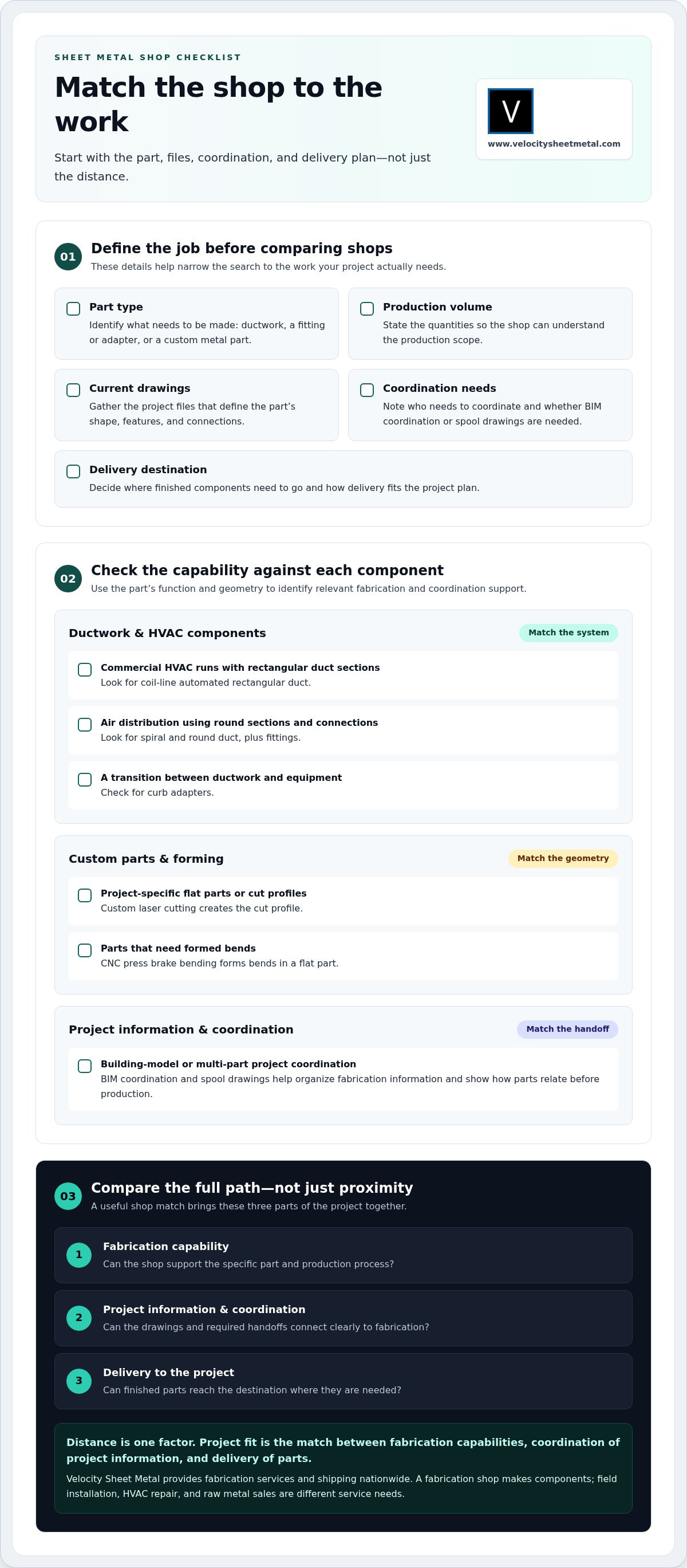
A well-prepared request gives a fabrication team the information needed to understand the part and its role in the project. Before contacting sheet metal shops near me, organize the requirements in a clear sequence. Include the intended use, relevant dimensions, quantity, current drawings, coordination needs, and schedule context. A target date helps frame the project and its delivery needs.
- Define the part. Describe what it needs to do and where it fits in the assembly or system. Note important features, connections, or interfaces shown in the design.
- Gather the current drawings. Send the project files that represent the intended design. Include useful dimensions and identify the current revision so older versions aren’t mistaken for the one to fabricate.
- State quantities. Give the requested count and explain whether the work is a one-time requirement or part of recurring production. This helps frame the scope.
- Identify coordination and delivery needs. Note whether BIM coordination, spool drawings, or other drawing support is relevant, along with the destination and schedule context for shipment.
Which project details help scope the work?
Provide part requirements alongside the drawings, not as disconnected notes. Explain the component’s intended use, call out dimensions that affect its fit, and specify which revision is current. If the project includes related parts or a larger assembly, share enough context to show how the requested component connects to the whole. Clear revision information distinguishes design changes from superseded details.
For projects built around digital models and coordinated design information, the BIM coordination guide for sheet metal fabrication provides more context on moving from digital planning toward production. Complete inputs help align the requested work with fabrication requirements and make coordination needs visible early.
How does a digital request move toward delivery?
The workflow begins with project information: drawings, part requirements, quantities, and context. BIM coordination or spool drawings can organize that information. The parts then move into the relevant fabrication process, such as automated ductwork, custom laser cutting, or CNC press brake bending, before shipment to the project destination.
Coordinated files guide the handoff from project design to fabricated parts and shipment. Velocity Sheet Metal supports fabrication projects from technical coordination through shipping, connecting project information with physical production. Share the current project files and scope to put that workflow in motion: Submit your fabrication project information.
Work With Velocity Sheet Metal From Project Files to Fabrication
For contractors, engineers, makers, and OEMs, the right fabrication partner connects project requirements to parts that can be produced and shipped. Velocity Sheet Metal supports that workflow with automated HVAC ductwork, custom laser cutting, CNC press brake bending, BIM coordination, and spool drawings. These capabilities support commercial ductwork and project-specific sheet metal parts, with coordination for designs involving multiple components or shared project information.
A search for sheet metal shops near me can surface nearby listings, but your project may need a specific combination of fabrication and coordination. Velocity serves projects nationwide through shipping. For organizations managing recurring work, national account partnerships emphasize standardized quality and production standards. That can align production expectations across projects without making distance the deciding factor.
Which projects can Velocity support?
Velocity supports commercial HVAC ductwork projects with coil-line automated rectangular duct, spiral and round duct, fittings, and curb adapters. For custom components, laser cutting and CNC bending support project-specific part requirements. BIM coordination and spool drawings organize fabrication information when digital coordination is part of the project. These capabilities serve contractors, engineers, makers, and OEMs seeking fabricated components, rather than field installation or equipment repair.
Each project starts with its own requirements. A mechanical contractor may need coordinated duct components; an engineer may need fabrication information aligned with a building model; an OEM may need parts for its equipment or assembly. Sharing the project context helps connect the requested work with an appropriate fabrication approach.
What is the next step for a fabrication project?
Bring the essential inputs together before submitting a project: current drawings, part details, quantities, applicable dimensions, and coordination requirements. Identify the current drawing revision and include the intended use or assembly context where it helps explain how the parts fit into the job. Add the delivery destination and schedule context so the request reflects the full project need.
With those details in hand, Velocity can support the project from technical coordination through fabrication and shipping. The handoff moves from organized project files to manufactured parts, with capabilities matched to the scope. Clear inputs give the team a practical starting point and keep the request grounded in the work required.
Ready to move your project forward? Share your sheet metal fabrication requirements with Velocity, including the drawings, quantities, and coordination needs that define the job.
Put Your Fabrication Plan in Motion
The best result from searching for sheet metal shops near me is a partner that can move your project from requirements to production with the right capabilities and coordination. Before taking the next step, make sure the scope, drawings, quantities, and delivery expectations are clear. A focused project brief gives everyone a stronger starting point.
Velocity Sheet Metal works with contractors, engineers, makers, and OEMs on fabrication needs, backed by a management team with more than 50 years of combined industry experience. Nationwide shipping and national account partnerships support projects that call for delivery across the country or standardized production across multiple jobs.
Have a project ready to scope? Share your project requirements with Velocity Sheet Metal and take the next step from design information toward fabricated parts. Include your drawings and project details to start a practical conversation about the work ahead.
Frequently Asked Questions
What does a sheet metal shop make?
A sheet metal shop makes fabricated components, including HVAC ductwork and custom parts built to project requirements. Depending on the job, components may include rectangular duct, spiral or round duct, fittings, laser-cut parts, or bent pieces. Fabrication produces components; it doesn’t place ductwork in a building or diagnose and repair existing HVAC equipment. For example, a contractor may source duct sections from a fabricator and coordinate field installation separately.
How do I choose a sheet metal fabrication shop near me?
Compare process fit, drawing coordination, production consistency, and fulfillment, not just distance. A shop’s capabilities should match the part and quantity, while its coordination approach should support the project information your team uses. For repeat orders, consider whether production standards can carry across jobs. Also account for shipping and delivery needs. Velocity Sheet Metal provides fabrication, BIM coordination, and nationwide shipping to support projects beyond nearby search results.
Can a sheet metal shop ship parts nationwide?
Yes. A fabricator can serve a project beyond its immediate area when it ships to the required destination. Nationwide delivery is an important comparison point when a project requires particular fabrication or coordination capabilities that aren’t defined by the closest listing. Velocity Sheet Metal ships nationwide, supporting customers across the United States. Include the delivery destination and schedule context in your request so fulfillment is considered alongside fabrication.
What information should I send for a sheet metal fabrication project?
Send current drawings, clear part requirements, requested quantities, and revision context. Include dimensions or features that affect how a component connects to other parts, plus the intended use if it clarifies the design. Identify the current drawing version and distinguish it from superseded files. For example, if a revised opening changes a part’s fit, call out that revision so the fabrication request reflects the intended design.
Can sheet metal shops work from BIM files or digital drawings?
Yes, digital project information can support fabrication planning when it’s coordinated and clearly tied to the parts being produced. BIM coordination and spool drawings help organize design details and connect model information with fabrication needs. Share relevant project context, identify the current model or drawing revision, and flag changes that affect component relationships. Velocity Sheet Metal provides BIM coordination and spool drawings to help bridge digital planning and physical production.
What is the difference between sheet metal fabrication and HVAC installation?
Fabrication makes the metal components; HVAC installation places and connects system components at a project site. A fabricator may produce duct sections, fittings, or custom parts from project requirements and drawings. Installation involves fitting those components into the building’s system. The scopes are related but distinct, so a request for manufactured ductwork is different from a request to install it or repair existing HVAC equipment.
Can one fabrication partner support recurring or multi-location projects?
Yes. A fabrication partner can support recurring or multi-location work when the project needs a consistent production approach and coordinated fulfillment. Clear drawings, shared part requirements, and documented revisions help teams carry expectations from one job to the next. Velocity Sheet Metal supports national accounts with standardized quality and production standards. This provides a framework for repeat work without implying that every project or outcome will be identical.