Sheet Metal Laser Cutting and Bending: Precision Fabrication for 2026 Industrial Standards
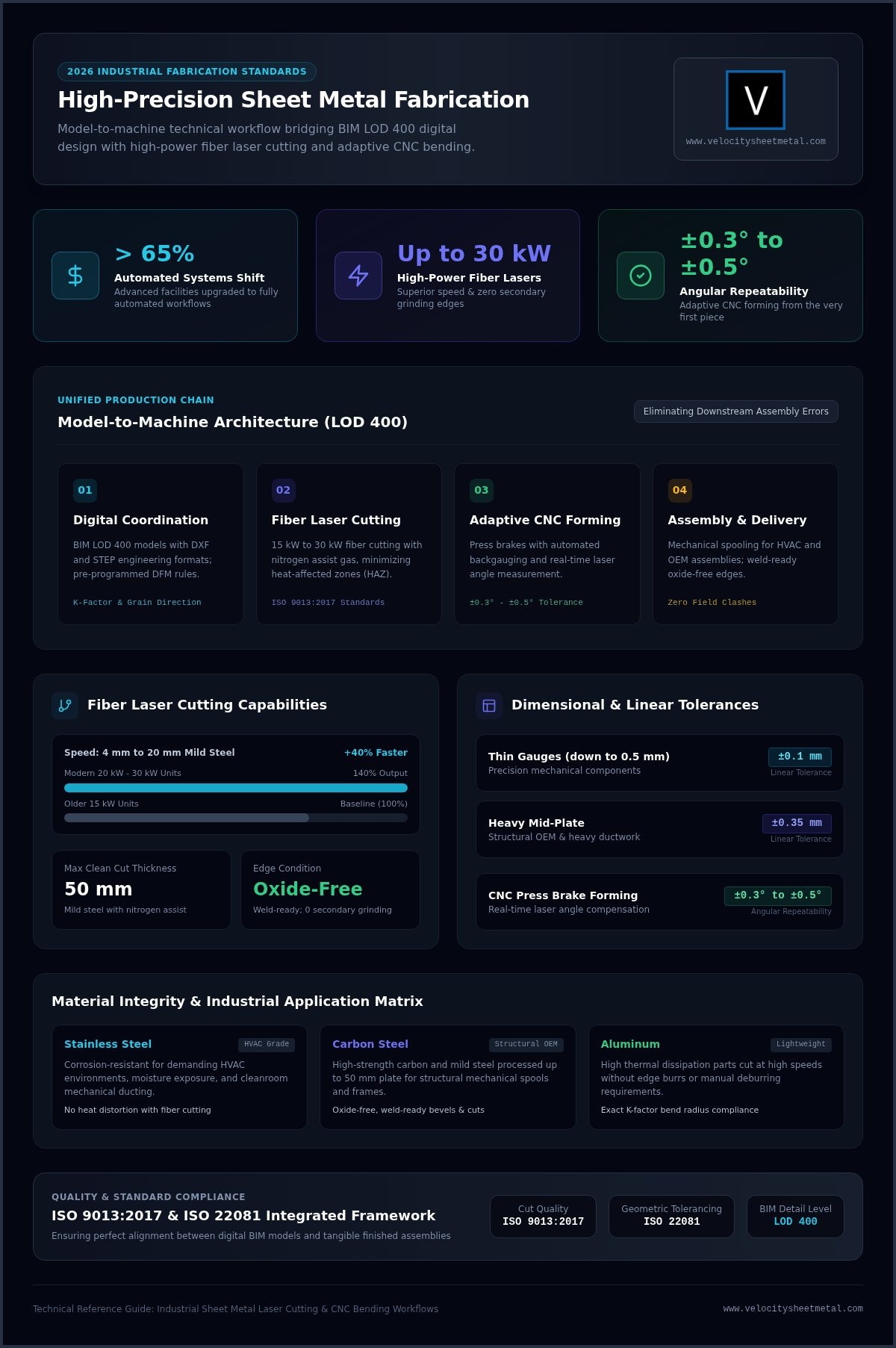
Did you know that over 65% of advanced fabrication facilities have now shifted to fully automated systems to meet the rigorous demands of 2026 industrial standards? If you're managing large scale HVAC projects, you've likely felt the sting of material waste when poor tolerances lead to scrap. You can't afford project delays or field clashes because your sheet metal laser cutting and bending doesn't match the BIM model. You need a workflow that bridges the gap between a digital file and a tangible, high precision product.
We understand that in a modern workshop, precision isn't just a goal; it's a requirement for survival. This article will help you master the technical essentials of industrial fabrication to streamline your production and HVAC coordination. We'll show you how to achieve high precision parts that fit the first time, reducing field labor through mechanical spooling and scalable partnerships. We will explore the shift toward 30 kW fiber lasers, the move to ISO 22081 standards, and the model to machine workflow that defines LOD 400 fabrication. By the end, you'll have the roadmap to turn complex industrial tasks into a controlled, repeatable process.
Key Takeaways
- Learn how integrating precision cutting with CNC bending eliminates downstream assembly errors and significantly reduces material waste.
- Understand the technical capabilities of high-power fiber lasers and adaptive CNC forming to achieve repeatable tolerances within ISO standards.
- Master the model-to-machine workflow using BIM coordination to ensure your sheet metal laser cutting and bending perfectly matches your digital models.
- Optimize your engineering files for manufacturability by applying precise K-factor calculations and DFM rules for DXF and STEP formats.
- Discover how to leverage scalable fabrication and nationwide shipping to streamline logistics for high-volume industrial accounts.
The Synergy of Precision: Why Laser Cutting and Bending Define Modern Fabrication
Modern industrial production doesn't treat cutting and forming as separate events. Instead, sheet metal laser cutting and bending function as a unified, high-speed workflow. When the initial laser cut is precise to within ISO 9013:2017 standards, the subsequent CNC bend follows with surgical accuracy. This integration eliminates the downstream assembly errors that traditionally forced expensive field modifications. It's about moving from a digital file to a finished part without the friction of manual adjustment or "trial-and-error" shop floor fixes.
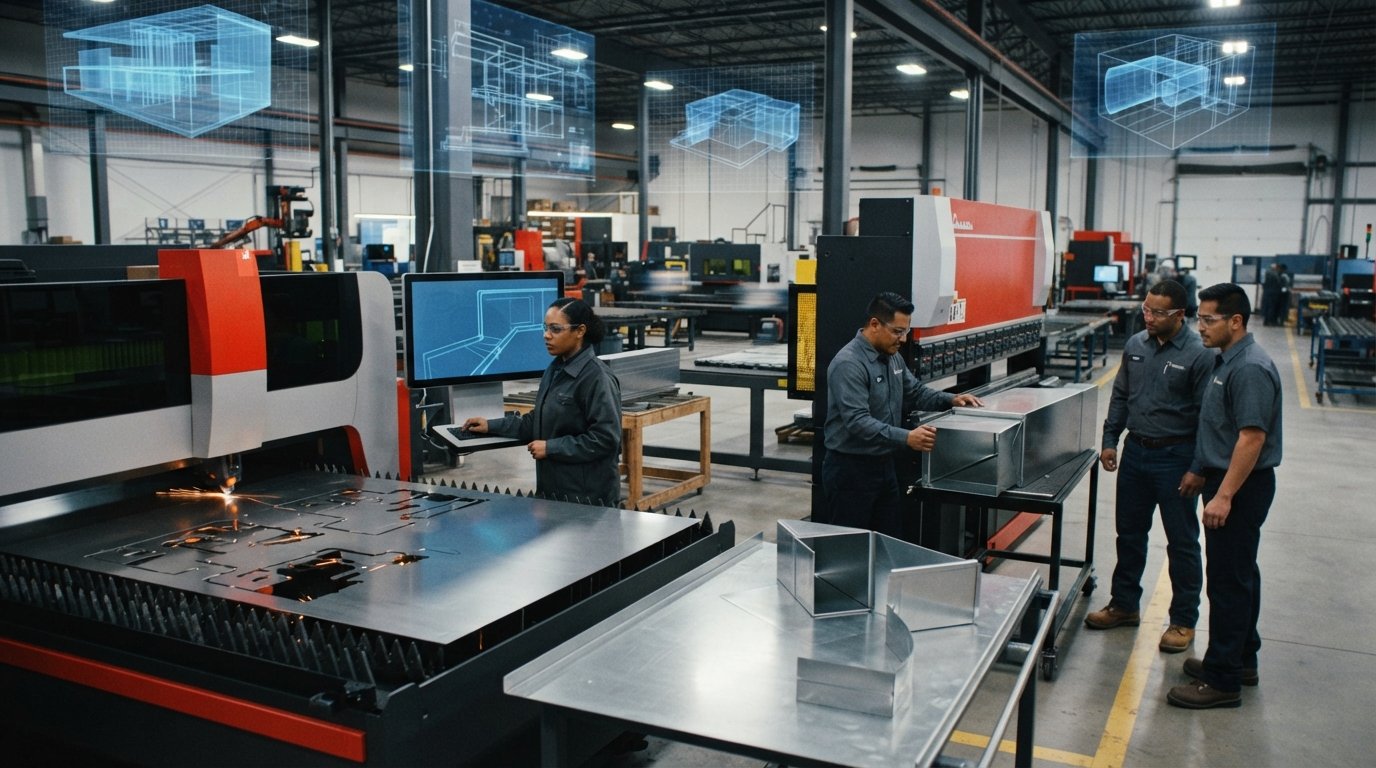
The 2026 industrial landscape demands a "digital-to-physical" approach. We utilize BIM models to drive automated machinery, ensuring that what's designed in the office is exactly what arrives on the job site. This relies on established sheet metal fabrication processes that prioritize material integrity and dimensional stability. Selecting the right alloy is vital. From corrosion-resistant stainless steel for HVAC environments to high-strength carbon steel for structural OEM components, material choice dictates industrial performance.
The Evolution of Sheet Metal Laser Cutting
The transition from legacy CO2 systems to high-speed Fiber laser technology has redefined production speeds. Modern fiber platforms, often reaching 30 kW, cut through heavy plate with a speed and edge quality that was once impossible. This versatility allows us to process stainless steel, aluminum, and carbon steel without the risk of heat distortion. Achieving tight tolerances for complex mechanical components is now the industrial baseline. We focus on clean-cutting mild steel up to 50 mm, providing oxide-free, weld-ready edges that require zero secondary grinding or prep work.
CNC Bending: Adding the Third Dimension
A precision cut is useless if the forming stage fails. CNC press brakes provide the repeatability necessary for large industrial batches. By utilizing automated backgauging and real-time laser angle measurement, we ensure every flange meets the exact specifications of the shop drawing. This is critical for HVAC ductwork and OEM parts where even a minor deviation can cause clashes in the field. Bending accuracy is the bridge between a flat blank and a functional mechanical component. It ensures your spool drawings translate perfectly into physical assemblies that fit the first time. Our workflow accounts for material grain direction and K-factors to guarantee that the final geometry matches the BIM model exactly.
Technical Excellence: Fiber Laser Capabilities and CNC Forming Tolerances
Industrial production in 2026 relies on high-power fiber laser systems operating between 15 kW and 30 kW to deliver superior sheet metal laser cutting and bending results. These machines aren't just faster; they're more precise. Modern 20-30 kW platforms cut 4 mm to 20 mm mild steel up to 40% faster than older 15 kW units. This speed doesn't compromise quality. Using nitrogen assist gas, these systems produce oxide-free, weld-ready edges that eliminate the need for secondary finishing. This level of industrial laser cutting capabilities ensures that every component meets the strict requirements of ISO 9013:2017.
Consistency is the hallmark of modern CNC press brake services for OEMs. Adaptive forming systems now achieve angular repeatability of ±0.3° to ±0.5° from the first piece. This eliminates the manual trial-and-error scrap that plagued legacy shops. By integrating sheet metal laser cutting and bending into a single, cohesive technical workflow, we ensure that parts align perfectly with BIM LOD 400 requirements. If your project demands this level of precision, it's time to partner with a fabricator that prioritizes model-to-machine accuracy.
Precision Laser Cutting Specification Standards
Accuracy varies by material thickness. For thin gauges down to 0.5 mm, linear tolerances stay within ±0.1 mm. As we move into heavier mid-plate, tolerances expand slightly to ±0.35 mm. Heat-affected zones (HAZ) are significantly reduced in fiber systems compared to CO2, preserving the material's structural integrity. This precision is vital for mechanical components that must slide into place without field adjustment. We move from digital concepts to physical reality by maintaining Range 1 and Range 2 quality standards across all production runs.
CNC Press Brake Bending Limits
Forming heavy-gauge material requires a deep understanding of tonnage and bend length capacity. We follow DIN 6935:2011-10 standards for flat blank development, ensuring K-factors are calculated with surgical precision. To avoid forming defects, we adhere to strict design rules:
- Minimum Flange Length: Must be at least four times the material thickness (4t) to prevent slipping into the V-die.
- Hole-to-Bend Relief: Cutouts must be placed at a distance of at least 2t + R from the bend tangent to prevent distortion.
- Relief Notches: Width must be equal to or greater than sheet thickness (w ≥ t) to prevent material tearing.
These parameters allow for complex, multi-stage bending for industrial enclosures while maintaining structural strength. Using closed-loop, in-process measurement, we compensate for material thickness variance and grain direction in real time. This ensures that every part, from the first to the thousandth, remains identical.
From Model to Machine: How BIM Coordination Enhances Fabrication Accuracy
The gap between a 3D model and a physical installation often leads to field fixes that bleed budgets dry. We close this gap through a dedicated model-to-machine workflow. This process ensures that every piece of sheet metal laser cutting and bending is driven directly by high-fidelity BIM data. By utilizing BIM for sheet metal fabrication, mechanical contractors move from abstract design to fabrication-ready LOD 400 geometry. This isn't just about cutting metal; it's about manufacturing a fully coordinated system that eliminates the administrative delays typical of traditional shops. Our management team, with over 50 years of combined experience, understands that a digital file is only as good as the physical part it produces.
Mechanical Spooling and Spool Drawings
Converting a massive mechanical model into fabricatable parts requires surgical precision. We break down complex duct runs and structural assemblies into individual spools. These spool drawings provide the exact roadmap for our automated machinery, including our coil-line and laser tables. Each part is tagged and labeled during the production process to match the project's digital identifiers. This ensures that when the shipment arrives, your field crew knows exactly where every component fits without searching through a pile of raw stock. Pre-fabricated assemblies can reduce field labor significantly, turning a chaotic job site into an efficient assembly line. It moves the complexity from the field to the factory floor, where we can control every variable with absolute certainty.
Eliminating Field Collisions
Field collisions are the primary cause of project delays and cost overruns. When parts don't match the coordination model, crews resort to forced fits or on-site modifications. This compromises system performance and wastes valuable material. Our integration of BIM coordination with automated duct production ensures that every flange and radius is perfect. We follow precision sheet metal bending practices to guarantee that physical parts mirror their digital twins. Clash detection happens in the software, not in the ceiling. This proactive approach saves thousands in rework costs and keeps national accounts on schedule. It accelerates project timelines for large-scale HVAC installations by ensuring that every component of your sheet metal laser cutting and bending order fits the first time. We act as the essential bridge between your digital files and a tangible, high-performance product.
Optimizing Your Workflow: Design for Manufacturability (DFM) in Sheet Metal
Efficiency starts in the CAD environment. High-quality sheet metal laser cutting and bending relies on digital files that translate seamlessly to the factory floor. If your geometry is cluttered with duplicate lines or inconsistent units, you're inviting production delays. We bridge the gap between design and delivery by applying strict DFM principles. It turns a digital concept into a physical product with zero field rework. Our process moves your project from the initial technical review to the final logistics of delivery with surgical precision.
File Preparation for Laser Cutting
Your 2D DXF files must be clean for automated processing. Remove all construction lines, hatch patterns, and text layers to prevent the laser from misinterpreting the cut path. For 3D STEP files, ensure the model represents the final formed state. This allows our integrated software to calculate the flat pattern and bend deductions in seconds. Standardizing units across all files prevents scaling errors during national fabrication runs. We utilize high-yield nesting software to minimize material scrap. This reduces costs and accelerates the production line by optimizing the laser's movement across the sheet.
Designing for the Press Brake
Bending accuracy depends on the K-factor. This neutral-axis correlation formula, defined by DIN 6935:2011-10, determines exactly how much the material stretches during forming. If your bend allowances are calculated incorrectly, your final dimensions'll fail ISO 22081:2021 profile tolerances. Springback is the physical phenomenon where metal partially returns to its original shape after the bending force is removed, a variable our CNC press brakes automatically correct using 100 Hz laser sensing arrays. To ensure a successful bend, follow this industrial checklist:
- Minimum Hole Diameter: Keep the diameter equal to or greater than the material thickness (1.0t) to prevent nozzle blowback.
- Hole-to-Bend Clearance: Place all cutouts at least 3t away from the bend tangent to avoid oval distortion.
- Minimum Flange Length: Ensure flanges are at least four times the material thickness (4t) so they span the lower V-die safely.
- Grain Direction Awareness: Orient critical bends perpendicular to the rolling grain to prevent material cracking and maintain strength.
Strategic part orientation is vital. Bending parallel to the rolling grain of cold-rolled sheet significantly increases the risk of structural failure. We analyze every layout to ensure bends are oriented at 90 or 45 degrees to the grain. This methodical approach guarantees that every component of your sheet metal laser cutting and bending order is built for industrial performance. Optimize your next project by partnering with our engineering team for a full DFM review.
Scalable Fabrication Solutions for National Contractors and OEMs
Managing large scale industrial projects requires more than just a local shop with a laser. It demands a partner capable of handling high volume output while maintaining surgical precision across every piece. National accounts often struggle with fragmented local sourcing. This leads to inconsistent quality and assembly headaches in the field. By centralizing your sheet metal laser cutting and bending needs, you ensure that every part meets the same rigorous 2026 industrial standards. We act as the authoritative bridge between your digital BIM models and a tangible, high performance product delivered anywhere in the country. Our management team brings over 50 years of combined experience to every production run, ensuring we handle the administrative and technical hurdles that slow down smaller operations.
Standardization for National Accounts
Consistency is the foundation of scalable production. When you're managing multiple mechanical engineers and various project sites, you can't afford deviations in material gauge or bend accuracy. Centralized fabrication eliminates the "local shop variance" that plagues national procurement. We provide a streamlined process that moves from initial technical review to final delivery with predictable results. This approach is essential for HVAC duct fabrication for mechanical contractors who need parts to fit perfectly the first time. It's about reliability and technical capability that local vendors simply cannot match at scale. We treat your national account as a partnership, providing the same high end engineering standards across every zip code.
Automated Production and Logistics
Speed in high volume manufacturing comes from automation. We leverage coil line duct fabrication to produce rectangular ductwork with unmatched efficiency. This automated workflow allows us to scale production rapidly without sacrificing the precision found in our custom sheet metal laser cutting and bending services. Logistics are just as critical as the fabrication itself. We utilize specialized packaging and shipping strategies to ensure that high volume ductwork and OEM parts arrive on site undamaged. Our nationwide shipping capabilities mean we can support rapid project scaling. We provide on-demand part production that keeps your field crews moving. We don't just cut metal; we provide a scalable industrial solution that respects your timeline and your budget. From the initial digital concept to the final physical result, we are ready to get to work immediately.
Bridge the Gap Between Digital Design and Physical Reality
The industrial landscape of 2026 demands a shift from manual guesswork to automated reality. We've explored how high-power fiber lasers and adaptive CNC forming eliminate the assembly errors that derail budgets. By mastering DFM principles and integrating BIM coordination, you transform complex designs into high-precision parts that fit the first time. This isn't just about individual components. It's about a scalable, model-to-machine workflow that supports your national accounts across the country.
Our team brings over 50 years of combined expertise to your production line. We provide a BIM-integrated workflow that targets 100% accuracy, ensuring your field labor stays focused on installation rather than rework. From custom prototypes to high-volume ductwork, we offer the technical capability and national shipping required to keep your projects on schedule. Don't let poor tolerances or slow lead times compromise your project's reputation.
Get a Quote for Your Precision Fabrication Project and see how our sheet metal laser cutting and bending services can streamline your industrial production today. We're ready to get to work immediately.
Frequently Asked Questions
What is the difference between laser cutting and plasma cutting for sheet metal?
Laser cutting provides higher precision and smaller heat-affected zones than plasma systems. While plasma is effective for thick, low-tolerance plates, modern fiber lasers handle mild steel up to 50 mm with oxide-free edges. Laser technology minimizes dross and eliminates secondary grinding. It's the superior choice for mechanical components requiring tight tolerances. You get a finished, weld-ready edge instead of a rough industrial cut.
What file formats are required for custom laser cutting and bending quotes?
We require 2D DXF files for flat cutting and 3D STEP or IFC 4.3 files for complex bending projects. Clean geometry is essential. Please remove duplicate lines, text, and hatch patterns before submission. These formats allow our software to calculate bend deductions and nesting strategies in seconds. Precise digital files ensure your project moves from technical review to the production floor without administrative delays.
Can you handle high-volume production for national HVAC projects?
Yes, we specialize in high-volume production for national accounts using our automated coil-line for rectangular duct. Our facility is built for speed and scalability. We move your project from digital concept to physical reality rapidly. We partner with large-scale mechanical contractors to provide standardized quality across multiple project sites. Our management team leverages 50 plus years of experience to handle major industrial logistics.
How does BIM coordination improve the sheet metal fabrication process?
BIM coordination prevents field collisions by verifying fitment in a digital environment before we cut a single piece of metal. We utilize LOD 400 fabrication-ready models to drive our automated machinery directly. This model-to-machine workflow ensures accuracy between the shop drawing and the physical ductwork. It reduces material waste, eliminates forced fits on-site, and protects your project timeline from the costs of unexpected rework.
What are the maximum material thickness limits for laser cutting in 2026?
Modern fiber laser systems operating at 30 kW clean-cut mild steel and stainless steel up to 50 mm thick. While ultra-high-power systems reach 60 kW for heavy industrial plate, the standard for high-precision mechanical parts remains within the 0.5 mm to 32 mm range. We maintain linear tolerances within Range 1 of ISO 9013:2017 for these thicknesses. Every part meets the rigorous structural requirements of 2026 industrial standards.
How do you ensure consistent bending tolerances across large orders?
We ensure consistency by using CNC press brakes equipped with real-time laser angle measurement and closed-loop feedback. These systems sample the bend angle at 100 Hz during the stroke to compensate for material grain variations. This technology achieves angular repeatability of plus or minus 0.3 degrees across large batches. Our sheet metal laser cutting and bending workflow follows DIN 6935 standards to guarantee identical results.
What is mechanical spooling and how does it benefit contractors?
Mechanical spooling involves breaking down complex BIM models into smaller, fabricatable assemblies called spools. This process benefits contractors by moving assembly complexity from the chaotic job site to our controlled factory floor. Each spool arrives tagged and labeled to match your digital coordination model exactly. It reduces field labor, simplifies site logistics, and ensures that large-scale HVAC systems are installed with surgical precision and minimal friction.
Do you provide nationwide shipping for custom sheet metal parts?
We provide nationwide shipping for all custom sheet metal parts, ductwork, and OEM components. Our logistics team utilizes specialized packaging strategies to protect high-precision flanges and complex assemblies during transit. Whether you need a single custom curb adapter or high-volume spiral ducting, we deliver directly to your project site. This centralized fabrication model ensures standardized quality for national accounts, regardless of the project's geographic location.