Sheet Metal for Industrial Automation: 2026 Guide
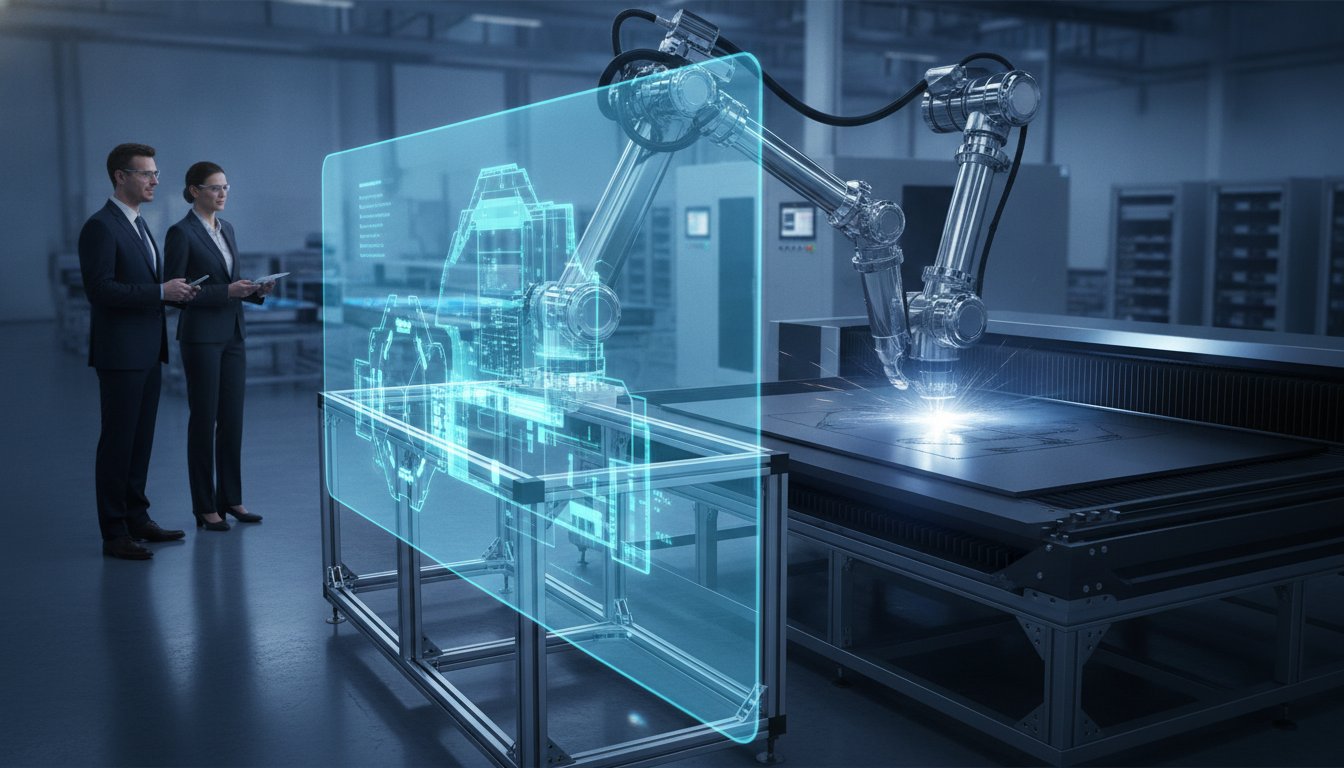
The most expensive component of your new automated assembly line isn't the high-end robotics. It's the three-week delay while your team waits for custom frames that don't align with the digital model. Mastering sheet metal fabrication for industrial automation is about closing the gap between a CAD file and a physical part to ensure your project never loses its momentum.
You've likely dealt with the frustration of tolerance inconsistencies that stall production and communication gaps that force expensive reworks. Reliable fabrication requires more than just heavy machinery; it demands a digital-to-physical continuity that eliminates administrative lag. You deserve a partner who values your time as much as your technical specifications.
This 2026 guide explores how automated fabrication workflows and precision laser technology accelerate your path from digital design to physical delivery. You'll discover how to achieve faster time-to-market through seamless BIM integration and standardized quality. We'll examine the technical shift toward high-speed, coil-line production and custom laser cutting that keeps your national accounts on schedule.
Key Takeaways
- Learn how custom NEMA-rated enclosures and structural frames provide the physical foundation for sensitive electronics and robotic systems.
- Discover how fiber laser technology and CNC press brake bending achieve the micron-level accuracy required for complex industrial components.
- Streamline your project timelines by integrating BIM coordination with sheet metal fabrication for industrial automation to eliminate field errors before production begins.
- Identify the critical technical and scalability criteria needed to select a fabrication partner capable of handling both rapid prototyping and national rollouts.
- Understand how automated coil-line production and digital spooling bridge the gap between complex CAD designs and physical delivery at scale.
Defining Sheet Metal Fabrication for Industrial Automation and Robotics
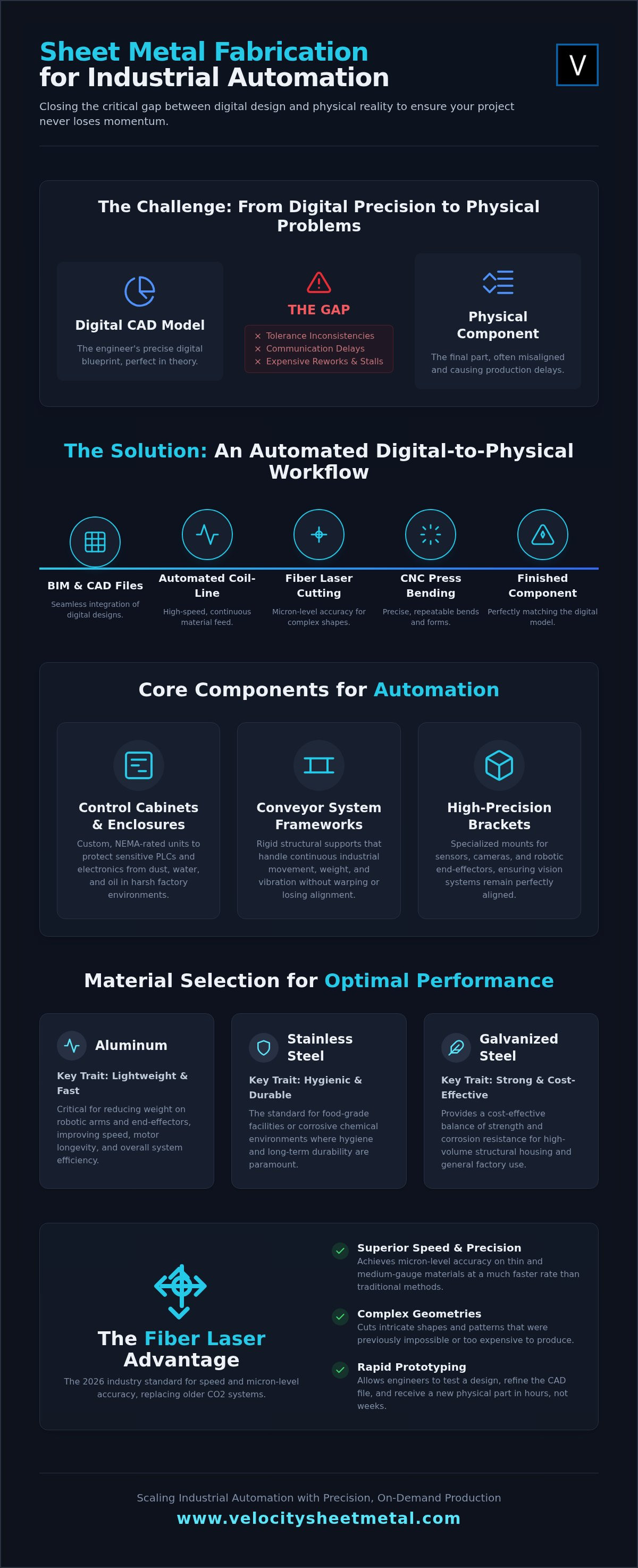
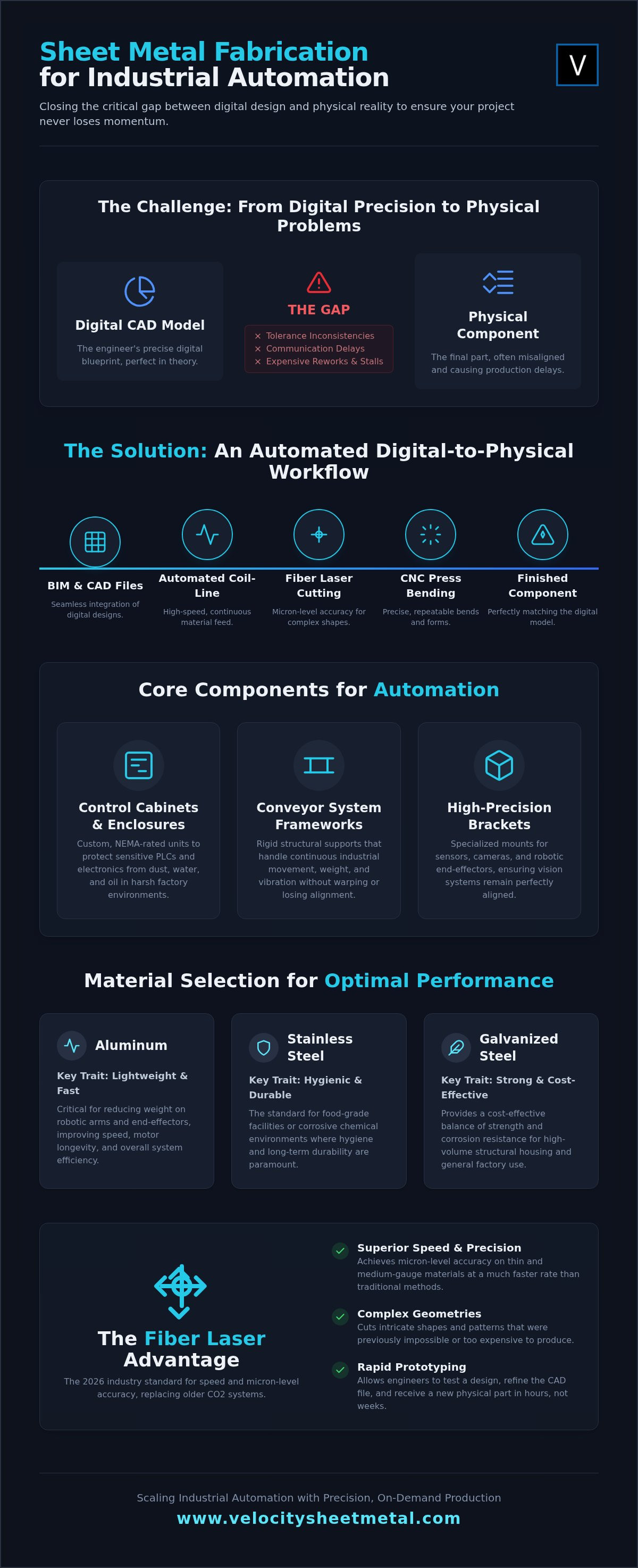
Industrial automation relies on more than just software and sensors. It requires a physical infrastructure capable of protecting sensitive electronics while maintaining rigid structural integrity. Sheet metal fabrication for industrial automation has evolved from a manual craft into a high-tech discipline. Modern facilities now operate on a digital-to-physical model. This shift ensures that every custom enclosure and frame matches the engineer's CAD model with surgical precision. We move your project from the initial digital concept to the final physical result without the administrative friction of traditional shops.
In the automation sector, tolerances are non-negotiable. While standard HVAC ductwork might allow for slight variations, robotic systems stall if a mounting bracket is off by a fraction of a millimeter. Precision sheet metal serves as the essential skin and skeleton for these systems. From NEMA-rated enclosures that shield PLC units from factory dust to structural frames that support high-speed conveyor lines, the quality of the fabrication dictates the reliability of the entire assembly line.
Common Industrial Automation Components
The components required for modern robotics go far beyond basic boxes. Precision fabrication shops produce specialized parts designed for high-performance environments. Sheet metal fabrication for industrial automation projects often include:
- Control cabinets and custom electrical enclosures: These units protect critical controllers and power supplies. They often require specific NEMA ratings for environmental protection against dust, water, or oil.
- Conveyor system frameworks: Rigid structural supports must handle the vibration and weight of continuous industrial movement without warping or losing alignment.
- High-precision brackets: Specialized mounts for sensors and cameras ensure that vision systems remain perfectly aligned during high-speed operations.
Material Selection for Automation Environments
Choosing the right alloy is a technical decision based on the specific demands of the automation environment. The fabrication process must adapt to these material properties to maintain accuracy.
- Aluminum: Preferred for robotic end-effectors and arm mounts. Reducing weight is critical for speed, motor longevity, and overall system efficiency.
- Stainless steel: The standard for food-grade facilities or corrosive chemical environments. It's essential where hygiene and long-term durability are paramount.
- Galvanized steel: Used for high-volume structural housing and industrial ductwork. It provides a cost-effective balance of strength and corrosion resistance for general factory floor use.
Precision Laser Cutting and CNC Bending: The Core of Automation Components
Precision is the heartbeat of modern robotics. If a structural frame is out of square by a hair, the entire assembly line fails. High-performance sheet metal fabrication for industrial automation relies on fiber laser technology to achieve micron-level accuracy. We eliminate the guesswork by moving directly from your digital files to the cutting bed. This process removes the administrative lag and human error that plague traditional manual shops. It turns your design into a physical part with surgical speed.
The Fiber Laser Advantage
Fiber lasers have replaced CO2 systems as the 2026 industry standard for a reason. They offer superior speed and precision on thin and medium-gauge materials. This technology allows for cutting complex geometries that were previously impossible or too expensive to produce. For engineers, precision laser cutting services provide a massive advantage during rapid prototyping. You can test a design, refine the CAD file, and have a new physical part in hours rather than weeks.
According to research from the National Institute of Standards and Technology (NIST) regarding Robotics and Manufacturing Automation, consistency is the primary driver of ROI in automated systems. Fiber lasers deliver that consistency. They produce clean edges with minimal heat-affected zones. This edge quality reduces the need for secondary finishing. It lowers your total production costs and accelerates your time-to-market. When every second of downtime costs thousands, these precision cuts are your best insurance policy.
Mastering CNC Press Brake Bending
Cutting the part is only half the battle. Precision bending ensures that your custom enclosures and brackets actually fit together during final assembly. Our CNC press brake services for OEMs utilize advanced back-gauge systems to guarantee repeatability across 1,000+ identical units. We focus on air bending techniques to achieve precise industrial angles without marring the material surface. This is critical for parts that house sensitive electronics or high-speed moving components.
Reliable fabrication also means proactively avoiding common press brake forming defects like springback or cracking in heavy-gauge parts. Automated nesting software further optimizes material usage. It ensures that every bend is calculated based on the specific grain of the metal. If your project requires high-volume components with zero tolerance for error, our precision bending and laser cutting workflow provides the essential bridge between your digital design and a tangible product.
Digital-to-Physical Workflows: Reducing Lead Times with BIM and Spooling
The true value of modern manufacturing isn't just the robots on the floor. It's the digital-to-physical continuity that eliminates administrative lag and field errors. In the context of sheet metal fabrication for industrial automation, this means moving from a 3D model to a finished part without manual data entry. We use integrated workflows to ensure that what you design in CAD is exactly what arrives on your loading dock. This methodical approach turns a complex digital file into a tangible product with surgical speed.
Digital coordination allows us to identify problems before the first sheet of metal is cut. By utilizing Advanced manufacturing technologies, we bridge the gap between high-level engineering requirements and high-speed production. This process isn't just about speed; it's about the precision required for automated environments where even a minor misalignment can stall an entire assembly line.
BIM Coordination for Industrial Systems
Building Information Modeling (BIM) is the master blueprint for every cable tray, duct, and structural support in an industrial facility. Integrating BIM with sheet metal fabrication for industrial automation ensures that complex components are manufactured to exact specifications. Collaborative design allows engineers and fabricators to work within the same model simultaneously. This transparency reduces waste through exact material calculations and ensures that every component fits the physical space perfectly.
The most critical advantage is pre-production conflict resolution. Implementing BIM clash detection for HVAC fabrication and industrial housing prevents installation delays. We find the collisions in the digital model so you don't find them on the factory floor during assembly.
Mechanical Spool Drawings and Accuracy
Once the BIM coordination is complete, we break the model down into manageable segments for the shop floor. This is where mechanical spooling becomes essential. Spooling is the vital link in automated manufacturing that translates complex 3D assemblies into individual, machine-ready CNC instructions. This transition happens in hours rather than days, maintaining the momentum of your project.
- Precision Labeling: Every component is tagged and tracked for perfect assembly in complex automation cells.
- Direct Integration: Spool data feeds directly into our CNC systems to eliminate manual transcription errors.
- Waste Reduction: Parts are nested directly from spool data to maximize material yield and lower costs.
Real-time production monitoring provides the final layer of transparency for your project. You shouldn't have to guess where your parts are in the production cycle. We provide clear, data-driven timelines from the moment the spool is approved to the final delivery. This level of control ensures your automation project stays on schedule and meets the standardized quality requirements of your national accounts.
Selection Criteria for Industrial Sheet Metal Fabrication Partners
Finding a partner for sheet metal fabrication for industrial automation requires looking beyond the equipment list. Every shop has a laser; not every shop has the digital infrastructure to integrate with your BIM model. You need a partner who functions as an extension of your engineering team. This means moving from a prototype in a local shop to a national rollout without losing precision or quality. A reliable partner acts as the essential bridge between your digital design and a tangible product.
The 5-Point Vetting Checklist
Use this technical checklist to audit potential partners. It ensures they can handle the complexity of 2026 automation standards and maintain standardized quality across your entire project footprint.
- Digital Compatibility: Verify they can ingest STEP, DXF, and BIM files without manual data entry. This eliminates the transcription errors that cause field collisions during assembly.
- Material Traceability: Audit their quality control to ensure every alloy used meets your specific industrial rating. This is critical for environments requiring food-grade stainless or high-strength aluminum.
- High-Volume Capability: Confirm they operate an automated coil-line for high-volume rectangular duct and housing needs. Manual shops cannot match the speed of an automated line.
- National Account Experience: Evaluate their history of managing distributed projects across multiple states. Logistics management is as important as the fabrication itself.
- Standardized Quality: Ensure their production process guarantees identical tolerances for every unit. Whether you are ordering ten units or ten thousand, the specs must remain surgical.
Lead Time and Logistics Management
Speed is the primary currency of industrial automation. Traditional batch ordering often creates bottlenecks that stall assembly lines and inflate project costs. Modern fabrication relies on 'on-demand' production. This model moves parts from the digital file to the shipping crate in a fraction of the time by leveraging real-time spooling data. Centralized fabrication reduces logistics complexity by providing a single point of truth for your entire project footprint. It ensures that a frame manufactured in one region fits an assembly line in another perfectly.
Standardizing HVAC duct fabrication for mechanical contractors is equally vital for large-scale industrial facilities. Whether you need custom enclosures or high-volume ducting, your partner must maintain consistency across every national site. Unreliable lead times for custom frames are a project killer. You need a tech-savvy operator who cuts through administrative delays to deliver tangible results immediately. Contact our national accounts team to discuss your automation project's scalability requirements.
Velocity Sheet Metal: Scaling Industrial Automation with On-Demand Production
Velocity Sheet Metal (VSM) solves the complex logistical and technical hurdles of 2026 automation projects. We leverage a management team with over 50 years of industry experience to provide the essential bridge between digital BIM models and physical industrial components. Our facility is optimized for high-volume coil line duct fabrication, allowing us to produce rectangular ducting and structural housing with unmatched speed. We don't just cut metal; we provide a tech-savvy partnership that values your project's momentum as much as its precision.
Our expertise in sheet metal fabrication for industrial automation extends from the initial digital spooling to final delivery. We specialize in custom laser cutting and CNC forming tailored strictly to OEM specifications. Our facility is strategically positioned for seamless national shipping. We deliver precision-engineered parts from our floor to any US project site, ensuring your distributed assembly lines remain operational.
Standardizing National Accounts
Scaling an automation rollout across multiple states requires a partner who can maintain identical production standards at every site. VSM offers dedicated support for engineers and mechanical contractors who manage high-volume national accounts. We eliminate the variability that often stalls large-scale industrial projects. The 'Velocity' promise is simple: we deliver industrial speed without sacrificing the technical precision your robotics require. By standardizing our output, we ensure that a component shipped to a facility in the Northeast is a perfect match for one delivered to the West Coast.
From Spool to Shipment
Our BIM-to-Machine workflow is the engine behind our on-demand production model. We ingest your digital spool drawings and move directly into fabrication, cutting the administrative lead times that typically plague custom orders. This digital-to-physical continuity ensures sheet metal fabrication for industrial automation is predictable and repeatable. Beyond enclosures and frames, we provide custom curb adapters and transition fittings to facilitate rapid on-site integration. These specialized components allow for faster equipment swaps and seamless connections between new automated units and existing infrastructure.
Your project shouldn't be held hostage by unreliable lead times or communication gaps. We act as a firm guide through the manufacturing process, providing the straight talk you need to keep your assembly lines moving. Whether you need a single precision prototype or a full national rollout of custom enclosures, we are ready to get to work immediately. Request a quote for your next industrial automation fabrication project and experience the efficiency of a truly modern workshop.
Accelerating Your Digital-to-Physical Industrial Rollout
Success in 2026 manufacturing depends on the speed of your digital-to-physical bridge. We've explored how precision laser technology and CNC forming create the foundation for reliable robotics. By integrating BIM coordination directly with the shop floor, you eliminate the administrative lag that stalls assembly lines. High-quality sheet metal fabrication for industrial automation is now a data-driven process that ensures every custom enclosure fits perfectly the first time.
Velocity Sheet Metal brings over 50 years of combined manufacturing experience to your project. We leverage a precision BIM-to-Machine workflow to move your designs from digital files to physical results with surgical accuracy. Our nationwide shipping capabilities and national account support ensure your distributed project sites receive standardized quality every time. You deserve a tech-savvy partner who acts as the essential link between a CAD file and a tangible product.
Get an On-Demand Quote for Your Automation Components and secure the momentum your project requires. We're ready to get to work immediately to bring your automated systems online without delay.
Frequently Asked Questions
What are the typical tolerances for sheet metal fabrication in industrial automation?
We target tolerances of +/- 0.005 inches for high-precision components. Achieving these tight specs is essential for robotic mounts where even minor misalignments cause system failure. Our CNC press brake bending and fiber laser systems ensure every part matches your CAD model with surgical precision. This consistency reduces field reworks and assembly line downtime during final integration, keeping your project on its technical timeline.
Can you fabricate custom NEMA-rated enclosures from BIM models?
Yes, we fabricate custom NEMA-rated enclosures directly from your digital BIM models. Our workflow integrates your 3D design files into our automated fabrication floor to maintain environmental protection standards. This digital-to-physical continuity ensures that every cutout and seal aligns perfectly with your internal components. It eliminates the administrative lag found in manual shops that require manual data entry for every custom design change.
How does automated coil-line fabrication improve project timelines?
Automated coil-line fabrication reduces production times by up to 50% compared to traditional manual shearing and forming. This technology allows for continuous high-volume production of rectangular duct and industrial housing. By automating the workflow, we remove the bottlenecks associated with manual batch processing. It ensures that large-scale industrial projects stay on schedule while maintaining standardized quality across every linear foot of the production run.
Do you offer nationwide shipping for large-volume industrial components?
We provide seamless nationwide shipping from our central facility in Texas to any US project site. Our logistics team specializes in handling high-volume industrial components and national account rollouts. This centralized approach ensures that your distributed assembly lines receive identical parts regardless of their location. We manage the logistics complexity so you can focus on the technical implementation and assembly of your automated systems.
Which materials are best for robotic arm mounts and end-effectors?
Aluminum is the preferred material for robotic arm mounts and end-effectors due to its high strength-to-weight ratio. Reducing mass is critical for maintaining motor longevity and high-speed cycle times in robotics. For corrosive or food-grade environments, we utilize stainless steel to meet strict hygiene requirements. Our team assists engineers in selecting the optimal alloy to balance weight, durability, and environmental resistance for specific factory floor conditions.
How do BIM coordination and spooling reduce errors in industrial ductwork?
BIM coordination and mechanical spooling identify physical collisions in the digital model before production begins. This process ensures that sheet metal fabrication for industrial automation remains error-free during site installation. We translate complex 3D assemblies into machine-ready CNC instructions through digital spooling. This methodical approach eliminates field errors and ensures that every transition and fitting integrates perfectly with existing industrial infrastructure without expensive on-site modifications.
Can Velocity Sheet Metal handle both rapid prototyping and high-volume OEM production?
Velocity Sheet Metal leverages 50 years of manufacturing expertise to handle the entire lifecycle from rapid prototyping to high-volume OEM production. Our fiber laser technology allows for quick design iterations without expensive tooling changes. Once your design is validated, our automated systems scale sheet metal fabrication for industrial automation to meet national requirements. This scalability provides a single point of truth for your entire automation component supply chain.
What digital file formats are required for custom laser cutting services?
We require STEP or DXF files to initiate our custom laser cutting services. These formats allow for direct integration with our nesting software and CNC systems. Providing clean digital files eliminates the need for manual transcription and significantly reduces lead times. Our engineering team can also work with integrated BIM models to ensure that complex geometries are translated accurately from the digital environment to the physical part.