Sheet Metal Fabrication Lead Times: What Drives the Schedule in 2026

What if sheet metal fabrication lead times depend less on a shop-wide number and more on the sequence your project needs? A standard part with complete files and specified material follows a different path from a custom assembly that needs design review, bending, finishing, and coordinated delivery. A generic industry average cannot tell you which schedule applies to your job.
If you’re coordinating installation crews or follow-on work, uncertainty matters. Incomplete drawings and late design changes can interrupt production and force you to revise plans. A useful schedule starts with understanding the required steps and the information each one depends on.
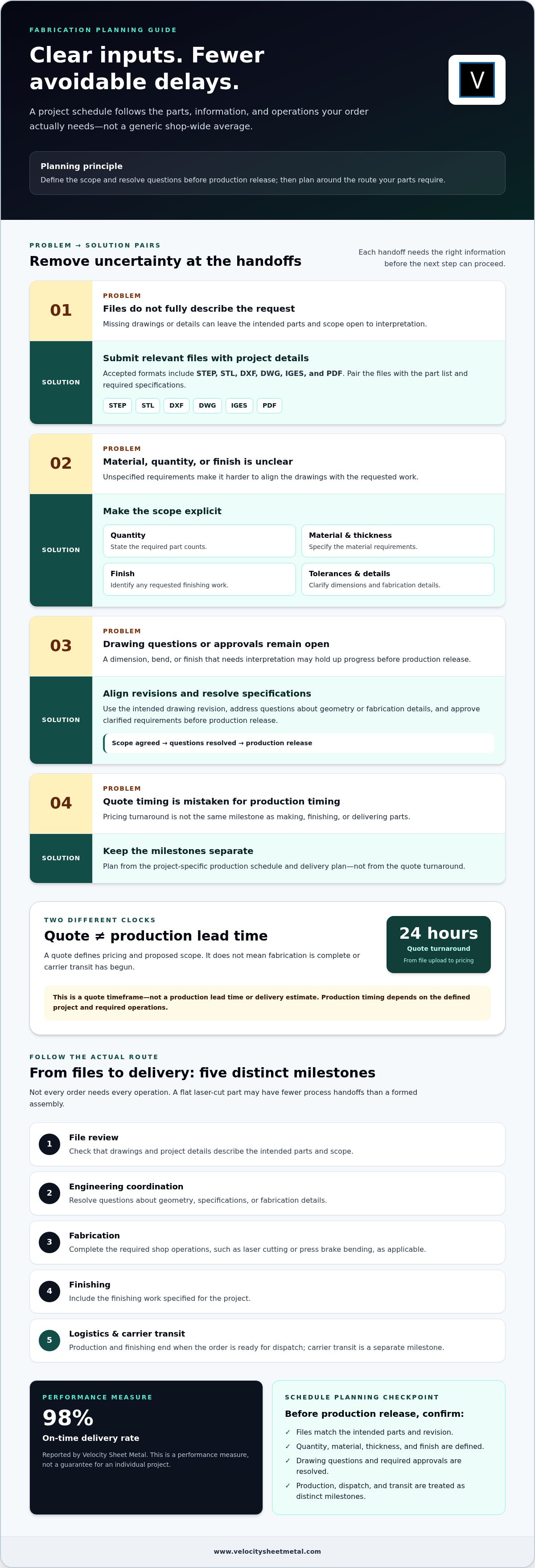
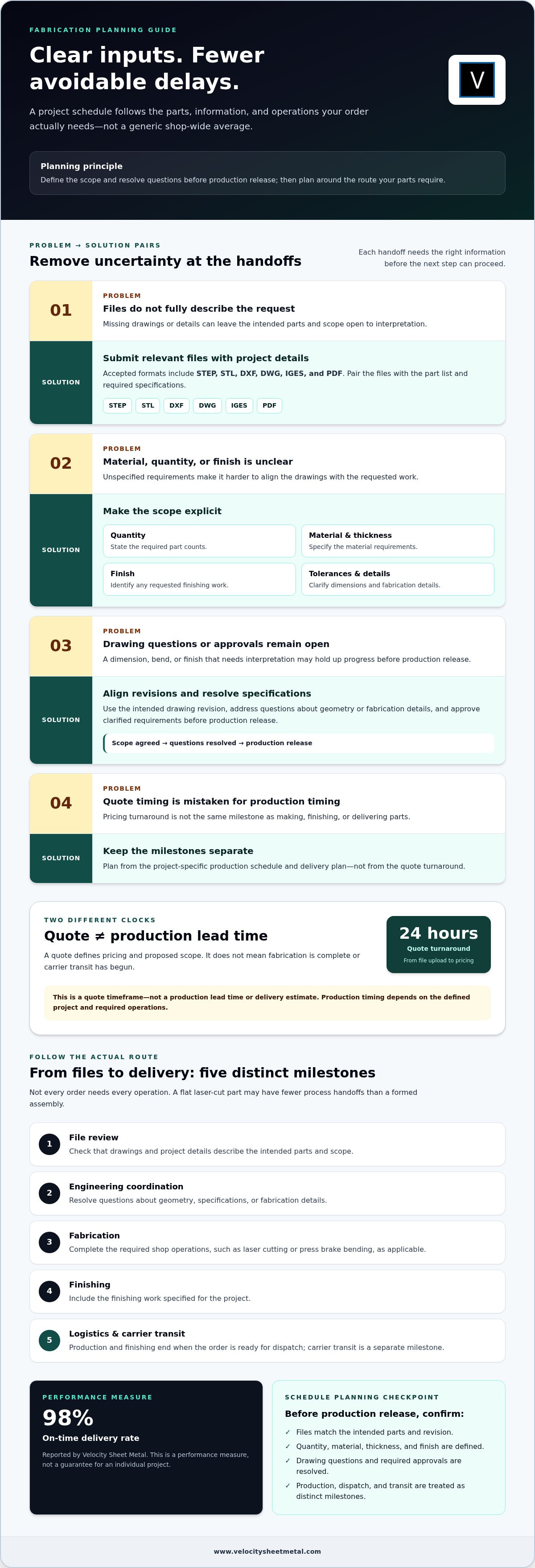
This article explains what shapes a fabrication schedule in 2026, from file review and material requirements to production and shipping. You’ll learn what to submit to reduce avoidable review delays and how to plan around a project-specific timeline. Complete digital files also support a clear quote: Velocity Sheet Metal provides a 24-hour quote turnaround from file upload to pricing. That is a quote timeframe, not a production lead time.
Key Takeaways
- Sheet metal fabrication lead times cover a sequence of project stages, not just time on the production floor.
- An order’s route depends on the parts and operations required, from file review through fabrication, finishing, and dispatch.
- Material, thickness, quantity, tolerances, and finish requirements can all shape the schedule. Define them clearly to support project planning.
- Use a pre-submission checklist to catch missing specifications, align drawing revisions, and secure approvals before production release.
- Velocity Sheet Metal reports a 98% on-time delivery rate. This is a performance measure, not a guarantee for an individual project.
What Do Sheet Metal Fabrication Lead Times Include?
Sheet metal fabrication lead times describe the project-specific schedule from an agreed starting point through the stages needed to prepare, make, finish, and deliver the parts. The schedule depends on the scope: a part requiring cutting alone follows a different route from an assembly that needs engineering coordination, bending, finishing, and shipment. To plan installation or follow-on work, identify which stages are included and where the schedule ends.
Keep five milestones distinct: quote turnaround, engineering review, production, finishing, and carrier transit. They may be connected, but they are not interchangeable. A quote provides pricing and defines the proposed scope. It does not mean fabrication is complete or that transit has begun. A project schedule should make clear which milestones apply and what event starts each one.
Quote turnaround versus production lead time
Velocity Sheet Metal provides a 24-hour quote turnaround from file upload to pricing. That timeframe applies to the quote, not to completed parts. Production timing is specific to the defined project and required operations, so don’t use the quote turnaround as a delivery estimate.
The distinction matters when coordinating crews, materials, or follow-on trades. Treat pricing and scope review as early planning milestones. Once the project scope is defined, use the production schedule and delivery plan to coordinate installation. Don’t assume work begins or ends when the quote arrives.
Which stages may appear on a fabrication schedule?
A schedule may move from file review and engineering coordination into fabrication, finishing, and logistics. The exact route depends on the part and its specified operations. The metal fabrication process can involve methods such as cutting, bending, and assembly, but an order only needs the steps required by its design.
- File review: Check that the submitted drawings and project details describe the intended parts and scope.
- Engineering coordination: Resolve questions about geometry, specifications, or fabrication details before production release.
- Fabrication: Complete the required shop operations, such as laser cutting or press brake bending, as applicable.
- Finishing: Include any specified finishing work in the production sequence.
- Logistics: Prepare the completed order for dispatch, then account separately for carrier transit.
Shop processing ends when the order is ready for dispatch. Transit begins as the shipment moves through the carrier network. A project-specific plan should distinguish these milestones instead of folding them into one unclear estimate. Generic online averages can provide context, but they cannot account for your files, scope, operations, or delivery needs. Define those inputs first, then plan around the schedule for the project.
How a Sheet Metal Fabrication Order Moves from Files to Delivery
A fabrication order moves through a sequence of decisions and shop operations. Each handoff needs clear information before the next step can proceed. The route depends on the parts: a laser-cut component won’t follow the same path as a duct assembly that requires bending and additional operations. Knowing the sequence helps you identify where your team needs to supply details, review a drawing, or approve a change.
For commercial HVAC projects, procurement planning also affects how parts fit into the wider work plan. A HVAC duct fabrication procurement guide can help connect duct requirements with purchasing decisions and project coordination.
File review and project definition
Start with a defined scope and files that represent the parts you need. Velocity accepts STEP, STL, DXF, DWG, IGES, and PDF files. Pair drawings with quantities, material, thickness, and finish requirements so the review has the information needed to interpret the request.
CAD/CAM engineering and design-for-manufacturability (DFM) review support the move from a digital design to a fabrication plan. If a drawing leaves a dimension, bend, or finish requirement open to interpretation, a question or approval may be needed before the scope is ready to advance.
- Submit files: Provide the relevant drawings and project details together, using file formats that suit the design information.
- Review the scope: Align the part list, quantities, material, thickness, and requested finish with the submitted files.
- Resolve specifications: Address drawing questions and approve clarified details before production release.
- Fabricate and finish: Complete the operations required by the part design and agreed scope.
- Plan dispatch: Coordinate shipping or pickup once the production and finishing scope is established.
Fabrication, finishing, and logistics handoffs
After the scope is aligned, the required process determines the shop route. Cutting may lead to bending, welding, assembly, or specified finishing, but not every order needs every operation. For example, a flat laser-cut part may need fewer process handoffs than a formed assembly with several components. The schedule should reflect the actual sequence, not a generic list of everything a shop could do.
Drawing questions, pending approvals, or a revised scope can pause progress at different points. A change after release may require the team to reassess affected operations and coordinate updated requirements. Consolidate revisions and communicate which drawing version governs the order to reduce confusion between review and production.
Logistics planning follows the agreed production and finishing scope. Velocity offers LTL freight, dedicated trucking, and will-call. These arrangements are separate from shop processing: dispatch marks the handoff to transportation, while transit is the time the shipment spends moving to its destination.
For a project-specific starting point, organize the drawings and scope details before submitting fabrication project files. Clear inputs help align review, production, and delivery planning from the outset.
Which Project Factors Change Sheet Metal Fabrication Lead Times?
Sheet metal fabrication lead times depend on the work defined for an order, not just the part count. A straightforward part with a ready drawing and one operation has a different workflow from an assembly with complex geometry, tight tolerances, several processes, and a specified finish. The useful question is not whether a job is “simple” or “complex” in isolation. It’s which decisions and operations the project actually requires.
Separate factors you can define early, such as complete drawings and approved specifications, from shop-dependent conditions such as production capacity and delivery variables. That distinction helps pinpoint where better project information can reduce uncertainty and where the schedule depends on coordination beyond the design itself.
Design, material, and process complexity
Design readiness affects how directly a file can move into a fabrication plan. Revisions, unclear geometry, or unresolved specifications can trigger questions and approvals. Once the design is clear, material and thickness help determine the processing route. Tolerances and finish requirements also matter because they shape how the part is made and what work follows fabrication.
Consider the difference between a flat component and a formed part with several bends. The formed part requires additional process steps and coordination. Add a specified finish or partner-based plating, and the sequence must also account for that finishing work. Each requirement can be manageable on its own. Combined, they create more handoffs to define in the project schedule.
For commercial HVAC projects, automated rectangular duct production is a distinct workflow. Coil-line duct fabrication can be relevant when planning repeat duct requirements, but the project’s design, quantity, and scope still determine the order’s route. Automation describes a production capability, not a promised completion date.
Quantity, capacity, and order type
A prototype or small run and a repeat order may involve different preparation and production considerations. Velocity supports run sizes from single parts through 10k+ runs. This range accommodates projects with different order quantities, but quantity alone doesn’t establish a schedule. Part geometry, required processes, and the status of the approved design remain relevant.
Velocity cuts 100k+ parts per month. Treat that figure as capacity context, not as a deadline or a prediction for an individual order. A shop’s overall output doesn’t tell you where a particular job fits in the production plan.
For a clearer schedule discussion, organize the project inputs by category:
- Design readiness: Identify the current drawing revision and resolve open questions.
- Part requirements: State material, thickness, quantity, tolerances, and finish.
- Process scope: Clarify which operations the parts require.
- Planning variables: Distinguish production scheduling from finishing coordination and shipment needs.
This breakdown makes it easier to see which factors are defined and which still need coordination before the schedule can be planned with confidence.
How to Reduce Avoidable Delays Before Fabrication Starts
A clean handoff helps the team review scope and plan the work without chasing missing details. Before submitting an order, bring drawings, specifications, quantities, approvals, and delivery needs into one coordinated package. This won’t remove every production or logistics variable, but it can reduce preventable pauses caused by conflicting revisions or unanswered questions.
Use this checklist to prepare:
- Geometry: Make sure drawings show the intended part shape and relevant dimensions.
- Revision control: Identify one controlling drawing revision and consolidate changes before submission.
- Material and thickness: State the required material and thickness for each part or group of parts.
- Quantity: Match the part count in the drawings, scope, and order details.
- Tolerances and finish: Document required tolerances and any specified finishing work.
- Interfaces and assembly: Flag mating parts, connection points, and assembly requirements that affect fabrication.
- Approvals and delivery: Identify who approves design questions and note shipment requirements for project planning.
Prepare a clear, production-ready file package
Submit the accepted file formats and label the current drawing revision clearly. Include dimensions, tolerances, material, thickness, quantity, and finish requirements rather than leaving key details to inference. Flag interfaces, assembly needs, and project-specific approval dependencies. A consistent set of files gives review and engineering coordination a clear basis for defining the scope.
For commercial HVAC work, coordinate the model and fabrication information early if duct routes, equipment connections, or other building interfaces affect the parts. BIM coordination for sheet metal fabrication helps connect model-based project information with fabrication planning. Resolving interface questions before release can help prevent a late design clarification from disrupting follow-on work.
Align scope, approvals, and delivery planning
Make sure quantities and required operations describe the same order. If one document calls for a finish or formed feature that another omits, resolve the mismatch before production release. Assign responsibility for answering design questions and approving revisions, so decisions don’t stall between teams.
Next, align shipment requirements with the project team. Share the delivery destination and any receiving or scheduling considerations early, but keep carrier transit separate from shop processing. Planning the handoff helps coordinate follow-on work without assuming a transit date that hasn’t been established.
These steps give the project team a stronger foundation for planning sheet metal fabrication lead times. They also make open decisions visible: what’s ready, what needs approval, and what information still affects the scope. Keep revisions consolidated and communicate changes through the agreed project process. That way, everyone is working from the same requirements as the order moves toward production.
Ready to organize a fabrication package? Submit your project files for a quote with the scope and specifications gathered together.
Plan Sheet Metal Fabrication Lead Times with Velocity Sheet Metal
A useful fabrication schedule starts with a defined scope, complete project files, and a clear understanding of the required operations. Velocity Sheet Metal connects engineering coordination, fabrication, finishing, and logistics planning to organize the path from digital drawings to delivery. The schedule still depends on the specific project, so a quote and a production timeline serve different purposes.
What Velocity's confirmed capabilities mean for project planning
Velocity provides a 24-hour quote turnaround from file upload to pricing. That gives you a defined timeframe for the quote, not for production or delivery. Once the project scope is reviewed, planning can account for the work your parts actually require and the handoffs between engineering, shop processing, finishing, and dispatch.
Velocity reports a 98% on-time delivery rate. This is a reported performance measure, not a guarantee for an individual order. The company ships nationwide to 48 states, supporting project planning across a broad delivery footprint. Keep carrier transit distinct from production timing when coordinating follow-on work.
Production context matters, but it doesn’t replace a project-specific schedule. Velocity cuts 100k+ parts per month, a company-scale capacity indicator rather than a deadline for an individual order. Its management team brings 50+ years of combined industry experience, useful background for coordinating fabrication work, not a promise of a specific turnaround.
Start with the information that makes a useful quote
Gather the project details in one package so the scope can be reviewed against the drawings. Include:
- Drawings: Provide the current files and identify the controlling revision.
- Part requirements: State quantities, material, and thickness.
- Operations: Specify required fabrication steps and any finish requirements.
- Planning needs: Share relevant approval dependencies and delivery requirements.
These inputs help clarify what’s being priced and which project details may affect the production plan. If drawings, quantities, or finish specifications conflict, resolving them early gives the review a clearer scope. A defined scope also helps separate quote preparation from the decisions that shape production and shipment planning.
Submit complete project files and the team can review the scope and provide pricing within 24 hours of file upload. That quote turnaround is not a production lead time. Use the project details and agreed scope to plan the fabrication schedule, then coordinate follow-on work around the production and delivery milestones for your order.
Upload your project files to get started and include the quantities, material, thickness, and finish requirements needed to define the work.
Turn Your Project Scope into a Clear Next Step
Give your team a stronger planning baseline by working backward from the date parts are needed. Identify internal approval points, installation dependencies, and the latest date your project can absorb a change. Use those priorities to frame the schedule conversation instead of treating a general benchmark as a commitment. This makes sheet metal fabrication lead times easier to manage across purchasing, fabrication, and follow-on work.
Keep one owner responsible for consolidating drawing updates and communicating approved changes. A single source of truth helps everyone plan from the same scope as the project moves forward. If requirements are still developing, flag what’s settled and what remains open before the schedule is set.
Ready to put your project details into motion? Start your fabrication project by uploading the files. A clear package gives the team a practical basis for reviewing the work and planning the next steps.
Frequently Asked Questions
What is a typical sheet metal fabrication lead time?
There’s no single duration that applies to every project. Sheet metal fabrication lead times depend on the defined scope, design readiness, material, quantity, required processes, approvals, and logistics. Broad industry examples can offer context, but they don’t predict the schedule for a specific order. For a useful project estimate, prepare a clear file package and scope, including part details and any finishing or delivery requirements.
Is sheet metal fabrication lead time measured in business days or calendar days?
It depends on the convention used in the schedule. A timeline should state whether it uses business days or calendar days, what event starts the clock, and which milestones it covers. Don’t interpret a number in isolation. Check how approval points, production completion, dispatch, and delivery are represented so you can coordinate internal deadlines against the same schedule basis.
Why can two fabricators give different lead-time estimates for the same part?
Estimates can differ because they may start from different milestones or cover different scopes. One may include finishing or shipment planning, while another may describe shop processing only. Capacity assumptions, material plans, approval steps, and the selected route through operations can also vary. Compare the milestones and work included in each estimate, not only the headline duration, to understand what each timeline represents.
Can a design change affect a sheet metal fabrication schedule after work begins?
Yes. A revision may require drawing review, updated approvals, or changes to parts and planned operations. The effect depends on when the change arrives and which work it affects, so there’s no standard delay for every revision. Maintain clear version control and consolidate feedback before release. If a change is necessary later, communicate the affected drawing and requirements promptly.
Does a fabrication lead-time estimate include freight delivery?
Not always. A schedule may end at shop completion, dispatch, or arrival, depending on its stated scope. These milestones aren’t interchangeable: completed parts may still need to be prepared and dispatched before carrier transit begins. Velocity offers LTL freight, dedicated trucking, and will-call. Read the schedule’s endpoint carefully, and don’t assume it includes transit unless that’s stated.
How can I plan around a sheet metal delivery date that may change?
Build follow-on work around confirmed milestones, and coordinate approval points with trades or tasks that depend on the parts. Share drawing or material changes promptly so the project team can assess their effect on the plan. For commercial HVAC projects, BIM coordination and spool drawings can help align fabrication information with building interfaces. Keep shipment and arrival updates connected to the current project schedule, without treating an unconfirmed date as fixed.