Precision Sheet Metal for Mechanical Contractors: 2026 Guide

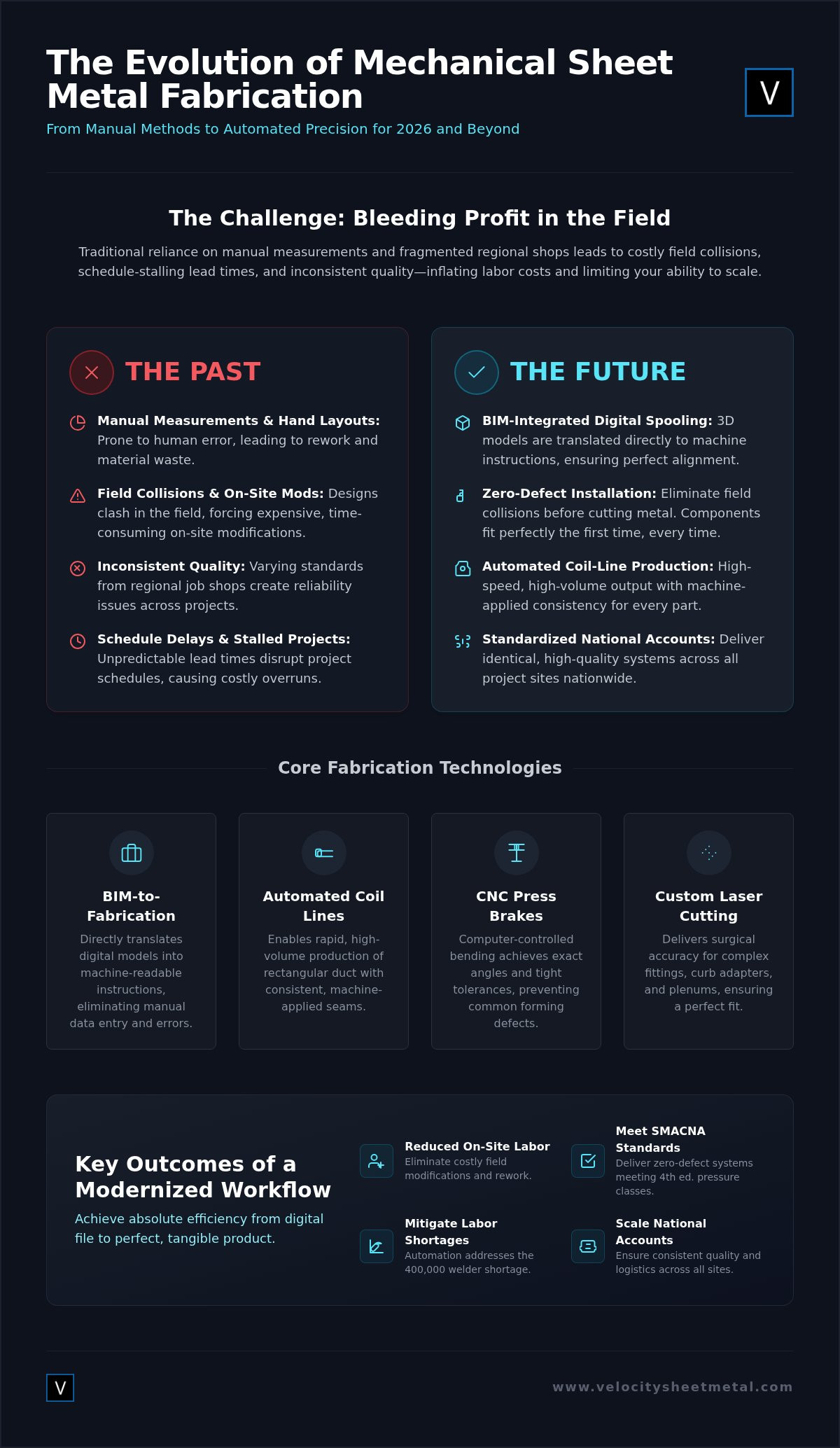
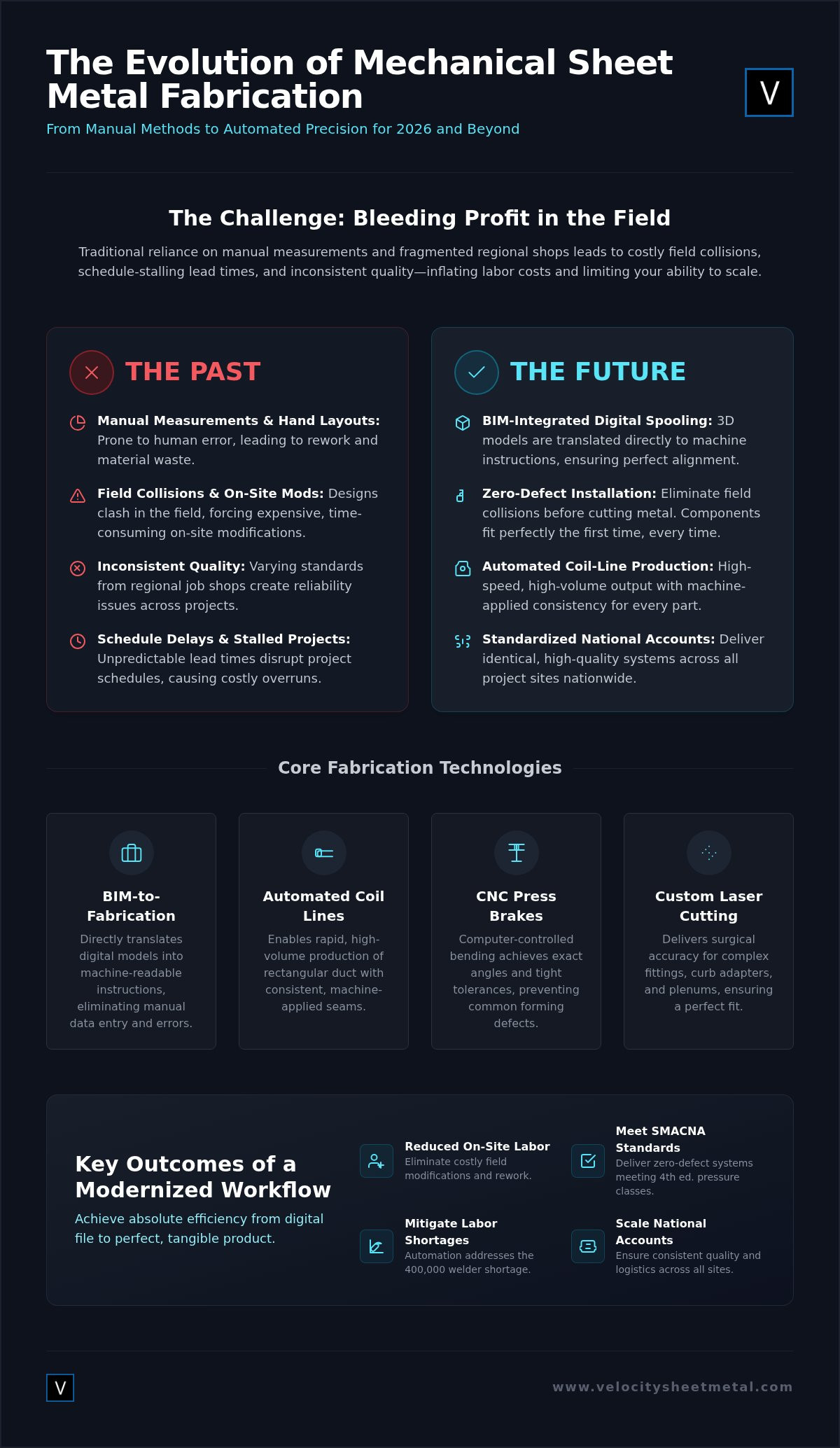
In 2026, the most critical tool in your mechanical arsenal isn't a plasma cutter or a press brake; it's the digital data flowing from your BIM model. The gap between a coordinated design and a successful installation is narrowing. If your sheet metal fabrication for mechanical contractors still relies on manual measurements and regional job shops with varying quality, you're bleeding profit in the field. You've felt the sting of field collisions that force expensive on-site modifications and lead times that stall your schedule. It's a common pain that inflates labor costs and limits your ability to scale national accounts.
This guide provides the roadmap to master the technical workflows and automated fabrication standards required to deliver zero-defect mechanical systems. We'll show you how to achieve a seamless BIM-to-fabrication workflow that reduces field labor through precise spooling and standardized components. Our preview includes an analysis of SMACNA 4th edition standards, the impact of the current 400,000-welder shortage on shop automation, and how Revit 2026.5 is streamlining digital spooling. It's time to move from the digital file to a tangible, perfect product with absolute efficiency.
Key Takeaways
- Shift from manual regional shops to automated coil-line production to maximize throughput and ensure part consistency across every project.
- Utilize BIM-integrated digital spooling to eliminate field collisions and reduce high on-site labor costs before a single piece of metal is cut.
- Master the technical standards of sheet metal fabrication for mechanical contractors to deliver zero-defect systems that meet 2026 SMACNA pressure class requirements.
- Employ precision technologies like custom laser cutting and CNC press brake bending to achieve tight tolerances and avoid common forming defects.
- Scale national accounts by standardizing fabrication quality and logistics through a single-source partner equipped for high-volume delivery.
The Evolution of Sheet Metal Fabrication for Mechanical Contractors
Industrial sheet metal fabrication for mechanical contractors has transitioned from a manual trade to a high-precision engineering service. In the past, shops relied on hand-layout and manual shears. Today, the 2026 manufacturing environment is defined by automated systems that translate digital BIM files directly into physical components. This evolution isn't just about speed; it's about the precision required for high-performance HVAC and mechanical systems. Every piece of Sheet metal must be formed with surgical accuracy to ensure the integrity of the entire building's climate control.
Modern commercial projects demand strict adherence to the SMACNA HVAC Duct Construction Standards, 4th Edition. These standards are the benchmark for 2026 projects, ensuring system performance and energy efficiency. By utilizing advanced forming techniques, specialized fabricators deliver components that meet exact pressure classes without the risk of field failure. Relying on outdated manual processes is no longer a viable strategy for contractors who need to compete on large-scale, high-complexity builds.
The Shift Toward Outsourced Automation
The decision to maintain an in-house shop is becoming harder to justify. With the American Welding Society reporting a shortage of approximately 400,000 welders in the U.S., mechanical contractors are struggling to staff their own fabrication lines. Specialized partners solve this by investing in robotics and automated cells that do the work of dozens of manual operators. This shift allows contractors to focus their skilled field labor on installation rather than production.
Outsourcing turns a fixed overhead cost into a variable project expense. You don't pay for the machinery or the floor space when the machines aren't running. Instead, you leverage the scale of a high-volume partner to secure better lead times. Speed is the primary competitive advantage in 2026. If you can't get duct on-site the moment the floor is ready, the schedule slips and profits evaporate.
Key Components in Modern Mechanical Systems
High-efficiency projects rely on specialized parts that "standard" ductwork simply can't match. Utilizing coil line duct fabrication allows for the rapid production of rectangular duct with consistent, machine-applied seams. This level of automation ensures every piece is identical. It's a critical requirement for national accounts that demand standardized quality across multiple project sites.
Beyond straight runs, complex layouts require custom fittings, curb adapters, and plenum boxes designed for specific rooftop units or air handlers. Precision sheet metal fabrication for mechanical contractors ensures these components fit perfectly the first time. When your curb adapters and custom fittings are laser-cut and CNC-bent to exact tolerances, you eliminate the need for field modifications. High-performance buildings don't have room for "close enough." They require the accuracy of modern automated fabrication.
Core Fabrication Technologies: From Coil Lines to Laser Cutting
Modern sheet metal fabrication for mechanical contractors relies on a tech stack that eliminates human error through a methodical, data-driven progression. The process transforms raw material into finished systems using a sequence of automated operations. This isn't just about cutting metal; it's about a high-speed manufacturing workflow that ensures every component is bolt-ready the moment it arrives on-site. By leveraging these technologies, you move from a digital concept to a physical reality with surgical accuracy.
Automated Rectangular Duct Production
The automated coil-line is the engine of high-volume commercial ductwork. It manages the entire production cycle from uncoiling and leveling to beading, punching, and shearing in one continuous pass. These lines handle wrap joints and seam closures with robotic precision, ensuring that every section of duct is perfectly square. This level of consistency is vital for meeting the latest SMACNA standards regarding air leakage and pressure classes.
High-volume output is no longer a bottleneck. Automated lines can integrate insulation application and sealing into the same pass, allowing for the production of thousands of linear feet per shift. This speed is a requirement for large-scale developments where tight schedules leave no room for manual fabrication delays. Precision seam closure also reduces the need for secondary sealants in the field, cutting down on installation time and material costs.
Precision Components and Custom Laser Cutting
While plasma cutting has served the industry for decades, industrial laser cutting services have become the gold standard for tight-tolerance mechanical parts. Laser technology offers superior edge quality and accuracy, often holding tolerances within +/- 0.005 inches. This precision is critical for complex transition fittings, plenum boxes, and custom curb adapters that must interface perfectly with specialized HVAC equipment. Laser cutting also allows for tighter nesting of parts, which minimizes material waste and helps stabilize project costs despite fluctuating steel prices.
The workflow continues with integrated CNC press brake services for OEMs and mechanical contractors. Modern multi-axis press brakes create complex brackets and housings with repeatable accuracy. Because there's no manual layout, the risk of human error is eliminated. The digital file directs the machine exactly where to bend, ensuring that every custom fitting fits the rooftop unit or air handler without field modifications. If you're looking to streamline your next project, partnering with an automated fabrication shop can significantly reduce your field labor requirements.
On-demand part production is the final piece of the 2026 efficiency puzzle. When a project hits a snag or a design change occurs, laser cutting and CNC bending allow for rapid prototyping and production. You don't have to wait weeks for a custom fitting. The digital-to-physical workflow means parts move from the design software to the shipping dock in a fraction of the time required by traditional shops.
BIM Coordination: Eliminating Field Collisions Through Digital Spooling
Building Information Modeling (BIM) serves as the digital foundation for modern sheet metal fabrication for mechanical contractors. It's no longer just a 3D visualization tool; it's a living data set that governs every cut and bend in the shop. By creating a high-fidelity digital twin of the mechanical system, you identify spatial conflicts long before a single piece of steel is uncoiled. This data-driven approach removes the guesswork that historically plagued large-scale commercial installations.
Clash detection is your primary defense against field re-work. In a coordinated model, the software flags every instance where a duct run intersects with structural steel, plumbing lines, or electrical trays. Resolving these collisions in the digital environment costs pennies compared to the thousands of dollars lost to field modifications and schedule delays. This process ensures that finished components arrive on-site ready for immediate hanging. The transition from model to metal happens through mechanical spooling services, a workflow that breaks down complex system designs into manageable, shop-ready sections.
The Role of Spool Drawings in Production
Spool drawings act as the direct instruction set for automated machinery. They provide the precise coordinates for the coil-line, laser cutter, and CNC press brake. Beyond fabrication, these drawings facilitate efficient site logistics through systematic labeling and kitting. Parts are organized by floor, zone, or system, allowing your field crews to spend their time installing rather than sorting through a pile of metal. A BIM-integrated shop acts as a comprehensive insurance policy against the unpredictable costs of field errors. It's the bridge between a digital file and a tangible, perfect product.
Reducing Material Waste with Digital Precision
Digital precision maximizes material yield through advanced nesting algorithms. By strategically arranging parts on a sheet of raw stock, automated systems minimize scrap and lower the overall project cost. With galvanized steel prices reaching approximately $1,205 per metric ton in early 2026, every square inch of material saved contributes directly to your bottom line. Zero-rework fabrication doesn't just save money; it reduces the environmental impact of the construction process. Mechanical contractors prioritize spool-ready fabrication partners because they deliver a product that respects both the budget and the project timeline. You get exactly what you need, exactly when you need it, with zero waste.
Material Standards and Precision Tolerances for 2026 Projects
High-performance mechanical systems start with material science. Choosing the right alloy and gauge is the first engineering decision that dictates the success of a project. Galvanized steel remains the standard for most commercial ductwork due to its cost-efficiency and corrosion resistance. However, specialized environments require more robust solutions. Stainless steel is the baseline for laboratory exhaust and commercial kitchens, while aluminum is the preferred choice for weight-sensitive rooftop installations. Each material has unique mechanical properties that influence how it behaves under the pressure of a CNC press brake.
Gauge thickness is the primary constraint in sheet metal fabrication for mechanical contractors. It dictates the minimum bend radius and the tonnage required for forming. In 2026, engineering teams must account for the specific tensile strength of the raw stock to prevent structural failure. If the gauge is too heavy for the specified radius, you risk material fracture. If it's too light, the part may lack the rigidity needed to maintain its shape under high static pressure. Mastering the relationship between material thickness and forming limits is essential for delivering zero-defect components.
Material Selection for Specialized Environments
Stainless steel (typically 304 or 316 grade) offers superior chemical resistance but presents challenges in the shop. It's harder on tooling and has a higher rate of springback than galvanized steel. Aluminum, while lightweight, is prone to marking and requires specialized handling to maintain its aesthetic and structural integrity. Effective HVAC duct fabrication for mechanical contractors balances these material costs against the lifecycle durability of the building's mechanical systems. You don't just pick a metal; you select a performance profile that matches the environment.
2026 Engineering Tolerances
Precision is the difference between a system that snaps together and one that requires expensive field grinding. While standard industrial tolerances often allow for a variance of +/- 0.030 inches, 2026 precision requirements often demand +/- 0.005 inches for OEM-level components. Achieving this accuracy requires a deep understanding of K-factor and bend allowance. The K-factor represents the ratio of the neutral axis to the material thickness, and it's the mathematical key to predicting how much a part will "stretch" during a bend. Without precise K-factor calculations, your finished parts won't match your digital model.
Managing "springback" is another critical factor in heavy-gauge CNC bending. When the press brake releases a part, the metal naturally tries to return to its original flat state. Automated systems compensate for this by over-bending the part to a specific degree based on the material's elasticity. Failure to manage this leads to common press brake forming defects like angular inaccuracy or "bowing" in long sections. In a multi-component assembly, a cumulative error of even a fraction of an inch can cause a total system misalignment. Precision isn't a luxury; it's the mandatory bridge between a digital spool drawing and a functional mechanical system. To ensure your next project meets these rigorous standards, request a technical review of your fabrication specs from our engineering team.
Scaling Production: National Account Support and Logistics
Scaling a mechanical project across multiple regions demands a logistics infrastructure that matches the precision of the fabrication floor. When you manage national accounts, the biggest risk is variability. A part fabricated in one shop might not match the specs of a shop five hundred miles away. Single-source sheet metal fabrication for mechanical contractors eliminates this inconsistency. By centralizing production, you ensure that every rectangular duct, spiral fitting, and curb adapter adheres to a single, unified standard of quality regardless of the project's physical location.
Centralized fabrication turns your supply chain into a competitive advantage. You no longer have to manage a fragmented network of regional job shops with varying capabilities. Instead, you leverage the speed of an automated facility that treats every project with the same technical rigor. This approach provides a predictable cost structure and a reliable delivery timeline. It allows your project managers to focus on field execution rather than vendor management.
Standardizing Quality for National Accounts
Consistency is the bedrock of national account management. Large-scale mechanical engineering firms can't afford to vet new regional vendors for every project. Utilizing a partner with automated quality control ensures that high-volume production remains within the tight tolerances required for 2026 builds. Automated sensors and digital verification tools check every seam and bend against the original BIM data. This streamlines procurement; you place one order for multiple sites and receive the same industrial-grade result every time. It's the only way to ensure that a system installed in one region performs exactly like its counterpart in another.
Logistics and Delivery for Large-Scale Components
Shipping oversized ductwork and complex assemblies requires more than just a flatbed truck. It demands a strategic approach to packaging and transit. Precision-formed parts, especially those made from lighter gauges or aluminum, are vulnerable during long-haul transit. Specialized crating and kitting processes protect these components from structural deformation. Because we kitted parts by zone or floor during the spooling phase, offloading at the job site becomes a methodical process rather than a chaotic search for missing pieces.
Urban job sites rarely have room for inventory. An on-demand production model allows you to implement just-in-time (JIT) delivery strategies. Instead of paying to store weeks' worth of ductwork, you receive shipments exactly when the installation crew is ready. This reduces your inventory carry costs and minimizes the risk of on-site damage. Scaling sheet metal fabrication for mechanical contractors requires a partner who understands the logistics of a nationwide rollout. If you're ready to eliminate the logistical friction of your next build, partner with Velocity Sheet Metal for your next national mechanical project.
Building the 2026 Mechanical Infrastructure
The transition from a digital design to a physical mechanical system requires more than just raw material; it demands a data-driven manufacturing process. By integrating BIM coordination with high-speed automation, you eliminate the physical gap between the office and the job site. This precision ensures that every component fits the first time. It's the most effective way to reduce field labor and protect your project margins. Whether you're managing a single complex build or scaling standardized parts across national accounts, the quality of your fabrication partner dictates your success.
Mastering sheet metal fabrication for mechanical contractors in 2026 means embracing technical dominance. You need a partner who delivers a BIM-integrated fabrication workflow, automated coil-line efficiency, and nationwide shipping for all components. Velocity Sheet Metal provides the essential bridge between your digital files and a tangible, zero-defect product. Stop fighting field collisions and start building with industrial certainty.
Get a Precision Fabrication Quote from Velocity Sheet Metal and streamline your next project today. We're ready to get to work immediately.
Frequently Asked Questions
What is the maximum gauge for automated coil-line duct fabrication?
Our automated coil-line processes up to 16-gauge galvanized steel for high-volume rectangular duct production. This capacity covers the vast majority of commercial HVAC requirements under the latest SMACNA pressure class standards. By using heavy-gauge automated production, we ensure structural integrity and air-tightness for high-static systems. This automation eliminates the inconsistencies of manual braking, providing perfectly square duct sections that snap together in the field without modification.
How does BIM coordination reduce costs for mechanical contractors?
BIM coordination identifies spatial conflicts in the digital model before fabrication begins. This prevents clash scenarios where ductwork intersects with structural steel or plumbing. By resolving these in the office, you eliminate expensive field re-work and wasted materials. Sheet metal fabrication for mechanical contractors is most efficient when parts are spool-ready. This workflow reduces on-site labor costs because every component arrives precisely sized for the specific installation zone.
Can you ship large-scale rectangular ductwork nationwide?
Yes, we provide comprehensive nationwide shipping for all fabricated components, including large-scale rectangular and spiral ductwork. We utilize specialized crating and kitting strategies to protect precision-formed parts during long-haul transit. Parts are organized by floor or zone to facilitate immediate offloading and installation. This logistical support allows mechanical contractors to maintain a single-source fabrication partner regardless of where their national project sites are located.
What are the benefits of using laser cutting over plasma for HVAC fittings?
Laser cutting is superior to plasma for HVAC fittings because it offers tighter tolerances and a cleaner edge finish. While plasma is often sufficient for standard duct, laser cutting holds tolerances within +/- 0.005 inches. This precision is critical for complex transition fittings and custom plenum boxes. The reduced heat-affected zone prevents material warping, ensuring that every interlocking part fits perfectly. This eliminates the need for field grinding or forced assembly.
Do you provide spool drawings for mechanical systems?
We provide full BIM coordination and detailed spool drawings as a core part of our fabrication service. These drawings act as the bridge between your digital Revit model and our automated shop machinery. By detailing every section, fitting, and accessory, we ensure that the finished product matches the coordinated design exactly. Spooling allows for systematic labeling and kitting, which significantly accelerates the installation timeline for your field crews.
How do national accounts manage standardized quality across regions?
National accounts manage standardized quality by utilizing a single-source fabrication partner with automated production lines. Centralizing sheet metal fabrication for mechanical contractors ensures that every project site receives components built to the same engineering standards. Automated sensors and digital verification tools check finished parts against the original BIM data. This removes the variability of regional job shops and provides a predictable, repeatable result across your entire national portfolio.
What materials are available for custom curb adapter fabrication?
Custom curb adapters are available in galvanized steel, stainless steel, and aluminum. Galvanized is the industry standard for most rooftop unit replacements due to its balance of durability and cost. Stainless steel is used for highly corrosive environments or food-grade applications, while aluminum is ideal for weight-sensitive rooftops. Every adapter is laser-cut and CNC-bent to match the specific footprint of the existing curb and the new equipment.
What is the typical lead time for custom precision formed parts?
Typical lead times for custom precision formed parts vary based on project complexity and volume, but our automated workflow is designed for speed. By translating digital files directly to our laser cutters and CNC press brakes, we bypass the delays of manual layout. We prioritize on-demand production models to help contractors meet tight project schedules. For an accurate timeline on your specific build, we recommend a technical review of your design files.