Precision Sheet Metal Fabrication for 2026 Robotics
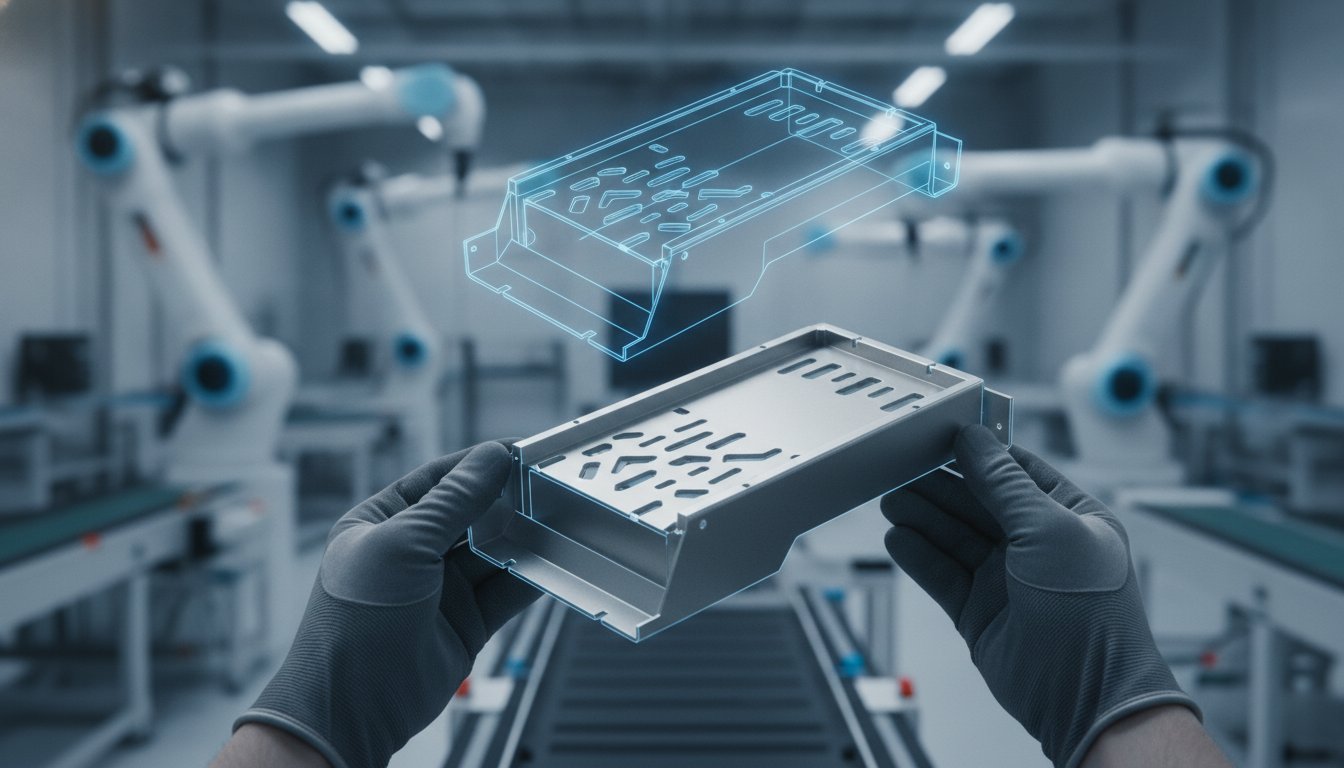
In the high-stakes world of 2026 robotics, a brilliant CAD model is a liability if it can't survive the transition to the factory floor. You've likely felt the friction of parts that look perfect on screen but require manual "adjustment" during assembly because tolerances drifted. High-performance sheet metal fabrication for robotics isn't just about bending material; it's about maintaining a digital-to-physical bridge that ensures every bracket and chassis fits the first time. It's the difference between a robot that launches on schedule and one that stays stuck in the prototype phase.
We understand that scaling from a single prototype to national production is where most OEMs stumble. This article explores how modern BIM integration, custom laser cutting, and automated CNC bending provide the lightweight, durable foundation your autonomous systems demand. You'll discover how to achieve sub-millimeter precision across every part while building a reliable, standardized supply chain that keeps your assembly line moving without delay. We'll break down the technical workflows that turn complex digital files into tangible, high-performance structural components with surgical accuracy.
Key Takeaways
- Learn why transitioning from heavy castings to lightweight, high-strength assemblies is essential for modern robotic agility and payload capacity.
- Understand how sub-millimeter tolerances in sheet metal fabrication for robotics eliminate assembly friction and protect sensitive motor housings.
- Compare the technical advantages of custom laser cutting and CNC press brake bending to optimize your chassis for both speed and structural integrity.
- Discover how BIM coordination and spool drawings bridge the gap between digital design and physical components for seamless multi-part integration.
- Establish a reliable national supply chain using standardized quality controls to scale your production from prototype to high-volume OEM delivery.
The Critical Role of Precision Sheet Metal in Robotics
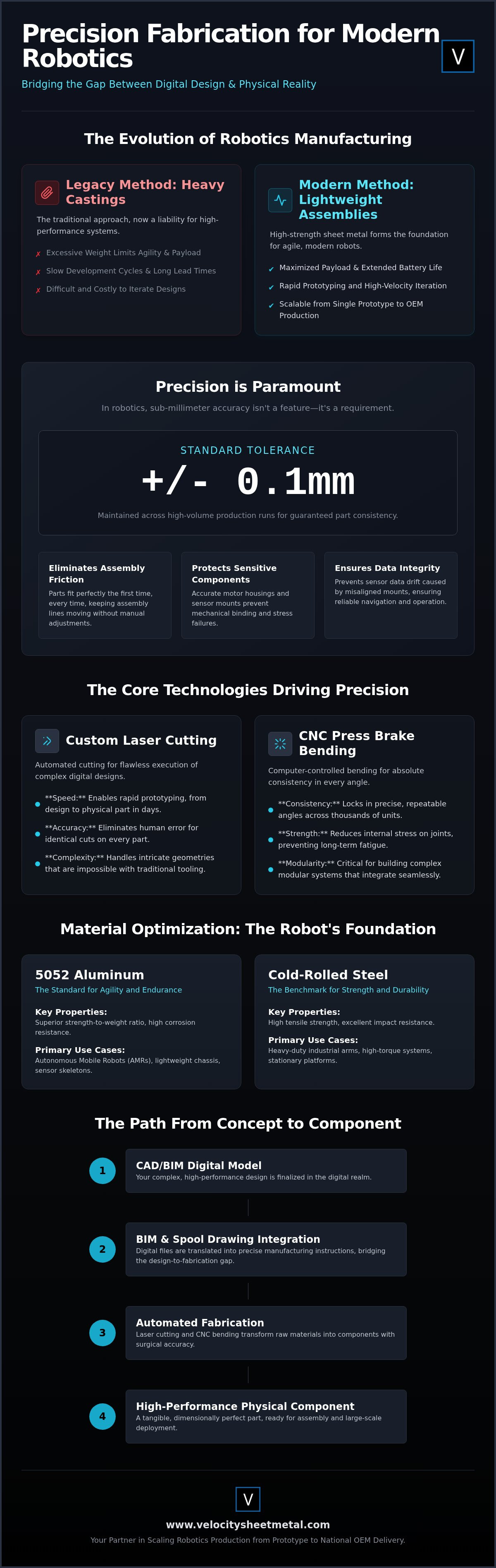
High-performance robotics depends on a structural foundation that balances weight and rigidity. Modern sheet metal fabrication for robotics has evolved into a sub-millimeter discipline where tolerances are measured in microns, not fractions. Heavy castings are becoming obsolete. They're too heavy for mobile platforms and too slow for modern development cycles. Instead, engineers utilize Sheet metal assemblies to create lightweight, high-strength frames that maximize payload capacity and battery life.
Our approach to sheet metal fabrication for robotics is to serve as the essential bridge between your digital file and a tangible product. We don't just bend metal; we translate complex CAD designs into repeatable physical components. This repeatability is critical for large-scale deployments. If part 100 doesn't match part one, your assembly line stops.
Why Robotics Demands Specialized Fabrication
Mobile robotic platforms face constant vibration and mechanical stress. Standard fabrication often fails here. Precision bending using CNC press brakes reduces internal stress on robotic joints, preventing fatigue over thousands of cycles. Specialized fabrication also addresses the technical requirements of the electronics. Robotic enclosures must provide effective EMI/RFI shielding to protect sensitive sensors from interference. By utilizing specific alloys and precise seam closures, we ensure your hardware remains electrically isolated and operationally stable.
From Prototype to Production: The Speed Factor
The robotics market moves fast. Startups can't wait months for traditional tooling or sand castings. Custom laser cutting offers a high-velocity alternative that enables rapid iteration. You can test a design on Monday, refine the digital model on Tuesday, and have new physical parts in hand by Thursday. This speed eliminates the long-lead times associated with traditional manufacturing. We focus on on-demand part production. This allows you to scale from a single prototype to a national OEM account without the administrative delays of old-school machine shops. It's about moving from digital concept to physical reality with surgical precision and industrial speed.
Material Optimization and Tolerance Standards for 2026
Selecting the right substrate is a critical engineering decision that defines a robot's performance limits. In sheet metal fabrication for robotics, the choice between 5052 aluminum and cold-rolled steel dictates the power-to-weight ratio and structural lifespan of the machine. Aluminum 5052 is the industry standard for autonomous mobile robots (AMRs). It offers high corrosion resistance and a superior strength-to-weight ratio, which directly extends battery life by reducing dead weight. Cold-rolled steel, conversely, provides the high-tensile strength and impact resistance required for heavy-duty industrial arms or multi-axis pick-and-place systems.
Aluminum vs. Steel: Choosing the Right Foundation
Mobile robots prioritize agility. We use aluminum for chassis and sensor skeletons to minimize inertia, allowing for faster acceleration and stops. However, stainless steel remains the benchmark for stationary industrial robots that handle high-torque loads. Material gauge also plays a decisive role. A thinner gauge of high-strength steel can often provide the necessary rigidity for a compact robotic arm while keeping the profile slim enough for tight work cells. Balancing these material properties ensures the frame doesn't fail under the repetitive stress of 24/7 operation.
Maintaining Sub-Millimeter Precision
Robotic sensor mounts and motor housings require absolute accuracy. If a mount is misaligned by even half a millimeter, the resulting sensor data drift can cause navigation failure or mechanical binding. Automated laser cutting eliminates the human error factor in complex geometries, ensuring every cutout is identical. CNC press brake bending then locks in consistent angles across thousands of parts, which is essential for modular robotic systems. In the context of 2026 robotics standards, precision tolerance refers to the consistent maintenance of dimensional variance within +/- 0.1mm across high-volume production runs. This level of accuracy is why many OEMs rely on CNC press brake bending to ensure seamless assembly.
The final layer of optimization is the material finish. Industrial environments are harsh. Powder coating offers a thick, impact-resistant barrier for warehouse robots that might bump into racking. Anodizing is the better choice for motor housings because it improves heat dissipation while providing a hard, scratch-resistant surface. Choosing the right finish is just as important as the material itself to ensure long-term reliability in the field.
Comparing Custom Laser Cutting and CNC Bending for Robotics
Choosing the right fabrication method is a balance of speed and structural integrity. For most robotic components, laser cutting outperforms waterjet in both cycle time and edge quality. While waterjet is effective for extremely thick plates, it's significantly slower and often unnecessary for the gauges used in sheet metal fabrication for robotics. Laser cutting provides the high-velocity throughput required for OEM production schedules. It allows for rapid transitions from digital design to physical part without the need for expensive, long-lead tooling.
For flat parts under 10mm, laser cutting is typically 50% to 80% cheaper than traditional CNC machining. This cost-to-speed ratio is a decisive factor for startups and established OEMs alike. It allows teams to allocate more budget toward sensors and software rather than over-spending on basic structural components. We focus on maximizing this efficiency to keep your production moving.
Custom Laser Cutting for Complex Geometries
Intricate sensor brackets and motor mounts require tight tolerances that traditional methods struggle to hit. Laser cutting handles these complex geometries with ease. It allows us to process specialized alloys like 6061 aluminum or 304 stainless steel with minimal heat-affected zone (HAZ) distortion. This precision ensures that mounting holes and alignment tabs remain perfectly true to the original CAD model. For a deeper look at hardware selection, see our Precision Laser Cutting Services guide.
CNC Bending and Forming: Building the Robotic Chassis
A robotic chassis must be rigid but lightweight. Multi-axis CNC bending allows us to create single-piece frames that replace complex assemblies of multiple welded parts. This reduction in part count simplifies your supply chain and eliminates assembly friction. By using automated press brakes, we maintain sub-millimeter accuracy across every bend. This ensures that motor shafts and gears align perfectly. It's a methodical approach that turns a flat sheet into a three-dimensional structural foundation.
Preventing defects like springback or cracking is essential when working with high-strength alloys. Automated systems adjust for material variance in real-time, delivering a level of consistency that manual operation cannot match. You can learn more about maintaining quality in our breakdown of Common Press Brake Forming Defects.
For large-scale robotic infrastructure, such as automated warehouse racking or external enclosures, we adapt coil-line production. This allows for the high-speed fabrication of standardized components at a scale that traditional job shops can't reach. It moves your project from a batch process to a continuous production flow, ensuring your national deployment stays on schedule.
Integrating BIM Coordination into Robotics Fabrication
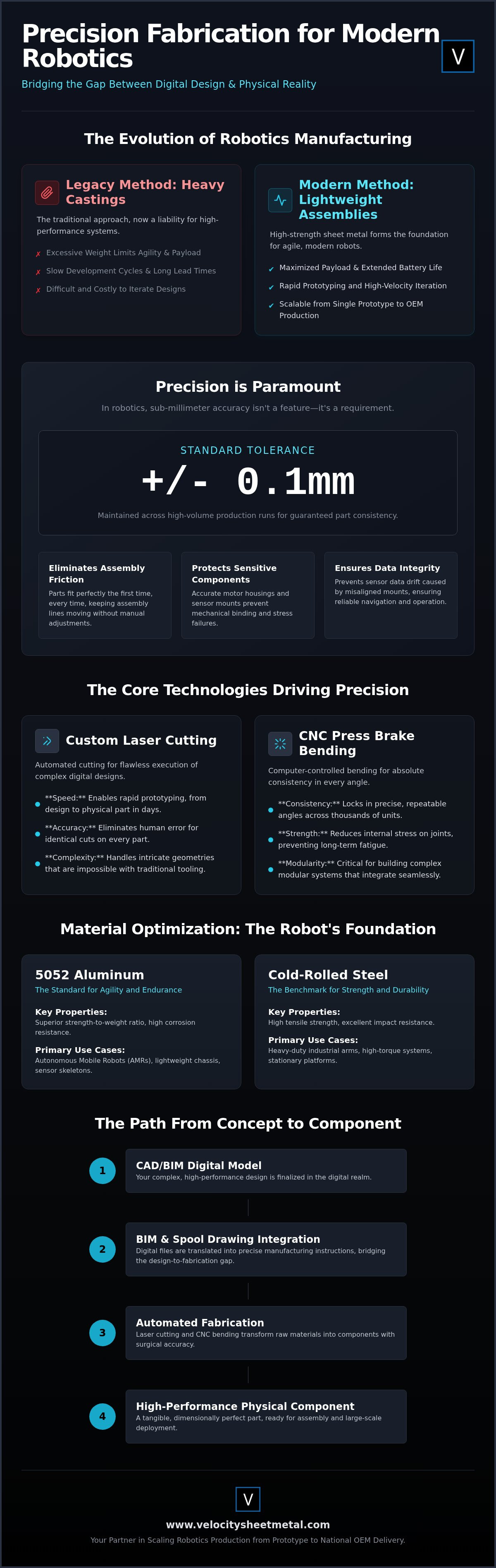
BIM isn't just for ductwork. In 2026, Building Information Modeling is a critical coordination tool for robotics OEMs. It provides a data-rich environment where every component of a robotic system is mapped in 3D before a single sheet of metal is cut. This integration ensures that sheet metal fabrication for robotics moves beyond simple part production into full system synchronization. We use these digital models to verify that every chassis, bracket, and enclosure interacts perfectly with the surrounding environment.
BIM Clash Detection for Robotics Installation
Field errors are expensive. If a robotic arm's range of motion hits a structural pillar or an HVAC line, the downtime costs are staggering. Digital clash detection allows us to simulate the entire robotic workcell in a 3D environment. This process identifies physical interference early in the design phase, long before parts arrive on-site. Research shows that projects utilizing BIM-enabled prefabrication can see a 20-50% reduction in construction time. It reduces material waste and prevents the need for on-site modifications that compromise structural integrity. For a detailed breakdown of these processes, read our guide on BIM for Sheet Metal Fabrication.
Spool Drawings: The Blueprint for OEM Success
Translating a complex robotic CAD file into actionable shop data requires surgical precision. We utilize spool drawings to break down large-scale assemblies into manageable, fabricatable segments. These drawings include every bend, hole, and hardware insertion point. They act as the definitive source of truth for our fabrication team. By using digital spool files, we maintain absolute consistency across high-volume production runs. This is vital for national accounts where parts may be shipped to various assembly plants across the country. Standardizing your sheet metal fabrication for robotics through spooling ensures that a part made today is identical to one made six months from now.
The digital-to-physical workflow is the modern standard for OEM production. It eliminates the ambiguity of traditional paper blueprints. Every part we produce is a direct physical manifestation of your digital model. This level of coordination is why leading innovators partner with us for their BIM and spool drawing needs. We ensure that your hardware fits the first time, every time, regardless of the project's scale. This methodical approach turns digital concepts into tangible results with zero administrative friction.
Scaling Robotics Production for National OEM Accounts
Scaling a robotics startup into a national OEM requires more than just a good design. It demands a fabrication partner that can replicate sub-millimeter precision at scale. Relying on fragmented local shops leads to inconsistent tolerances and assembly friction. For US-based robotics OEMs, a centralized national partner ensures that every bracket and chassis meets the same rigorous spec, whether it's delivered to an R&D lab or a high-volume production facility. Velocity Sheet Metal acts as this essential bridge, providing the standardized quality necessary for national infrastructure projects.
Standardized Quality for National Accounts
Consistency is the bedrock of industrial robotics. When you have multiple production sites, you can't afford variance in your structural components. We implement rigorous quality control standards that mirror the requirements of high-reliability sectors. Our sheet metal fabrication for robotics utilizes automated inspection and CNC verification to ensure every part is identical. This single-source approach eliminates the administrative delays of managing multiple vendors. It streamlines your supply chain from the first digital file to the final physical delivery. By maintaining a unified fabrication standard, we help you avoid the costly rework associated with dimensional drift across different manufacturing batches.
Nationwide Logistics and On-Demand Production
Speed is a competitive advantage. In the robotics industry, long lead times kill momentum. We leverage strategic nationwide shipping capabilities to reduce transport times and lower logistical costs. This supports Just-In-Time (JIT) manufacturing, allowing you to maintain leaner inventories without risking production stalls. Our on-demand part production model means we can pivot quickly to meet your fluctuating demand. We handle the logistics so your engineering team can focus on software and system integration.
From initial prototype iteration to high-volume national rollout, our workflow is designed for velocity. We don't just ship parts; we deliver the structural foundation for the next generation of autonomous systems. If you're ready to scale your production with a partner who understands the urgency of modern manufacturing, it's time to Partner with Velocity for your robotics fabrication needs. We provide the precision, speed, and national reach your OEM account requires to dominate the 2026 market.
Build the Future of Robotics with Precision Fabrication
The robotics landscape of 2026 demands a manufacturing partner that operates at the speed of digital design. Success requires a seamless transition from CAD models to high-performance structural components without the administrative delays of traditional shops. By integrating BIM coordination and automated laser cutting, you ensure every chassis and bracket fits perfectly the first time. This level of precision eliminates assembly friction and provides the reliable foundation necessary for autonomous systems to scale.
Our team brings over 50 years of combined industry experience to every project. We provide a BIM integrated workflow that bridges the gap between your engineering team and the factory floor. With nationwide shipping capabilities, we support your production needs from initial prototype to national rollout. High-velocity sheet metal fabrication for robotics is no longer a luxury; it's a structural requirement for OEM success.
Ready to move from digital concept to physical reality? Get an On-Demand Quote for Your Robotics Fabrication Project and let's get to work on your next deployment.
Frequently Asked Questions
What are the best materials for robotic sheet metal fabrication?
Aluminum 5052 and stainless steel are the industry standards for sheet metal fabrication for robotics. Aluminum provides the high strength to weight ratio required for mobile autonomous robots to maximize battery life. Stainless steel is preferred for stationary industrial arms that require high tensile strength and corrosion resistance. Cold rolled steel is often used for structural frames where cost efficiency and durability are the primary drivers for high volume production runs.
How do BIM services help in the manufacturing of robotic components?
BIM coordination identifies physical interference between robotic systems and their environment before production begins. We use digital models to verify that every chassis and bracket integrates perfectly with existing infrastructure. This digital to physical workflow reduces material waste and prevents on site errors during installation. Spool drawings then translate these 3D models into actionable fabrication data, ensuring that every hole and bend aligns with the master design.
Can you provide custom laser cutting for rapid robotics prototyping?
We offer high velocity custom laser cutting specifically designed for rapid iteration. This process allows robotics startups to test new designs in days rather than months. By cutting specialized alloys directly from CAD files, we eliminate the need for expensive, long lead tooling. This speed enables engineers to refine sensor mounts or motor brackets quickly, moving from a digital concept to a physical prototype with surgical accuracy.
What tolerances can be achieved with CNC press brake bending for robotics?
Our CNC press brake technology achieves sub millimeter precision with tolerances typically held within +/- 0.1mm. This level of accuracy is essential for robotic motor housings and sensor mounts where even slight deviations cause mechanical binding or data drift. Automated bending systems adjust for material springback in real time. This ensures that every bend angle is consistent across high volume production runs, which is critical for modular robotic assemblies.
Do you offer nationwide shipping for large-scale robotics OEM orders?
We provide comprehensive nationwide shipping for all national robotics OEM accounts. Our logistical infrastructure is designed to handle high volume orders and ensure standardized parts reach your assembly plants across the country on schedule. This capability supports Just In Time manufacturing strategies by reducing lead times and ensuring a reliable supply of structural components. We act as a single source partner for national accounts to simplify supply chain management.
How does sheet metal fabrication compare to 3D printing for robotic chassis?
Sheet metal fabrication for robotics offers superior structural integrity and cost efficiency at scale compared to 3D printing. While 3D printing is useful for complex internal geometries, sheet metal provides the durability and impact resistance required for industrial environments. For parts under 10mm, laser cutting is faster and more affordable for volume production. Sheet metal assemblies also offer better heat dissipation and EMI/RFI shielding for sensitive electronics.
What is the typical lead time for custom robotic part production?
Lead times vary based on project complexity, but our automated workflow is designed for maximum velocity. Custom laser cutting and CNC bending often allow for production to begin immediately after the technical review of your digital files. We focus on cutting through administrative delays to deliver parts as quickly as possible. This approach supports rapid deployment schedules and helps robotics OEMs meet aggressive market launch dates without sacrificing precision.
How do you ensure quality consistency for national robotics accounts?
We maintain quality consistency through a standardized, data driven production process. Every part is verified against the original digital model using automated inspection protocols. Our management team, with 50+ years of combined experience, oversees rigorous QC standards that mirror high reliability industry requirements. By centralizing fabrication in our facility and utilizing BIM integration, we ensure that a part produced for one site is identical to those shipped elsewhere.