Precision Laser Cut and Bent Metal Parts: The 2026 Industrial Procurement Guide
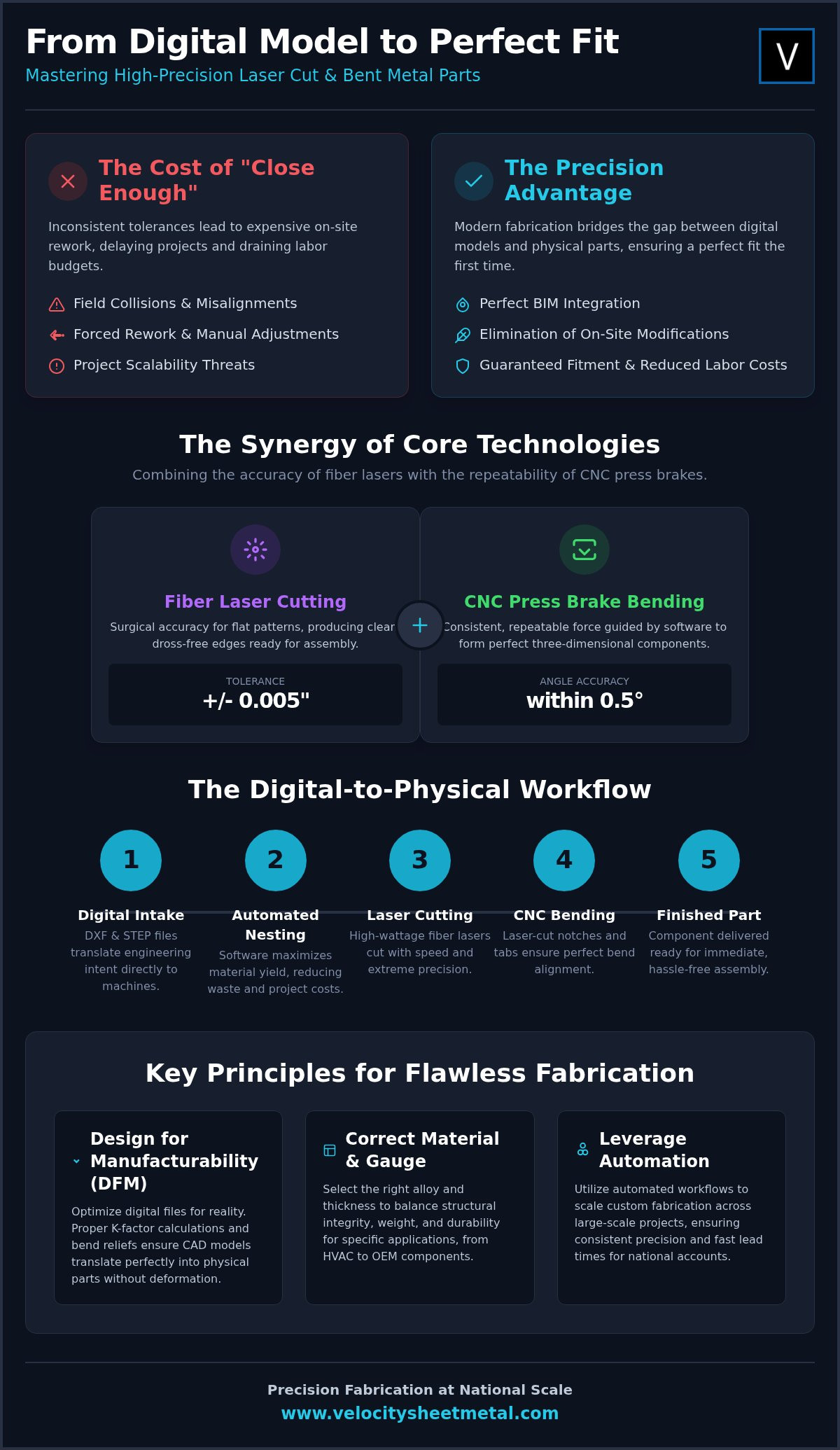
In 2026, a part that matches a shop drawing is just the entry fee; the real win is a component that integrates perfectly into a complex BIM environment without a single field adjustment. You've seen the cost of "close enough" when inconsistent tolerances lead to field collisions and force your crew to rework custom HVAC components on-site. It's a drain on labor and a threat to your project's scalability. We understand that in high-stakes industrial fabrication, there's no room for administrative delays or technical guesswork.
This guide helps you master the technical requirements and procurement strategies for high-precision laser cut and bent metal parts to streamline your production timeline from the first digital file to the final delivery. You'll learn how to leverage automated CNC press brake bending and fiber laser technology to bridge the gap between digital models and physical reality. We're breaking down how to standardize quality across national accounts, reduce field labor through precision fitment, and ensure your procurement process is as fast and methodical as the machines on the factory floor.
Key Takeaways
- Bridge the gap between digital BIM models and physical components to eliminate field collisions and costly manual rework on-site.
- Understand how the integration of fiber laser cutting and CNC press brake bending produces high-tolerance laser cut and bent metal parts for complex industrial applications.
- Identify the correct alloy and gauge thickness combinations to optimize structural integrity while meeting weight and durability requirements for national accounts.
- Master Design for Manufacturability (DFM) principles, such as K-factor calculations and bend relief, to ensure your digital files translate into perfect physical parts.
- Leverage automated production workflows to scale custom fabrication across large-scale projects without sacrificing precision or lead times.
Defining Industrial-Grade Laser Cut and Bent Metal Parts
The standard for industrial fabrication has shifted. We've moved past the era of manual shearing and hand-marking. Modern metal fabrication processes now rely on the surgical accuracy of fiber lasers and the repeatable force of CNC press brakes. In 2026, precision isn't just a goal; it's the baseline. When you procure laser cut and bent metal parts, you aren't just buying material. You're buying the assurance that every component will fit the first time, every time.
Industrial-grade precision is quantified by tight tolerances. For laser cutting, this typically means maintaining accuracy within +/- 0.005 inches. For bending, it's about holding consistent angles within half a degree across an entire production run. This level of control is essential for complex geometries found in OEM components and heavy-duty HVAC systems where manual adjustments are too costly to ignore. It's the difference between a project that stays on schedule and one that gets bogged down by field collisions.
The Process: From CAD to Finished Component
Every project begins with digital intake. We utilize DXF and STEP files to translate your engineering intent directly to our machines. This digital-to-physical bridge eliminates the human error inherent in manual data entry. Once the files are in our system, automated nesting software takes over to maximize efficiency. This technology arranges parts to maximize material yield, ensuring we're using every square inch of galvanized steel or aluminum effectively.
- Digital Accuracy: DXF and STEP files provide a 1:1 map for the laser, ensuring design intent is preserved.
- Yield Optimization: Automated nesting reduces material waste, which helps lower your overall project costs.
- Edge Quality: High-wattage fiber lasers produce dross-free edges that require zero secondary grinding.
The actual cut is a matter of physics. Fiber lasers use a concentrated beam of light to melt and vaporize metal with extreme speed. Unlike older CO2 technology, fiber lasers interact more efficiently with reflective alloys like stainless steel. This results in a cleaner edge and a smaller heat-affected zone. Your parts arrive ready for the assembly line immediately.
Why Industrial Contractors Prioritize Precision
Precision is a direct driver of profitability. When parts are fabricated with exact tolerances, field labor costs plummet. Your crew spends their time installing rather than grinding, shimming, or forcing assemblies together. This "perfect fit" approach is especially critical for HVAC duct fabrication for mechanical contractors. In high-velocity systems, even a minor misalignment can disrupt airflow efficiency and cause long-term performance issues. By eliminating the need for on-site modifications, you eliminate waste and keep your project on a strict timeline. We don't just deliver parts; we deliver components that bridge the gap between a digital BIM model and a tangible, high-performance physical product.
The Synergy of Fiber Laser Cutting and CNC Press Brake Bending
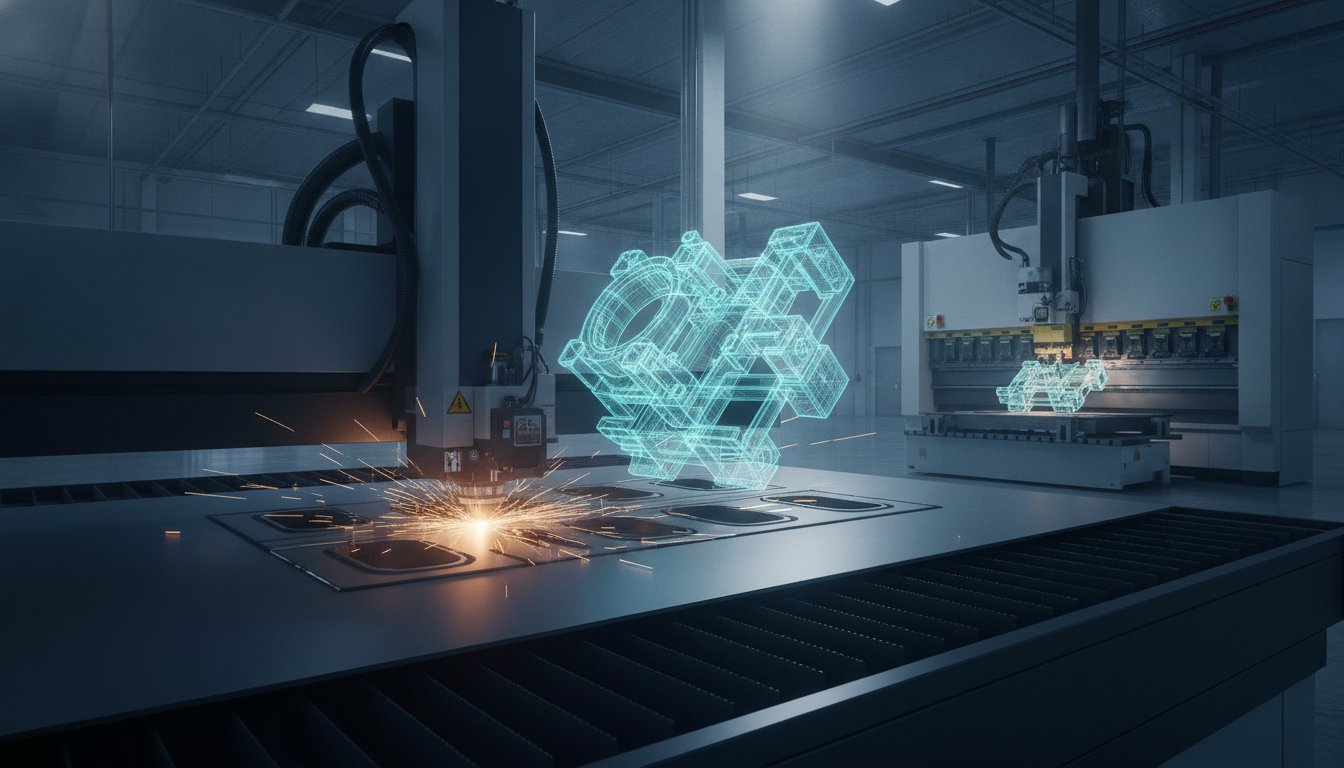
Precision fabrication is a handshake between two distinct technologies. It's the moment where the flat accuracy of a laser meets the three-dimensional reality of a press brake. In a modern workflow, these processes aren't isolated. They're integrated through software that predicts how a material will behave before the first cut is even made. This synergy is what allows us to produce laser cut and bent metal parts that slide into place on a job site without a single field adjustment.
One of the most effective strategies for ensuring accuracy is the use of laser-cut notches and tabs. By cutting small alignment markers directly into the flat pattern, we provide the press brake operator with physical locators. This eliminates the need for manual layout and ensures that every bend occurs exactly where the digital model dictates. When combined with modern software that calculates material springback, we can achieve perfect angles on the first hit, reducing waste and accelerating your production timeline.
Advanced Fiber Laser Capabilities
Fiber technology has revolutionized industrial applications of high-power lasers by providing a concentrated focal point that exceeds the capabilities of older CO2 systems. This intensity allows for extreme speed without sacrificing a +/- 0.005 inch tolerance. Because the fiber laser is so efficient, the Heat Affected Zone (HAZ) is significantly smaller than what you'll find with plasma cutting. This prevents material warping and preserves the structural integrity of the alloy edge.
The result is a clean-cut edge that is virtually dross-free. For industrial contractors, this means your parts arrive ready for assembly or welding immediately. There is no need for secondary deburring or grinding, which removes a massive bottleneck from the fabrication cycle. Whether you are working with stainless steel or aluminum, the fiber laser provides a mirror-finish edge that meets the strictest aesthetic and functional standards.
Precision CNC Bending Techniques
Once the laser has finished its work, the part moves to the CNC press brake. This is where automated back-gauging becomes the hero of the process. These systems move in multiple axes to position the part with surgical precision for every bend. For thinner gauges, we often utilize air bending, which allows us to achieve various angles using a single set of tools. For heavier applications, such as HVAC curb adapters, bottoming ensures extreme repeatability across thousands of units.
Multi-stage setups allow our operators to stage several tool sets along the same bed. This means we can produce complex enclosures with multiple bend radii in a single handling. It's a methodical approach that prioritizes speed and consistency. If you're looking to scale a project across national accounts, integrated CNC press brake bending is the only way to ensure that the thousandth part is an exact replica of the first. This level of repeatability is essential for maintaining standardized quality across diverse job sites.
Material Selection and Precision Tolerances for Custom Parts
Choosing the right material is a balancing act between structural requirements and fabrication reality. Your choice of alloy dictates how the fiber laser cuts and how the press brake forms the final geometry. Producing high-quality laser cut and bent metal parts starts with understanding material hardness and grain direction. If you overlook these variables, you risk material failure or inconsistent dimensions that disrupt your production timeline.
Standard Materials for HVAC and Industrial Use
Industrial applications demand specific material properties. We focus on alloys that provide the best performance for national-scale projects. From corrosive environments to weight-sensitive rooftop installations, the material must match the mission. We don't just provide metal; we provide the specific alloy that ensures your project's longevity.
- Galvanized G90: This is the gold standard for corrosion-resistant ductwork. The G90 designation ensures a heavy zinc coating that protects the steel from moisture and oxidation.
- Aluminum 5052: Known for its high fatigue strength and excellent corrosion resistance. It's the ideal choice for rooftop units where reducing weight is a priority.
- Stainless Steel 304/316: 304 is the workhorse for commercial kitchens, while 316 offers superior resistance to chlorides in lab or marine environments.
The relationship between material hardness and bending radius is critical. Harder materials require a larger minimum bend radius to prevent cracking along the outer radius. We help you navigate these specifications to ensure structural integrity across every part. Whether it's a simple bracket or a complex enclosure, the material's behavior under stress is our primary concern.
Understanding Bending Tolerances
Precision is defined by what you can measure. Engineers must specify both linear and angular tolerances to ensure a perfect fit in the field. A linear tolerance of +/- 0.005 inches is standard for laser cutting, but bending introduces new variables. Angular consistency depends on the material's grain direction. Bending against the grain provides more strength and prevents material tearing in high-stress components.
Surface finishes represent the final step in the fabrication process. While many industrial parts use a raw mill finish, we also provide options for industrial powder coating. This adds an extra layer of protection and professional aesthetics to your custom enclosures. By standardizing these material choices and tolerances, you ensure that your laser cut and bent metal parts integrate perfectly into your BIM-coordinated projects.
Design for Manufacturability: Optimizing Your CAD Files
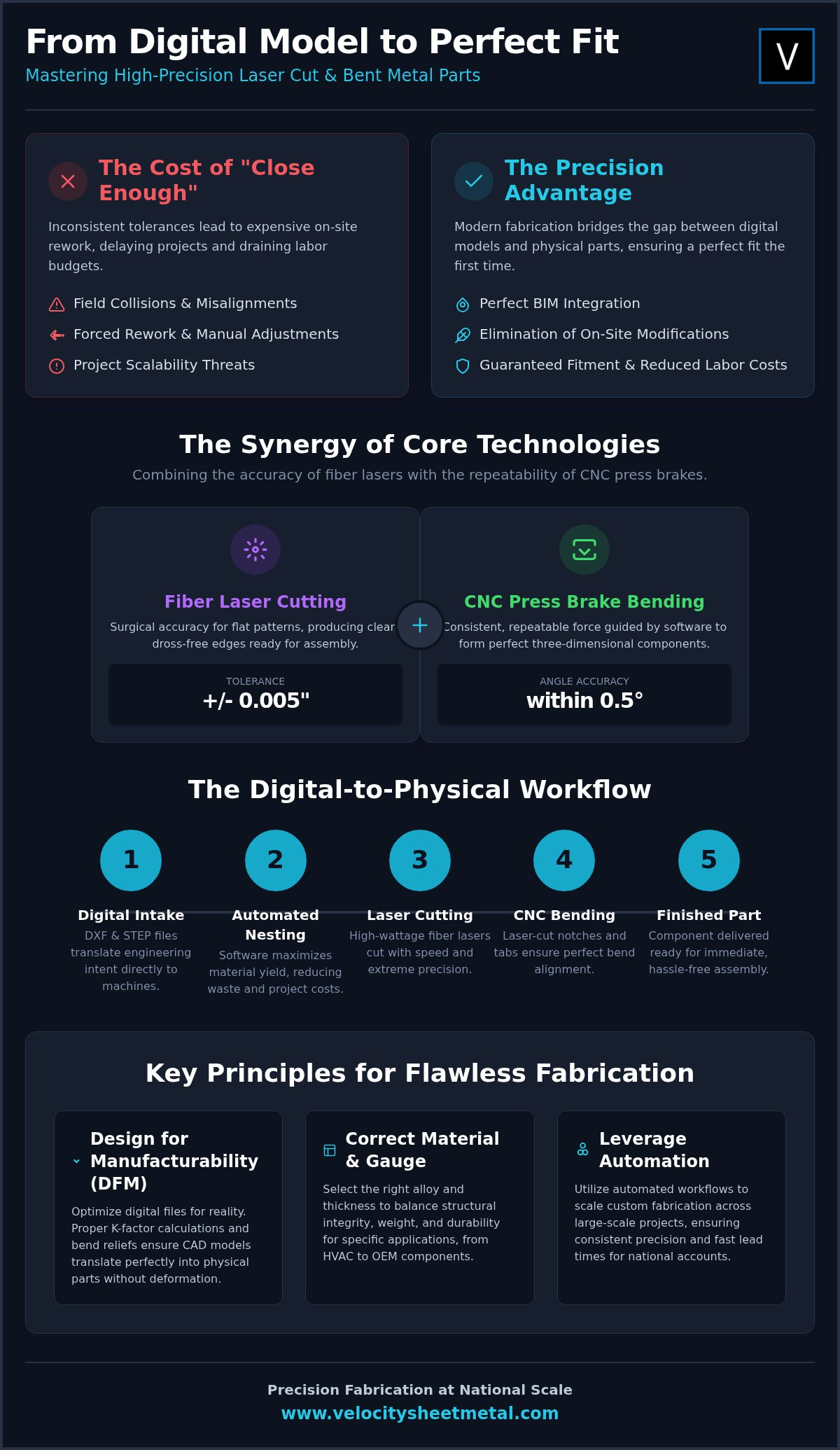
Success in industrial fabrication is determined long before the laser hits the sheet. To produce high-quality laser cut and bent metal parts, your CAD files must be optimized for the specific physics of the fiber laser and the CNC press brake. We don't just "hit print" on your digital designs; we analyze them to ensure they are manufacturable at scale. A file that looks perfect on a screen can fail on the shop floor if it doesn't account for material behavior.
- Step 1: Account for the K-factor. This constant represents the shift of the material's neutral axis during a bend. If your flat pattern doesn't account for this, your final dimensions will be off.
- Step 2: Design with bend relief. Adding small cutouts at the ends of a bend line prevents material tearing and unwanted deformation. It ensures a clean, professional finish.
- Step 3: Optimize hole-to-edge distances. Placing holes too close to a bend or an edge can lead to structural instability or "ovalization" during the forming process.
- Step 4: Incorporate laser-etched part numbers. We can etch identification marks directly onto your parts. This simplifies assembly for your field crew and eliminates sorting errors.
- Step 5: Validate against BIM models. Every part should be checked against the broader mechanical model to ensure it fits within the allocated space without interference.
The Role of BIM Coordination in Fabrication
We act as the essential bridge between 3D mechanical models and CNC machinery. While some shops offer automated portals for simple parts, we provide human expert oversight to handle complex mechanical spooling. Integrating BIM clash detection for HVAC fabrication into the design phase saves weeks of on-site troubleshooting. We turn massive digital models into manageable, precision-cut components that arrive at your job site ready for immediate installation. This methodical approach ensures your project stays on schedule and your labor costs stay under control.
Common Pitfalls in Laser and Bend Design
One of the most frequent mistakes is over-specifying tolerances. Demanding a +/- 0.001" tolerance when +/- 0.005" is sufficient for the application makes parts unnecessarily expensive without adding functional value. You also need to avoid common press brake forming defects by designing with the correct material thickness in mind. Failure to account for the "inside radius" of a bend can lead to tight-clearance assemblies that simply don't fit together in the field. Precision isn't just about tightness; it's about accuracy that aligns with real-world assembly requirements. Request a technical review of your BIM coordination files to ensure your next project is optimized for automated production.
Velocity Sheet Metal: National Scale for Custom Fabrication
Velocity Sheet Metal isn't just a fabrication shop; it's a high-capacity partner for national industrial projects. We combine 50+ years of combined industry experience with a fully automated production environment. This allows us to deliver high-tolerance laser cut and bent metal parts at a speed that traditional fabrication houses can't match. We act as the essential bridge between your digital BIM files and the tangible components required on the factory floor. Our process is built for speed, accuracy, and seamless integration into your workflow.
Scalability for National HVAC Accounts
Managing a national account requires a level of consistency that manual processes simply can't provide. We specialize in HVAC duct fabrication for mechanical contractors who need standardized quality across multiple project sites. By centralizing your fabrication with Velocity, you eliminate the variability of using different regional shops. Every curb adapter, fitting, and duct section meets the same rigorous tolerance standards, regardless of the final destination.
Our nationwide shipping capabilities reduce the logistics headaches often associated with large-scale procurement. We get your precision parts to your site, anywhere in the US, exactly when they're needed. It's a methodical, on-demand delivery system designed to keep your production timeline moving. We don't just ship metal; we deliver project-ready components that arrive sorted, labeled, and ready for install.
Custom Solutions: Beyond the Standard Duct
Our capabilities extend far beyond standard rectangular ductwork. We provide precision-cut CNC press brake services for OEMs who require complex geometries and repeatable accuracy for their own product lines. From industrial prototyping to high-volume production runs, we handle the technical heavy lifting so you don't have to. Our facility is equipped to handle the diverse needs of modern industry.
- Custom curb adapters: We provide fast, precise solutions for rooftop unit replacements, ensuring a leak-proof fit every time.
- Standardized quality control: National accounts trust our automated coil-line and laser precision for repeatable results across every order.
- Rapid industrial prototyping: Transition from a digital model to a physical part in record time to keep your R&D cycles on track.
- BIM-to-Physical workflow: We turn your spool drawings into laser cut and bent metal parts with surgical precision.
In the high-stakes world of industrial procurement, you need a partner who values your time as much as your technical specifications. We've embraced modern technology to solve traditional industrial problems, cutting through administrative delays and field collisions. Velocity Sheet Metal delivers the reliability of a long-term partner with the speed of a modern tech-driven workshop. We're ready to get to work immediately on your next national project.
Accelerate Your 2026 Procurement Strategy
Industrial success depends on the surgical integration of digital design and physical reality. You've learned how fiber laser precision and CNC bending eliminate the need for costly on-site modifications. From selecting the right alloy to optimizing CAD files for the K-factor, every step in the process must be methodical. Procuring high-quality laser cut and bent metal parts shouldn't be an administrative bottleneck. It should be a predictable, high-speed extension of your production line.
Velocity Sheet Metal provides the national shipping and standardized quality you need to scale. We leverage 50+ years of combined industry experience and a BIM-integrated fabrication workflow to deliver components that arrive ready for install. Don't let inconsistent tolerances stall your production. Request a Quote for Precision Laser Cut and Bent Parts today and move your project from the screen to the site with confidence.
Frequently Asked Questions
What is the standard lead time for laser cut and bent metal parts?
Lead times fluctuate based on project complexity and material availability. For standard industrial components, automated workflows often allow for production within days rather than weeks. High-capacity facilities utilizing fiber lasers and CNC press brakes significantly reduce the administrative delays typical of manual shops. We prioritize speed and methodical delivery to keep your production timeline on track. Contact our team for a specific timeline based on your current spool drawings.
Can you provide BIM coordination for custom HVAC fabrication projects?
Yes, we specialize in bridging the gap between digital models and physical parts. Our team provides full BIM coordination and spool drawing expertise to ensure every component fits perfectly in the field. By identifying potential collisions in the digital phase, we eliminate the need for on-site modifications. This integrated approach is essential for large-scale mechanical contractors who require seamless transitions from 3D models to laser cut and bent metal parts.
What file formats are required for custom laser cutting and bending?
We require DXF or STEP files for most fabrication projects. These formats allow our software to translate your engineering intent directly to our CNC machinery with surgical precision. DXF files are ideal for flat laser cutting, while STEP files provide the 3D data necessary for accurate press brake bending. Using these industry-standard formats ensures a 1:1 transition from your design software to the final physical component without data loss.
What are the maximum dimensions for laser cutting and CNC bending?
Our fiber laser systems typically accommodate sheet sizes up to 5 feet by 10 feet. For CNC bending, the capacity is determined by the length of the press brake bed and the material gauge. We handle everything from small, intricate OEM components to large-scale curb adapters and industrial duct sections. If your design exceeds standard dimensions, we can often engineer multi-part assemblies that maintain structural integrity while meeting your specific footprint requirements.
Do you offer nationwide shipping for large-scale ductwork orders?
Yes, we provide nationwide shipping for all industrial fabrication orders, including large-scale rectangular and spiral ductwork. Our logistics process is designed for national accounts that require standardized quality across multiple job sites. We ensure that every shipment is sorted, labeled, and delivered on-demand to match your installation schedule. This centralized fabrication model reduces regional variability and ensures consistent production standards for your entire project portfolio across the US.
How do I ensure my part design is optimized for CNC bending?
Optimization starts with Design for Manufacturability (DFM) principles. You must account for the material's K-factor to ensure accurate flat patterns and include bend relief to prevent material tearing. It's also critical to maintain a minimum bend radius based on the material's hardness and thickness. By validating these technical requirements during the design phase, you ensure that your laser cut and bent metal parts are repeatable and free from common forming defects.
Can you handle high-volume production for national accounts?
We're built for high-volume scalability. Our facility utilizes automated coil-line production and high-wattage fiber lasers to handle massive orders for national accounts without sacrificing precision. We maintain standardized quality control across every run, ensuring that the thousandth part is an exact replica of the first. This capacity is ideal for mechanical contractors and OEMs who need a reliable partner capable of meeting the demands of large-scale industrial projects.
What materials are best suited for outdoor HVAC curb adapters?
Galvanized G90 steel is the industry standard for outdoor curb adapters due to its superior corrosion resistance and structural integrity. For applications where weight reduction is a priority, Aluminum 5052 offers excellent durability and fatigue strength in harsh environments. We also fabricate adapters from stainless steel for specialized lab or coastal environments. Selecting the right alloy ensures your rooftop units remain leak-proof and structurally sound for the long term.