On-Demand Metal Part Production: The 2026 Guide to Rapid Industrial Fabrication
The traditional six-week lead time for custom metal is a relic of the past. You shouldn't have to tolerate unreliable delivery dates from local job shops or handle the fallout when digital designs don't match physical parts on-site. It's frustrating to watch project timelines slip because of material waste or procurement bottlenecks. Most project managers agree that the gap between a BIM model and a finished component is where the most money is lost. That's why quick turn sheet metal fabrication has evolved into a data-driven service that bridges the gap between your design software and the factory floor.
This guide shows you how modern on-demand fabrication and BIM coordination eliminate these bottlenecks to streamline your national supply chain. You'll learn how to achieve faster project completion cycles and ensure zero-defect parts that fit perfectly the first time. We'll explore the technical shift toward automated coil-lines and precision laser cutting that makes nationwide logistics simpler than ever. From digital spooling to final delivery, it's time to demand a manufacturing partner that values your schedule as much as your specifications.
Key Takeaways
- Identify why 2026 procurement teams are prioritizing digital agility over expensive, inventory-heavy local stockpiles.
- Learn how quick turn sheet metal fabrication uses automated nesting and CAD analysis to maximize material yield.
- Discover how BIM coordination and mechanical spooling prevent costly field collisions before production begins.
- Understand how centralized fabrication streamlines logistics and ensures standardized quality for national accounts.
- See how automated coil-lines accelerate the delivery of high-volume rectangular ductwork for large-scale projects.
Defining On-Demand Metal Part Production in the 2026 Landscape
The industrial supply chain has moved past the era of massive local stockpiles and bloated inventories. In 2026, agility is the primary metric for procurement success. Procurement teams now prioritize just-in-time digital fabrication over the risk of maintaining huge warehouses. This shift toward quick turn sheet metal fabrication ensures that parts move from the cloud to the shipping pallet in hours, not weeks. It's about precision, speed, and the total elimination of administrative friction.
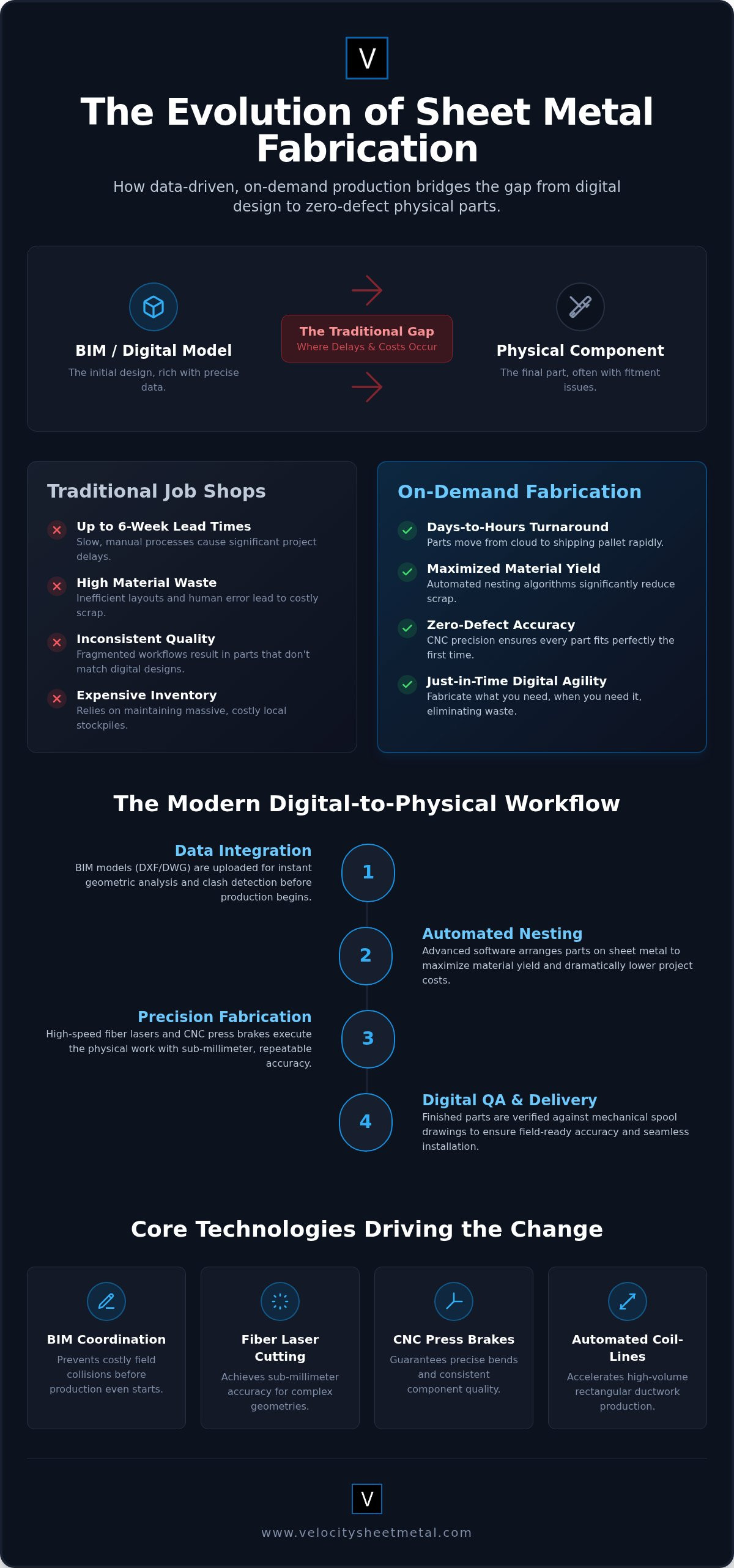
Modern sheet metal fabrication relies on precision software to dictate every cut, bend, and seam. By utilizing automated precision and advanced nesting algorithms, manufacturers can significantly reduce human error and material scrap. This isn't just about saving money; it's about reliability. When a digital design matches the physical part exactly, field installation becomes a seamless process of assembly rather than a struggle for fitment. High-speed laser cutting and CNC bending ensure that every component meets the exact tolerances required for complex mechanical systems. On-demand services act as the essential bridge between complex engineering models and the reality of the job site.
The Core Benefits of On-Demand Workflows
On-demand production removes the "minimum order" barrier that often stalls custom industrial projects. Whether you need a single custom curb adapter or a thousand feet of coil-line automated rectangular duct, the workflow remains the same. Automated scheduling tools allow shops to reduce lead times from months to days. For national accounts, this creates a standardized quality level that local job shops simply can't match. You get the same precision in every state, every time. It simplifies logistics by providing a single point of truth for all fabricated components.
On-Demand vs. Traditional Job Shops
Traditional job shops often rely on manual setups and fragmented workflows that invite delays. In contrast, on-demand facilities use CNC-driven automation to maintain a high-velocity output for quick turn sheet metal fabrication. The integration of digital files like DXF and DWG is the core of this modern production cycle. It allows for instant analysis and rapid execution. "Digital first" shops offer superior repeatability for recurring orders, ensuring that the tenth batch of spiral duct is identical to the first. This level of consistency is what separates a modern fabrication partner from a standard vendor.
The Digital-to-Physical Workflow: BIM, CAD, and Laser Precision
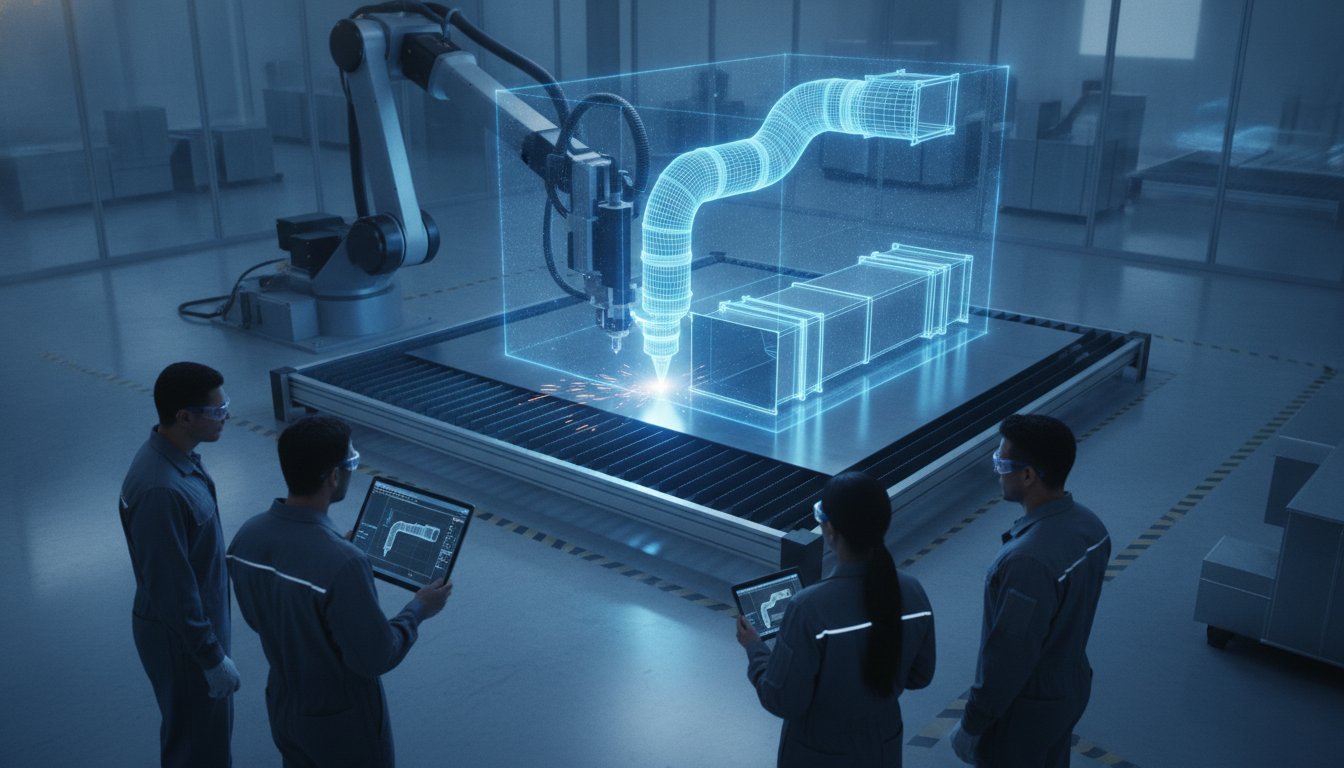
The transition from a digital design to a physical part must be seamless to maintain a competitive schedule. This workflow starts with uploading precision CAD files or BIM models for instant analysis. Our system evaluates the geometry to identify potential fabrication issues before the first spark flies. This proactive approach is the backbone of quick turn sheet metal fabrication. It ensures that every minute spent on the shop floor is productive and every part fits the first time.
- Step 1: Data Integration: Uploading BIM models allows for instant geometric analysis and clash detection.
- Step 2: Automated Nesting: Software arranges parts to maximize material yield and lower project costs.
- Step 3: Precision Fabrication: High-speed fiber lasers and CNC press brakes execute the physical work.
- Step 4: Digital QA: Parts are verified against mechanical spool drawings to ensure field-ready accuracy.
While research into additive manufacturing processes continues to evolve, high-speed laser cutting remains the fastest route for industrial-scale production. This high-velocity output is what defines quick turn sheet metal fabrication in a modern industrial setting. By aligning digital spool drawings with physical production, we eliminate the guesswork that often leads to field modifications and delays.
Precision Laser Cutting for Complex Geometries
Fiber lasers are the workhorse of the modern shop. They achieve incredibly tight tolerances for OEM components, allowing for intricate designs that traditional methods can't match. This technology offers immense material versatility, handling everything from heavy-gauge carbon steel to custom aluminum parts with ease. In 2026, laser cutting precision is defined by sub-millimeter accuracy. This level of detail eliminates the need for secondary finishing, pushing your project closer to completion with every cut.
CNC Press Brake Bending for Structural Integrity
Bending is where digital precision meets structural reality. The mechanics of automated bending allow us to produce custom brackets and enclosures that meet exact structural requirements. By utilizing CNC technology, we ensure consistent angles across high-volume production runs, which is critical for parts that must stack or interlock perfectly. This repeatability is why many contractors rely on our CNC press brake services for OEMs to maintain tight project timelines. Every bend is measured against the original digital model to guarantee a zero-defect result on the job site.
The BIM Advantage: Why Coordination is the Secret to On-Demand Accuracy
Speed is a liability if the final parts don't fit the physical space. BIM coordination acts as the critical filter that catches design errors before a single piece of metal is cut. It's the difference between a project that maintains its momentum and one that stalls because of costly field collisions. By identifying overlaps between mechanical, electrical, and plumbing systems in a virtual environment, we ensure that every component arrives on-site ready for immediate installation. This proactive approach is what makes quick turn sheet metal fabrication a viable solution for high-stakes commercial construction.
The transition from a high-level 3D model to the factory floor requires a methodical breakdown of data. We move beyond general design intent to provide mechanical spooling services that translate complex models into fabricatable parts. While some sectors look toward modern additive manufacturing for prototyping, industrial contractors rely on our BIM-integrated workflow to produce large-scale, structural components with surgical precision. Engineers trust this process because it bridges the gap between engineering theory and shop-floor reality, ensuring that even the most complex commercial projects stay on schedule.
Mechanical Spooling and Drawing Accuracy
Mechanical spooling is where digital designs become actionable fabrication data. We take your HVAC layouts and generate detailed spool drawings that guide our automated production lines. This level of detail is essential for ensuring an exact field fit-up, especially in tight mechanical rooms or crowded ceiling plenums. By utilizing BIM clash detection for HVAC fabrication, we eliminate the guesswork that traditionally leads to expensive on-site modifications. You get parts that are verified against the digital spool, reducing field labor and accelerating the assembly process.
Eliminating Field Waste with Digital VDC
Virtual Design and Construction (VDC) is a powerful tool for minimizing material scrap on the job site. When every part is coordinated in real-time between MEP teams, there's no need for "field-measuring" that often results in wasted material and lost time. This digital-first strategy allows for quick turn sheet metal fabrication that serves the exact needs of the project without excess. The impact on your project's ROI is direct; you spend less on scrap and more on productive installation hours. BIM doesn't just improve accuracy; it transforms the entire economic profile of your mechanical procurement.
Scaling On-Demand Production for National Accounts
Fragmented procurement is the enemy of a national rollout. Sourcing from multiple local job shops creates inconsistent tolerances and varying lead times. Centralized production solves this by allowing for standardized quick turn sheet metal fabrication across every state. You get the same gauge, the same seam, and the same precision from the first delivery to the last. This level of consistency is vital for multi-state commercial developments where uniformity is a requirement, not a luxury.
Managing high-volume orders usually means sacrificing speed. Our automated coil-lines and laser systems change that math. We process large-scale industrial orders while maintaining the agility of a custom shop. From initial digital spooling to final site delivery, the workflow remains fast and predictable. This approach moves your project forward without the typical administrative delays of traditional procurement. It's about maintaining project continuity through a single, reliable point of contact.
Nationwide Shipping and Logistics
Logistics for large-scale ductwork requires more than just a truck. Robust packaging is essential to prevent damage during transit, especially for long-run spiral duct or complex fittings. We provide full tracking and transparency throughout the delivery chain so your field teams know exactly when to expect their components. This level of coordination is a staple of our HVAC duct fabrication for mechanical contractors. It ensures that your national supply chain remains unbroken, regardless of the project's location.
Standardizing Quality for OEMs and National Accounts
Consistency is the foundation of a successful national account partnership. We maintain strict fabrication tolerances and consistent material sourcing for every order. Whether you need custom OEM brackets or standard rectangular duct, the quality remains identical batch after batch. Dedicated account management provides a direct line to the factory floor, cutting through the noise of traditional procurement. For large-scale industrial partners, having a single point of contact for all sheet metal needs simplifies the entire workflow. You can partner with our national accounts team to standardize your fabrication quality and meet aggressive project deadlines.
Velocity Sheet Metal: Your National Partner for On-Demand Production
Velocity Sheet Metal provides the technical capability and industrial pragmatism required for high-stakes projects. We aren't just a supplier; we're a reliable, tech-savvy partner. Our facility handles everything from initial BIM coordination to final nationwide shipping. By focusing on quick turn sheet metal fabrication, we help contractors eliminate lead-time bottlenecks and meet aggressive project deadlines. Every project we touch benefits from over 50 years of combined industry experience. We act as the essential bridge between your digital files and the final, physical product.
Our approach is methodical and fast-paced. We understand that in commercial construction, time is the most valuable commodity. That's why our workflows are designed to move your project from a digital concept to a tangible result with surgical precision. We don't just cut metal; we execute a data-driven production cycle that prioritizes your schedule and your specifications. From custom OEM parts to high-volume ductwork, we deliver the reliability you need to maintain project continuity across the country.
Automated Coil-Line Efficiency
High-volume commercial HVAC projects demand more than manual labor can provide. Our automated coil-line produces rectangular ductwork with surgical speed and repeatable accuracy. This system transforms raw metal into finished duct in a single, continuous process. It's the most efficient way to handle large-scale requirements without compromising on quality. By utilizing coil line duct fabrication, we significantly reduce production costs for our partners. This automation ensures your project stays on budget and ahead of schedule. Speed is a requirement. We deliver it.
Custom Solutions: From Curb Adapters to Enclosures
Not every part fits a standard mold. We specialize in the rapid production of custom curb adapters for rooftop units, ensuring a perfect fit between the unit and the roof. Our facility also fabricates precision enclosures and brackets for industrial OEMs who require high-velocity output. From heavy-gauge steel to lightweight aluminum, our CNC press brake bending and custom laser cutting services handle complex geometries with ease. We apply our deep technical expertise to every custom component we build. The Velocity promise is simple: 50+ years of expertise applied to modern on-demand technology. We bridge the gap between engineering theory and shop-floor reality.
Standardized quality shouldn't be a luxury. We ship nationwide, providing engineers and contractors across the US with a consistent source of high-quality metal parts. This national reach ensures that your project standards remain intact across multiple job sites. When you need quick turn sheet metal fabrication that scales with your business, Velocity Sheet Metal is the partner that delivers. We're ready to get to work immediately.
Standardize Your Industrial Supply Chain for 2026
The shift toward digital-to-physical workflows is the new standard for commercial success. By integrating BIM coordination with automated production, you eliminate the field collisions and lead-time bottlenecks that plague traditional procurement. You've seen how quick turn sheet metal fabrication bridges the gap between complex engineering models and the reality of the factory floor. This precision ensures that every part fits the first time, reducing material waste and accelerating project completion cycles.
With 50+ years of combined industry experience, we understand the pressure of tight deadlines and the need for zero-defect parts. Our nationwide shipping capabilities mean your national accounts receive standardized quality across every job site. It's time to stop settling for unreliable local job shops and start leveraging a partner with deep BIM-to-physical coordination expertise. Get a Precision Quote for Your On-Demand Metal Parts and experience the speed of automated fabrication. Your next project deserves the reliability of a tech-savvy manufacturing partner.
Frequently Asked Questions
What is on-demand metal part production?
It's a manufacturing model where parts are fabricated as needed based on digital designs rather than being pulled from a pre-built inventory. This approach relies on automated machinery to move from a CAD file to a physical component in days. It eliminates the need for massive stockpiles. For contractors, it means getting custom brackets, ductwork, or OEM parts exactly when the project schedule demands them.
How does BIM coordination improve the manufacturing process?
BIM coordination identifies physical clashes in a virtual environment before fabrication begins. By aligning mechanical, electrical, and plumbing designs, we ensure that every part fits the site perfectly. This process transforms a 3D model into accurate mechanical spool drawings. It reduces field labor and material scrap. Engineers rely on this digital-to-physical bridge to keep complex commercial projects on schedule without the risk of on-site modifications.
Can on-demand production handle high-volume orders for national accounts?
Yes, on-demand production is built for scale through automation. By utilizing high-speed coil-lines and laser systems, we maintain quick turn sheet metal fabrication speeds even for large-scale multi-state developments. This centralized approach ensures standardized quality across every delivery. National accounts benefit from a single point of contact and consistent tolerances that local shops can't match. It's a methodical way to manage volume without sacrificing the agility of custom work.
What file formats are required for on-demand metal fabrication?
Most modern fabrication workflows require high-precision vector files or 3D models. Standard formats include DXF and DWG for 2D laser cutting or bending. For more complex mechanical systems, BIM models are preferred to facilitate full coordination. These digital files allow for instant analysis and automated nesting. Providing clean, accurate files is the fastest way to move your project from the design phase to the shop floor.
What is the difference between laser cutting and waterjet for on-demand parts?
Laser cutting uses a concentrated beam of light to melt material with sub-millimeter accuracy. It's typically faster for sheet metal up to certain thicknesses and offers a cleaner finish for industrial components. Waterjet uses a high-pressure stream of water and abrasive to cut through much thicker or heat-sensitive materials. For most quick turn sheet metal fabrication needs, fiber lasers provide the speed and precision required for rapid industrial delivery.
How does an automated coil-line speed up HVAC duct production?
An automated coil-line processes raw metal coils into finished rectangular duct in a single continuous sequence. It handles uncoiling, leveling, beading, and notch cutting without manual intervention. This surgical speed allows us to produce high-volume HVAC ductwork far faster than traditional manual methods. It reduces labor costs and ensures every piece meets exact specifications. This is the most efficient route for large-scale commercial HVAC procurement.
What are the typical lead times for on-demand precision parts in 2026?
Lead times vary based on project complexity and volume, but the industry standard for 2026 has shifted toward days rather than weeks. Automated scheduling and digital file integration allow for rapid production cycles. While local job shops might quote six weeks, on-demand facilities leverage CNC-driven automation to cut that time significantly. You should check with your provider for specific nationwide shipping times to ensure your project timeline remains intact.
Does Velocity Sheet Metal ship parts nationwide?
Velocity Sheet Metal provides nationwide shipping for all national accounts across the United States. We use robust packaging to protect large-scale ductwork and precision parts during transit. This national reach ensures that contractors and engineers receive standardized quality regardless of their project's location. By centralizing fabrication and utilizing a reliable delivery chain, we act as a single, tech-savvy partner for all your industrial metal needs.