NFPA 96 Ductwork Fabrication: 2026 Engineering & Procurement Guide

A single non-compliant weld on a 16-gauge grease duct doesn't just fail an inspection. It halts a multi-million dollar kitchen commission and resets your project timeline to zero. You understand the high stakes of coordinating Type I hood exhausts where there's zero margin for error. Field collisions and custom fabrication delays aren't just inconveniences; they're profit killers that stem from outdated manual processes and poor shop coordination.
Mastering NFPA 96 ductwork fabrication requires a shift from traditional manual welding to automated, digital-first workflows. This 2026 engineering and procurement guide ensures you meet every technical requirement for grease-tight commercial systems. You'll learn how to source fabrication partners who prioritize 100% liquid-tight integrity while reducing field waste through BIM-ready spool drawings. We'll move from material specifications like 16-gauge carbon steel to the logistics of nationwide delivery. We'll preview the automated fabrication technologies that eliminate the rework and inspection failures that plague standard kitchen projects. This is how you bridge the gap between a digital design and a compliant, physical reality.
Key Takeaways
- Master the critical code requirements for 100% liquid-tight integrity and continuous welding standards in NFPA 96 ductwork fabrication.
- Compare the performance and corrosion resistance of 16-gauge carbon steel versus 18-gauge stainless steel to select the optimal material for high-moisture exhaust environments.
- Leverage precision laser cutting and automated fabrication to ensure perfect fit-ups for complex transition fittings, reducing labor costs and field rework.
- Utilize BIM coordination and digital spool drawings to identify system collisions early, ensuring seamless integration between grease ducts and other building trades.
- Streamline procurement for national brand rollouts by partnering with a high-capacity fabrication hub capable of delivering standardized, compliant ductwork across multiple regions.
Navigating Commercial Kitchen Ductwork Standards and NFPA 96 Compliance
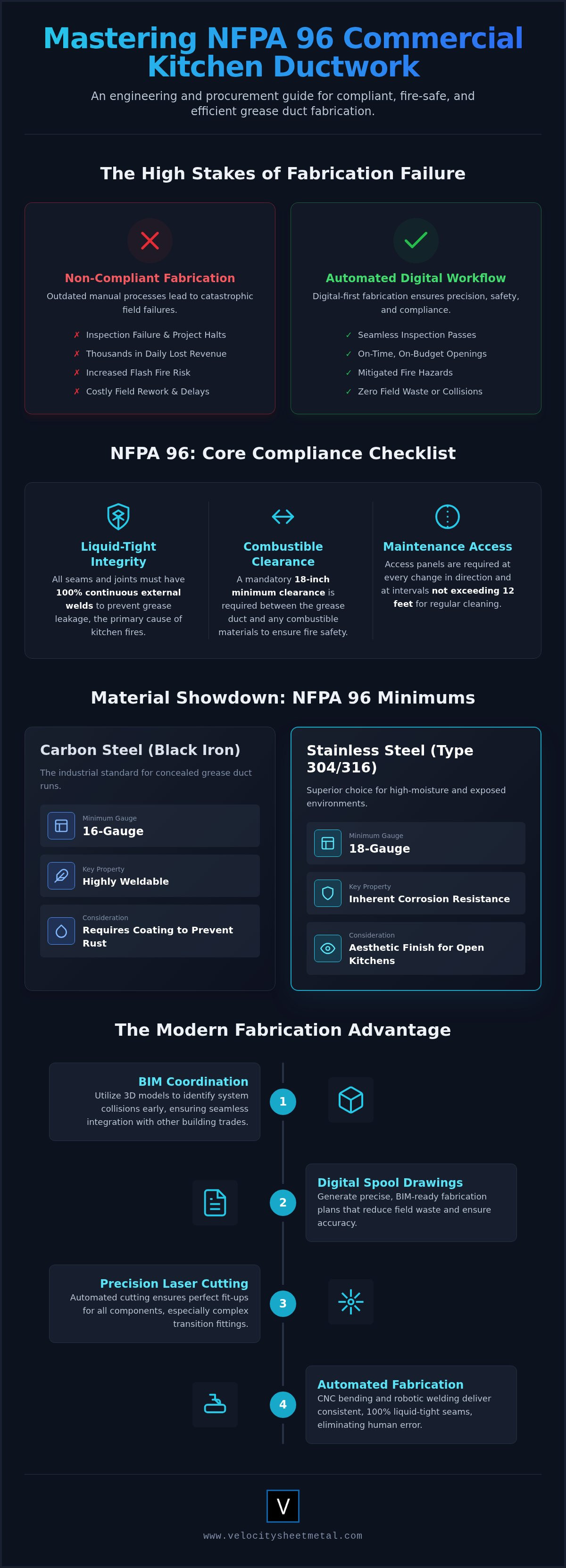
Grease ductwork isn't standard HVAC. It's a specialized, fire-rated conduit that serves as the critical link between a commercial kitchen hood and the exhaust fan. Because these systems transport high-heat air laden with flammable grease vapors, the NFPA 96 standard serves as the mandatory benchmark for ventilation control and fire protection. In the context of NFPA 96 ductwork fabrication, "liquid-tight" is the only acceptable metric. This isn't just a recommendation; it's a structural requirement to prevent grease from leaking into wall cavities or ceiling plenums where it creates an invisible fire fuse.
The Consequences of Non-Compliant Fabrication
Precision matters on the shop floor because failures in the field are catastrophic. Poorly welded seams or inconsistent metal gauges allow grease to accumulate in gaps, significantly increasing the risk of flash fires. Beyond safety, non-compliant ductwork leads to immediate inspection failure. For a commercial build, a failed fire marshal walkthrough means missed opening dates and thousands in daily lost revenue. Precision manufacturing, utilizing automated laser cutting and CNC bending, ensures every joint fits perfectly before the first bead of weld is laid. This eliminates the "make it fit" mentality that often leads to leaks and structural weaknesses.
Key Code Requirements for Kitchen Exhaust
Compliance in NFPA 96 ductwork fabrication starts with understanding spatial constraints and maintenance access. NFPA 96 mandates a minimum 18-inch clearance between the grease duct and any combustible materials, though this can be reduced using specific fire-rated wraps or enclosures. Fabrication must also account for mandatory access panels. These panels are required at every change in direction and at intervals not exceeding 12 feet. This ensures the system meets NFPA 96 cleaning requirements throughout its service life.
Structural integrity is equally vital. Because grease ducts are fabricated from heavy 16-gauge carbon steel or 18-gauge stainless steel, they require robust bracing and support systems. A fabricator's role is to deliver a system that doesn't just fit the BIM model but maintains its shape and seal under extreme thermal expansion. High-heat environments demand a level of durability that standard galvanized ducting simply cannot provide. From the initial digital concept to the final physical result, every inch of the duct must prioritize fire containment and grease management.
Material Selection: Stainless Steel vs. Carbon Steel for Grease Ducts
Success in NFPA 96 ductwork fabrication begins with the raw sheet. You aren't just choosing a metal; you're selecting the system's defense against fire, corrosion, and structural fatigue. The NFPA 96 Standard dictates specific minimum thicknesses to ensure fire containment. For carbon steel, this means a minimum of 16-gauge. For stainless steel, the requirement is 18-gauge. While carbon steel remains the industrial standard for concealed runs, stainless steel offers distinct advantages in high-moisture or exposed environments.
Weldability is the common denominator between both materials. To achieve a liquid-tight seal, all seams and joints must have continuous external welds. Carbon steel, often referred to as black iron, is highly weldable but requires post-fabrication coating to prevent exterior rust. Stainless steel provides inherent corrosion resistance, making it the superior choice for kitchens with heavy steam production or high-volume dishwashing stations. Selecting the right alloy is simpler when you partner with a shop that utilizes custom laser cutting to ensure every edge is ready for a perfect weld.
Stainless Steel (Type 304 and 316) Applications
Type 304 stainless steel is the standard for most high-end kitchen exhausts. It balances cost with exceptional durability and heat resistance. In open-concept kitchens, the mill finish of stainless steel provides a clean, professional aesthetic that carbon steel cannot match. For coastal environments or facilities using heavy chemical sanitizers, Type 316 offers superior pitting resistance. These alloys handle constant thermal cycling without warping, ensuring the duct maintains its structural integrity over decades of service.
Carbon Steel: The Industrial Workhorse
Carbon steel is the go-to for cost-efficient, concealed grease duct runs. It provides the necessary fire rating at a lower material cost than stainless. However, fabrication requires strict attention to detail at the seams. Because carbon steel is prone to oxidation, welds must be cleaned and protected immediately. Using precision CNC press brake bending minimizes the number of welds required, which reduces potential failure points. Meeting the 16-gauge requirement ensures the duct can withstand the intense heat of a grease fire while remaining structurally sound for the exhaust fan's pull.
Precision Fabrication: The Role of Custom Laser Cutting in Kitchen Exhaust
Traditional cutting methods often leave rough edges and thermal distortion. For 16-gauge carbon steel or 18-gauge stainless, these imperfections invite failure during the welding phase. Precision laser cutting delivers tolerances within thousandths of an inch. This accuracy is the foundation of high-quality NFPA 96 ductwork fabrication. It ensures a perfect fit-up for every seam. When metal edges align perfectly, the welder can lay a continuous, liquid-tight bead without the risk of burn-through or structural gaps.
Modern shops utilize high-efficiency nesting software to maximize material usage. It maps out complex offsets, tapers, and plenum boxes across the raw sheet to minimize scrap. This process isn't just about material economy; it's about throughput. Automated lasers cut through high-volume orders for national kitchen rollouts with surgical speed. It moves the project from a digital concept to a physical part in minutes. From the initial file upload to the final laser-cut fitting, the workflow is designed for immediate execution.
Custom HVAC Transition Fittings
Airflow is the primary driver of kitchen safety. Sharp angles and poorly designed transitions create "dead zones" where grease vapors cool, condense, and pool. Laser-cut transitions allow for smooth, engineered tapers that maintain air velocity throughout the system. This level of detail is a core component of HVAC duct fabrication for mechanical contractors. By following established commercial kitchen design guidance, fabricators can eliminate the turbulence that leads to dangerous grease accumulation. It ensures the system remains compliant and easy to maintain.
Automated Production for National Accounts
National brands require standardized quality across every location. Automated production lines ensure that every part is an exact replica of the master digital file. CNC press brake bending creates precise, seamless corners in heavy-gauge metal. This reduces the total linear feet of welding required, which inherently decreases the number of potential leak points. Scaling for large-scale food processing facilities becomes a matter of digital logistics rather than manual labor. It's the most reliable way to maintain 100% liquid-tight integrity across a national rollout. You get the same precision on the first part as you do on the thousandth.
BIM Coordination: Eliminating Field Collisions in Exhaust Ductwork
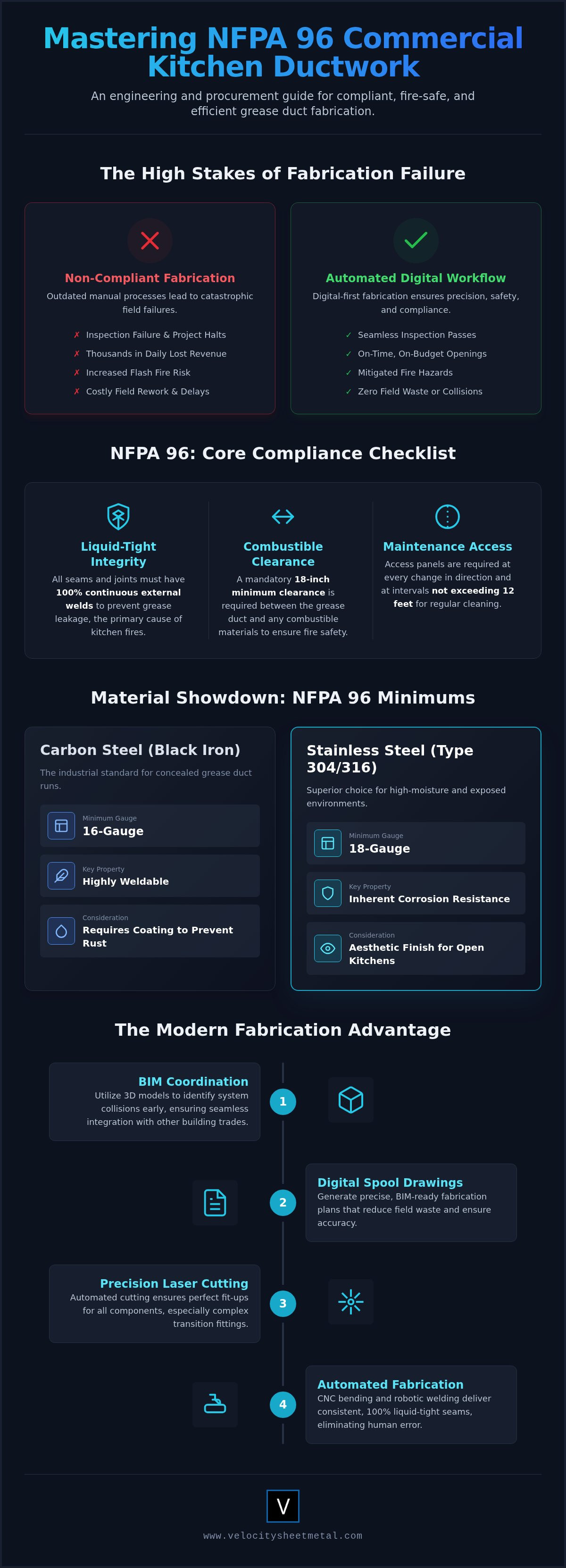
Grease ducts are the most inflexible elements in any mechanical room. Unlike standard galvanized ducting, NFPA 96 ductwork fabrication involves heavy-gauge materials that offer zero room for field adjustments. You cannot simply "nudge" a welded 16-gauge carbon steel offset around a structural beam. Every inch of the run must be coordinated in a 3D environment to account for mandatory slopes and the 18-inch clearance to combustibles required by code. This digital-first approach ensures that the "rigid" components of the kitchen exhaust system are positioned correctly before a single piece of metal is cut.
Utilizing BIM clash detection for HVAC fabrication identifies these spatial conflicts in the design phase rather than the installation phase. This proactive strategy eliminates the field collisions that typically derail kitchen project timelines and inflate labor budgets. When the model is clash-free, the digital file serves as the absolute source of truth for the shop. It moves the project from a series of educated guesses to a high-precision manufacturing process where every component fits the first time.
Mechanical Spooling Services for Kitchen Projects
Mechanical spooling transforms a complex 3D model into a set of manageable, labeled components ready for immediate assembly. Each spool is engineered to fit through standard access points and meet the weight limits of field lifting equipment. Spool drawings provide clear, sequential instructions for the field team, showing exactly where each welded section belongs within the system. This level of precision reduces field labor costs and ensures the final assembly maintains its 100% liquid-tight integrity. It shifts the site work from a chaotic build to a streamlined, predictable assembly.
Digital-to-Physical Workflow
The bridge between the digital model and the physical product is a direct data export. Automated fabrication equipment reads the coordinated BIM files to execute precise laser cuts and CNC bends with surgical accuracy. This workflow ensures that every part matches the model exactly, moving the project from digital concept to physical reality without the risk of manual measurement errors. It improves communication between the engineering team and the fabrication floor, ensuring the final product meets every specification of the coordinated plan. If you want to eliminate field rework and ensure NFPA 96 ductwork fabrication compliance, you can upload your coordinated BIM files to our fabrication team to begin production immediately.
Scaling National Kitchen Projects with Automated Duct Fabrication
Standardizing a restaurant rollout across forty states requires more than just a set of blueprints; it requires a manufacturing partner capable of replicating precision at scale. For NFPA 96 ductwork fabrication, regional variability in shop quality is a liability. A centralized, high-tech fabrication hub eliminates this risk by delivering identical, code-compliant components to every job site. From the initial digital spooling to the final crated delivery, the process remains under a single roof of quality control. This ensures that a kitchen in the Northeast meets the exact same liquid-tight integrity as one in the Southwest.
Automated coil lines are the engine of this scalability. By automating the feeding and positioning of heavy-gauge metals, we reduce the lead times that typically stall large-scale builds. High-volume orders move through the shop with a rhythm that manual shops cannot match. This speed allows national brands to maintain aggressive opening schedules without compromising on the technical requirements of grease-tight systems. It's the difference between waiting weeks for custom fittings and having them arrive on-site exactly when the project schedule demands.
National Account Management
Franchises and restaurant chains benefit from centralized procurement as a primary strategy for cost control. Instead of managing dozens of local sheet metal vendors, national accounts leverage coil line duct fabrication to secure volume discounts and consistent part production. This approach guarantees that every transition fitting and plenum box is built to the same master specification. It simplifies the engineering review process and ensures that the Authority Having Jurisdiction (AHJ) in any region sees a familiar, compliant product. You get predictable results without the administrative delays of local coordination.
Precision and Logistics
Heavy-gauge grease ducts require specialized handling to reach the site in pristine condition. Precision doesn't end at the welding station; it extends to the packaging and crating of every spool. We utilize custom crating solutions to protect 18-gauge stainless and 16-gauge carbon steel components from damage during nationwide shipping. Velocity Sheet Metal is committed to this digital-to-physical bridge, providing on-demand part production for rapid project turnarounds. We act as the essential link between your coordinated 3D model and a tangible, compliant product delivered to your site, regardless of the geographic location. The entire process is controlled, transparent, and repeatable.
Future-Proofing Your Kitchen Exhaust Infrastructure
Commercial kitchen projects move fast; there's no room for the administrative delays or field rework caused by manual fabrication errors. Success in 2026 requires a shift from traditional shop methods to a digital-to-physical workflow. By prioritizing BIM coordination and automated coil-line production, you eliminate the spatial collisions that derail heavy-gauge duct installations. Whether you're selecting 16-gauge carbon steel for concealed runs or 18-gauge stainless for exposed designs, the standard for NFPA 96 ductwork fabrication remains a 100% liquid-tight integrity that passes inspection every time.
Standardizing your national rollouts through a centralized, high-tech hub ensures consistent quality and predictable lead times across every geographic region. Our BIM-to-Machine precision workflows bridge the gap between your engineering files and a tangible, compliant product. It's time to streamline your procurement and secure your project timelines with a partner who understands the urgency of modern manufacturing. We're ready to get to work on your next rollout immediately.
Request a Precision Fabrication Quote for Your Kitchen Project
Frequently Asked Questions
What is the required gauge for commercial kitchen grease ductwork?
The minimum requirement for Type I grease ducts is 16-gauge carbon steel or 18-gauge stainless steel. These thicknesses are mandatory under the NFPA 96 standard to ensure fire containment and structural stability under extreme heat. Standard HVAC gauges like 22 or 24-gauge are non-compliant for grease exhaust. Selecting the correct gauge is the first step in ensuring your system can withstand a potential grease fire without collapsing or leaking.
How do you ensure a grease duct is liquid-tight?
Ensuring a duct is liquid-tight requires continuous external welding on all longitudinal seams and transverse joints. Spot welding or mechanical fasteners are strictly prohibited for grease-carrying systems. Every penetration must be sealed with a liquid-tight weld to prevent flammable grease from escaping. During NFPA 96 ductwork fabrication, we prioritize precision fit-up through laser cutting to ensure the welder can achieve a seamless, leak-proof bead across the entire run.
Can I use galvanized steel for a commercial kitchen exhaust?
No, galvanized steel is not permitted for Type I grease ducts under NFPA 96 standards. The zinc coating on galvanized metal can flake off or produce toxic fumes when exposed to the high temperatures typical of grease fires. Instead, codes mandate the use of carbon steel or stainless steel. While galvanized ducting is suitable for standard air distribution, kitchen exhaust systems require the heat resistance and structural integrity of 16-gauge black iron or 18-gauge stainless.
Why is BIM coordination critical for kitchen ductwork?
BIM coordination is critical because grease ducts are rigid and cannot be adjusted easily in the field. Unlike flexible ductwork, heavy-gauge welded sections require a precise path with specific slopes and clearances. Utilizing BIM clash detection allows engineers to identify conflicts with plumbing, electrical, or structural elements before fabrication begins. This digital-first approach eliminates costly field collisions and ensures that every laser-cut part fits the coordinated model perfectly upon delivery to the site.
What are the cleaning access requirements for grease ducts under NFPA 96?
NFPA 96 requires access panels at every change in direction and at intervals not exceeding 12 feet on horizontal runs. These openings must be large enough for a technician to reach all interior surfaces for cleaning and inspection. Panels must also be constructed of the same material and gauge as the duct itself and must be liquid-tight when closed. Proper placement during the fabrication phase ensures long-term compliance and system safety for the operator.
How does laser cutting improve kitchen exhaust fabrication?
Laser cutting improves kitchen exhaust fabrication by providing tolerances within thousandths of an inch. This level of precision is vital for creating the perfect fit-up required for continuous, liquid-tight welding. Rough edges or gaps from manual cutting lead to weak welds and potential leaks. Automated lasers also handle complex transition fittings like offsets and tapers with surgical speed, ensuring that high-volume orders for national rollouts are executed with consistent quality and accuracy.
Do you provide national shipping for large HVAC duct orders?
Yes, Velocity Sheet Metal provides nationwide shipping for all large HVAC duct orders and custom fittings. We partner with national accounts to deliver standardized, high-quality components to job sites across the United States. Every order is crated and protected to ensure heavy-gauge spools arrive in pristine condition. This centralized fabrication model allows national brands to maintain consistent quality across multiple geographic regions without relying on variable local shop standards or limited regional capacity.
What is the difference between a grease duct and a standard HVAC duct?
The primary difference lies in material thickness and joint integrity. Standard HVAC ducting is often light-gauge galvanized steel with mechanical joints designed for air pressure. In contrast, NFPA 96 ductwork fabrication requires 16-gauge or 18-gauge steel with continuous liquid-tight welds. Grease ducts are fire-rated systems designed to contain flammable liquids and withstand intense heat. They also require specific slopes and frequent access panels for grease removal, which are not necessary for standard air distribution systems.