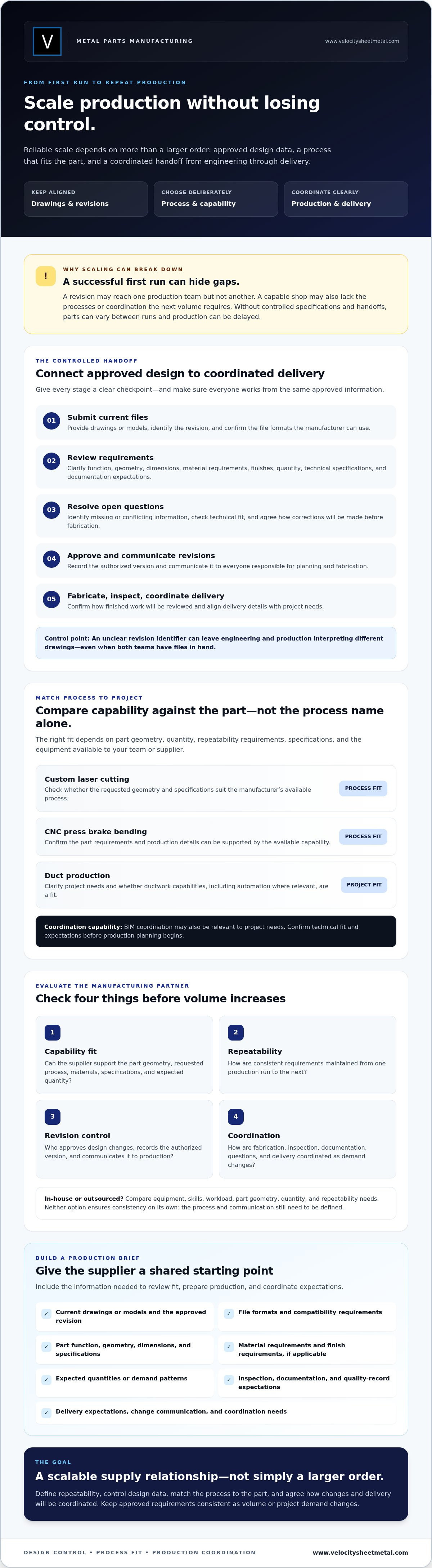
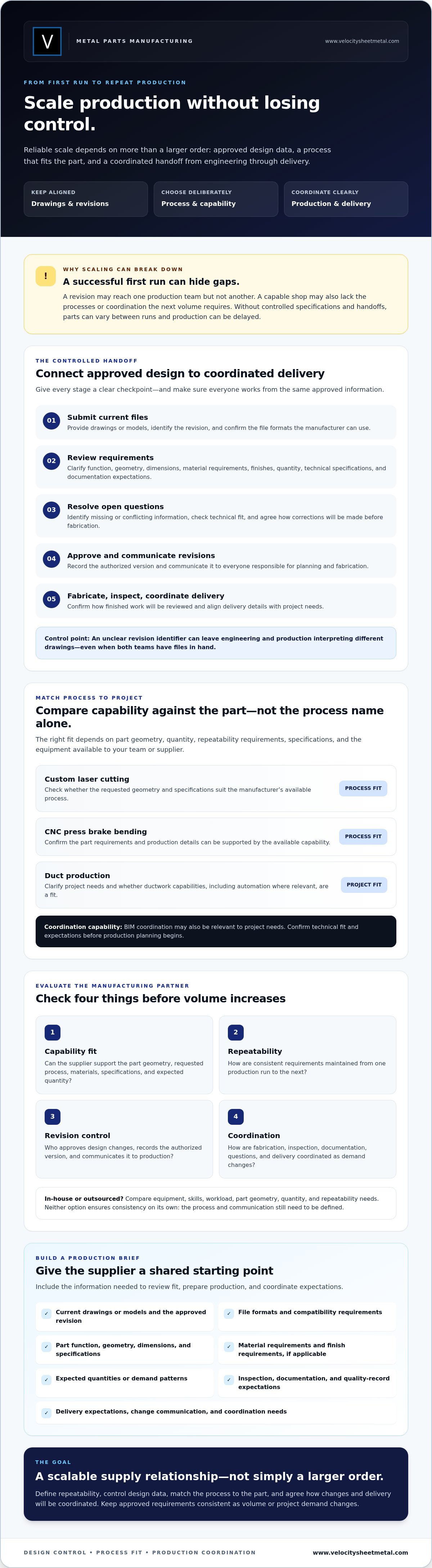
Metal Parts Manufacturing: How to Scale Production Reliably

What breaks first when a metal part moves from a successful first run to higher-volume production: the drawing, the process, or the handoff between suppliers? In metal parts manufacturing, scaling can expose gaps that a prototype run hides. A revision may reach one production team but not another. A capable shop may also lack the processes or coordination your next volume requires.
Scaling reliably takes more than finding a supplier with the right equipment. You need approved design data, clear production requirements, and a partner who can coordinate fabrication, documentation, and delivery as demand changes. Without those controls, parts can vary between runs and production can be delayed.
This article explains how to evaluate manufacturing partners, check whether their capabilities fit your needs, and build repeatability into the move from approved design to ongoing production. You’ll also learn what to clarify about engineering changes, quality expectations, and communication before volume increases. The goal is a scalable supply relationship with consistent standards, not simply a larger order.
Key Takeaways
- Scale metal parts manufacturing by defining repeatability, design control, and production fit before increasing order volume.
- Use a clear handoff from file review and revision approval through fabrication, inspection, and delivery coordination.
- Match the process to the part: compare laser cutting, CNC press brake bending, and duct fabrication against project requirements.
- Evaluate manufacturers by asking how they manage revisions, communicate changes, and maintain consistent standards across production.
- Build a production brief that clarifies project needs and helps identify whether capabilities such as BIM coordination or automated ductwork are a fit.
Metal Parts Manufacturing: What Scaling Production Actually Requires
Metal parts manufacturing turns design requirements into physical components through processes such as cutting, forming, and joining. Metalworking provides a broad overview of these foundational methods. Scaling production means more than making a larger quantity. Specifications, revision status, fabrication methods, and handoffs all need to stay controlled from one run to the next.
A one-off part may be managed through close, direct communication. Repeat production needs a shared reference point: approved drawings, clear requirements, and an agreed process for handling changes. Assess four things early: whether the supplier’s capabilities fit the part, how repeatability is managed, who controls design revisions, and how fabrication and delivery are coordinated.
Scalable manufacturing uses repeatable specifications and controlled workflows to produce parts consistently as volume or project demand changes. It means making components to defined requirements, not selling raw metal stock or providing on-site installation. Those are separate needs to confirm with the appropriate supplier.
How custom parts move from design files to finished components
A reliable handoff starts with a design review. The buyer and manufacturing partner clarify the part’s intended function, geometry, material requirements, quantity, and any inspection or documentation expectations. The manufacturer then checks whether the design suits its available processes and identifies questions that could affect fabrication.
Before production, confirm which drawing revision is approved and how later changes will be recorded and communicated. This helps prevent an outdated file from becoming the basis for another run. When requesting a proposal, provide current drawings and relevant files, expected quantities or demand patterns, required materials and specifications, finish requirements if applicable, and delivery expectations. Confirm file compatibility and available quality records rather than assuming.
When to use a manufacturing partner instead of managing every process in-house
In-house production can make sense when the required equipment, skills, and available workload align with the part and its expected volume. Outsourcing may be a better fit when a project needs capabilities your organization does not maintain internally, or when internal resources are committed elsewhere. Neither option guarantees consistency on its own. The process and communication still need to be defined.
Compare the part geometry, quantity, repeatability requirements, and equipment needed with what your team or a prospective supplier can support. A partner such as Velocity Sheet Metal offers capabilities including custom laser cutting, CNC press brake bending, BIM coordination, and duct production. Confirm technical fit, revision handling, and coordination expectations before production planning begins.
How Repeatable Metal Parts Manufacturing Connects Engineering to Production
Repeatability depends on a controlled handoff, not simply on sending a drawing to the shop. In metal parts manufacturing, engineering and production need to work from the same approved information, with a clear route for questions and changes before fabrication begins. That discipline helps keep separate production runs aligned as project requirements evolve.
From submitted files to coordinated delivery
A practical workflow gives each stage a clear checkpoint:
- Submit files: Provide current drawings or models, identify the revision, and confirm the file formats the manufacturer can use.
- Review requirements: Clarify dimensions, materials, finishes, quantities, and technical specifications. Verify that the manufacturer can support the requested details and documentation.
- Resolve questions: Identify missing or conflicting information and agree on how it will be corrected before production.
- Approve revisions: Record the authorized version and communicate it to everyone responsible for planning and fabrication.
- Fabricate, inspect, and coordinate delivery: Confirm how the finished work will be reviewed and align delivery details with project needs.
Resolve open questions early. For example, an unclear revision identifier can leave engineering and production interpreting different drawings, even when both teams have files in hand. Verify file formats, material availability, tolerances, and inspection records with the manufacturer rather than assuming they are available.
Why revision control and coordination matter
Use one approved revision as the production reference. If a design changes, document what changed, obtain the required approval, and distribute the updated information before work proceeds. Make obsolete versions easy to identify so they are not accidentally reused. This creates a traceable handoff, though a digital file alone does not prevent errors.
For mechanical and HVAC projects, BIM coordination and spool drawings can help teams review how fabricated components relate to building systems before production. They support shared project information, but they do not eliminate design updates or field changes. Teams still need a process to communicate and approve adjustments. For further guidance, see BIM for sheet metal fabrication.
Digital tools can also connect planning and production workflows. The National Institute of Standards and Technology discusses how advanced manufacturing technologies can support manufacturing capability and process improvement. The right approach depends on a supplier’s actual systems and project requirements.
For sheet metal fabrication, laser cutting, ductwork, or BIM coordination, you can include Velocity Sheet Metal in your supplier review.
Compare Metal Parts Manufacturing Processes by Part and Project Needs
Choose a process based on the part and its function, not a machine list. In metal parts manufacturing, geometry, material, specified dimensions, finish, quantity, and repeatability needs all influence which fabrication route is worth discussing. The table below is a starting point, not a substitute for checking a shop’s capabilities against the actual drawing.
| Part or project need | Capability to discuss | What to verify |
|---|---|---|
| Flat profiles or cutouts defined in a drawing | Custom laser cutting | Material, thickness, edge or finish requirements, file format, and applicable tolerances |
| Flat parts that need formed bends | CNC press brake bending, potentially alongside cutting | Bend locations, angles, geometry, material, thickness, and dimensional requirements |
| HVAC air-distribution components and fittings | Rectangular duct production or spiral and round duct fabrication | Project specifications, repeated requirements, connections, and coordination information |
Process selection should follow part requirements, not equipment labels alone. A supplier may have relevant equipment, but the fit still depends on whether the specific geometry and documented requirements suit its verified processes. Confirm material availability, thickness ranges, tolerances, and finish capabilities directly with the shop. Do not infer them from a general service description.
When laser cutting or CNC bending may fit a component
For a flat component with a defined profile, ask whether laser cutting fits the drawing and required edge condition. If the part also needs bends, discuss how bend locations and angles relate to the flat pattern and final dimensions. These details can affect whether one capability or a coordinated sequence is appropriate. Review the precision laser cutting services guide for more on evaluating cutting needs.
When duct production is a distinct requirement
HVAC ductwork is not interchangeable with general OEM components. It has project-specific dimensions and connections, and repeat orders depend on teams working from consistent specifications. Automated rectangular duct, spiral and round duct, and fittings serve HVAC air-distribution needs. Assess these separately from custom-cut or bent parts. For more detail, see the guide to coil-line duct fabrication.
For projects considering metal additive manufacturing instead, NIST’s work on additive manufacturing measurement standards covers a distinct process area. It is not a substitute for confirming the capabilities and requirements relevant to sheet metal fabrication.
Evaluate a Metal Parts Manufacturer for Consistency, Capacity, and Coordination
A supplier’s equipment list is only a starting point. To judge whether a manufacturer can support your work reliably, ask how its processes match your requirements and how it manages production as orders or project needs change. In metal parts manufacturing, scale alone does not prove consistency. Ask for evidence of process control, not just assurances that a shop can handle volume.
Use this checklist to structure supplier conversations:
- Technical fit: Can the manufacturer support the part’s geometry, specifications, and required fabrication processes? Confirm materials, thicknesses, tolerances, and other limits for your project.
- Repeatability: How are production requirements recorded and applied to repeat orders or related parts?
- Revision handling: How are drawing changes reviewed, approved, and shared before production?
- Communication: Who raises technical questions, reports constraints, and coordinates updates?
- Distribution: Can the supplier confirm delivery arrangements for the project, including requirements across multiple destinations?
Questions to ask about repeatability and quality controls
Ask how the manufacturer documents specifications, revisions, inspection expectations, and nonconformances. Find out which checks apply to your parts and what records can be provided. Confirm quality procedures and any certifications directly. Do not assume they exist based on a capability statement. Where available, request examples of relevant production experience, especially with parts or project workflows similar to yours.
Look for clear answers and defined responsibilities. A useful discussion should establish how the shop will identify the approved requirements, handle a deviation, and communicate an issue before it affects downstream work.
How to assess production fit as demand changes
Describe expected order patterns, related part families, forecast visibility, and likely project changes. Ask how the supplier reviews equipment capacity and workload before accepting work, and how it will flag constraints. Verify production capacity, lead times, and volume limits for the specific parts and schedule rather than relying on general statements.
National-account relationships can help align shared requirements across projects, such as common documentation or revision practices. Standardization creates a consistent framework for coordination, but it does not guarantee identical results across different parts, specifications, or production conditions. Confirm the controls that apply to each project.
Once you have defined your requirements and evaluation criteria, compare them with Velocity Sheet Metal’s fabrication, laser cutting, duct, and BIM coordination capabilities. Review your manufacturing requirements with Velocity Sheet Metal.
Start a Metal Parts Manufacturing Partnership with a Clear Production Brief
A clear production brief turns supplier conversations into useful technical reviews. It helps both sides separate confirmed requirements from open questions, assess capability fit, and plan next steps before production begins. For metal parts manufacturing, start with the information that defines the part, then align on approvals, communication, and project-specific expectations.
Prepare a production brief that supports a useful review
Bring together current drawings, specifications, revision history, expected quantities or order patterns, and requested delivery information. Flag details that still need confirmation, such as material, finish, tolerances, inspection requirements, or compatible file formats. Mark assumptions clearly. That gives the manufacturer a chance to identify gaps instead of treating incomplete details as approved requirements.
A practical brief should make clear:
- Which drawing or model revision is current and approved.
- Which requirements are fixed and which need engineering or supplier review.
- What quantities, repeat orders, or project phases are anticipated.
- What inspection records and delivery arrangements the project requires.
Move from supplier review to a coordinated production plan
After technical review, confirm the scope, approval owners, communication contacts, and how future revisions will be submitted and authorized. Before setting a production plan, verify project-specific capacity, lead times, shipping details, and available documentation with the supplier. Confirm these for the actual requirements rather than assuming them from a general capability list.
Velocity Sheet Metal’s capabilities may suit different project needs: custom laser cutting and CNC press brake bending for formed sheet metal components; BIM coordination and spool drawings for relevant mechanical projects; and automated rectangular duct, spiral and round duct, and fittings for HVAC air-distribution work. The right fit depends on the part, its specifications, and the project workflow.
Velocity ships nationwide and works with national accounts focused on standardized production requirements across projects. Its management team brings more than 50 years of combined industry experience. These details can inform your evaluation, while technical fit, project capacity, and delivery expectations still need to be confirmed for each scope.
Share your project brief to discuss requirements, open questions, and production fit with Velocity Sheet Metal. Discuss your metal parts manufacturing needs.
Build Your Next Production Run on a Clear Plan
Reliable metal parts manufacturing starts with more than a capable shop. It depends on approved design information, a process suited to the part, and clear controls for revisions, inspection, and delivery. Evaluate suppliers against those requirements, then confirm capacity and project expectations before production is planned.
Velocity Sheet Metal offers custom laser cutting, CNC press brake bending, BIM coordination, and duct production for distinct fabrication and HVAC project needs. Its management team has more than 50 years of combined industry experience, and the company ships nationwide. National-account partnerships also focus on standardized production requirements across projects, while each project’s details still need direct review.
Have a project in view? Prepare your drawings, specifications, quantities, revision details, and open questions, then discuss your metal parts manufacturing needs with Velocity. A clear brief is a practical first step toward a coordinated production plan.
Frequently Asked Questions
What is metal parts manufacturing?
Metal parts manufacturing is the process of turning design requirements into metal components through methods such as cutting, forming, and joining. It can range from making a single custom part to producing repeat orders against approved specifications. The work is distinct from buying raw metal stock or arranging on-site installation. Production planning, process selection, and clear drawings help define what the finished part must be and how it will be made.
How do I choose a metal parts manufacturer?
Choose a manufacturer whose verified capabilities match your part, specifications, order pattern, and coordination needs. Ask how it controls drawing revisions, documents requirements, handles inspection expectations, and communicates production constraints. Confirm materials, thickness ranges, tolerances, capacity, and lead times for your specific project. Request relevant examples of production experience where available. Compare the supplier’s process and evidence, not just its equipment list or general claims about handling volume.
Can one manufacturer produce both prototypes and repeat orders?
Some manufacturers can support both, but confirm this directly before planning around it. Ask whether the shop can review an early part, document approved requirements, and apply the same current revision to repeat orders. The process, equipment, and production capacity that suit a prototype may not fit larger quantities. Clarify how the supplier handles design changes and whether the required inspection and documentation can be provided at each production stage.
How can manufacturers keep metal parts consistent across production runs?
They need controlled, accessible production requirements. Use an approved drawing revision, record specifications and inspection expectations, and communicate authorized changes before fabrication. Ask how the supplier identifies obsolete files, documents nonconformances, and checks parts against agreed requirements. Consistent equipment or higher volume alone does not ensure repeatability. Clear ownership of approvals and a defined communication path help teams work from the same information across runs.
What files should I send for a metal parts manufacturing quote?
Send current drawings or models, dimensions, material requirements, finish details, quantity or expected order pattern, and revision status. Include applicable tolerances, inspection expectations, and requested delivery information. Identify unresolved items rather than leaving the manufacturer to infer them. Confirm which file formats the supplier can accept and whether additional technical specifications or documentation are needed. Complete, current information gives the shop a stronger basis for reviewing fit and preparing a useful proposal.
Is outsourcing metal parts manufacturing a good option for OEMs?
Outsourcing can fit OEMs that need capabilities or equipment not available in-house, or need to coordinate production alongside internal work. The right choice depends on part geometry, order volume, repeatability, workload, and supplier fit. Velocity Sheet Metal provides custom laser cutting, CNC press brake bending, on-demand part production, and related sheet metal and HVAC capabilities. OEMs should verify project-specific capacity, specifications, communication, and delivery details before selecting a partner.
What should I verify before scaling metal part production?
Confirm that drawings and revisions are approved, specifications are clear, and inspection expectations are understood. Verify the supplier’s technical fit, equipment capacity, volume limits, lead times, shipping arrangements, and available documentation for your project. Establish who approves changes and how constraints will be communicated before work proceeds. If orders span projects or locations, align shared requirements while checking that each project’s specific details are still addressed.