Mechanical Spooling Services: The 2026 Guide to HVAC Prefabrication
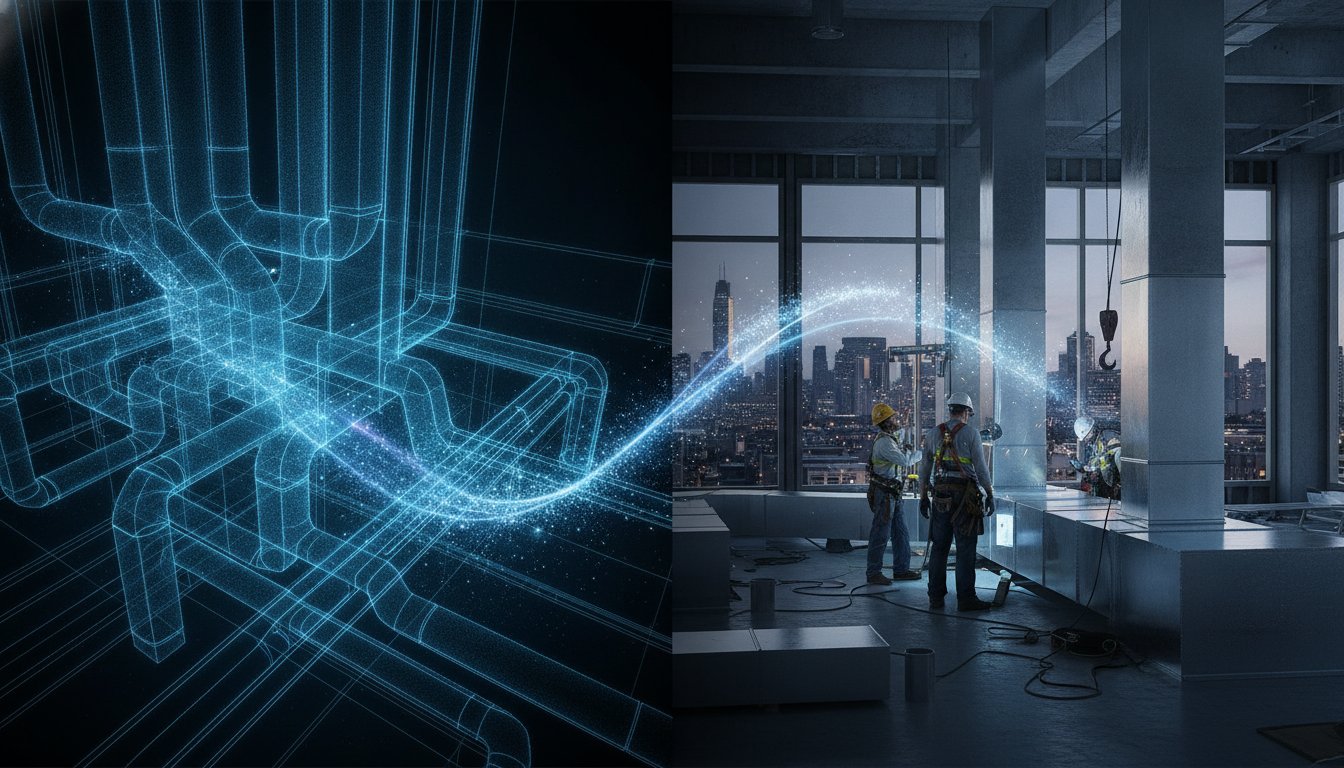
The most expensive tool on a modern jobsite isn't the crane; it's the saw used to fix errors that should've been caught in design. With commercial HVAC labor rates reaching $175 per hour in 2026, field-cutting ductwork is a luxury your budget can't afford. You've likely dealt with the frustration of coordination errors and material waste that turn a tight schedule into a series of expensive delays. Our mechanical spooling services solve this by acting as the essential bridge between your digital BIM files and a tangible, finished product.
This guide shows you how to move the heavy lifting from the field to a controlled shop environment. We'll examine how the latest Revit 2027 workflows and automated coil-line production create a "plug-and-play" installation process. You'll learn how to achieve zero-waste fabrication and slash field labor hours while maintaining the precision your project demands. From initial digital concept to final physical result, we're breaking down the roadmap for high-efficiency HVAC prefabrication.
Key Takeaways
- Transition from inefficient stick-built field installation to a streamlined kit-of-parts prefabrication model.
- Use BIM coordination to detect and resolve clashes in the digital model, preventing costly rework during physical assembly.
- Implement mechanical spooling services to divide complex systems into precision-engineered sections tailored for your specific site constraints.
- Shift high-cost labor into a controlled manufacturing environment to maximize productivity and eliminate jobsite safety hazards.
- Define clear spool boundaries early in the coordination phase to ensure seamless integration between automated fabrication and final delivery.
What are Mechanical Spooling Services in HVAC Construction?
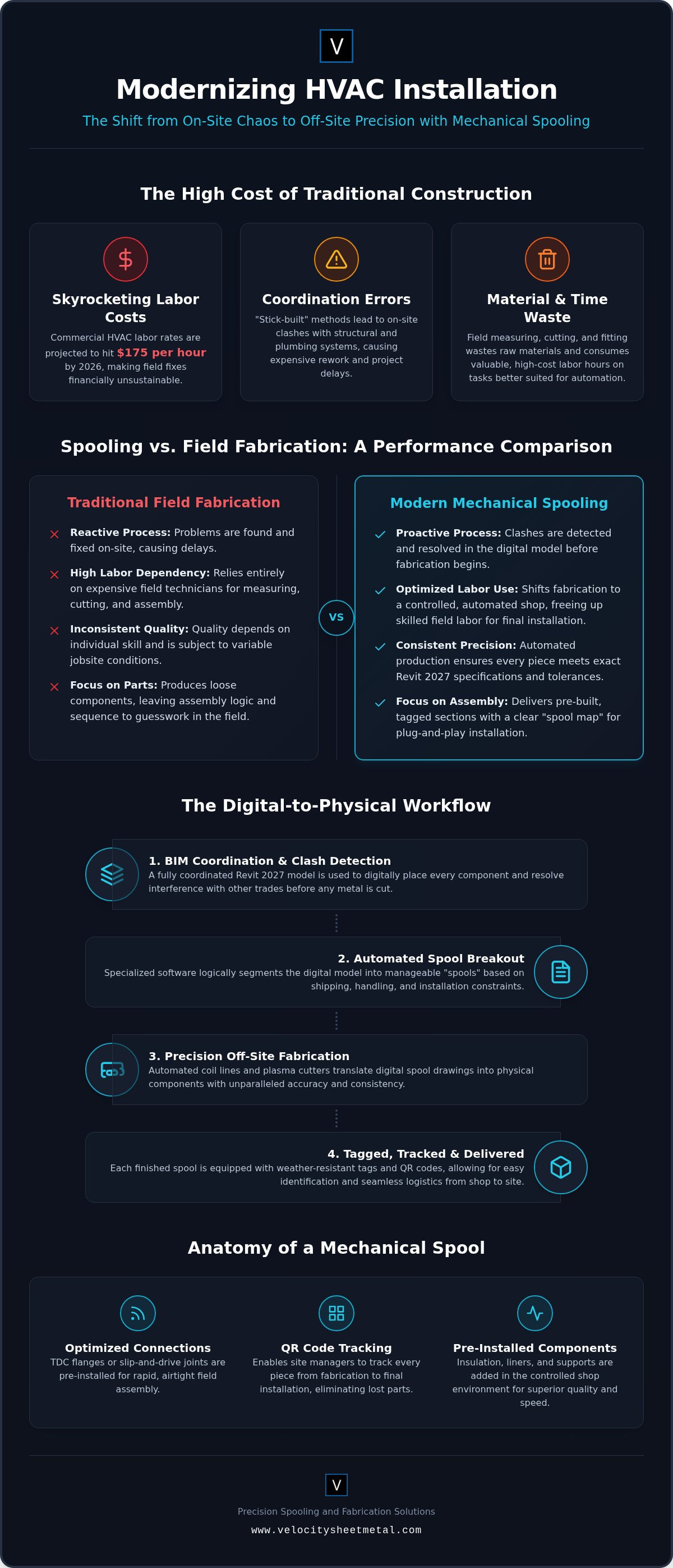
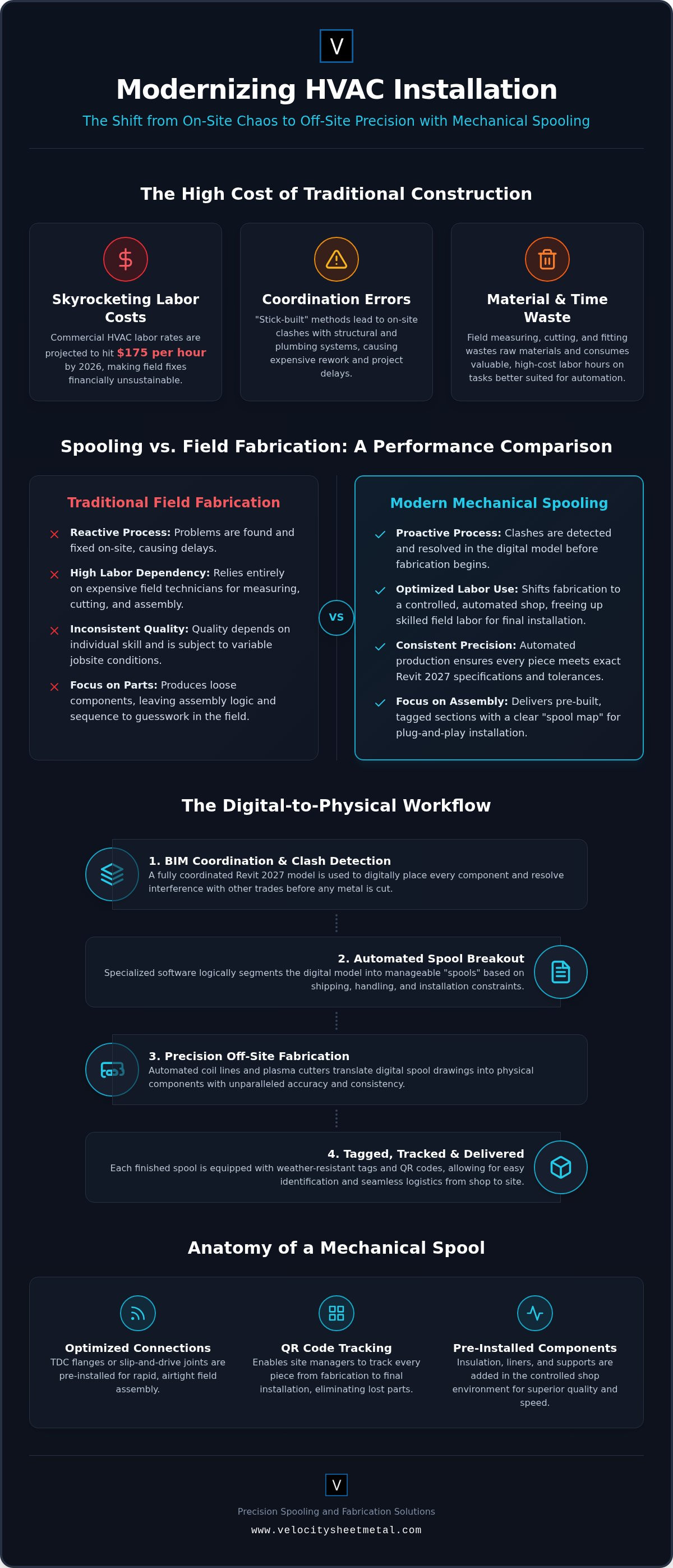
Mechanical spooling services represent the industrial transition from field-based construction to shop-controlled manufacturing. In the past, HVAC contractors relied on "stick-built" methods. This involved shipping raw materials to the site and tasking field crews with measuring, cutting, and fitting ductwork in real time. Today, that process is obsolete. Spooling is the methodical segmenting of a complex mechanical system into prefabricated sections, or "spools," designed for rapid assembly. It turns a chaotic jobsite into a streamlined installation zone. It is the evolution of Prefabrication within the mechanical trades. Instead of sending raw lengths of duct to a jobsite, we deliver finished assemblies ready for immediate hanging.
As of 2026, the demand for precision has never been higher. With commercial labor rates for HVAC technicians reaching up to $175 per hour, every minute spent on a ladder is a drain on profit. New ASHRAE 62.1-2025 requirements for humidity control and air density mean ductwork must be airtight and accurately sized. Modern mechanical spooling services use Revit 2027 data to ensure tolerances stay within a fraction of an inch. This level of accuracy is essential for fitting complex systems into the tight plenum spaces common in modern high-rise and healthcare construction. A mechanical spool isn't just a piece of duct; it's a finished assembly comprising ductwork, fittings, and integrated supports, all built to the exact specifications of a digital model.
The Anatomy of a Mechanical Spool
Each spool is a self-contained unit of production. We equip every section with weather-resistant identification tags and QR codes. This allows site managers to track every piece from the fabrication floor to the final hanger. Connection points, such as TDC flanges or slip-and-drive joints, are optimized for speed and airtight performance. To reduce field labor, we offer spools with pre-installed insulation and liners. This moves the messy, time-consuming task of lining duct into our automated environment, ensuring a cleaner and more consistent finish than field-applied alternatives.
Spooling vs. Traditional Duct Fabrication
Traditional fabrication focuses on making parts; spooling focuses on the assembly logic. It is the difference between buying loose bricks and receiving a pre-built wall. We use a detailed "spool map" to guide field crews through the installation sequence. This map eliminates the guesswork that leads to material waste and coordination errors. By moving production to a shop environment, we drastically reduce the "man-hour per foot" metric. This shift lets your skilled workers focus on high-level system integration while our automated equipment handles the heavy volume.
How BIM Coordination Powers Mechanical Spooling
BIM is more than a visualization tool; it's the operational brain of the modern fabrication shop. Mechanical spooling services rely on this digital data to translate complex designs into actionable fabrication tickets. This digital-to-physical workflow begins with a fully coordinated model where every duct, fitting, and hanger is placed with surgical precision. By utilizing BIM clash detection for HVAC fabrication within Revit 2027, we resolve interference issues with structural steel or plumbing lines months before your crew arrives on site. This proactive approach eliminates the costly "field-fit" adjustments that typically derail project schedules.
The transition from a massive, unified system to individual sections happens during the automated breakout process. We use specialized software to slice the coordinated model into hundreds of unique spools based on your specific project constraints. By 2026, BIM data provides the foundation for BIM model to fabrication accuracy, ensuring that every physical component mirrors the digital design within precise tolerances.
Generating Accurate Spool Drawings
Accurate drawings are the roadmap for your field team. We standardize spool lengths to maximize shipping efficiency and ensure easy handling within tight service elevators or through standard door frames. Every drawing includes critical metadata such as total weight, center of gravity, and a specific installation sequence number. We also incorporate strategic field joints and "make-up" pieces. These components allow for minor site tolerances without requiring a complete rework of the system, keeping the installation moving forward without delay.
Model-to-Machine Integration
The real power of BIM integrated fabrication shops lies in direct data transfer. We eliminate manual entry errors by feeding spool data directly from the model into our automated coil lines and laser cutters. This ensures that every elbow, transition, and tap matches the exact coordinates of the digital model. When the spools arrive at your site, they fit together with the predictability of a precision-engineered kit. If you're ready to see this precision in action, check out our BIM coordination for mechanical contractors to streamline your next project.
Spooling vs. Field Fabrication: A Performance Comparison
Field fabrication is a gamble with your project's profitability. Traditional "stick-built" methods rely on skilled labor to perform complex assembly in uncontrolled environments. This approach is prone to error and expensive. By utilizing mechanical spooling services, you shift high-cost labor from the jobsite to a controlled manufacturing facility. In 2026, commercial HVAC labor rates can reach $175 per hour according to industry data. Every minute a technician spends measuring and cutting in the field is a minute that could've been spent on high-level system integration. Moving this work to our shop ensures that your field crew focuses on installation; not manufacturing.
Safety and quality control also see immediate improvements. Shop-controlled environments eliminate the need for excessive ladder time and on-site hot work; these are primary drivers of jobsite injuries. Shop-sealed ductwork consistently outperforms field-sealed alternatives in pressure tests. Our automated processes ensure that every joint is airtight and every fitting is precise. This leads to fewer leaks and faster system commissioning. It's a level of quality that field fabrication simply can't match under tight project deadlines.
The Economics of Prefabricated Spools
The true value of spooling is found in the Total Cost of Installation (TCI). While raw material costs might seem similar, the labor savings and schedule compression of prefabricated spools are substantial. Spooling allows you to deliver components "just-in-time." This reduces site congestion and eliminates the need for large on-site storage areas. It compresses the critical path by allowing fabrication to happen simultaneously with site prep. When the building is ready, the HVAC kit is ready to go. You don't have to wait for field measurements to start the build.
Waste Reduction and Sustainability
Centralized fabrication is inherently more sustainable. We use automated nesting and high-precision laser cutting to maximize material yields. This process drastically reduces the scrap metal that typically ends up in a jobsite dumpster. For projects seeking LEED credits, this level of waste management is a significant advantage. We turn digital files into physical products with surgical precision. This ensures that every pound of raw metal is used effectively. It's a cleaner, faster, and more profitable way to build that respects both the budget and the environment.
Implementing Mechanical Spooling on Your Jobsite
Successful execution of mechanical spooling services requires more than just a digital file. It demands a methodical approach to jobsite logistics and a technical partnership between the shop and the field. You don't just order spools; you integrate a production system. This process replaces the traditional "figure-it-out" field mentality with a controlled, sequential workflow that keeps your project moving forward without the typical administrative friction.
- Step 1: Secure early involvement of the BIM coordination for mechanical contractors team. This ensures the digital model is built for fabrication, not just for design, allowing for a seamless transition to the shop floor.
- Step 2: Define spool boundaries based on real-world constraints. We analyze service elevator dimensions, door widths, and crane capacities to ensure every section fits into its final location without site modifications.
- Step 3: Establish a clear tagging and kitting system. Every component is labeled by floor, zone, and air handling unit, creating a logical delivery sequence that matches your installation schedule.
- Step 4: Utilize high-fidelity spool drawings for rapid on-site assembly. Your crews follow a precise map that dictates the exact order of operations, eliminating guesswork and coordination errors.
Logistics and Delivery Management
Kitting is the core of our logistics strategy. We group spools into manageable kits based on specific project zones or system types. This prevents site bottlenecks by delivering only what your crew can install in a single shift. Staging deliveries "just-in-time" reduces on-site storage needs and protects the material from jobsite damage. Every spool is capped or wrapped before leaving our facility to maintain the strict cleanliness standards required for modern healthcare and laboratory projects.
Field Assembly Best Practices
Modern field crews use QR codes on spool tags to access live 3D models on tablets. This provides instant clarity on complex connections and hanger placements. We recommend verifying site benchmarks before beginning the first spool run to ensure the digital model aligns perfectly with the physical space. For areas with high field-verified dimensions (FVDs), we provide "green-tagged" spools. These sections include extra material on one end, allowing for precise site trimming without halting the production line. If you're ready to eliminate field errors and compress your schedule, partner with Velocity Sheet Metal for your next commercial project.
Velocity Sheet Metal: Precision Spooling and Fabrication Solutions
Velocity Sheet Metal operates at the intersection of high-end engineering and practical workshop capability. We've optimized our mechanical spooling services to serve as a high-speed bridge between your BIM models and the physical jobsite. Our workflow is designed for contractors who can't afford the administrative delays of traditional fabrication. We take your digital files and move them through a technical review process that guarantees every spool is ready for immediate installation. This isn't just about bending metal; it's about delivering a precision-engineered kit that fits the first time, every time.
Our facility utilizes coil-line automated rectangular duct production to handle high-volume demands with surgical accuracy. By integrating digital spool drawings directly with our automated machinery, we eliminate the manual data entry errors that plague traditional shops. Whether you need standard straight runs or complex transition fittings, our precision laser cutting and CNC press brake bending ensure that every component matches the exact coordinates of your coordinated model. We turn raw material into finished spools with a level of speed and reliability that national accounts depend on.
Technology-Driven Production
We leverage over 50 years of industry expertise to guide our modern manufacturing processes. Our shop is built for scale. We specialize in high-volume rectangular duct production for large-scale commercial projects where schedule compression is non-negotiable. Beyond standard ductwork, we provide custom solutions like curb adapters and specialized fittings. This comprehensive capability allows us to manage the entire fabrication scope of a project, moving you from the initial digital concept to the final physical result without interruption.
National Reach and Reliability
Precision is meaningless if the product doesn't arrive when you need it. Velocity Sheet Metal maintains strategic shipping capabilities to serve commercial projects across the United States. We understand the underlying sense of urgency in modern construction. We've built our reputation on meeting aggressive timelines while maintaining the highest technical standards. We act as your tech-savvy partner, obsessed with the details of delivery and accuracy. If you're ready to see how our workflow can reduce your field labor hours, contact Velocity Sheet Metal for a spooling quote today.
Building the Future of HVAC with Precision Spooling
The construction industry is shifting toward a manufacturing mindset. Adopting mechanical spooling services isn't just a technical upgrade; it's a strategic necessity for staying profitable in a competitive market. By moving high-risk field work into a controlled shop environment, you eliminate the guesswork that causes schedule delays and material waste. A coordinated BIM model translates into a physical kit of parts, ready for rapid installation the moment it arrives on site.
Velocity Sheet Metal acts as your essential bridge between digital design and tangible results. We utilize automated coil-line rectangular duct production and an integrated BIM-to-fabrication workflow to ensure every spool meets your exact specifications. With our national shipping and distribution capabilities, we support your commercial projects regardless of location. It's time to stop fighting field errors and start building with industrial precision. Our team is ready to help you compress your project timeline and maximize your jobsite productivity.
Request a quote for mechanical spooling and fabrication services to streamline your next commercial project. Let's get to work on a more efficient jobsite today.
Frequently Asked Questions
What are mechanical spool drawings?
Mechanical spool drawings are detailed fabrication maps that segment a large HVAC system into manageable, prefabricated sections. These drawings provide the exact dimensions, material specifications, and connection details required for our automated machinery. By utilizing mechanical spooling services, you ensure that every component is tracked with a unique ID, creating a clear roadmap for your field installation team.
How does spooling reduce HVAC installation costs?
Spooling slashes costs by shifting expensive field labor into a controlled, automated shop environment. With commercial HVAC labor rates reaching up to $175 per hour in 2026, reducing on-site "stick-build" time is a financial necessity. Prefabrication eliminates the material waste and field-cutting errors that typically consume 40% to 60% of a project's total installation budget.
Can spooling be used for both rectangular and spiral ductwork?
Yes, mechanical spooling services are highly effective for both rectangular and spiral duct systems. We use automated coil lines for high-volume rectangular duct and precision fabrication for spiral and round fittings. Both types are segmented into spools based on your specific shipping constraints and site access, allowing for a consistent "kit-of-parts" installation across the entire project.
What BIM software is required for mechanical spooling services?
The industry standard for 2026 is Autodesk Revit 2027, often paired with specialized plugins like MSUITE BIM 9.2.1. These tools enable native clash detection and automated spool management within the model. This software stack ensures that digital designs are accurately translated into fabrication-ready tickets, maintaining a seamless digital-to-physical workflow from the initial design to final delivery.
How do you handle field changes when using prefabricated spools?
We manage site variations by incorporating field-verified dimensions (FVDs) and "green-tagged" spools into the production run. These specific spools include extra material on one end, allowing for precision field trimming to match unexpected site conditions. This strategy allows the majority of the system to remain prefabricated while providing the flexibility needed to handle site tolerances without halting production.
Is mechanical spooling suitable for small-scale commercial projects?
Spooling is scalable, though it offers the highest return on investment for mid-to-large scale installations where labor hours are high. For smaller commercial buildings, the primary benefit is radical schedule compression. Even on a limited footprint, delivering a prefabricated kit reduces site congestion and allows a smaller crew to complete the system installation much faster than traditional methods.
What information is typically included on a spool tag?
Each tag includes a unique spool ID, floor and zone designation, and a QR code for accessing the 3D model on a tablet. We also list critical metadata such as total weight and center of gravity for safe handling. This information ensures your field crew knows exactly where each piece belongs in the assembly sequence and what equipment is required to hang it.
How does spooling improve jobsite safety for mechanical contractors?
Prefabrication significantly reduces jobsite hazards by moving complex assembly work off the floor and into a controlled facility. It minimizes the total time workers spend on ladders and eliminates the need for hot work or grinding in tight plenum spaces. By delivering finished assemblies, we reduce the physical strain on field crews and lower the overall risk of jobsite injuries.