Low-Volume Sheet Metal Fabrication: The 2026 Guide to Efficient Production
Traditional manufacturing logic says you have to buy a thousand units to get a decent price, but that math is obsolete in 2026. Carrying excess inventory is no longer a safety net; it is a financial anchor that drags down your agility. This is why on-demand sheet metal fabrication has moved from a prototyping luxury to a core production strategy for industrial OEMs and HVAC contractors. You know the frustration of paying massive setup fees for a 50-unit run or watching a project stall because a high-volume shop pushed your small order to the back of the queue.
The bridge between a digital BIM file and a physical product shouldn't be paved with long lead times or inconsistent quality. You need parts that fit the first time, whether you're ordering custom curb adapters or standardized duct components. This guide shows you how to master the economics of low-volume production to reduce inventory costs and accelerate your speed-to-market. We'll explore how automated coil lines, CNC bending, and AI-driven workflows make batch production of 10 to 500 units more efficient and repeatable than ever before.
Key Takeaways
- Identify the strategic middle ground for production runs between 10 and 500 units to bypass the massive upfront costs of traditional high-volume tooling.
- Leverage custom laser cutting and CNC press brake bending to achieve complex geometries without the need for permanent, expensive dies.
- Master the financial logic of on-demand sheet metal fabrication to reduce non-recurring engineering (NRE) expenses and free up capital tied in inventory.
- Apply Design for Manufacturability (DFM) standards to your digital designs to ensure efficient nesting and rapid turnaround from the shop floor.
- Streamline your workflow from digital BIM coordination to physical delivery, including specialized components like custom curb adapters shipped nationwide.
Defining On-Demand Sheet Metal Fabrication for the 2026 Market
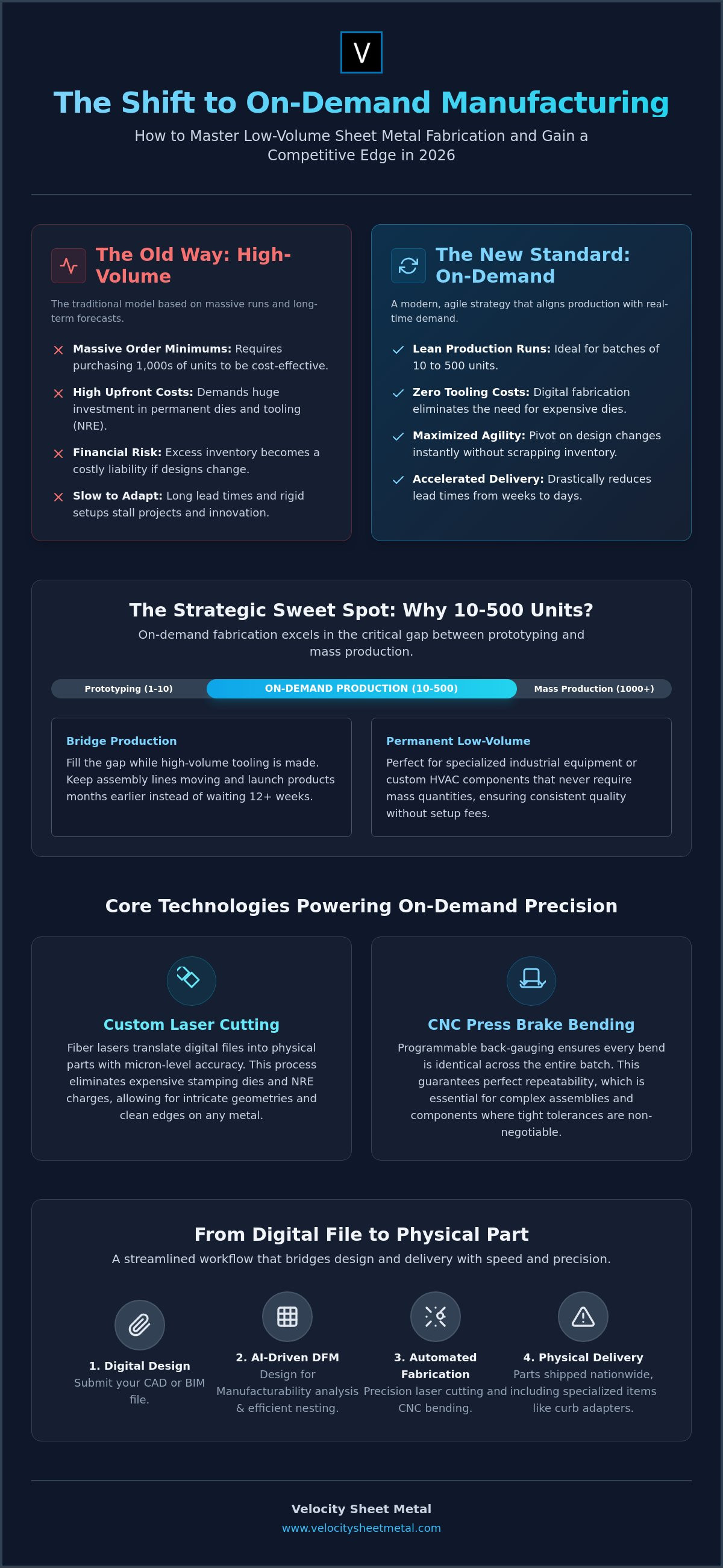
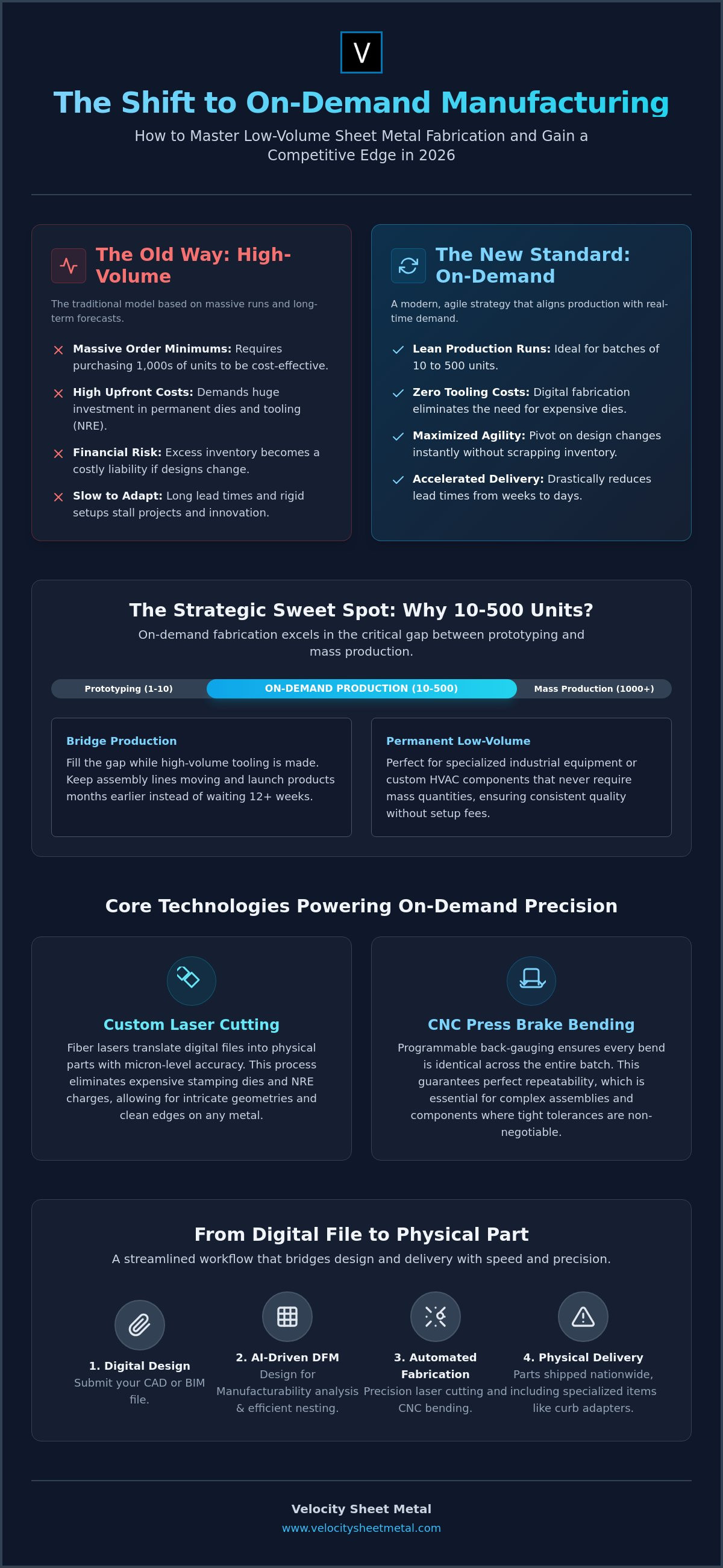
Manufacturing speed is the new currency. In 2026, on-demand sheet metal fabrication isn't just a niche service; it's a necessary logistics strategy. It addresses the critical gap between the first prototype and full-scale mass production. While high-volume shops demand orders in the thousands, on-demand focuses on the 10 to 500 unit range. This model allows engineers to align their physical output with real-time project demand. Sheet metal is a versatile medium, but its traditional production cycle has often been plagued by rigid tooling and long lead times. On-demand workflows eliminate these bottlenecks by prioritizing digital accuracy over physical dies.
The 2026 market requires a specific type of industrial agility:
- The ability to handle rapid engineering changes without scrapping existing inventory.
- A reduction in Non-Recurring Engineering (NRE) costs for short-run projects.
- Seamless integration between digital BIM design files and the shop floor.
- Minimized warehouse overhead by producing parts only when they are needed.
The Economic Case for Smaller Batch Sizes
Inventory is a liability, not an asset. Storing 5,000 units of a part that might need an engineering change in six months is a massive financial risk. By shifting to smaller batches, you slash carrying costs and minimize warehouse overhead. If a field test reveals a necessary design tweak, you can pivot immediately without scrapping thousands of dollars in existing stock. This approach lowers the barrier to entry for New Product Introductions (NPI). It allows OEMs to test market reactions with production-quality parts before committing to massive capital expenditures. On-demand sheet metal fabrication ensures a lean supply chain where every physical part has a clear destination. You aren't just buying components; you're buying the ability to adapt.
Bridge Production vs. Permanent Low-Volume
Timing dictates your market position. Bridge production fills the void while you wait for high-volume hard-tooling to be manufactured. Instead of delaying a product launch for 12 weeks, you can run a batch of 200 units to keep the assembly line moving. In other cases, low-volume is the permanent solution. Highly specialized industrial equipment or custom HVAC components often don't require thousands of units. For these applications, on-demand fabrication provides a consistent quality standard that matches mass production without the associated setup fees. It ensures that specialized parts, from complex brackets to custom curb adapters, meet exact specifications every single time. This model provides the flexibility to adapt to project-specific requirements without a financial penalty.
Core Technologies Powering On-Demand Production and Precision
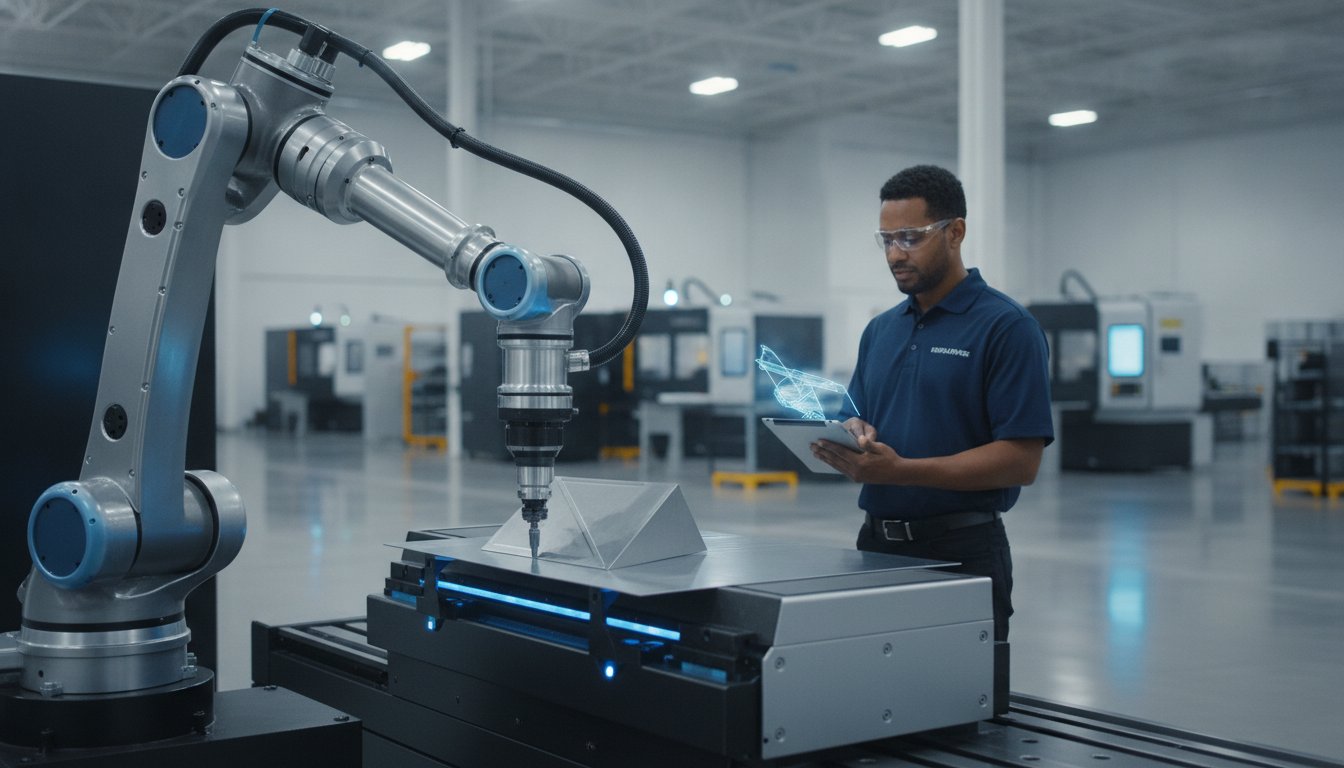
Success in on-demand sheet metal fabrication relies on replacing physical templates with digital accuracy. Modern shops no longer spend weeks building specialized dies for short-run projects. Instead, they use high-speed automated systems that translate CAD files directly into finished parts. This shift eliminates the heavy upfront costs typically associated with custom manufacturing. It ensures that your production run of 100 units is as cost-effective as a run of 5,000. High-speed automation bridges the gap between design and delivery with surgical precision.
Custom Laser Cutting: Eliminating Tooling Costs
Fiber lasers are the backbone of modern shop efficiency. They provide incredible precision without the need for expensive stamping dies or non-recurring engineering (NRE) charges. This technology allows for the rapid creation of intricate HVAC transition fittings and complex industrial brackets. Whether you're working with thin-gauge aluminum or heavy-duty galvanized steel, laser cutting delivers clean edges and tight tolerances. It is the fastest way to move from a digital concept to a physical component. If you need a partner who understands this speed, Velocity Sheet Metal integrates these technologies to streamline your supply chain.
CNC Press Brake Bending for Complex Geometries
Precision bending is where geometry meets repeatability. CNC press brakes use programmable back-gauging to ensure every bend is identical across the entire batch. This level of control is essential for mechanical components and complex HVAC assemblies where tolerances are non-negotiable. While standard shop tolerances often follow general benchmarks, assembly-critical features can be held to much tighter specifications when the project demands it. Rapid part changeovers mean a shop can switch from bending a custom bracket to a large enclosure in minutes. This flexibility is what makes low-volume production viable for modern OEMs.
Automated coil lines further enhance this workflow by streamlining the production of rectangular ductwork. These systems handle varied sizes with minimal manual intervention, reducing labor costs and the risk of human error. Digital workflows track every step of the process. They ensure the 500th part is a perfect match for the first. This technological stack provides the reliability you need for high-growth sectors like data centers, defense, and medical equipment manufacturing.
Evaluating the ROI: Low-Volume vs. High-Volume Production Models
Efficiency is a calculation, not a guess. High-volume production is often a gamble on design stability. It relies on the assumption that your requirements won't change for the next 50,000 units. For most industrial applications and mechanical contractors, that assumption is a liability. The ROI for on-demand sheet metal fabrication isn't found in the lowest possible unit price. It's found in the total cost of ownership. You aren't just paying for metal; you're paying for the ability to stay lean.
When you evaluate production models, use this formula: Total cost = (Unit cost x Quantity) + Setup/Tooling fees. High-volume models front-load these fees. You might pay thousands for stamping dies before the first part hits the floor. In an on-demand scenario, those setup fees are virtually eliminated. This makes the "sweet spot" for specialized HVAC projects and custom OEM parts fall squarely in the 10 to 500 unit range. You avoid the "tooling trap" where the cost of the mold exceeds the value of the parts themselves.
Understanding Non-Recurring Engineering (NRE) Costs
Non-Recurring Engineering (NRE) costs are the hidden killers of project budgets. These include programming time, machine setup, and material nesting optimization. Traditional shops often rely on manual shop drawings. This process inflates NRE through human error and slow revisions. Modern digital workflows slash these costs. By using digital BIM files, we move straight from data to the laser cutter. This precision ensures that every square inch of material is used efficiently. While coil line duct fabrication is the industrial standard for massive straight-run requirements, it lacks the surgical flexibility needed for custom fittings or specialized brackets. Digital NRE reduction turns complex geometries into affordable realities.
Lead Time Advantages in Rapid Market Entry
Time is a cost that rarely shows up on a quote. Waiting three months for a hard-tooling die is an eternity in commercial construction or product development. On-demand production delivers parts in days. This rapid turnaround is critical when you encounter field collisions or unexpected design changes on a job site. If a duct run doesn't clear a structural beam, you can't wait weeks for a solution. You need a part that fits the current reality of the site, not the blueprint from six months ago. Speed is a competitive advantage for OEMs and national accounts. You get to market faster. You respond to problems quicker. You keep your capital liquid instead of burying it in a warehouse full of "just in case" parts. Real ROI comes from the ability to deliver on time, every time.
Design for Manufacturability: Optimizing Files for Rapid Turnaround
Precision on the shop floor starts with intelligence on the screen. In the world of on-demand sheet metal fabrication, the Design for Manufacturability (DFM) phase is the difference between a three-day turnaround and a two-week delay. When you're producing batches of 10 to 500 units, you don't have the luxury of a slow ramp-up. Every manual adjustment or tool change adds cost and eats into your speed-to-market. A DFM-optimized file ensures the laser never stops and the press brake never hesitates. It's about translating engineering intent into a workflow that prioritizes operational speed.
Material Selection and Gauge Optimization
Nesting efficiency is the engine of cost reduction. If your project uses five different material gauges for five different parts, the machine must stop for five separate setups. By standardizing your material thicknesses, you allow for superior nesting on standard sheet sizes. This minimizes scrap and lowers the unit cost of every part in the run. Material choice also dictates the edge quality of precision laser cutting services. For custom HVAC enclosures, balancing structural integrity with weight is critical. We recommend staying within common commercial gauges to ensure material availability and consistent bending performance. Simplifying your bend sequences is another quick win. The fewer tool changes a technician has to perform, the faster your parts move from the rack to the shipping dock.
Leveraging BIM and Spool Drawings for Accuracy
The biggest waste in commercial construction isn't scrap metal; it's field rework. This is where digital coordination becomes your most valuable tool. BIM coordination allows us to identify collisions in a 3D digital environment before a single cut is made. We use spool drawings to translate these complex 3D models into accurate flat patterns for the shop. This process bridges the gap between the design office and the job site. It ensures that every duct run, bracket, and custom fitting fits perfectly the first time. By identifying potential field errors digitally, you eliminate the need for emergency on-site modifications. This level of precision is why national accounts rely on a digital-first fabrication partner. If you want to eliminate the guesswork from your next project, partner with Velocity Sheet Metal for BIM-driven fabrication.
Digital workflows also allow for tighter control over tolerances. While standard benchmarks like ISO 2768 are sufficient for non-critical features, assembly-critical points can be held to much tighter specs when the digital model is the source of truth. This consistency is vital for high-growth sectors like data centers and defense, where a millimeter of error can derail an entire installation. When your files are optimized for the machine, your production becomes a predictable, repeatable process.
Velocity Sheet Metal: Scaling Your Production with Precision and Speed
Precision is a standard, not an option. At Velocity Sheet Metal, we act as the essential bridge between your digital BIM files and a finished, physical product. We've built our workflow around the reality of modern industrial timelines. Whether you're an engineer designing a complex enclosure or a mechanical contractor managing a multi-state rollout, you need a partner who can move as fast as your data. Our on-demand sheet metal fabrication model is designed to handle the critical middle ground where traditional high-volume shops fail. We focus on the 10 to 500 unit range, delivering production-quality parts without the administrative delays or massive tooling fees of the past.
Our facility is a modern industrial workshop powered by over 50 years of combined management experience. We don't just cut metal; we solve supply chain problems. By integrating automated technology with deep technical expertise, we ensure that every part-from a simple bracket to a complex HVAC sub-assembly-meets your exact specifications. This is manufacturing for the 2026 market: fast, precise, and entirely scalable.
On-Demand Production for National HVAC Accounts
Consistency is the biggest challenge for national accounts. Managing multiple job sites across the country often leads to fragmented quality and varying lead times. We solve this through standardization. Our automated coil-line rectangular duct production ensures that every piece of ductwork is identical, regardless of where it's being installed. This automation allows us to support large-scale national needs while maintaining the flexibility of a short-run shop. We ship nationwide, ensuring your project stays on schedule and your field teams aren't left waiting for critical components. It's about providing a reliable, repeatable result for every account, every time.
Custom Curb Adapters and Specialized HVAC Components
Field collisions and equipment changes shouldn't stall your project. We specialize in the rapid production of custom curb adapters designed to fit any rooftop unit. Our on-demand sheet metal fabrication capabilities extend to precision transition fittings, plenum boxes, and specialized spiral and round duct components. We translate your spool drawings into flat patterns instantly, using custom laser cutting and CNC press brake bending to achieve tight tolerances. This specialized focus allows us to deliver:
- Custom curb adapters fabricated and shipped to meet tight site windows.
- Precision transition fittings for complex mechanical room layouts.
- Standardized quality for national HVAC accounts and OEM partners.
- BIM coordination that identifies errors before they reach the shop floor.
Velocity Sheet Metal is built for the professional who values time and accuracy. We've eliminated the unnecessary fluff of traditional manufacturing to focus on what matters: delivery and detail. From the initial digital input to the final logistics of national shipping, we are ready to get to work immediately. Your project doesn't have time for excuses; it needs precision parts delivered at the speed of your business.
Accelerate Your Production Cycle with Precision Fabrication
Efficiency in 2026 isn't about bulk storage; it's about on-demand agility. You've seen how digital BIM coordination and DFM optimization turn complex geometries into repeatable results. By mastering the economics of smaller batches, you protect your capital and respond to field changes in real time. On-demand sheet metal fabrication is no longer just for prototypes. It's a core strategy for maintaining a lean, responsive supply chain that prioritizes speed-to-market.
With over 50 years of combined industry experience, Velocity Sheet Metal provides the BIM-to-machine accuracy your projects demand. We eliminate the administrative delays of traditional shops and provide nationwide shipping capabilities to keep your job sites active. Don't let long lead times or high tooling fees stall your growth. It's time to bridge the gap between your digital files and a physical product that fits perfectly the first time.
Get a Precision Quote for Your On-Demand Project and start building with industrial confidence today.
Frequently Asked Questions
What is considered a low-volume production run in sheet metal?
A low-volume production run in sheet metal typically ranges from 10 to 500 units. This volume serves as the essential middle ground between one-off prototyping and high-volume mass production. It allows engineers to test the market or bridge the gap while permanent tooling is being manufactured. This scale is ideal for specialized industrial equipment and commercial HVAC projects where thousands of identical units aren't required.
How does on-demand fabrication save money compared to mass production?
On-demand sheet metal fabrication saves money by eliminating the massive upfront costs of permanent hard-tooling and stamping dies. You only pay for the parts you need, which significantly reduces your inventory carrying costs and warehouse overhead. This model also minimizes the risk of financial loss due to engineering changes. It's a more efficient way to manage capital while maintaining high production quality.
Can low-volume parts achieve the same tolerances as high-volume stamping?
Yes, low-volume parts achieve high precision through CNC press brake bending and custom laser cutting. Modern automated equipment can maintain tolerances as tight as ±0.01 to 0.02 mm for assembly-critical features. While stamping is faster for millions of parts, digital fabrication matches its accuracy without the long lead times for die manufacturing. It's a reliable solution for complex geometries and strict industrial specifications.
What are the best materials for on-demand laser cutting?
The most effective materials for on-demand laser cutting include galvanized steel, stainless steel, and aluminum. Fiber lasers handle these materials with high precision across various gauges. Standardizing your material selection across a batch improves nesting efficiency and reduces scrap. This versatility makes laser cutting ideal for everything from intricate industrial brackets to heavy-duty HVAC transition fittings and custom enclosures.
How does BIM coordination improve the accuracy of low-volume orders?
BIM coordination identifies potential field collisions in a digital environment before any metal is cut. It allows for the seamless translation of complex 3D models into accurate flat patterns for the shop floor. This process eliminates the guesswork and manual errors often found in traditional shop drawings. You get parts that fit the first time, which prevents costly rework and delays on the job site.
What is the typical lead time for an on-demand sheet metal order?
Typical lead times for on-demand orders range from a few days to two weeks, depending on project complexity. This is a significant improvement over the months required for high-volume tooling setup. Speed is a major competitive advantage for OEMs and contractors responding to rapid project changes. While specific timelines vary by project scope, the digital-to-machine workflow is built for immediate execution.
Does Velocity Sheet Metal offer national shipping for small batch orders?
Velocity Sheet Metal provides reliable national shipping for all batch sizes, including small on-demand orders. We support national accounts by delivering standardized quality to multiple job sites across the country. Our logistics network ensures that your custom parts and HVAC components arrive on schedule, regardless of your location. This capability allows you to maintain a consistent supply chain without relying on local shop availability.
Are custom curb adapters available for on-demand production?
Yes, custom curb adapters are a core offering available for on-demand production. We specialize in fabricating adapters that fit any rooftop unit, regardless of the existing curb configuration. By using digital spool drawings, we ensure a perfect fit that prevents field modifications. These components are produced with the same precision and speed as our standard ductwork and shipped directly to your site.