Lennox Commercial Duct System Alternatives: A 2026 Procurement Guide
Relying on a single OEM catalog for your entire HVAC distribution network isn't a procurement strategy. It's a project bottleneck. You've likely experienced the frustration of waiting weeks for a proprietary transition fitting while your crew sits idle. You've probably struggled to force a standardized curb into a complex building geometry that doesn't accommodate catalog dimensions. These rigid lead times and high markups on Lennox commercial duct system alternatives can derail a 2026 project budget before the first segment is even hung.
We agree that proprietary delays shouldn't dictate your construction schedule. This guide shows how custom automated fabrication provides the flexibility, speed, and precision that standardized OEM systems often lack. You'll discover how to slash project lead times and ensure BIM-level precision through advanced manufacturing. We'll move from the limitations of catalog-dependent procurement to the advantages of high-speed automated production. We cover everything from coil-line rectangular duct efficiency to custom curb adapter integration. You'll see how shifting toward precision-engineered alternatives lowers your total installation costs and eliminates field fit-up headaches.
Key Takeaways
- Shift from proprietary catalogs to custom fabrication to eliminate supply chain bottlenecks and regain control over your construction schedule.
- Evaluate Lennox commercial duct system alternatives that leverage automated coil-lines to meet or exceed SMACNA standards without the OEM markup.
- Use BIM coordination to bridge the gap between digital design and physical production, ensuring every custom curb adapter and transition fitting fits perfectly on delivery.
- Reduce total project costs by eliminating the need for expensive field modifications and on-site adjustments typical of "standard" catalog parts.
- Leverage high-speed national shipping and automated production to keep large-scale projects moving regardless of local inventory shortages.
What Are Lennox Commercial Duct System Alternatives?
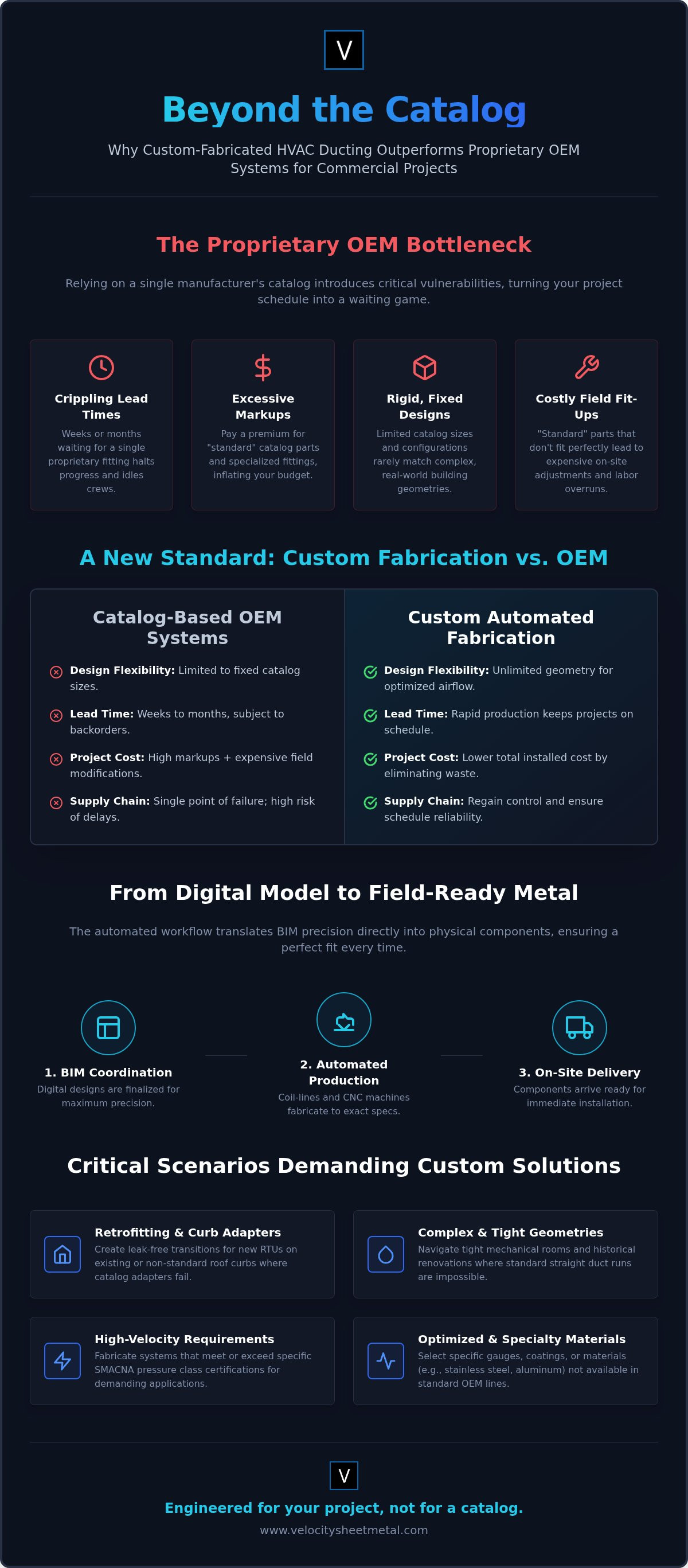
Lennox commercial duct system alternatives represent a strategic shift from proprietary, catalog-ordered components to high-precision, custom-fabricated HVAC distribution. These aren't just generic substitutes. They're engineered solutions built to match or exceed OEM specifications. Modern mechanical construction demands speed. Relying on a manufacturer's specific inventory often means accepting long lead times and rigid design constraints. Custom fabrication removes these hurdles by providing a direct link between your design files and the production floor.
Contractors are increasingly moving toward brand-agnostic fabrication to regain control of their project timelines. This approach focuses on high-speed, automated production of essential components like coil-line rectangular duct and spiral duct. It's about precision. When you move away from catalog-based systems, you're choosing a workflow that translates digital BIM models directly into physical metal. This ensures that every transition fitting and duct segment is field-ready the moment it arrives on-site. You aren't just buying metal; you're buying a streamlined installation process.
Standardized OEM Ducting vs. Custom Fabrication
OEM systems rely on fixed sizes and limited configurations. They're designed for the average install, which rarely exists in large-scale commercial projects. This creates a proprietary lock-in. If a catalog part doesn't fit your specific building geometry, you're often stuck with expensive field modifications. Custom fabrication offers unlimited geometry. You can optimize airflow by tailoring material gauges and fitting shapes to the exact needs of the structure. It's the difference between forcing a part to fit and manufacturing the perfect solution. Custom shops use CNC press brake bending and automated coil lines to ensure every piece meets the highest tolerances.
Common Scenarios Requiring Alternatives
Certain project demands make Lennox commercial duct system alternatives the only practical choice. Retrofitting is a major driver. When you're placing a new RTU on an existing roof curb, a custom curb adapter is essential for a leak-free transition. Standard catalog adapters often lack the precision needed for older roof footprints. Other common scenarios include:
- Complex Geometries: Tight mechanical rooms or historical renovations where standard straight runs won't work.
- High-Velocity Requirements: Systems that must meet specific SMACNA pressure class certifications for 2026.
- Optimized Materials: Selecting specific coatings or gauges that are unavailable in standard OEM product lines.
By choosing custom fabrication, you're not just buying ductwork. You're investing in a procurement process that prioritizes your project's unique technical requirements over a manufacturer's stock levels. It's a pragmatic move for contractors who value field-ready accuracy and schedule reliability.
The Limitations of Proprietary OEM Ducting in Large-Scale Projects
Large-scale mechanical projects operate on razor-thin schedules. Relying on a single manufacturer's supply chain introduces a single point of failure that can halt progress across multiple trades. When you commit to proprietary ducting, you're bound by their production capacity and inventory levels. This dependency often leads to inventory bottlenecks that standardized catalogs simply cannot solve. It's a logistical gamble that many contractors are no longer willing to take.
Integration challenges further complicate the use of OEM-exclusive components. Connecting proprietary ducting to third-party air handlers or VAV boxes frequently requires specialized transition fittings. These catalog items often carry significant markups. You're paying a premium for a "standard" part that might still require modification once it arrives. Using Lennox commercial duct system alternatives allows you to bypass these price hikes by fabricating exact transitions that bridge the gap between different equipment brands without the proprietary tax.
Supply Chain Vulnerability and Lead Times
OEM backorders are a common reality that can stall multi-million dollar commercial projects for weeks. Localized, automated fabrication offers a strategic buffer against these delays. By producing ductwork closer to the site or through a high-capacity national partner, you eliminate the wait times associated with global manufacturer logistics. Lead time risk is the probability that a project schedule will collapse due to the unavailability of a single, non-substitutable proprietary component. If you're facing tight deadlines, partnering with a high-speed fabricator ensures your ductwork is on-site when the units are set, not a month later.
The Reality of Field Adjustments
Labor is the most expensive variable on any job site. Standardized catalog parts are built for ideal conditions, but real-world structural obstructions like steel beams or plumbing stacks are rarely ideal. When a "standard" part doesn't fit, your crew spends hours in the field cutting, patching, and sealing. This "make it fit" approach drives up labor costs and compromises system integrity. There is a massive efficiency gap between static OEM catalogs and BIM-coordinated shop drawings. Automated fabrication uses your digital models to account for every building obstruction before the metal is even cut. This precision ensures that components drop into place with minimal field labor, moving your project from digital concept to physical reality with surgical speed.
Custom Automated Fabrication vs. Catalog-Based OEM Systems
Comparing Lennox commercial duct system alternatives to catalog-based OEM systems reveals a fundamental difference in production philosophy. OEM manufacturing relies on massive batches of standardized components. This works for stock inventory but fails when project-specific adjustments are needed. Automated fabrication operates on a "just-in-time" model. It uses digital inputs to drive physical machines. This allows for rapid changes in geometry and material without stopping the line. You aren't limited by what's sitting in a warehouse; you're limited only by the digital model you provide.
The flexibility of on-demand part production is a game changer for national accounts. Instead of managing multiple regional suppliers with varying stock levels, you can partner with a single automated fabricator. This ensures that every component, from straight runs to complex transitions, meets the same rigorous material quality and SMACNA standards regardless of the job site location. It's about maintaining a consistent standard of excellence across your entire portfolio.
Automated Coil-Line Efficiency
High-volume production no longer requires a choice between speed and precision. Modern coil line duct fabrication transforms raw galvanized steel into finished rectangular duct in a single, continuous process. This automation significantly reduces material waste by optimizing the layout of every cut. It also ensures absolute consistency across thousands of feet of ductwork. For national rollout projects, this means the first piece shipped to one project location matches the last piece delivered to another, ensuring universal consistency. You get the same material gauges, the same coatings, and the same pressure class compliance every time.
Curb Adapters: The Ultimate Alternative
Curb adapters serve as the critical bridge in any RTU replacement or upgrade. When you switch equipment brands, the new unit footprint almost never matches the existing roof curb. OEM catalog adapters are often limited to specific model pairings. If your configuration isn't in the book, you're looking at a custom engineering delay. Custom-fabricated adapters solve this by matching the exact dimensions of any existing curb to any new unit. We use CNC press brake bending to ensure structural integrity and airtight seals in these transition zones. This process is often faster than waiting for a standard catalog order to clear a manufacturer's backlogged shipping department. It eliminates the "make it work" mentality and replaces it with an "engineered to fit" reality.
The cost-benefit analysis is clear. While a catalog part might look cheaper on a spreadsheet, the hidden costs of field labor and schedule delays quickly erase those savings. Custom fabrication provides the on-demand flexibility required to keep multi-million dollar projects on track.
How BIM Coordination and Coil-Line Production Speed Up Timelines
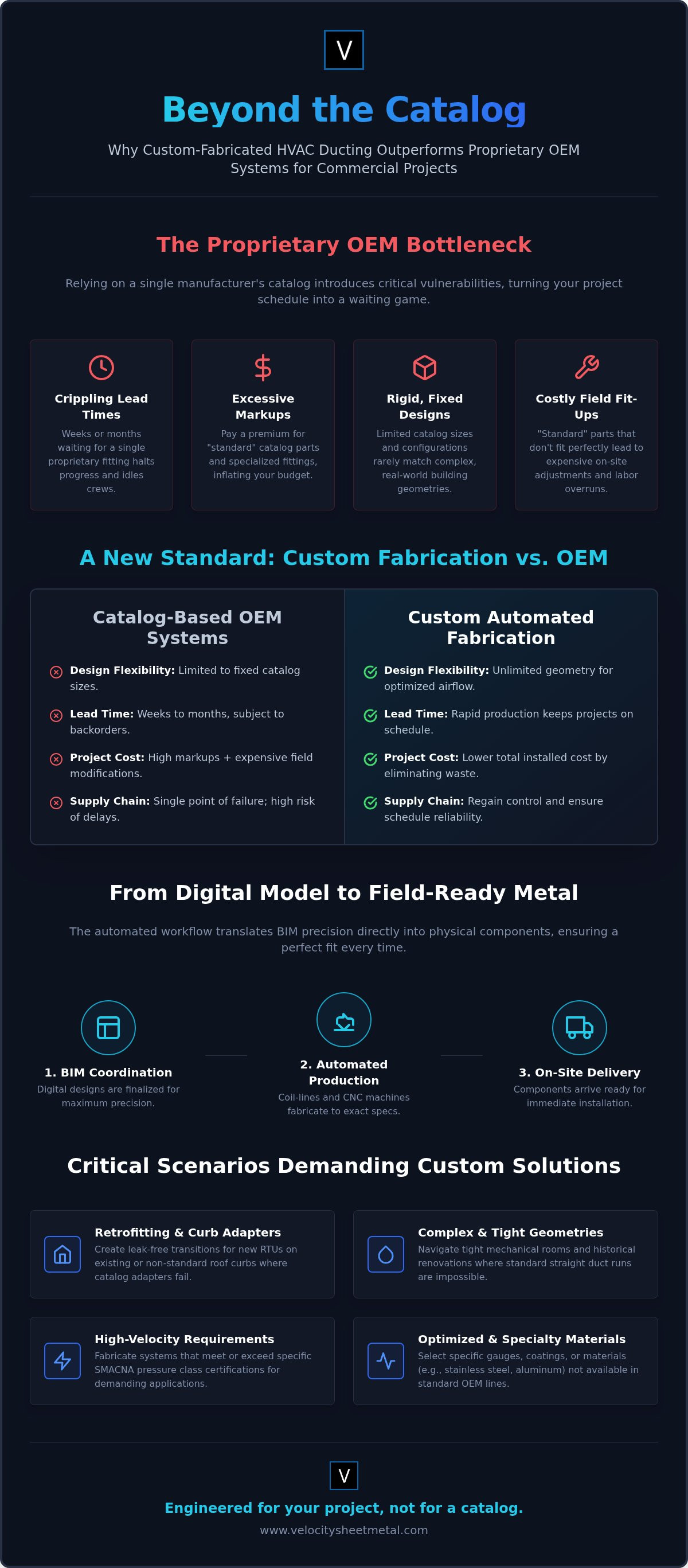
Modern contractors use Lennox commercial duct system alternatives to bridge the gap between design intent and physical reality. The process starts with a digital-to-physical workflow. We take your Revit models and convert them into machine-ready files for our automated coil lines. This eliminates the manual data entry that often leads to transcription errors. It's a direct pipeline from the engineer's desk to the factory floor. This digital-first approach proves that Lennox commercial duct system alternatives offer more than just metal; they offer a predictable construction schedule.
Proprietary load calculators can't see the structural steel or plumbing mains in your building. BIM clash detection for HVAC fabrication solves this by identifying spatial conflicts before production begins. We resolve these collisions in the virtual environment. This prevents the "proprietary fit-up" struggle where standard catalog parts hit a beam and require immediate, expensive field fixes. You get a system designed to navigate your specific building geometry with surgical precision.
Eliminating Field Errors with Precision Spooling
Precision spooling is the transition from broad mechanical drawings to detailed, machine-ready assembly files. Every segment of duct is assigned a unique identifier that correlates to a specific location in the building. High-quality HVAC duct fabrication for mechanical contractors relies on these spool drawings to act as a definitive map for the installation crew. BIM coordination reduces on-site scrap and rework by identifying spatial conflicts in the virtual environment before a single sheet of metal is sheared. This level of detail ensures that when the truck arrives, the crew spends their time hanging duct rather than measuring and cutting metal to fix mistakes.
Accelerating the Procurement Cycle
Custom fabrication allows for parallel processing. You don't have to wait for the site to be fully measured to order your distribution network. We can begin fabricating ductwork based on the coordinated BIM model while your team is still preparing the site. This just-in-time delivery model is essential for national accounts with limited on-site storage. We use automated labeling and tracking to ensure that every piece is organized for sequential assembly. This minimizes site clutter and keeps the workflow moving at a constant pace. It's a methodical, predictable system that scales across large-scale projects without the typical administrative delays of OEM procurement.
Streamline your next project with BIM-coordinated fabrication and automated production.
Velocity Sheet Metal: High-Precision HVAC Solutions for National Contractors
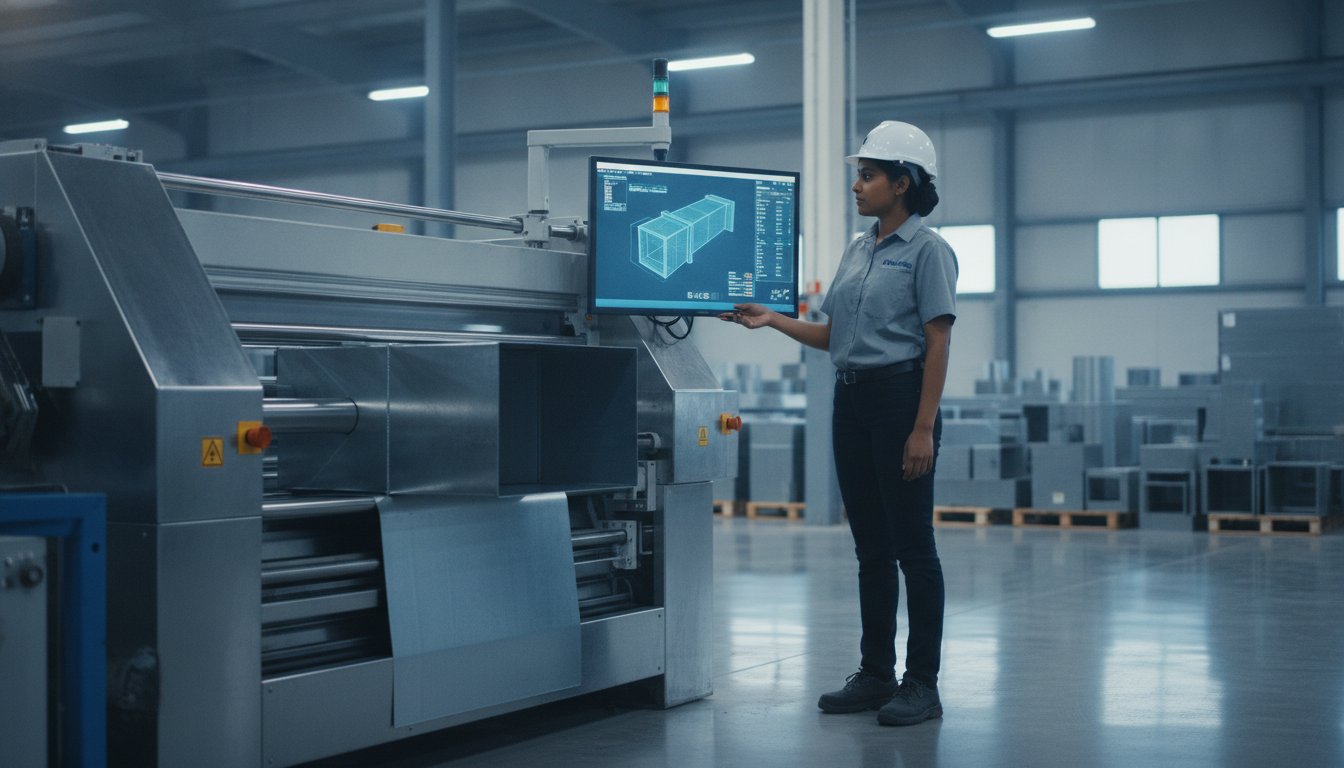
Velocity Sheet Metal acts as the high-speed engine for national mechanical contractors. We don't just supply metal; we provide a technical partnership that prioritizes delivery speed and field accuracy. Our facility utilizes automated coil-lines for rectangular duct and high-precision custom laser cutting to handle the most demanding specifications. This infrastructure positions us as one of the leading Lennox commercial duct system alternatives for high-volume projects. We understand that a missed delivery window or a misaligned fitting can cost thousands in field labor. Our approach is built on industrial pragmatism. We act as the essential bridge between your digital files and the final physical product.
National Reach, Precision Execution
Mechanical contractors managing national accounts need a standardized quality level that doesn't fluctuate by region. We provide consistent, industrial-grade reliability across the United States through our robust national shipping capabilities. Whether your project requires standard spiral duct or complex custom curb adapters, we execute with the same technical rigor. Every piece of ductwork we produce adheres to strict SMACNA standards. We handle custom transition fittings on demand, ensuring that your equipment integrates perfectly regardless of the OEM brand. This commitment to precision eliminates the guesswork typically associated with third-party fabrication. We move your project from raw material to site-ready components with surgical efficiency.
Partnering with Velocity for Your Next Project
Our onboarding process is designed for speed and clarity. We work directly with your engineers and BIM coordinators to ingest Revit models and spool drawings. This seamless workflow ensures that the digital intent is preserved through every stage of manufacturing. From initial file review to final logistics, our team maintains a methodical progression that mirrors an optimized production line. We provide the technical support necessary to navigate complex building geometries that standard catalogs ignore.
- Coil-line automated rectangular duct: High-volume production with minimal waste.
- Custom Laser Cutting: Precision for intricate components and transition fittings.
- BIM Coordination: Digital clash detection before the first cut is made.
- National Shipping: Reliable logistics for large-scale mechanical contractors.
Contact us to discuss your requirements for high-volume coil-line production or specialized custom fabrication. We are ready to get to work immediately to keep your 2026 procurement schedule on track. Choosing Lennox commercial duct system alternatives from an expert operator ensures your project remains flexible, precise, and cost-effective.
Regain Control of Your 2026 Procurement Schedule
Standardized catalogs shouldn't dictate your construction timeline. Moving toward Lennox commercial duct system alternatives allows you to bypass proprietary bottlenecks and reclaim project flexibility. We've seen how BIM coordination eliminates field collisions before they happen. We've explored how automated coil-line production delivers consistent quality at scale. These tools transform ductwork from a potential delay into a predictable, high-speed asset.
Velocity Sheet Metal brings 50+ years of combined industry experience to every project. We combine full BIM coordination capabilities with nationwide shipping to support your national account needs. Whether you're managing a single complex retrofit or a massive multi-state rollout, our team is ready to deliver field-ready precision. It's time to bridge the gap between your digital design and the physical installation. Get a quote for high-volume automated ductwork and start building with confidence. Your next project deserves the speed and accuracy of modern manufacturing.
Frequently Asked Questions
Can custom-fabricated ductwork be used with Lennox RTUs?
Yes, custom-fabricated solutions interface seamlessly with any major RTU brand. We engineer components that match the exact connection points and pressure requirements of your specific units. This ensures a tight fit and optimal airflow without relying on proprietary catalog parts. Our process focuses on technical compatibility, allowing you to maintain system integrity while utilizing more flexible distribution options.
Are custom curb adapters as reliable as OEM-provided adapters?
Custom curb adapters often exceed OEM reliability by providing a more precise fit for specific site conditions. We use CNC press brake bending and heavy-gauge materials to ensure absolute structural integrity. These adapters act as the perfect bridge between existing roof curbs and new units. They eliminate the leak risks often associated with "standard" catalog parts that don't quite match older roof footprints.
How do custom fabrication lead times compare to OEM catalog orders?
Custom fabrication lead times are typically much shorter than OEM orders, especially when manufacturers face supply chain backorders. Our automated coil-line production allows us to move from digital design to physical product in a fraction of the time. This makes our services a high-speed choice for those seeking Lennox commercial duct system alternatives during inventory shortages or project acceleration phases.
Does your ductwork meet SMACNA standards for commercial buildings?
Yes, every piece of ductwork we manufacture meets or exceeds current SMACNA standards for pressure and construction. We verify specific pressure class certifications to ensure full compliance with 2026 building codes. Our automated production line maintains consistent gauges and reinforcement schedules across every rectangular and spiral duct segment we ship to your job site.
Can you ship custom HVAC components to job sites nationally?
We provide robust national shipping for all our custom HVAC components, including high-volume rectangular duct and curb adapters. Our logistics network is optimized to support large-scale mechanical contractors across the United States. We ensure that your materials arrive organized, labeled, and ready for immediate installation. This national reach ensures standardized quality regardless of your project's geographic location.
Do you provide BIM coordination and spool drawings for all projects?
We offer full BIM coordination and spool drawings as a core part of our fabrication workflow. By translating Revit models into machine-ready files, we identify and resolve field collisions before the metal is cut. This digital-to-physical process ensures that every component fits perfectly upon delivery. It significantly reduces on-site scrap and rework, keeping your labor costs under control.
What materials are available for custom commercial duct systems?
We work with industrial-grade materials primarily focused on galvanized steel for high-volume commercial needs. Our automated systems handle various gauges and coatings required for different pressure classes and environmental conditions. We use CNC laser cutting and press brake bending to maintain surgical precision across all material types, from straight rectangular segments to complex transition fittings and curb adapters.
How does automated coil-line production reduce my project costs?
Automated coil-line production reduces costs by minimizing material waste and slashing manufacturing labor hours. The high-speed process produces rectangular duct with extreme precision, ensuring segments arrive field-ready. This eliminates the need for expensive on-site modifications and patches. When considering Lennox commercial duct system alternatives, the efficiency of automation provides a better total value than marked-up proprietary catalog components.