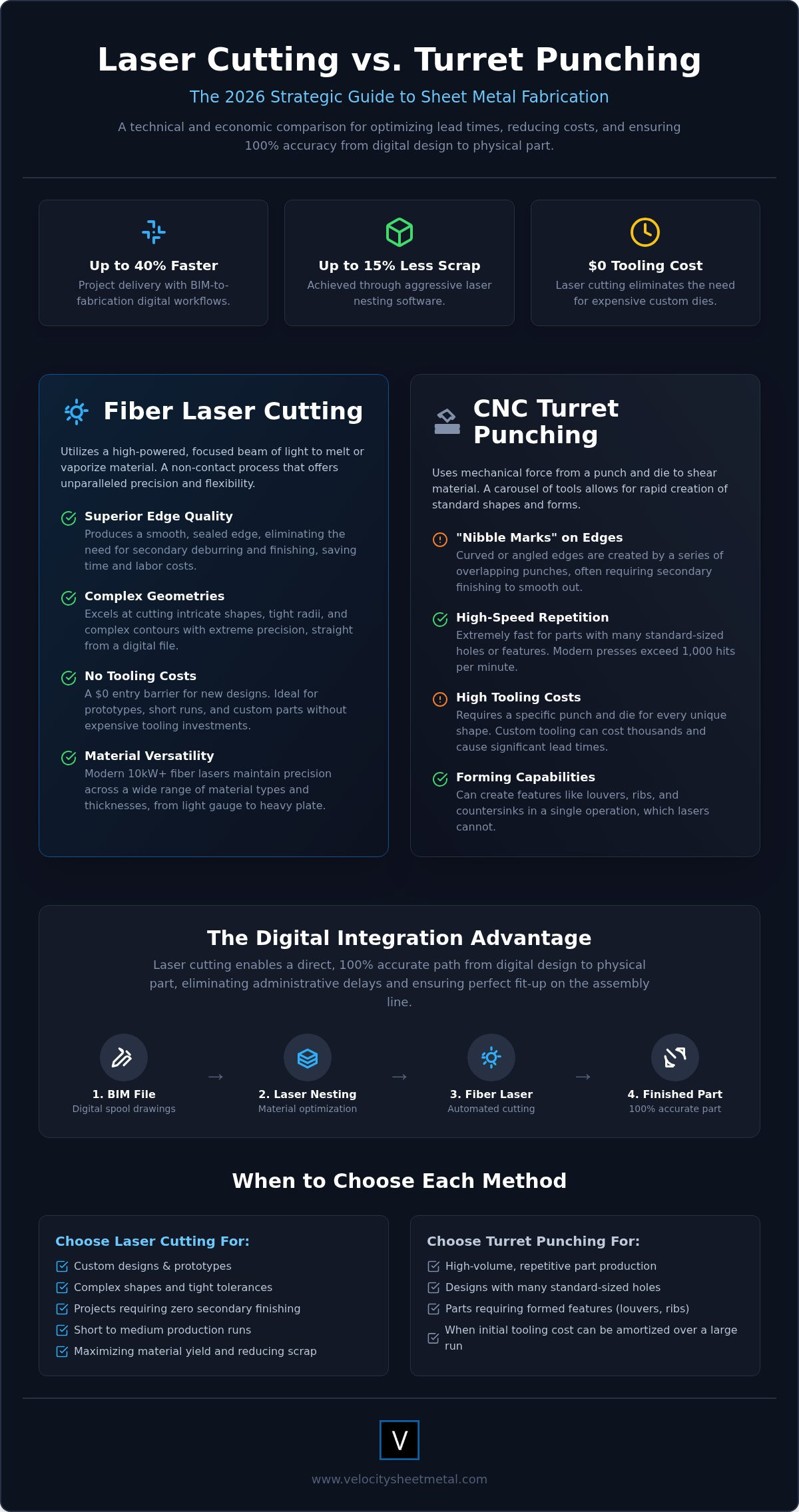
Laser Cutting vs. Turret Punching: 2026 Sheet Metal Fabrication Guide
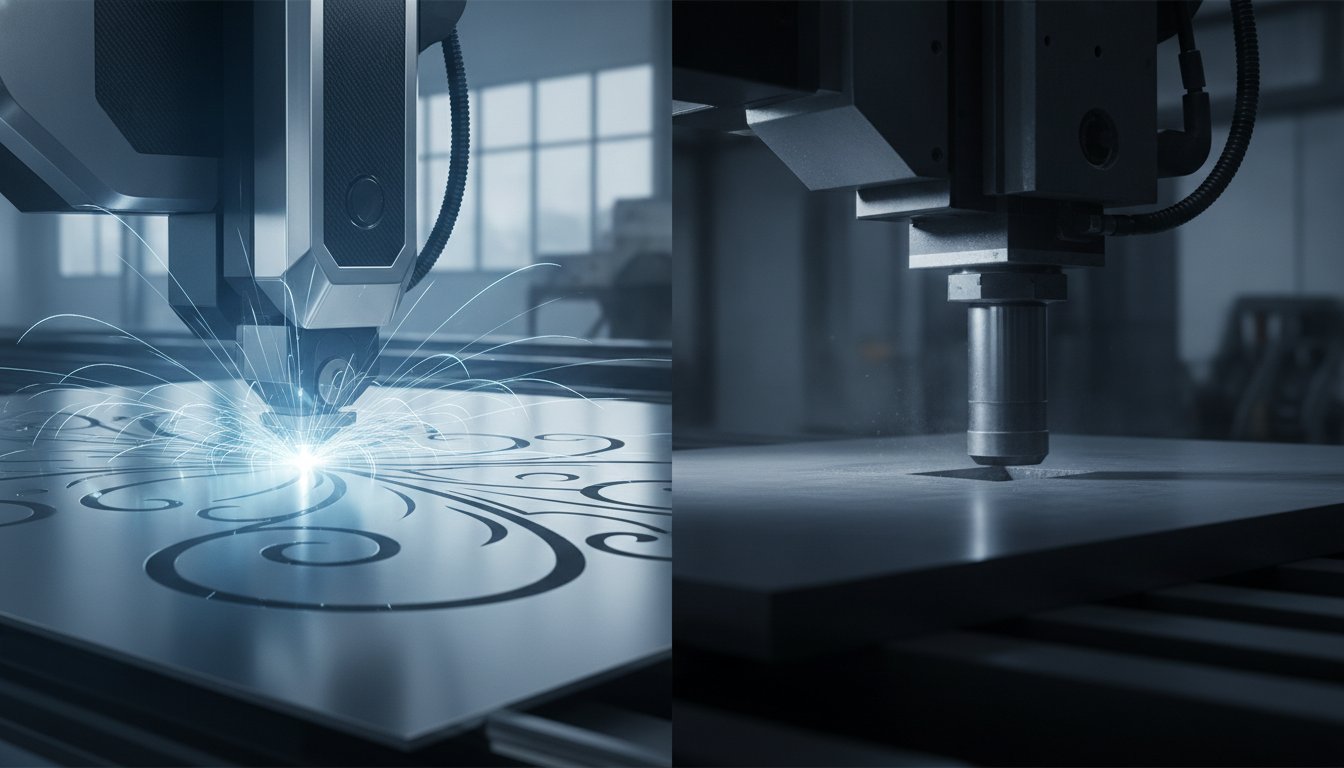
The cheapest part on your quote is often the most expensive one on your assembly line once you factor in secondary deburring and delayed schedules. You're likely feeling the pressure of rising material costs, with aluminum trading at $3,218.50 per metric tonne this August. Deciding on laser cutting vs turret punching for sheet metal is no longer a simple question of volume. It's a strategic choice about digital integration and eliminating the administrative delays that stall modern production.
We understand the frustration of high tooling costs for short runs and the headache of edge quality issues that require manual finishing. This guide promises to help you master the technical and economic differences between these two methods to optimize your project's lead times and production costs. You'll learn how to ensure 100% accuracy from your BIM files to the physical part. We will break down the 2026 benchmarks for material thickness, part complexity, and the digital workflows that are helping savvy contractors deliver projects up to 40% faster.
Key Takeaways
- Discover why laser cutting offers a zero-dollar entry barrier for custom designs by eliminating the need for physical tooling and expensive setups.
- Compare the technical performance of laser cutting vs turret punching for sheet metal to identify which process removes the need for secondary deburring.
- Learn how to leverage 10kW+ fiber laser technology to maintain precision across a wider range of material thicknesses, from light gauge ductwork to heavy plate.
- Master the integration of BIM coordination to ensure 100% accuracy from digital spool drawings to final physical parts.
- Optimize your production schedule by matching part complexity and volume to the most efficient CNC fabrication method for 2026.
The Fundamentals: Defining Laser Cutting vs. Turret Punching
Understanding the core mechanics of laser cutting vs turret punching for sheet metal is the first step toward reducing your production overhead. One process uses high-intensity light to vaporize material. The other uses mechanical force to shear it. Both have a place on the modern factory floor, but their impact on Sheet metal integrity differs significantly. In 2026, the industry is shifting toward methods that prioritize digital agility over mechanical repetition.
How Fiber Laser Cutting Operates
Fiber lasers utilize a high-powered beam focused through a narrow nozzle to melt or vaporize material instantly. Because it's a non-contact process, there's no physical pressure applied to the workpiece. This eliminates the risk of "oil-canning" or mechanical deformation common in lighter gauges. Modern 10kW+ fiber lasers offer a minimal heat-affected zone (HAZ), ensuring the structural properties of the metal remain intact right up to the cut line. Since there are no physical tools to swap, you can move from a digital BIM file to a finished part in minutes. This streamlined workflow is why contractors utilizing digital-to-physical integration report delivering projects up to 40% faster.
The Mechanics of the CNC Turret Press
A turret punch press relies on a rotating carousel of hardened steel tools. The machine positions the metal under the turret, which then strikes a punch through the material into a matching die. This mechanical shearing is incredibly fast for specific tasks. If your design requires hundreds of identical holes or specialized forms like louvers and ribs, the turret is the superior choice. However, every unique shape requires a specific tool. If your geometry isn't already in the carousel, you're looking at expensive custom tooling and significant administrative delays. The mechanical nature of the punch also leaves "nibble marks" on curves, often requiring secondary finishing steps that drive up the per-part cost.
The choice between laser cutting vs turret punching for sheet metal often comes down to the balance between speed and versatility. Turret presses excel at high-volume, repetitive punching of standard shapes. Fiber lasers dominate in precision and complex geometry. For 2026 projects that demand tight tolerances and zero secondary deburring, the laser’s non-contact nature provides the cleanest path from digital design to physical reality.
Cost Analysis: Tooling, Setup, and Production Volume
The financial reality of laser cutting vs turret punching for sheet metal often hinges on the first hour of production. If you are starting a new project with unique geometries, the laser offers a $0 entry barrier. There are no custom dies to order. No specialized punches to wait for. You move from a digital file to a physical part immediately. This speed allows you to bypass the traditional administrative delays that plague conventional fabrication shops.
Calculating the ROI on Custom Tooling
For simple, repetitive parts, a turret punch is a reliable workhorse. However, custom OEM components often require specialized punch sets that can cost thousands before the first part is even struck. Utilizing precision laser cutting services eliminates these upfront capital expenditures entirely. Tooling amortization is the process of spreading the initial cost of a punch and die set across the total number of parts produced in a specific run. If your run is limited to a few hundred parts, that amortization kills your margin. The laser keeps your per-part cost flat from part one to part one thousand.
Throughput Speed and Operational Efficiency
Turret presses are measured in hits per minute, often exceeding 1,000 strokes in modern machines. Fiber lasers are measured in inches per minute. For parts with hundreds of small holes, the turret is faster. For complex outlines, the laser wins. We often see that coil line duct fabrication provides the best high-volume solution for rectangular duct, while the laser handles the intricate transition fittings. This hybrid approach ensures maximum efficiency across the entire project footprint.
Nesting software for laser cutting is significantly more aggressive than turret software. A turret requires a structural skeleton to maintain sheet rigidity during the mechanical strike. Lasers don't. You can nest parts closer together, reducing scrap by up to 15% in some applications. This material saving is critical when aluminum and copper prices are volatile. When evaluating laser cutting vs turret punching for sheet metal, consider the total material yield alongside the machine time.
Velocity Sheet Metal bridges the gap between precision cutting and national delivery. We focus on getting your parts on a truck faster than local shops can even finish their setup. If you need a partner who values your timeline and can ship nationwide, contact Velocity Sheet Metal to see how our automated workflow reduces lead times and logistics headaches.
Precision, Complexity, and Secondary Operations
Precision isn't just a technical specification; it's a direct driver of your bottom line. When evaluating laser cutting vs turret punching for sheet metal, the physical finish of the edge determines your labor costs. Laser cutting delivers a surgical, dross-free edge that is ready for assembly immediately. In contrast, a turret punch leaves "nibble marks" as the tool steps around a curve. These mechanical imperfections often require manual deburring or secondary grinding. Those extra steps consume time and inflate your per-part cost. For complex HVAC transition fittings, the laser is the only logical choice to maintain airflow efficiency and structural tight-fits.
Dimensional Tolerances and Repeatability
Fiber lasers operate with a standard tolerance of +/- 0.005", providing a level of repeatability that mechanical punching struggles to match over long runs. Standard turret punching tolerances often fluctuate as tools wear down or material shifts under the physical strike of the punch. For OEMs, this precision is the difference between a seamless assembly and a bottlenecked production line. If your initial cut is inaccurate, your downstream bending will suffer. Understanding common press brake forming defects is vital because high-precision laser cuts provide the clean datum points required for accurate CNC bending. Accuracy at the start prevents failure at the finish.
Integrated Forming: The Turret’s Secret Weapon
The turret punch press has one distinct advantage: the ability to perform "in-machine" forming. It can strike louvers, knockouts, and offsets in the same operation as the hole punching. A laser, being a non-contact thermal process, cannot create these three-dimensional features. However, Velocity Sheet Metal bridges this gap by pairing precision cutting with specialized secondary operations. We utilize our CNC press brake services for OEMs to achieve complex forms that a turret simply cannot execute with the same level of detail. This hybrid approach is essential for modern BIM-coordinated projects. It allows designers to specify complex geometries in their digital models without worrying about the physical limitations of a single mechanical toolset. We translate your digital intent into physical reality without compromising on the forming requirements of the part.
Ultimately, the "cleanliness" of the laser process wins for 2026 manufacturing standards. It eliminates the administrative and physical delays caused by tool maintenance. You get parts that are accurate, clean, and ready for the next stage of the production cycle. By removing secondary finishing steps, you accelerate your entire project timeline.
Material Thickness and Gauge Constraints
Material thickness determines the structural outcome of your part. The physical limits of your stock often dictate whether laser cutting vs turret punching for sheet metal is the viable path. While a turret can punch through thin stock quickly, it introduces mechanical stress that thermal cutting avoids. In contrast, heavy plate requires the raw power of modern high-wattage fiber lasers to maintain edge quality.
Preventing Distortion in Thin Sheet Metal
Mechanical punching on 24-26 gauge galvanized steel is a high-stress event. Every strike of the punch creates a localized deformation zone. On large surface areas, these stresses accumulate, leading to "oil-canning" or visible warping. This distortion is unacceptable for components like custom curb adapters, where a flat, true surface is mandatory for a watertight seal. Laser cutting vs turret punching for sheet metal in these light gauges isn't just about speed; it's about material integrity. Because the laser is a non-contact process, it applies zero physical force. Advanced heat management and nitrogen assist gas ensure that even the most intricate patterns in thin stock remain perfectly flat. Reflected energy from materials like aluminum or copper, which once troubled older lasers, is easily managed by current fiber technology.
Cutting Heavy Gauge for Industrial Brackets
Standard turret punches hit a physical wall at 0.25" thickness. Punching anything heavier requires massive tonnage and leads to rapid tool degradation. It also produces a significant "breakout" on the bottom side of the part, where the metal shears away rather than cutting cleanly. Modern 10kW+ fiber lasers have revolutionized this space. These machines slice through 1" steel plate with a precision that was previously reserved for thin gauges. While a turret might struggle with the tonnage, a fiber laser maintains a consistent edge profile with minimal taper. This capability is vital for industrial brackets and structural components that must meet strict load-bearing specifications. It also handles galvanized coatings without the clogging issues that can sometimes affect mechanical punch dies.
Kerf width is another critical factor in your material yield. A turret punch removes a slug the size of the tool, typically 0.125" to 0.25" wide. A fiber laser kerf is roughly 0.010". This narrower cut allows for tighter nesting. You can fit more parts onto a single sheet of expensive stainless steel or aluminum. When material prices are high, this efficiency directly protects your project margins. If you're ready to see how high-precision laser cutting can improve your next project, get a quote from Velocity Sheet Metal today.
The Velocity Advantage: BIM Integration and National Logistics
Choosing between laser cutting vs turret punching for sheet metal is only half the battle. The real efficiency gains come from how that machine talks to your design team. At Velocity Sheet Metal, we've removed the administrative friction that traditionally slows down industrial production. We don't just cut parts; we execute a digital thread from the initial BIM model to the final delivery truck. This eliminates the wait time that usually occurs when a shop has to manually interpret complex drawings. We focus on speed because we know your project timeline depends on it.
Digital-to-Physical Accuracy
Precision in the shop is worthless if it doesn't match the reality of the job site. We integrate BIM clash detection for HVAC fabrication directly into our laser cutting workflow. Spool drawings are exported with zero manual translation. This ensures that every part arriving at your facility has 100% fidelity to the structural model. Field errors are expensive. They cause rework. They stall crews. Cutting parts with total model fidelity removes these risks before the metal even hits the truck. This on-demand production model supports just-in-time delivery, preventing job site clutter and reducing your overhead inventory costs.
Supporting National Accounts with Precision
Scaling production from a single prototype to a national rollout requires a partner with serious infrastructure. Velocity Sheet Metal leverages an automated coil-line for rectangular duct alongside high-speed laser services to handle massive volume surges without compromising accuracy. We ship standardized components nationwide, ensuring that a part delivered to one site has the exact same tolerances as another delivered three states away. This consistency is why engineers and contractors trust Velocity for precision components. Standardized quality isn't a luxury; it's an operational requirement. When you're managing large-scale HVAC projects, you can't afford variation between batches. Our automated systems ensure every cut is repeatable, whether it's the first part or the ten-thousandth.
We act as the essential bridge between your digital intent and a tangible, high-precision product. Our methodical approach to production and logistics means you spend less time managing vendors and more time meeting your delivery milestones. We've built our reputation on speed and accuracy, positioning ourselves as the reliable partner who gets to work immediately. This level of predictability allows your team to plan with confidence, knowing the parts will fit the first time, every time.
Contact Velocity Sheet Metal for a precision laser cutting quote today.
Optimize Your Production for 2026
The choice between laser cutting vs turret punching for sheet metal is a strategic pivot for your project's profitability. You've seen how fiber laser technology eliminates the upfront cost of custom dies while wiping out the need for secondary deburring. For modern projects, the real advantage lies in the digital thread. Moving from a BIM model to a finished part without manual translation is the only way to deliver complex assemblies on a 2026 timeline.
Velocity Sheet Metal provides the essential bridge between your digital files and tangible components. We back our precision with 50+ years of combined manufacturing expertise and a fully BIM-integrated shop floor. From initial spool drawings to national shipping for all custom parts, we manage the technical details so you can focus on the installation. It's time to stop waiting for custom tooling and start scaling your production with surgical accuracy.
Request a Precision Fabrication Quote from Velocity Sheet Metal and get your project moving immediately. We're ready to get to work.
Frequently Asked Questions
Is laser cutting more expensive than turret punching for high-volume runs?
Turret punching is often more cost-effective for extremely high volumes of simple parts because its cycle time per stroke is faster. However, the gap is closing. When evaluating laser cutting vs turret punching for sheet metal, modern fiber lasers eliminate tool maintenance costs and setup delays. For parts with complex outlines or those requiring zero dross, the laser's higher machine rate is offset by the elimination of secondary finishing labor and custom tool investments.
Can a laser cutter create louvers or countersinks like a turret punch?
No, a laser cannot perform 3D forming operations because it is a non-contact thermal process. It vaporizes metal rather than deforming it. While a turret punch uses specialized dies to strike louvers, knockouts, or offsets in a single pass, laser-cut parts require secondary operations. Velocity Sheet Metal solves this by using CNC press brake bending to achieve complex forms after the precision laser cut is complete, providing a more versatile finished product.
Which method provides better edge quality for stainless steel parts?
Laser cutting provides a superior edge quality for stainless steel by utilizing nitrogen assist gas. This prevents oxidation and creates a clean, bright finish that is ready for welding or painting. Turret punching often leaves a mechanical breakout on the bottom of the sheet and visible nibble marks along curved edges. For 2026 industrial standards, the laser's dross-free edge is the preferred choice for high-end aesthetic, medical, or food-grade hygienic applications.
How does BIM coordination improve the laser cutting process?
BIM coordination streamlines the transition from design to fabrication by allowing spool drawings to be exported directly to the laser's software. This digital-to-physical workflow eliminates manual data entry errors and ensures 100% fidelity to the structural model. Contractors utilizing this integration report delivering projects up to 40% faster. It turns the fabrication shop into a predictable extension of the design environment, reducing field rework and ensuring components fit the first time.
What is the maximum material thickness for laser cutting vs. turret punching?
Modern fiber lasers can slice through 1 inch steel plate with ease, while turret punches typically hit a physical limit at 0.25 inches. Punching thicker material requires massive tonnage and leads to rapid tool wear and breakout. For 2026 projects involving heavy industrial brackets or structural components, the 10kW+ fiber laser is the only viable option for maintaining precision and edge quality across thick gauge materials without causing mechanical sheet distortion.
Does Velocity Sheet Metal offer nationwide shipping for custom laser-cut parts?
Yes, Velocity Sheet Metal provides nationwide shipping for all custom laser-cut parts and HVAC components. We specialize in supporting national accounts by leveraging our automated production lines to maintain consistent quality across different regions. Our logistics network is designed for speed, ensuring that high-precision parts move from our shop floor to your job site immediately. This reliability makes us the essential bridge between a digital file and a tangible, delivered product.
Why is laser cutting preferred for rapid prototyping in OEM manufacturing?
Laser cutting is the gold standard for rapid prototyping because it has a $0 entry barrier for new designs. There's no need to wait for custom punch dies or specialized tool sets. An engineer can upload a CAD file and have a physical part in hand within minutes. This agility allows OEMs to iterate designs quickly, test fitments, and move into production without the administrative delays or capital costs associated with traditional mechanical tooling.
How do I decide which method is right for my HVAC curb adapter project?
Deciding on laser cutting vs turret punching for sheet metal depends on the complexity and gauge of your curb adapter. If your design features intricate transitions or requires 24-26 gauge galvanized steel, the laser prevents mechanical deformation and ensures a watertight fit. If the project involves thousands of identical units with simple holes, a turret might offer speed. However, most 2026 HVAC specifications favor the precision and BIM-readiness of the fiber laser.