Large Scale Ductwork Production: The Commercial Contractor Guide to High-Volume HVAC Fabrication
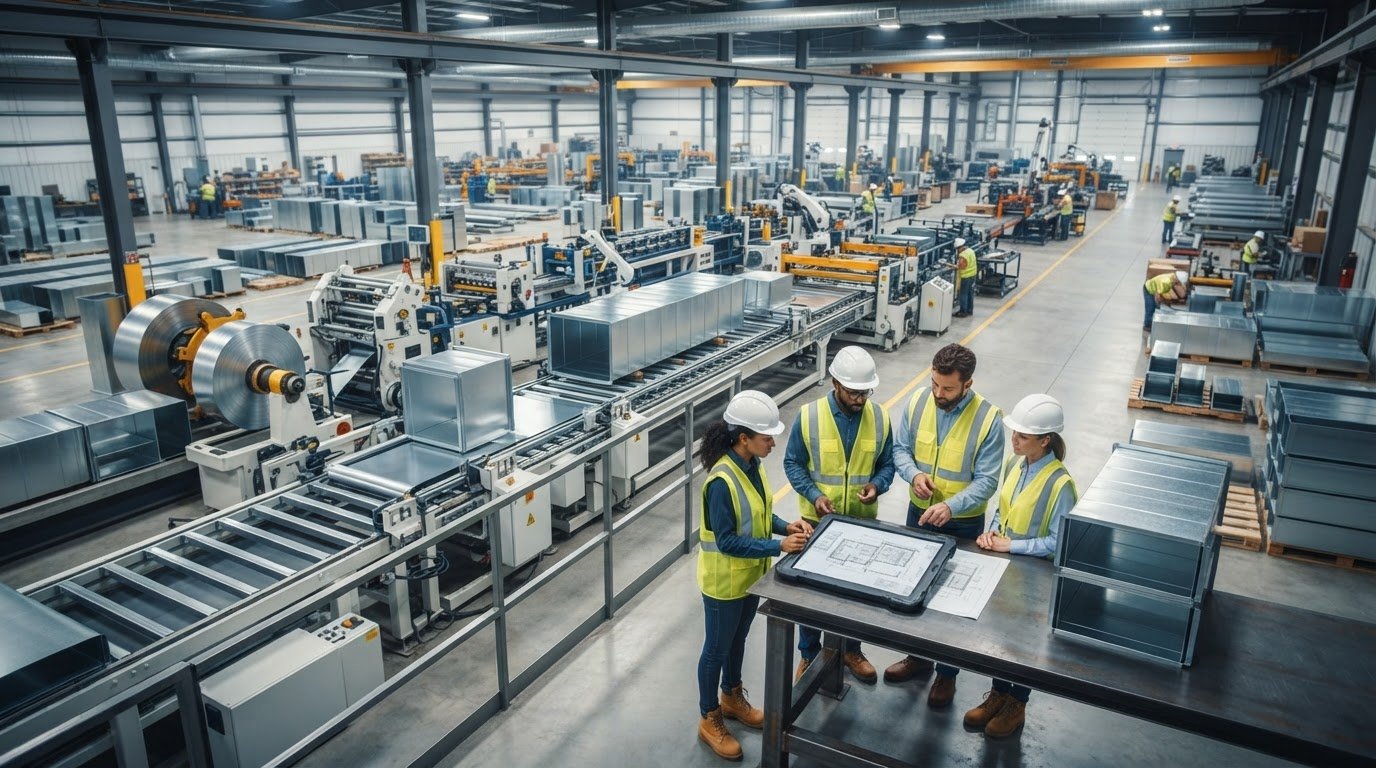
Your fabrication shop shouldn't be the bottleneck that stalls a multi-phase mechanical build. When high-tonnage project schedules compress, traditional manual shearing and hand-forming simply cannot keep pace with field installation crews. Disconnected 2D submittals inevitably trigger expensive dimensional clashes in the ceiling plenum, while damaged or out-of-sequence deliveries force installers to sort through chaotic staging areas instead of hanging runs. Executing large scale ductwork production shouldn't feel like an ongoing gamble with your project milestones and labor margins.
You already know that field profitability evaporates the moment an installation crew has to drop a lift to recut a fitting on the floor. Predictable progress requires dependable high-tonnage fabrication capacity that operates as a direct operational extension of your project plan. Discover how automated coil-line fabrication, BIM coordination, and national logistics streamline large scale ductwork production for major commercial projects.
In this guide, we examine how direct digital spooling eliminates field collisions, how automated coil lines compress turnaround times, and how phased, palletized deliveries protect your installation schedule while lowering total installed costs.
Key Takeaways
- Understand how automated coil lines modernize large scale ductwork production by converting raw coil stock into finished duct sections with minimal scrap and labor.
- Discover how direct handoffs from LOD 400 BIM models to shop machinery eliminate spatial clashes before metal is cut.
- Learn how automated longitudinal seamers and standardized quality control ensure consistent compliance across all SMACNA static pressure classes.
- Identify the core fabrication capabilities required to handle high-tonnage scopes, including multi-gauge processing, spiral duct, and custom curb adapters.
- See how high-density nesting strategies and phased, floor-by-floor delivery schedules keep jobsite laydown areas organized and installation crews moving.
What Defines Large Scale Ductwork Production in Modern Commercial HVAC?
High-volume commercial mechanical projects operate on tight schedules and uncompromising engineering specs. In this environment, large scale ductwork production means continuous, automated sheet metal conversion rather than sporadic job-shop fabrication. Small regional shops often rely on manual shears, hand brakes, and separate lock-forming stations. While that setup works for light tenant fit-outs, it buckles under the weight of major commercial builds. When a project demands hundreds of duct sections every week, manual handling creates immediate production delays.
Industrial manufacturing centers handle raw coil through direct machine integration. Master coils of prime ASTM A653 commercial galvanized steel feed directly into automated lines, eliminating the staging and handling of loose sheets. Unlike fabric dispersion socks or industrial dust-collection clamping, true commercial HVAC ductwork systems require rigid sheet metal construction built to withstand stringent differential pressures. This manufacturing workflow converts continuous coil stock into fully notched, beaded, and formed ductwork with minimal scrap and zero pauses in fabrication flow.
Tonnage Capacities and Output Benchmarks
Output volume separates light metal jobbers from dedicated production operations. A standard manual shop typically processes limited daily poundage, often constrained by table space and manual material transport. Industrial facilities maintain steady output across multi-gauge schedules:
- Continuous coil feeding: Automated decoilers eliminate crane lifts between cuts, keeping machines running continuously across entire production shifts.
- Standardized coil widths: Processing uniform master coils (typically 5-foot or 6-foot widths) minimizes changeovers, reducing line downtime during heavy runs.
- High-volume thresholds: Dedicated commercial lines produce hundreds of finished duct sections per week, providing the sheer volume required for phased corporate, healthcare, and educational builds.
Compliance with SMACNA and ASHRAE Engineering Standards
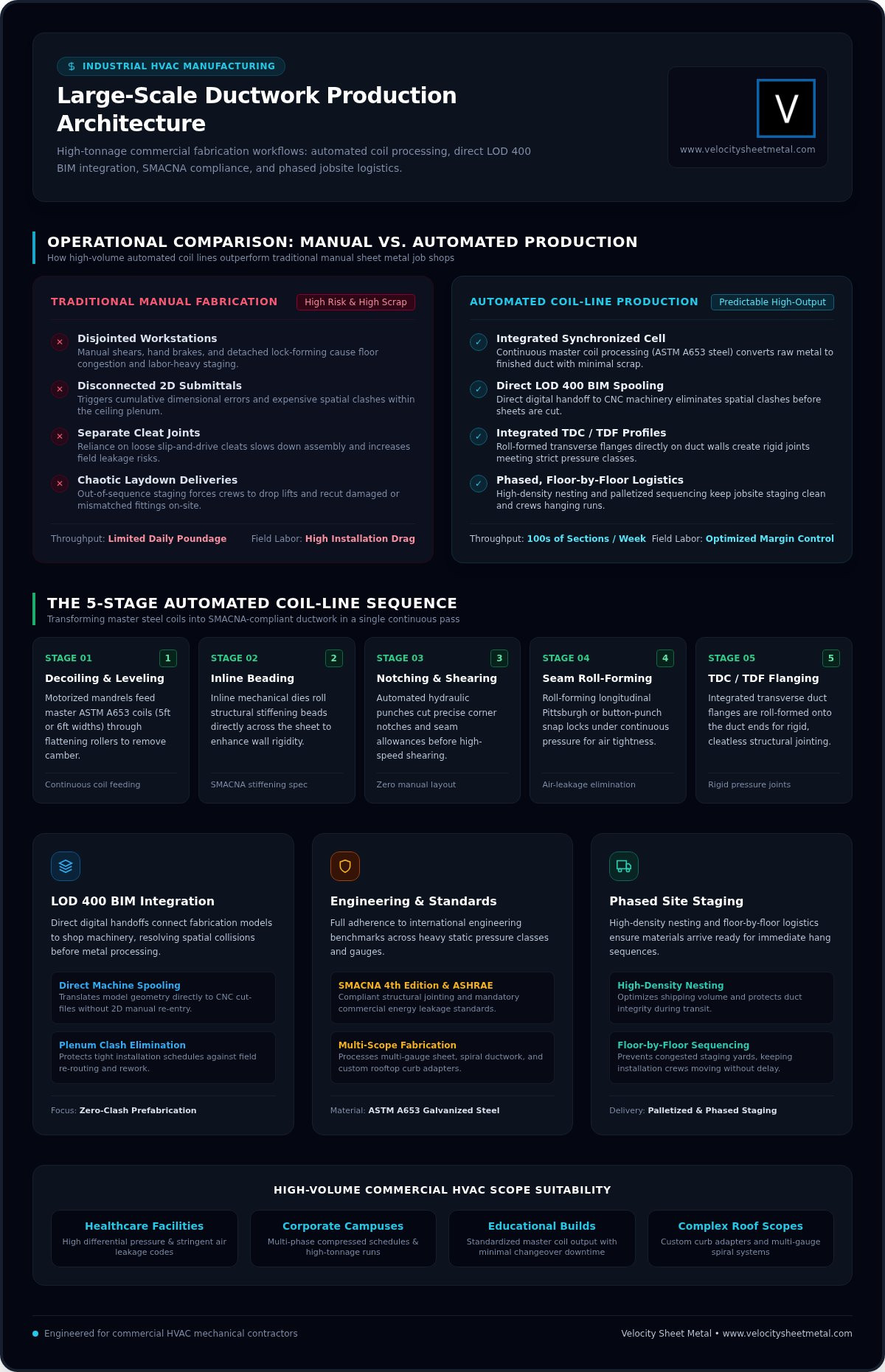
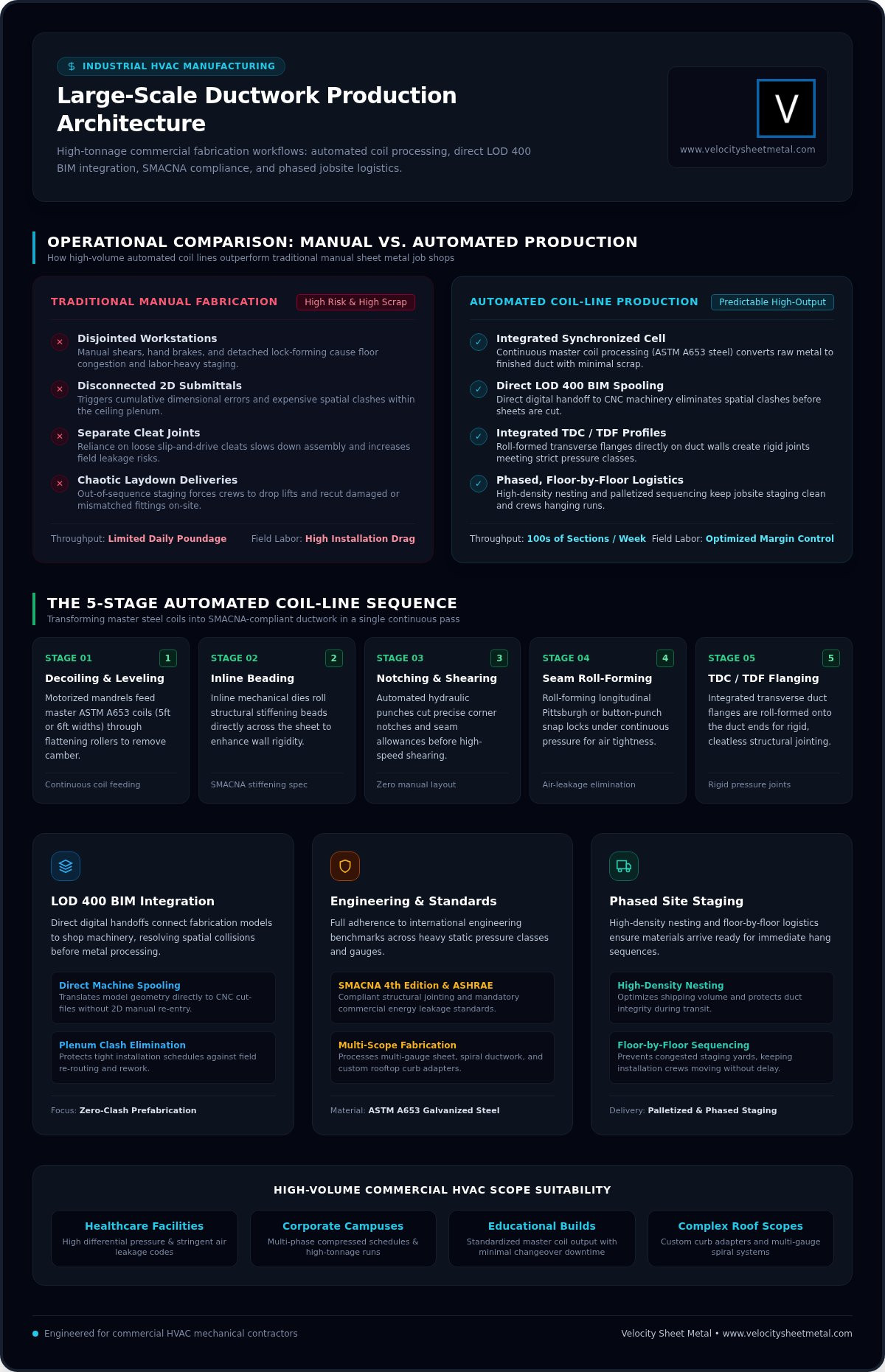
High-volume manufacturing must not compromise structural integrity. Every foot of fabricated metal must align with the SMACNA HVAC Duct Construction Standards – Metal and Flexible (4th edition) to meet ASHRAE energy performance guidelines. Large scale ductwork production uses automated roll-formers to shape transverse duct connector (TDC) or transverse duct flange (TDF) profiles directly onto the duct wall. These integrated flanges create rigid structural joints without requiring separate slip-and-drive cleats, ensuring the entire assembly withstands specified static pressure classes.
Precision seaming is equally critical. Longitudinal seams, such as automated Pittsburgh or button-punch snap locks, are roll-formed under continuous pressure. This automated consistency eliminates mechanical air leakage along the duct shell, ensuring mechanical contractors meet mandatory commercial energy code requirements right out of the crate.
Automated Coil Lines vs. Manual Fabrication: Operational Comparison
Manual shop workflows struggle when mechanical projects demand hundreds of linear feet of duct per day. Traditional sheet-by-sheet shearing, manual brake folding, and separate lock-forming consume extensive labor hours while introducing cumulative dimensional errors. Implementing coil line duct fabrication replaces disjointed workstations with an integrated, synchronized manufacturing cell. For commercial contractors managing strict schedules, this transition transforms large scale ductwork production from an erratic manual chore into a predictable, high-output process.
The Mechanics of Automated Coil-Line Manufacturing
An automated coil line processes master steel coils weighing thousands of pounds through a continuous, mechanical sequence:
- Decoiling and leveling: Motorized mandrels feed coil stock into heavy flattening rollers, eliminating coil set and camber across the sheet.
- Beading: Inline dies roll structural stiffening beads into the sheet metal, satisfying SMACNA duct construction standards without requiring manual cross-braking.
- Hydraulic notching: High-speed hydraulic tooling punches corner and seam notches required for L-sections, U-sections, or four-piece duct boxes.
- Roll-forming and shearing: Integrated rolls form Pittsburgh or snap-lock seams along the metal edges before an automated shear cuts the section to exact cut lengths, eliminating human error in joint geometry.
Scrap Reduction and Sheet Metal Yield Optimization
Manual shearing from pre-cut flat sheets often generates substantial off-fall scrap from end-cuts and manual layout mistakes. In contrast, an automated coil line feeds continuous material, cutting sections precisely to length with near-zero edge waste. Advanced production software groups varied duct dimensions along the same coil run, maximizing sheet metal yield and eliminating unused drops.
Higher yield rates directly protect commercial mechanical procurement budgets against raw material price volatility. When you integrate high-capacity manufacturing through Velocity Sheet Metal, your jobsites receive uniform, factory-squared duct sections that fit together quickly, lowering field assembly hours and eliminating expensive rework.
Integrating BIM Coordination and Spool Drawings into Factory Production
A high-speed manufacturing line is only as reliable as the data driving it. In modern commercial construction, relying on flat 2D shop drawings virtually guarantees plenum collisions with electrical conduit, domestic water lines, or structural beams. Leading mechanical contractors leverage BIM clash detection for HVAC fabrication to resolve spatial conflicts inside the digital model before feeding data to the shop floor. Resolving coordinate overlaps virtually safeguards project schedules and protects fabrication throughput.
When engineering teams model to Level of Development (LOD) 400, every duct run reflects true fabrication-level detail. Sheet metal gauges, connector clearances, insulation allowances, and stiffening profiles align precisely with design specs and governing ASHRAE standards. Transforming this digital model into coordinated mechanical spools bridges the gap between engineering intent and factory execution, establishing the foundation for accurate large scale ductwork production.
From Revit Model to CNC Machine Code
Bridging MEP coordination models to factory machinery requires a clean digital workflow without manual re-entry. Specialized CAM duct fabrication software parses coordinated spool assemblies directly into numeric control instructions:
- Direct data transfer: Spool files export dimensional geometry straight to automated coil lines, high-definition plasma tables, and precision laser cutters.
- Automated nesting: Software nests irregular fittings alongside straight runs instantly, calculating seam allowances, notch positions, and bend angles.
- Zero shop mark-ups: CNC controllers read machine code directly, completely eliminating manual tape measurements, shop floor chalking, and hand-transcription errors.
Piece Tagging and Digital Tracking on the Jobsite
Efficient fabrication must translate into streamlined field installation. As each duct section clears the roll-former or seamer, it receives an industrial barcode or QR code label linked directly to project spool drawings. Every tag identifies the specific mechanical system, floor level, building zone, and piece number matching the project's structural grid lines.
When deliveries arrive on site, staging crews simply scan tags to direct materials immediately to the corresponding ceiling bay. Installers hang sections in numerical order rather than sorting through unorganized bundles of metal. Connecting digital models directly to physical components accelerates large scale ductwork production and keeps mechanical crews moving forward without costly field fitment delays.
Evaluating a High-Volume Duct Manufacturer: Key Procurement Criteria
Evaluating potential fabrication partners requires looking beyond basic shop square footage. Commercial mechanical contractors need tooling versatility and proven machine reliability to protect their critical path. A single line stoppage can quickly halt installation crews across multiple building levels. Consult our procurement guide on HVAC duct fabrication for mechanical contractors to establish clear throughput benchmarks before issuing major purchase orders. True large scale ductwork production demands multi-gauge automated coil processing, continuous seam closing, and verified milestone performance.
Comprehensive Fabrication Scope Beyond Straight Duct
Straight duct accounts for high poundage, but complex fittings dictate jobsite speed. Sourcing straight runs from one vendor and custom fittings from another creates administrative drag and mismatched shipping schedules. Capable industrial facilities handle both scopes under one roof:
- Spiral and rectangular lines: High-speed spiral tube formers running alongside automated rectangular coil lines balance bulk distribution duct with ceiling plenum runs.
- Custom laser cutting: Industrial fiber lasers quickly cut complex transitions, offsets, and specialized damper housings without mechanical edge distortion.
- CNC press brake bending: Programmable multi-axis brakes form custom curb adapters and heavy-gauge structural transitions to tight angular tolerances.
Quality Assurance and Dimensional Tolerances
High production speeds mean nothing if sections arrive racked or out of square. Structured factory quality control catches dimensional drift before metal leaves the shop floor. Quality technicians perform routine diagonal checks across duct openings, ensuring corners form true 90-degree angles that align cleanly on trapeze hangers without field prying.
Inspectors also verify Pittsburgh lock seam closure and confirm coil mill certifications, ensuring ASTM standard G60 or G90 zinc coatings meet commercial corrosion resistance requirements. Every completed bundle passes signed quality control gates prior to palletizing. To secure dependable capacity and verified build quality for your upcoming construction phases, partner with Velocity Sheet Metal on your next high-tonnage mechanical project.
Nationwide Logistics, Staging, and Jobsite Delivery Strategies
Fabricating high-quality ductwork is only half the operational equation. If shipments arrive damaged, scrambled, or weeks ahead of schedule on a congested commercial site, field labor costs quickly spiral out of control. High-tonnage manufacturing must extend beyond the factory floor directly onto the delivery bed. Disciplined large scale ductwork production relies on coordinated freight packaging, high-density nesting, and phased logistics to transform raw metal tonnage into organized, predictable jobsite deliveries.
Nesting and Truckload Optimization Methods
Hauling fully assembled rectangular duct sections means paying freight carriers to transport empty air. High-capacity logistics optimize flatbed space by packaging unassembled, two-piece L-sections into dense bundles:
- Volume multiplication: Stacking nested L-shapes inside one another multiplies the total piece count per trailer by up to four times compared to assembled rectangular boxes.
- Transit protection: Heavy-duty dunnage, edge boards, and reinforced banding protect TDC and TDF connector corners from tie-down deformation and transit vibration.
- Rapid site closing: Field crews use portable closing machines to snap nested L-sections together in seconds, preserving trailer density without slowing down installation crews.
Just-in-Time Jobsite Staging Without Laydown Space
Downtown cores and tight commercial footprints rarely provide exterior laydown areas. Materials must transition directly from the trailer to the installation deck. Phased factory dispatches eliminate the risk of jobsite congestion by aligning each shipment with active construction milestones:
- Reverse-load sequencing: Crates and bundles load at the manufacturing plant in reverse installation order, ensuring priority runs and riser transitions exit the truck first.
- Crane-pick alignment: Dedicated freight dispatch schedules tight arrival windows coordinated with site crane picks or material hoist availability.
- Floor-by-floor staging: Shipments deliver in designated batches matched to specific floor levels, preventing double-handling on site and keeping mechanical installers focused entirely on hanging duct.
Disciplined shipping turns large scale ductwork production into a predictable logistical extension of your project, safeguarding schedules from fabrication plant to final hanger rod.
Transform Duct Procurement into a High-Output Assembly Line
Modern commercial contracting demands manufacturing capacity that matches the pace of active field crews. High-tonnage projects cannot afford shop bottlenecks, spatial collisions, or disorganized deliveries. Stepping up to industrial large scale ductwork production provides the horsepower your mechanical scope requires. Fully automated coil-line rectangular duct production with integrated connectors guarantees rapid output and tight tolerances, while end-to-end BIM coordination and mechanical spool drawing integration resolve trade clashes before sheets ever feed through the rollers.
When backed by reliable nationwide shipping logistics with sequenced jobsite deliveries, your crews spend their time hanging duct rather than sorting through laydown yards or modifying fittings on the floor. Take control of your project milestones and reduce your total installed costs on every phase. Partner with Velocity Sheet Metal for your next high-volume commercial HVAC project. Build with confidence knowing your fabrication schedule is fully aligned with your critical path.
Frequently Asked Questions
What is the primary difference between coil-line and sheet-fed duct production?
Coil-line fabrication continuously processes master steel coils through leveling, beading, notching, and roll-forming in one automated flow, whereas sheet-fed production requires manual handling across individual shears and folding stations. Feeding continuous coil stock slashes scrap rates, accelerates cycle times, and eliminates cumulative layout errors. Sheet feeding limits output to individual flat blanks, creating labor bottlenecks that slow down high-tonnage commercial mechanical schedules.
How does an automated coil line improve rectangular duct airflow efficiency?
Automated coil lines improve airflow efficiency by forming tight, machine-rolled seams and integrated transverse connectors that drastically reduce air leakage. Roll-forming tooling applies continuous hydraulic pressure to lock seams, meeting strict commercial air-leakage standards. Inline beading adds rigid structural reinforcement to the duct shell without internal tie rods, minimizing static pressure drop and eliminating casing vibration during system operation.
Can large scale ductwork production accommodate custom fittings and transitions?
Yes, facilities managing large scale ductwork production routinely produce custom fittings using secondary automated cells alongside high-speed coil lines. While coil lines process straight runs, CNC laser cutting tables and press brakes fabricate transitions, offsets, and curb adapters. Coordinated software maps digital model geometry directly to cutting heads, ensuring custom components match the precise tolerances and delivery timing of bulk straight runs.
How do spool drawings prevent jobsite installation delays?
Spool drawings divide complex mechanical routing into clearly defined, buildable assemblies mapped to specific ceiling bays and structural grid coordinates. Resolving spatial conflicts during digital coordination eliminates plenum clashes with plumbing or conduit before cutting metal. Field crews avoid measuring or cutting fittings on the floor. Every segment arrives pre-tagged with its exact assembly sequence, allowing installers to hoist pieces directly into place.
What sheet metal gauges are standard for commercial high-volume duct manufacturing?
Commercial duct manufacturing standardly processes prime galvanized sheet steel ranging from 26 gauge to 16 gauge, determined by duct dimensions and operating pressure classes. High-volume coil lines typically run continuous schedules of 24, 22, and 20 gauge stock for standard supply and return air runs. Heavier 18 and 16 gauge sheet metal is formed for high-pressure risers or mechanical rooms to satisfy SMACNA structural standards.
How is large rectangular duct packaged to avoid transit damage during shipping?
Large rectangular duct is nested as unclosed L-sections, banded securely to heavy pallets, and protected with rigid edge boards and industrial wrapping. Nesting sections multiplies trailer capacity and keeps critical transverse flanges from bending under tie-down straps. For fully assembled boxes, dedicated internal dunnage prevents crushing. Shipments arrive clean, square, and undamaged, ready for rapid assembly or immediate hanging.
What information does a fabricator need to generate an accurate production schedule?
A fabricator requires coordinated BIM models or detailed mechanical cut sheets, static pressure classes, connector specifications, and project phase delivery dates. Providing clear mechanical schedules allows the plant to plan coil inventory, line run sequences, and carrier routing. Aligning your floor-by-floor installation sequence with the manufacturing schedule ensures predictable lead times and reliable delivery for large scale ductwork production.