HVAC Ductwork for Data Centers: Precision Fabrication for Mission-Critical Cooling

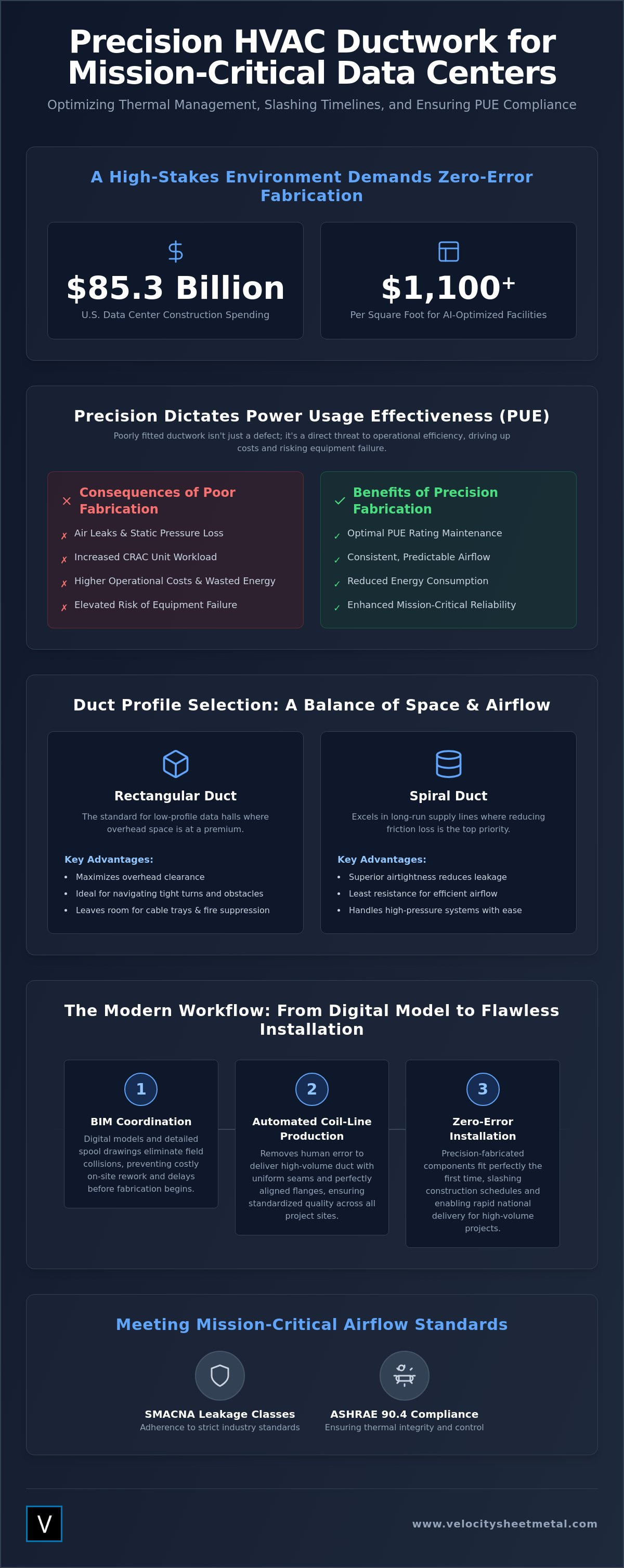
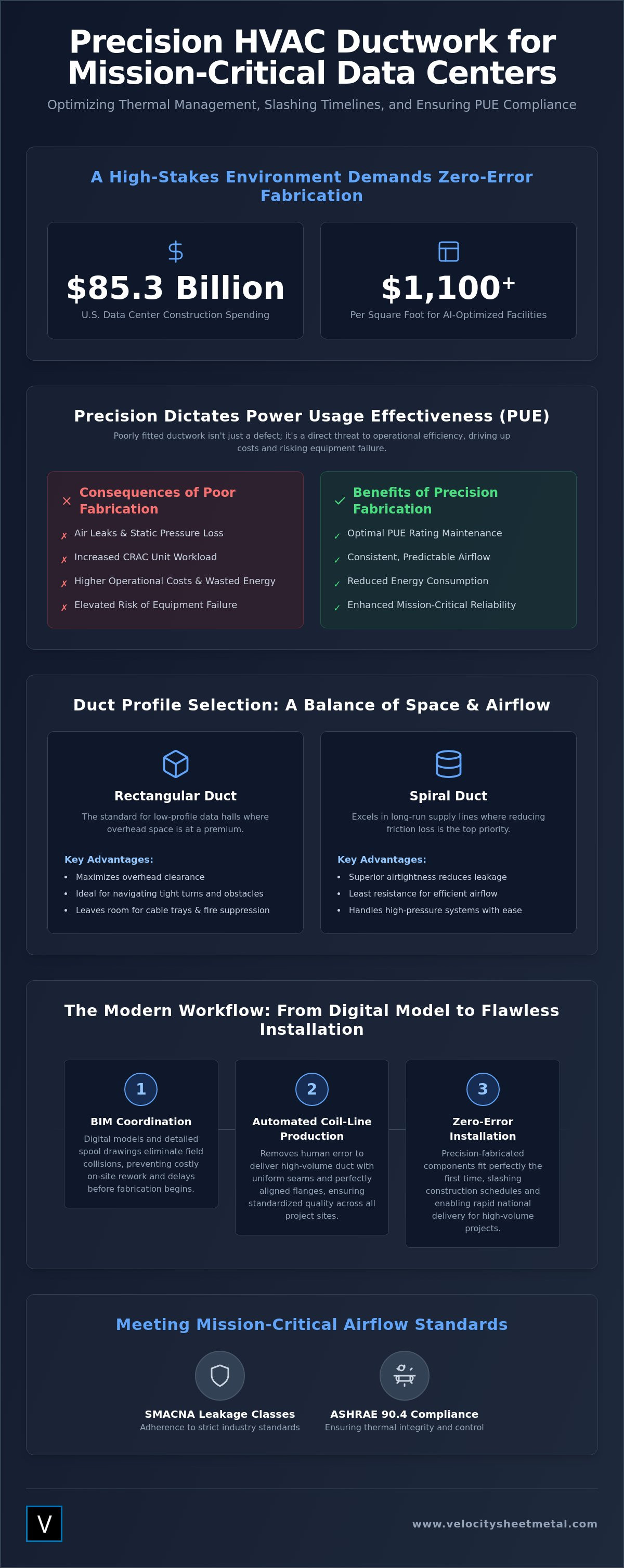
U.S. data center construction spending hit $85.3 billion this year, nearly doubling since 2024. When AI-optimized facilities cost over $1,100 per square foot, there's no room for guesswork in your mechanical specifications. You need HVAC ductwork for data centers that fits the first time, every time. You've likely seen how field collisions and air leakage can wreck a PUE rating or stall a mission-critical timeline. It's an expensive headache that modern, automated fabrication can solve.
We're here to bridge the gap between your digital models and the factory floor. Discover how precision-engineered metal ductwork and BIM coordination optimize thermal management while slashing construction schedules. This guide breaks down the move from automated coil-line production to zero-error installation. We'll examine the technical path to ASHRAE 90.4 compliance and the logistics of rapid national delivery for high-volume rectangular duct. It's time to move your project from a Revit 2026 file to a physical reality without the typical administrative delays.
Key Takeaways
- Learn why precision-engineered HVAC ductwork for data centers is the foundation of maintaining strict Power Usage Effectiveness (PUE) ratings.
- Discover how BIM coordination and detailed spool drawings eliminate field collisions and prevent costly on-site rework.
- Compare the spatial advantages of rectangular duct with the superior airtightness of spiral profiles to optimize your facility layout.
- Identify the SMACNA leakage classes and flange types required to meet mission-critical airflow standards.
- See how automated coil-line production and national shipping capabilities accelerate construction timelines for high-volume projects.
Why Precision Ductwork is the Foundation of Data Center Thermal Management
Data centers operate as high-intensity heat engines. Unlike standard office buildings where cooling is a matter of occupant comfort, cooling in a data hall is a matter of operational survival. Modern Data Center Design demands constant, high-velocity airflow to neutralize the massive heat loads generated by high-density server racks. This shift from comfort cooling to mission-critical infrastructure changes everything about how we approach fabrication. HVAC ductwork for data centers isn't just a conduit; it's a precision instrument. If the ductwork is poorly fitted or designed, the entire thermal management strategy collapses.
Precision fabrication directly dictates your Power Usage Effectiveness (PUE). When air leaks through sloppy seams or experiences friction from poor internal finishes, your Computer Room Air Conditioning (CRAC) units must work harder to compensate. This wasted energy drives up operational costs and risks equipment failure. Ductwork precision directly impacts CRAC unit efficiency by ensuring that static pressure remains consistent and that every cubic foot of chilled air reaches its intended destination without thermal loss.
Airflow Dynamics in High-Density Server Environments
Managing static pressure is the core challenge in hot aisle and cold aisle configurations. You need a predictable, laminar flow to move heat away from sensitive components. Standard commercial ductwork fails here because its tolerances are too loose. High-velocity air creates turbulence when it hits rough surfaces or uneven joints. This turbulence increases resistance, forces fans to spin faster, and generates unnecessary heat. Precision-fabricated ductwork uses smooth interiors and exact geometries to maintain the laminar flow required for high-density cooling. It's the difference between a system that fights itself and one that runs with surgical efficiency.
Thermal Integrity and Condensation Control
Thermal loss and moisture are constant threats in a mission-critical environment. You can't just wrap ductwork and call it a day. Maintaining ASHRAE 90.4 compliance requires precision-fitted insulation and robust vapor barriers that prevent condensation from forming near high-voltage equipment. Material selection is equally critical. We prioritize galvanized steel and specific coatings that mitigate static electricity risks, protecting the delicate circuitry within the racks. Every fitting must be tight. Every seal must be verified. In a data hall, the smallest gap doesn't just leak air; it leaks profit and reliability.
Rectangular vs. Spiral Duct: Selecting the Right Profile for Data Hall Efficiency
Data hall floor space is expensive. Overhead real estate is just as valuable. Selecting the right profile for HVAC ductwork for data centers is a balancing act between spatial constraints and airflow requirements. Rectangular duct is the standard for low-profile data halls. It maximizes overhead clearance. This leaves vital room for cable trays, power distribution, and fire suppression systems. Conversely, spiral ducting excels in long-run supply lines where reducing friction loss is the priority. Choosing the right profile depends on your CFM requirements and the specific geometry of the facility.
Air management is the most effective way to reduce cooling energy. According to industry benchmarks in Energy-Efficient Data Center Design, the delivery method is just as critical as the cooling source. Spiral ducting handles high-pressure systems with ease. Its circular cross-section offers the least resistance to airflow. However, rectangular duct is often necessary to navigate the tight turns and structural obstacles found in modern facilities. The decision often comes down to how much height you can afford to lose in the ceiling plenum.
The Advantages of Automated Coil-Line Rectangular Duct
Speed and consistency are the primary drivers in data center construction. Manual fabrication is too slow for today's timelines. Automated coil-line production changes the math. Every seam is uniform. Every flange is perfectly aligned. This level of precision is vital for national accounts that need standardized quality across multiple facility sites. When you move from a digital spool drawing to a physical product, the automated line removes human error. It delivers high-volume rectangular duct that meets mission-critical deadlines without the typical administrative delays of manual shops.
When to Utilize Spiral and Round Ducting
Spiral ducting isn't just about efficiency; it's about structural rigidity. In open-ceiling designs, spiral duct provides a clean, industrial aesthetic while maintaining superior airtightness. It's easier to install for secondary distribution runs because it requires fewer joints than rectangular sections. Fewer joints mean fewer points of potential leakage. For high-velocity systems, the round profile reduces turbulence. This helps you maintain the laminar flow required for sensitive server inlets.
Deciding between these profiles requires a partner who understands the bridge between a digital file and a tangible product. If you're looking for precision parts delivered on time, consider how our automated rectangular duct solutions can streamline your next build. Whether you need the clearance of rectangular or the efficiency of spiral, the fabrication method must match the mission-critical nature of the site.
The BIM Advantage: Reducing Lead Times and Field Errors
BIM isn't just a 3D visualization tool. It's the operational spine of mission-critical fabrication. For high-stakes environments, HVAC ductwork for data centers must be coordinated with surgical precision to avoid the "field-fit" delays that plague traditional construction. We utilize a "Model to Machine" workflow. This process moves your project from a digital Revit file directly to our automated coil-line and CNC machines. It cuts out the administrative lag of manual data entry. It ensures that every piece of metal matches the coordinated model without compromise.
Field collisions are the primary cause of rework in data hall builds. When ductwork, electrical conduits, and chilled water pipes compete for the same two inches of plenum space, something has to give. By adhering to ASHRAE data center standards during the coordination phase, we identify these clashes before a single sheet of metal is cut. This level of foresight eliminates the need for expensive field modifications. It ensures that when the duct arrives on-site, it fits exactly as planned. We treat the digital file as the single source of truth, acting as the essential bridge to the physical product.
Eliminating Rework Through Mechanical Spooling
Mechanical spooling converts complex 3D models into exact fabrication instructions. We don't guess on custom transition fittings; we model them to the millimeter. This approach ensures that every offset and drop is accounted for in the shop, not on the ladder. It improves site safety by reducing the need for on-site cutting and grinding. You get pre-planned components that drop into place. This reduces scrap waste and keeps your labor force focused on installation rather than problem-solving. Precision fabrication isn't just about the metal; it's about protecting your project's bottom line.
Accelerating Construction Timelines
Traditional shops often get bogged down in the transition from design to production. Our BIM-integrated workflow accelerates this timeline by automating the data transfer from model to machine. We coordinate deliveries with your on-site installation schedule to prevent site congestion and double-handling. For national rollout projects, this digital-first approach ensures standardized quality across every facility. Whether you're building in Virginia or Arizona, the ductwork remains consistent. It's a repeatable, transparent process that moves you from digital concept to physical reality with zero-error accuracy.
Specifying High-Performance Ductwork: Leakage Classes and SMACNA Standards
High-efficiency filtration and advanced CRAC units are useless if the delivery system is compromised. When you specify HVAC ductwork for data centers, you aren't just buying metal; you're investing in the long-term thermal integrity of a multi-million dollar asset. We follow SMACNA standards with surgical precision to ensure every joint and seam holds up under the high-static pressure typical of data hall cooling. While competitors often focus on filtration ratings like MERV 14, they frequently overlook the physical duct sealing required to maintain that air quality. If the ductwork leaks, your filtration strategy fails.
Material selection is the first step in high-performance specification. Galvanized steel remains the industrial standard for its rigidity and cost-effectiveness in high-volume rectangular duct. Aluminum offers a lightweight alternative for projects with strict roof load limits or suspended configurations. Regardless of the material, the fabrication method determines the final performance. Precision-cut metal parts, fabricated via automated laser and coil-line systems, ensure tighter tolerances that virtually eliminate the air gaps found in manual assembly.
Transverse Duct Connector (TDC) and Transverse Duct Flange (TDF) systems provide the airtight seals necessary for mission-critical air distribution. These integrated flange systems are rolled directly onto the duct during the fabrication process, creating a robust mechanical connection. This is a significant upgrade over traditional slip-and-drive joints, which are prone to leakage in high-pressure environments. We move your project from raw sheet metal to a pressure-tested fitting using CNC technology that guarantees a perfect fit every time.
Airtightness and Pressure Testing Requirements
Air leakage is a silent killer of Power Usage Effectiveness (PUE) ratings. Even a minor leakage rate forces fans to spin faster to maintain the required CFM at the server inlet. This wasted energy compounds over time, driving up operational costs. We utilize Class 3 leakage testing protocols to verify performance before the ductwork ever leaves our floor. By sealing longitudinal seams and using high-grade gaskets on all flanges, we ensure your facility meets the strict requirements of ASHRAE 90.4 from day one.
Custom Fittings: Plenum Boxes and Curb Adapters
Uniform air distribution requires more than just straight runs. Custom plenum boxes are essential for managing the transition from main supply lines to individual data halls without creating hotspots. We leverage high-speed laser cutting to produce these complex fittings with zero-error accuracy. Similarly, custom curb adapters are the essential bridge between rooftop units and your internal duct network. These parts must be exact to prevent thermal bridging and moisture infiltration. If you need components that meet these rigorous standards, view our custom HVAC fabrication services to see how we handle high-volume precision projects.
Velocity Sheet Metal: Precision HVAC Fabrication for National Data Center Projects
Standardizing HVAC ductwork for data centers across a national portfolio requires more than just a local shop. It requires an authoritative expert operator who understands the technical demands of high-density cooling and mission-critical timelines. Velocity Sheet Metal operates at the intersection of modern manufacturing and engineering precision. We act as the essential bridge between your digital BIM models and a tangible, high-performance product. Our facility is built for speed, accuracy, and the high-volume requirements of the 2026 data center construction market.
National shipping capabilities ensure you receive the same standardized quality whether your project is in a primary tech hub or a secondary market. We've eliminated the traditional administrative delays that stall large-scale builds. By utilizing an automated coil-line and a BIM-integrated workflow, we provide contractors and engineers with on-demand part production that fits the first time. There's no room for field-fit errors when every hour of construction delay impacts your Power Usage Effectiveness (PUE) and commissioning date.
Scalability for National Accounts
Consistency is the foundation of a successful national rollout. We maintain rigid production standards across every project location, ensuring that a fitting fabricated for a site in Virginia meets the exact same tolerances as one shipped to Arizona. Our logistics expertise allows us to manage the shipping of large-scale rectangular and spiral duct without the risk of damage or delivery lag. We support your national strategy with reliable lead times that keep your mechanical teams moving. From high-volume rectangular runs to complex custom fittings, we deliver the capacity needed for massive data hall footprints.
- Standardized fabrication quality across all U.S. project sites.
- Logistics management for high-volume rectangular and spiral duct shipping.
- Reliable lead times that align with aggressive construction schedules.
- Direct partnership with mechanical contractors for seamless site integration.
The Velocity Process: From Digital File to Site Delivery
Our process starts with speed. We provide rapid quoting and a technical review of your BIM models to identify potential issues before they reach the factory floor. Once the digital file is verified, our automated systems take over. We use precision laser cutting and CNC press brake bending to create custom components with zero-error accuracy. This "Model to Machine" workflow ensures that the physical product matches your coordinated design to the millimeter. It's a methodical, transparent progression designed to move your project from a digital concept to a physical reality with surgical precision.
Precision fabrication is the only way to meet the 2026 standards for speed and thermal efficiency. Don't let manual fabrication errors or long lead times compromise your facility's performance. Get a quote for your next data center project and see how our automated solutions bridge the gap between design and delivery.
Build for Mission-Critical Reliability
The infrastructure supporting your data hall is only as strong as its weakest fitting. Precision-engineered HVAC ductwork for data centers is the essential foundation for maintaining strict thermal control and high PUE ratings. We've seen how full BIM coordination and mechanical spooling prevent the field collisions that stall large-scale construction. By moving from a digital model directly to our automated coil-line production, you eliminate the administrative delays and manual errors of traditional fabrication.
Velocity Sheet Metal provides the technical expertise and industrial capacity to handle high-volume projects with surgical accuracy. Our national shipping and distribution network ensures that every facility in your rollout meets the same rigorous performance standards. You don't have to settle for long lead times or field-fit rework. It's time to bridge the gap between your engineering design and a physical product that performs from day one. Your project deserves a partner who values precision as much as you value uptime.
Partner with Velocity for Precision Data Center Fabrication and secure the cooling infrastructure your mission-critical facility demands. Let's get to work on your next build.
Frequently Asked Questions
What are the SMACNA leakage standards for data center ductwork?
Data center systems typically require SMACNA Leakage Class 3 or better to maintain high-pressure integrity. Because these facilities move massive volumes of air at high velocities, even minor leaks can compromise cooling efficiency. We fabricate to these rigorous standards to ensure your air distribution system meets the energy performance requirements of ASHRAE 90.4.
How does BIM coordination reduce HVAC installation costs in data centers?
BIM coordination eliminates the "field-fit" culture that leads to expensive labor overruns. By resolving clashes between ductwork, electrical trays, and fire suppression in a digital model, you prevent on-site rework. This pre-construction foresight ensures that every component arrives ready for immediate installation, slashing the total man-hours required for the mechanical scope.
Why is rectangular duct preferred over spiral in many data hall designs?
Rectangular duct is the primary choice for maximizing overhead clearance. Data halls often have limited plenum height due to the density of cable management and power distribution systems. The flat profile of rectangular ducting allows for high-volume airflow without sacrificing the vertical space needed for other mission-critical infrastructure.
Can metal ductwork improve a data center PUE rating?
Yes. Precision-fabricated HVAC ductwork for data centers directly impacts your Power Usage Effectiveness by reducing air leakage and friction loss. When the delivery system is airtight and internally smooth, CRAC unit fans don't have to work as hard to maintain static pressure. This reduces the facility's total energy footprint and lowers operational costs.
What is the typical lead time for automated coil-line duct fabrication?
Automated coil-line production is significantly faster than traditional manual fabrication. By moving directly from digital spool drawings to automated machinery, we cut out the administrative delays of manual data entry. While specific timelines vary by project volume, this workflow allows us to hit aggressive construction milestones that manual shops simply can't reach.
How do custom curb adapters benefit rooftop data center cooling units?
Custom curb adapters provide a seamless mechanical transition between rooftop units and the internal duct network. They're essential for preventing thermal bridging and moisture infiltration near sensitive server equipment. We use laser cutting to ensure these adapters match the exact footprint of your RTUs, providing a durable, airtight seal that protects the facility's interior.
What materials are best for data center HVAC ductwork to prevent static?
Galvanized steel is the industrial standard for its rigidity and grounding capabilities. It provides a stable, conductive path that helps mitigate static electricity risks in the data hall. For projects with specific weight or corrosion requirements, aluminum is a viable alternative, provided it is fabricated with the same precision tolerances to maintain airtightness.
Does Velocity Sheet Metal ship HVAC ductwork nationwide?
Yes. We provide national shipping capabilities to ensure standardized quality for accounts with multiple facility locations across the U.S. Our logistics network is designed to handle high-volume rectangular and spiral duct deliveries, ensuring your project stays on schedule regardless of the site's geographic location.