How to Execute Custom Sheet Metal Chassis Fabrication: A 2026 Industrial Guide
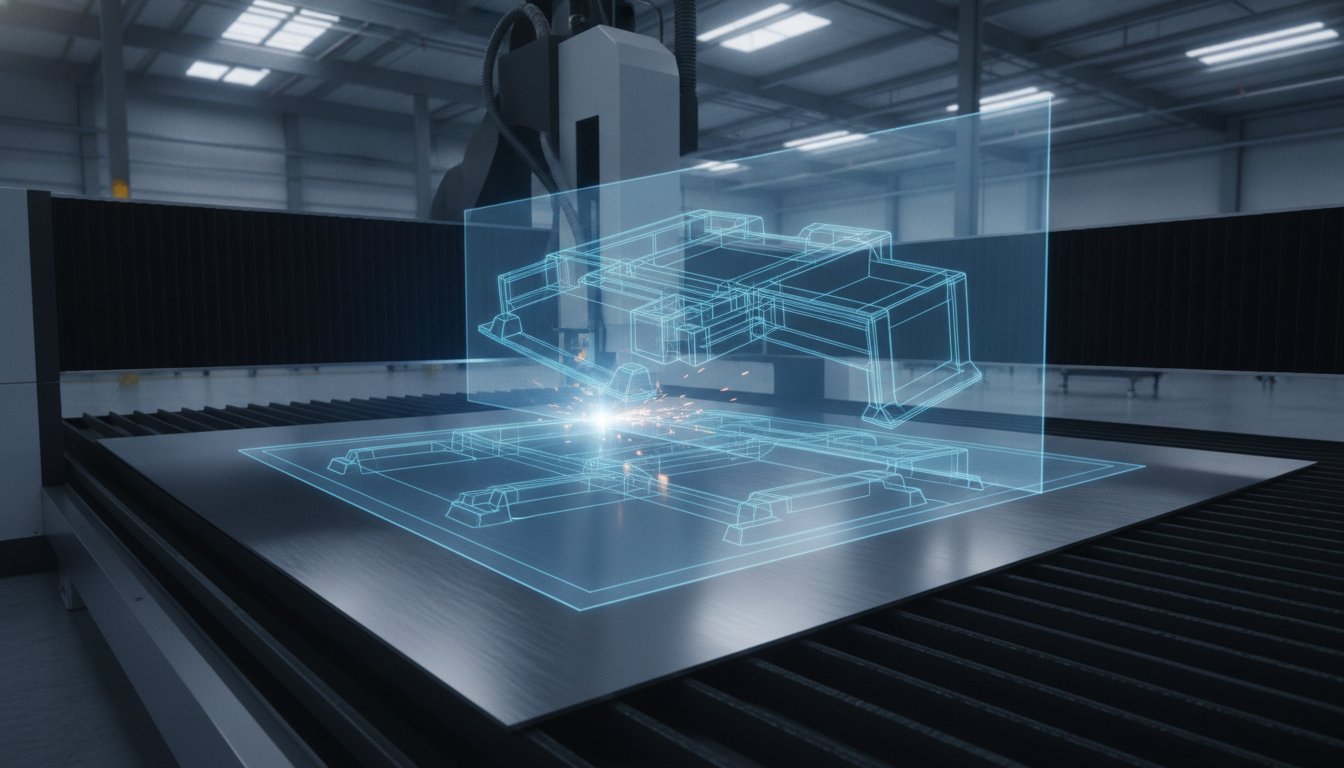
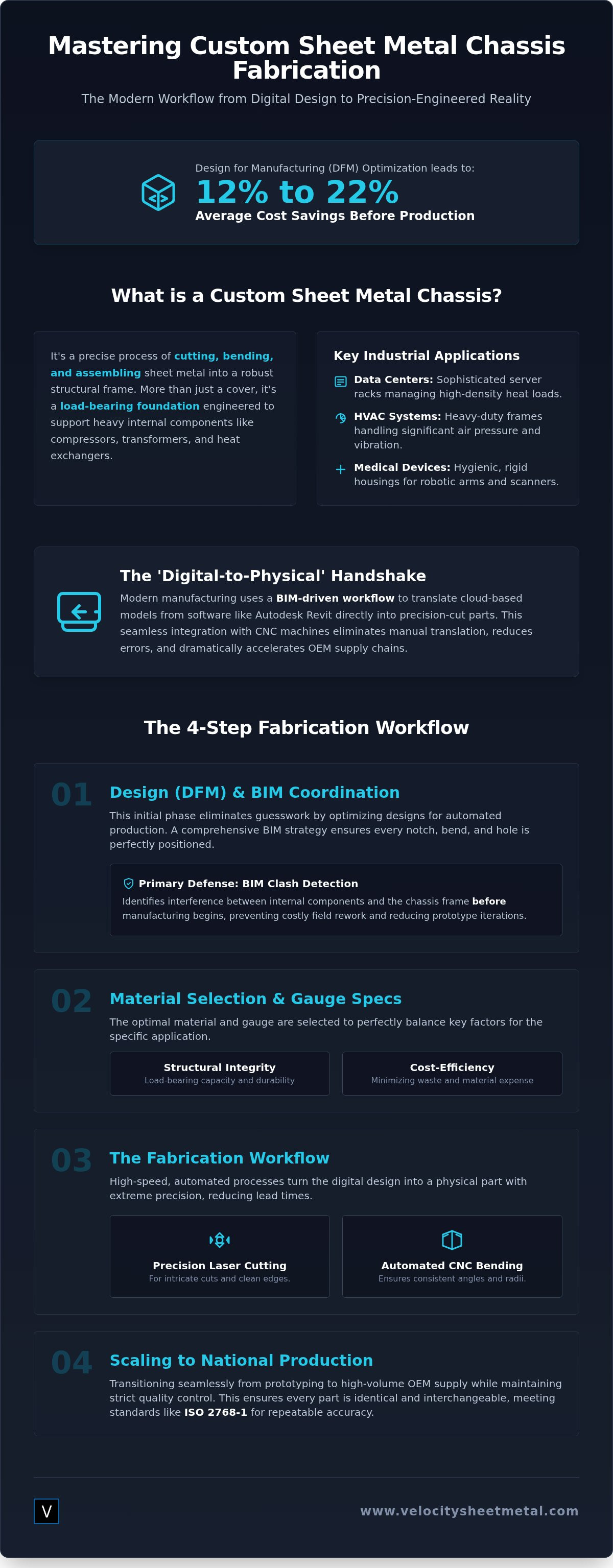
Design for Manufacturing (DFM) optimization can lead to an average cost saving of 12% to 22% before your first production run hits the shop floor. In the demanding world of industrial OEMs, custom sheet metal chassis fabrication is no longer just about bending metal. It's a high-speed digital-to-physical workflow where precision is dictated by the integrity of your data. You've likely faced the frustration of design errors leading to field collisions or the drag of inconsistent tolerances in high-volume runs. These bottlenecks aren't just annoying; they're expensive.
We're here to help you cut through the technical noise. This guide provides a clear roadmap to master the technical workflow of custom chassis fabrication, moving you from BIM-integrated design to precision CNC execution. You'll gain a deep understanding of material performance and learn how to leverage ISO 2768-1 standards to ensure repeatable accuracy. We'll preview the essential steps to reduce production waste and accelerate your digital-to-physical handoff for 2026 and beyond. It's time to bridge the gap between a digital file and a tangible, high-performance product.
Key Takeaways
- Identify structural collisions early by integrating BIM coordination and DFM principles into your initial design workflow.
- Master the technical phases of custom sheet metal chassis fabrication to ensure consistent tolerances across high-volume industrial runs.
- Select the optimal material gauge to balance structural integrity with cost-efficiency for diverse OEM applications.
- Optimize production speed using precision laser cutting and automated CNC bending to reduce digital-to-physical lead times.
- Transition seamlessly from prototyping to national-scale production while maintaining strict quality standards and part interchangeability.
What Defines Custom Sheet Metal Chassis Fabrication in 2026?
Custom sheet metal chassis fabrication is the precise process of cutting, bending, and assembling Sheet metal into a robust structural frame. It serves as the physical foundation for modern industrial equipment. In 2026, custom sheet metal chassis fabrication has moved far beyond simple manual layouts. It's now a fully automated, BIM-driven workflow. This evolution allows for the creation of complex geometries that were previously impossible or too expensive to produce at scale. By integrating digital models directly into the production line, manufacturers achieve a level of repeatability that manual processes can't match.
A chassis is the backbone of industrial electronics and HVAC systems. It must withstand mechanical stress, thermal expansion, and environmental factors. While a standard enclosure might only provide a basic cover, a load-bearing structural chassis is engineered to support the weight of heavy internal components like compressors, transformers, and heat exchangers. It ensures that sensitive electronics remain aligned during transport and operation. This structural integrity is what separates a high-end industrial chassis from a simple metal box.
Industrial Applications for Custom Chassis
Modern infrastructure demands extreme precision across several key sectors. A chassis must be both a protective skin and a functional component for these applications:
- Data Centers: Server racks have evolved into sophisticated cooling infrastructures that manage high-density heat loads and specialized airflow paths.
- HVAC Systems: Heavy-duty equipment frames require transition assemblies that handle significant air pressure and vibration without failure.
- Medical Devices: Housings must balance strict hygienic requirements with the rigid structural tolerances needed for robotic surgical arms or scanners.
The 'Digital-to-Physical' Handshake
The modern factory floor uses software like Autodesk Revit 2026 and Tekla Structures to bridge the gap between design and delivery. This software communicates directly with CNC machines, allowing for immediate production without manual translation. Automated part nesting plays a vital role here. It calculates the most efficient layout on a metal sheet to minimize waste and maximize throughput. This level of integration eliminates the traditional administrative delays that once slowed down OEM supply chains. Digital-to-physical is the 2026 standard for manufacturing speed, representing the seamless translation of a cloud-based model into a precision-cut part.
Step 1: Design for Manufacturing (DFM) and BIM Coordination
Precision in custom sheet metal chassis fabrication begins long before the laser touches the material. It starts with a comprehensive Building Information Modeling (BIM) strategy. For industrial OEMs, the goal is to eliminate the "guesswork" that often plagues traditional fabrication. DFM optimization isn't just a suggestion; it's a financial necessity. Research shows that DFM optimization can lead to an average cost saving of 12% to 22% before the first production run even starts. By applying these principles early, you ensure that every notch, bend, and hole is perfectly positioned for automated production.
Effective coordination requires a transition from a simple CAD file to a manufacturing-ready model. You must standardize your design around uniform material thickness and standard bend radii. This consistency allows the CNC press brake to operate with maximum efficiency. Utilizing BIM for sheet metal fabrication allows you to sync your internal designs with actual field requirements. We review detailed spool drawings to ensure every individual part is optimized for the production floor, bridging the gap between digital intent and physical reality.
BIM Clash Detection for Chassis Assemblies
In 2026, clash detection is the primary defense against expensive field rework. High-density chassis designs often house complex electronics, cooling lines, and power supplies. BIM software identifies interference between these internal components and the chassis frame before manufacturing begins. This validation of the digital twin ensures that everything fits the first time. For OEMs, this streamlines the approval process and reduces the need for multiple prototype iterations. If you're looking to tighten your production timelines, our BIM coordination services can help you spot these collisions early.
Optimizing Bend Deductions and K-Factors
Precision bending requires more than just a set of coordinates. It requires an understanding of how metal behaves under pressure. We calculate precise flat patterns based on the specific K-factors of your chosen material. This ensures that the final dimensions meet ISO 2768-1 general tolerance standards. You must also account for grain direction, as it significantly impacts both chassis strength and bending accuracy. By standardizing these technical variables in your design files, you guarantee part interchangeability across national production runs. This methodical approach ensures that every chassis in a 1,000-unit run is identical to the first prototype.
- Standardize Radii: Use a single bend radius across the design to minimize tool changes.
- Notch Placement: Ensure notches are placed at bend lines to prevent material tearing.
- Hole Clearance: Keep holes at a distance of at least twice the material thickness from any bend.
Step 2: Material Selection and Gauge Specifications
Material selection drives 25% to 40% of the total cost in custom sheet metal chassis fabrication. It's the first critical decision you'll make after finalizing your digital model. You aren't just choosing a metal. You're choosing a set of mechanical properties that must survive the factory floor and the field. For indoor industrial enclosures, cold-rolled steel with a powder coat remains the most cost-effective solution. However, if your chassis will live in a corrosive HVAC environment, you'll need to upgrade to 1.5–2.0 mm stainless steel 304L or 316L. These choices impact everything from shipping weight to long-term structural integrity.
Comparing Chassis Materials
Selecting the right alloy is about balancing performance with formability. In 2026, the market offers specialized options for every industrial niche:
- Aluminum: We recommend 5052-H32 for lightweight portable equipment. It offers high thermal conductivity for heat-sensitive electronics. Avoid 6061-T6 because its poor formability makes it a liability in sheet metal bending.
- Stainless Steel: With costs ranging from $8 to $19 per square foot, this is your premium option. It provides superior strength and hygiene for medical or food-grade applications.
- Cold Rolled Steel: This is the standard for high-volume industrial frames. It's easy to weld and offers a smooth surface for high-quality finishes. If you're unsure which material fits your budget, our fabrication experts can help you evaluate the best fit for your OEM requirements.
Understanding Gauge and Tolerance
Precision is the difference between a successful custom sheet metal chassis fabrication project and one that fails in the field. The 2026 industry standard for a high-performance chassis is a +/- 0.005 tolerance. Achieving this requires a perfect match between material thickness and your minimum bend radius. If you choose a gauge that's too heavy, you'll increase weight and shipping costs. If it's too light, the structural frame will flex under the weight of internal components. Your specific gauge selection directly dictates the tooling and pressure settings for the CNC press brake setup.
Don't overlook the role of specialized finishes. Powder coating provides a durable barrier for just $1 to $8 per production part. It's a small investment that significantly extends chassis longevity in harsh industrial settings. From initial material specifications to the final powder-coated finish, every choice impacts your bottom line. Ensure your finish is integrated into your initial design to avoid sizing issues after the parts are bent.
Step 3: The Fabrication Workflow: Laser Cutting to CNC Bending
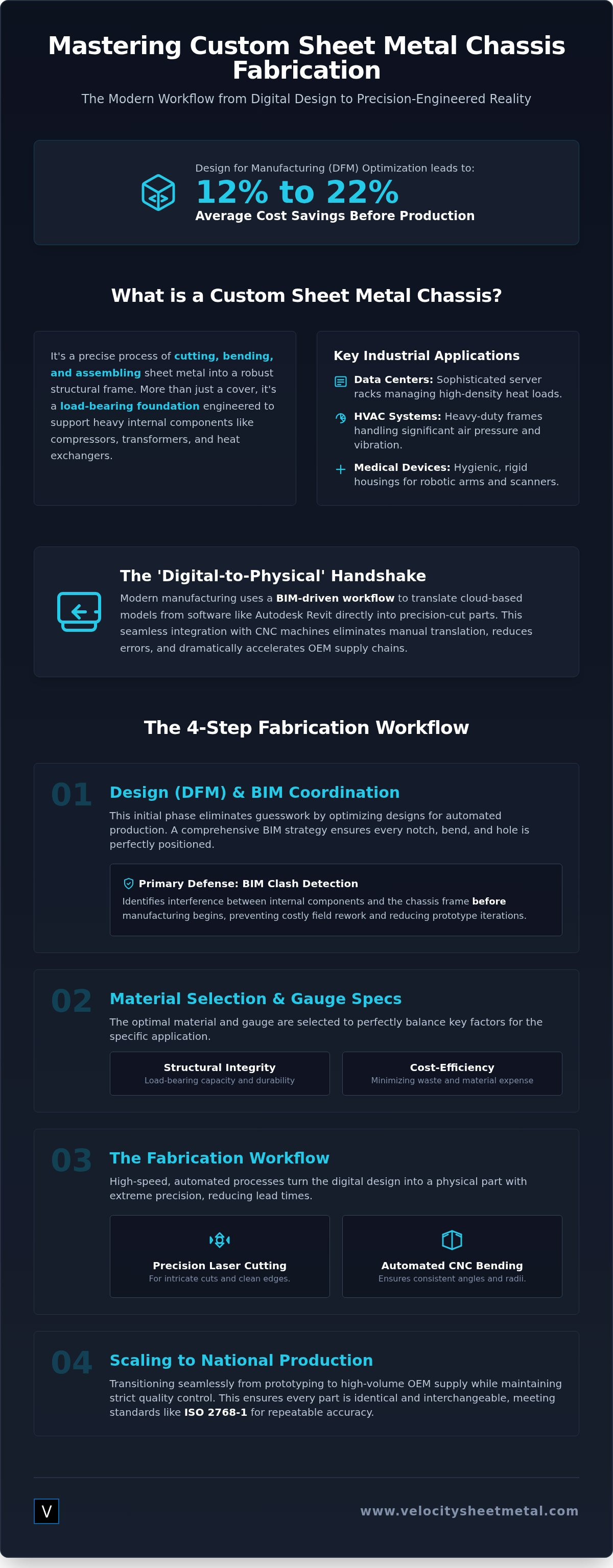
The transition from a digital model to a physical product happens on the shop floor. In custom sheet metal chassis fabrication, this workflow is a high-speed sequence of precision events. It starts with the laser and ends with a verified assembly. Every second matters. Every millimeter counts. We move your project through a streamlined production line where automated technology eliminates the risk of human error. From the initial laser pierce to the final quality check, the process is built for speed and repeatable accuracy.
Precision Laser Cutting for Complex Geometries
High-power fiber lasers are the 2026 standard for industrial OEMs. These machines handle intricate port cutouts and dense ventilation patterns with ease. By utilizing precision laser cutting services, you ensure that heat-affected zones are kept to an absolute minimum. This preserves the material's structural integrity and provides a clean edge that eliminates the need for secondary deburring. Fiber lasers offer a significant speed advantage in high-volume production, allowing us to move from raw sheet to cut parts in a fraction of the time required by traditional CO2 systems.
Advanced CNC Bending Techniques
Once the parts are cut, they move to the press brake. This is where the 2D flat pattern becomes a 3D structural frame. Achieving repeatable angles across multi-part assemblies requires multi-axis CNC press brake services for OEMs. Our automated tool changers reduce setup times, allowing for faster transitions between different chassis designs. We utilize real-time angle measurement systems to avoid common press brake forming defects like springback. This ensures that every bend is accurate to within the specified +/- 0.005 tolerance, regardless of material grain direction.
Secondary operations add the final functional details to your chassis. This includes the automated insertion of hardware like PEM nuts, standoffs, and the welding of internal support brackets. In 2026, quality control is no longer a manual checklist. We use 3D scanning technology to verify the physical parts against the original BIM model. This "digital-to-physical" verification ensures that every chassis is ready for immediate integration into your assembly line. Ready to accelerate your production? Get a precision fabrication quote today and bridge the gap between your design and a tangible product.
- Hardware Insertion: Automated PEM nut installation for consistent torque and placement.
- Bracket Welding: Precision spot welding or TIG welding for structural reinforcements.
- 3D Verification: Scanning the final assembly to ensure it matches the BIM coordination file.
Step 4: Scaling to National Production and OEM Supply
Transitioning from a single prototype to full-scale production is where most industrial supply chains break. In custom sheet metal chassis fabrication, prototype unit costs are typically 3 to 5 times higher than production pricing. This is due to unamortized setup and programming expenses that don't apply to high-volume runs. Moving to on-demand metal part production allows you to bridge this financial gap by leveraging automated workflows. You need a partner capable of handling the transition from a digital file to a national rollout without losing precision or increasing lead times.
The global sheet metal fabrication industry is projected to grow by 5.5% in 2026. To capitalize on this, OEMs must move beyond the "local shop" mentality. Scaling requires a decentralized manufacturing model where parts are produced with surgical precision and shipped nationwide. This ensures that a chassis fabricated in one facility is identical to one produced across the country. It's the essential bridge between a digital concept and a tangible, scalable product line.
Managing National OEM Accounts
Consistency in material sourcing is non-negotiable for national accounts. Whether you're building 50 units or 5,000, every chassis must be interchangeable to ensure field assembly goes off without a hitch. We utilize centralized BIM data to feed multiple production lines, ensuring your design intent is maintained across the US. This eliminates the variability of local sourcing and manual layouts. We also focus on logistical efficiency by utilizing flat-pack chassis designs. These designs significantly reduce shipping costs and warehouse footprints, allowing you to move parts from the factory to the field with maximum speed.
Standardizing Quality Control
Scaling requires more than just high-speed machines; it requires a rigorous regulatory framework. In 2026, key industry standards like ISO 9001 for quality management and ISO 3834 for welding quality are the baseline for national supply chains. If your project involves structural frames, ISO 1090 is the benchmark you should look for to ensure execution quality. We implement real-time production tracking, giving procurement managers a direct window into the fabrication floor. This level of transparency is why Velocity Sheet Metal’s national reach is a competitive advantage for 2026 OEMs.
We offer 50+ years of combined management experience to help you navigate the complexities of high-volume production. By standardizing quality across every run, we eliminate the risk of inconsistent tolerances that lead to field collisions. Partnering with a fabricator that offers nationwide distribution and consistent production standards is the only way to maintain your competitive edge. Don't let administrative delays or shipping bottlenecks slow your rollout. We're ready to get to work immediately on your next national chassis project.
- ISO 9001: Ensuring consistent quality management across all production batches.
- ISO 2768-1: Maintaining general dimensional and geometric tolerances for every part.
- Real-Time Tracking: Monitoring your order from the first laser cut to final delivery.
Accelerating Your Digital-to-Physical Rollout
The success of your custom sheet metal chassis fabrication project depends on the seamless integration of digital design and automated execution. We've explored how BIM coordination eliminates costly field collisions and how precise material selection protects your bottom line. By mastering the transition from a digital twin to a physical frame, you ensure your OEM products are ready for the rigorous demands of 2026. Precision isn't just a technical goal; it's the standard that keeps your production line moving without delay.
Velocity Sheet Metal acts as the essential bridge between your CAD files and a tangible, high-performance product. With 50+ years of industrial expertise, we've refined a BIM-to-Physical automated workflow that guarantees repeatable accuracy on every run. We provide national shipping on all OEM orders, ensuring your supply chain remains resilient and responsive across the country. It's time to stop managing administrative delays and start delivering results. Get a Precision Fabrication Quote for Your Custom Chassis today. Let's get to work on your next national rollout.
Frequently Asked Questions
What is the typical lead time for custom sheet metal chassis fabrication?
Lead times for national OEM accounts depend on project complexity and volume, but our automated digital-to-physical workflow minimizes traditional administrative delays. We prioritize rapid handoffs from your BIM model to our CNC machines to keep your production schedule on track. For specific timelines on high-volume runs, we recommend a technical review of your spool drawings to optimize the production sequence.
Can you fabricate a chassis directly from a BIM model?
Yes, we specialize in fabricating directly from BIM models to ensure absolute precision. This integration allows us to identify structural collisions in the digital twin before the first cut. By using your BIM data, we eliminate manual layout errors and ensure that the physical chassis matches your design intent perfectly.
What are the tightest tolerances achievable in custom chassis fabrication?
The industry standard for high-performance custom sheet metal chassis fabrication in 2026 is a tolerance of +/- 0.005. Achieving these tight specs requires synchronized CNC press brake bending and precision laser cutting. We account for material-specific K-factors and grain direction to maintain these tolerances across every part in a production run.
Do you offer national shipping for high-volume OEM chassis orders?
We provide national shipping capabilities for all high-volume OEM chassis orders across the United States. Our logistics team manages the distribution of standardized components to ensure part interchangeability. This allows you to maintain a consistent supply chain regardless of where your final assembly or installation site is located.
What is the difference between a chassis and a sheet metal enclosure?
A chassis acts as a load-bearing structural frame designed to support heavy internal components like compressors, transformers, or large heat exchangers. It's the skeleton of the machine. In contrast, a sheet metal enclosure is primarily a protective skin or housing that doesn't carry the same mechanical stress as a structural frame.
Which material is best for an outdoor HVAC equipment chassis?
For corrosive outdoor HVAC environments, 1.5–2.0 mm stainless steel 304L or 316L provides the best long-term durability. It withstands environmental exposure without compromising structural integrity. Galvanized steel is another viable, cost-effective alternative that offers essential corrosion resistance for industrial-grade frames and transition assemblies.
How does BIM coordination reduce the cost of chassis fabrication?
BIM coordination identifies interference between internal components and the chassis frame during the design phase. This prevents expensive field collisions and rework after the parts are fabricated. Additionally, BIM data feeds into automated part nesting software to reduce material waste, which can lower your overall production costs by 12% to 22%.
Do you provide hardware insertion like PEM nuts for custom chassis?
We provide automated hardware insertion as a core part of our custom sheet metal chassis fabrication workflow. This includes the installation of PEM nuts, standoffs, and specialized brackets. Automated insertion ensures consistent torque and placement across every unit, which is critical for maintaining structural integrity in high-volume industrial runs.