How to Choose an OEM Metal Fabrication Partner for Repeatable Production
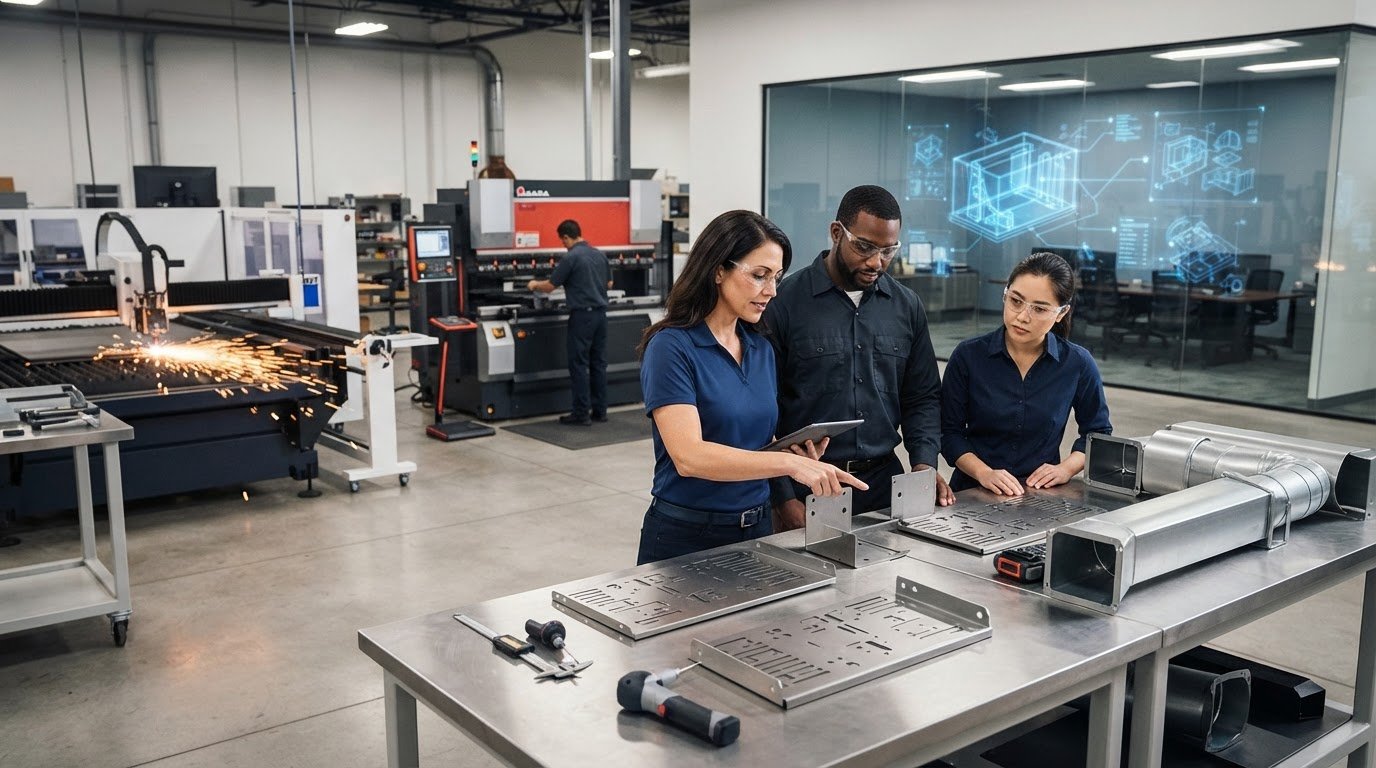
A strong first order doesn’t prove a supplier can deliver the next one consistently. The real test for an oem metal fabrication partner is whether its process keeps parts aligned with your drawings, acceptance criteria, and production schedule across repeat runs. To assess that before committing, look beyond the quote and trace how work moves from digital files to finished parts.
Clear capabilities, dependable communication, and parts that fit downstream assembly are practical requirements, not extras. If specifications or supplier handoffs are unclear, small gaps can become production delays. A structured evaluation helps you identify those risks before they disrupt your workflow.
This article breaks the decision into four checks: technical fit, production consistency, communication, and scalability. You’ll learn how to assess drawing and process alignment, define acceptance criteria, and determine whether a partner can adapt as demand or project requirements change. At Velocity Sheet Metal, automated ductwork, custom laser cutting, CNC press brake bending, and BIM coordination connect fabrication to the broader project workflow, from digital planning to physical production.
Key Takeaways
- Assess an oem metal fabrication partner by how its production workflow fits your parts and downstream interfaces, not by its equipment list alone.
- Compare specialist and broader fabrication workflows to see where focused expertise helps and where separate supplier handoffs add coordination.
- Build a clear RFQ package with current drawings, revision status, interfaces, and order expectations to establish a shared production baseline.
- Review first-production output and feedback to identify gaps and improve the process before repeat orders.
- Consider how fabrication and BIM coordination can connect digital project inputs with ductwork, laser cutting, and press brake bending.
Why an OEM Metal Fabrication Partner Is More Than a Parts Supplier
A part can match its drawing and still create problems if its interfaces, revisions, or delivery timing don’t align with the OEM’s production workflow. Choosing an oem metal fabrication partner therefore means looking beyond the first completed order. The relationship should connect specifications to production and keep expectations clear as work repeats or requirements change.
An OEM metal fabrication partner is a producer that makes components to an OEM’s defined requirements and coordinates its production workflow to support the OEM’s ongoing manufacturing needs. A one-time job shop focuses on a defined transaction. A partner relationship also accounts for repeat orders, information handoffs, and how fabricated parts fit into downstream assembly.
An Original Equipment Manufacturer (OEM) designs or produces a finished product under its own requirements. It may outsource components while retaining responsibility for the product’s design and specifications. For example, a fabricator may produce sheet metal parts or HVAC components to an OEM’s drawings. The fabricator supports component production; it doesn’t take ownership of the OEM’s finished product.
What does an OEM metal fabrication partner do?
The work starts with the OEM’s part definition: drawings, revision status, interfaces, and acceptance requirements. The fabricator turns those inputs into physical components through relevant processes, while the OEM remains accountable for product design and how components come together. The right production approach depends on the part’s geometry and complexity, as well as how it connects to the larger assembly.
When does a supplier relationship need to become a partnership?
Recurring orders, changing demand, or coordinated engineering are signs that a transactional handoff may no longer be enough. Controlled specifications help reduce interpretation differences between orders. Direct communication about revisions and production expectations helps teams plan component flow and downstream assembly, rather than discovering a mismatch after parts arrive.
Requirements vary by part, production pattern, and assembly context. A straightforward component ordered occasionally may need a simple, well-defined transaction. A part that repeats across production runs or interfaces with other components calls for tighter alignment on inputs and communication. Evaluate how clearly requirements move from design to fabrication and how consistently the process supports the next order. That’s the difference between receiving parts and building a repeatable production workflow.
How to Evaluate an OEM Metal Fabrication Partner’s Technical and Production Fit
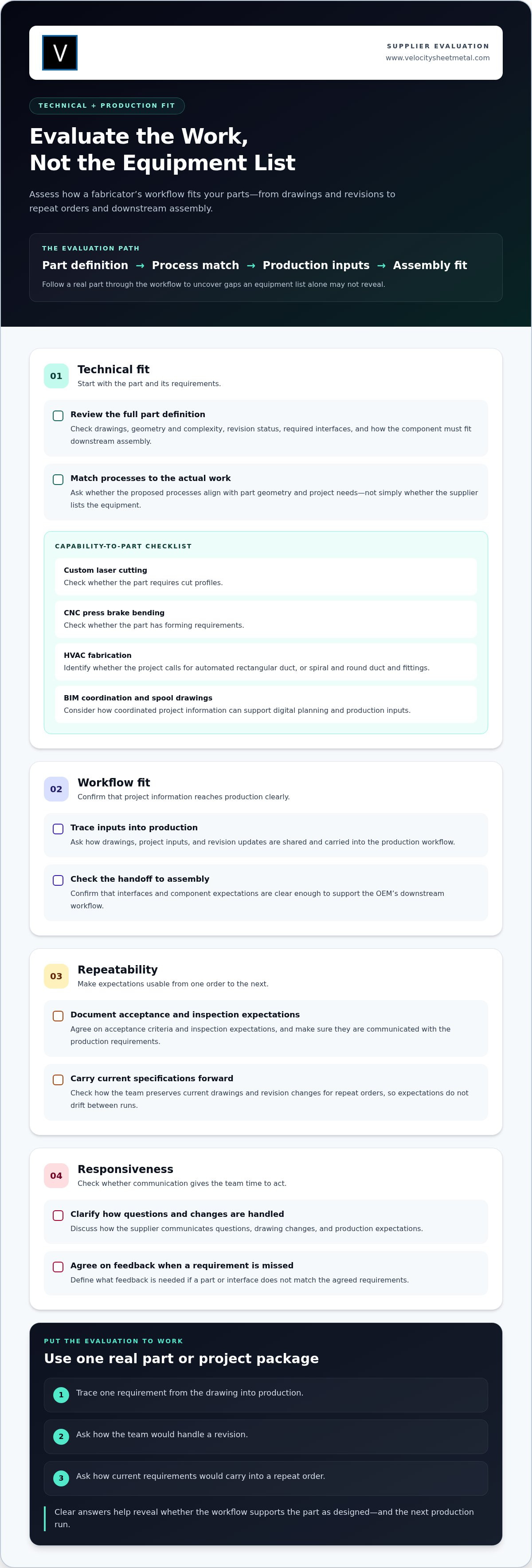
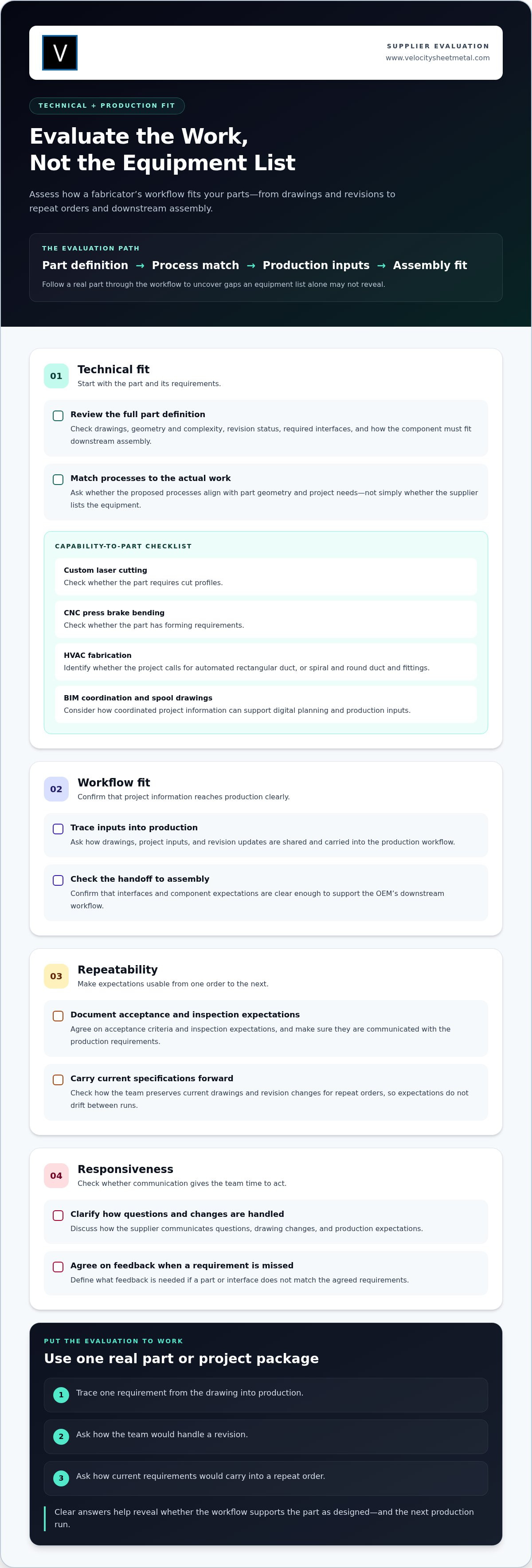
Start with the part, not the supplier’s equipment list. Review the drawing package, production pattern, required interfaces, and how the component must fit into downstream assembly. Then map those needs to the production processes involved. This sequence shows whether an oem metal fabrication partner fits the work as designed, rather than simply offering a broad menu of machinery.
Which capabilities should an OEM match to its parts?
Connect part geometry and project requirements to specific processes. Custom laser cutting suits parts that need cut profiles; CNC press brake bending addresses forming needs. For HVAC work, identify whether the project calls for automated rectangular duct or spiral and round duct and fittings. BIM coordination and spool drawings can support digital planning and coordination across project information.
For sheet metal projects, digital coordination matters alongside fabrication. A guide to BIM for Sheet Metal Fabrication can help clarify how coordinated project information relates to production inputs. Consider the Fabricators & Manufacturers Association as an industry resource, but assess each supplier against your actual part and workflow requirements.
How can you assess quality and repeatability?
Check how drawings, revision changes, acceptance criteria, and inspection expectations are documented and shared. Agree on what feedback is needed if a part or interface doesn’t match the requirements. Consistency across repeat orders depends on more than the initial setup: teams need a clear way to carry current requirements forward and communicate changes before they affect production or assembly.
Use this comparison to focus supplier discussions on the work itself:
| Evaluation area | What to assess |
|---|---|
| Technical fit | Do the processes align with the part geometry, drawings, and interfaces? |
| Workflow fit | Can project inputs and revisions move clearly into production? |
| Repeatability | Are specifications and acceptance criteria carried forward for repeat orders? |
| Responsiveness | Are questions, changes, and production feedback communicated in time to act? |
Apply the table to a real part or project package. Trace one requirement from the drawing into production, then ask how the team would handle a revision or repeat order. This can reveal workflow gaps an equipment list won’t show. To see how fabrication and digital coordination come together, explore Velocity Sheet Metal’s fabrication capabilities.
Compare OEM Fabrication Partner Models Before Choosing a Workflow
The right sourcing model depends on the part and the steps needed to produce it. A single-process specialist can be a strong fit when a project needs focused work, such as custom laser cutting. A broader fabrication workflow may suit parts that move through several connected processes or require fabrication coordinated with digital project information. Neither model is automatically better. Compare how each handles handoffs, specifications, and changes for your actual project.
Single-process specialist or coordinated fabrication partner?
A specialist concentrates on a defined process. That focus makes sense when the component has a clear scope and the OEM can manage the remaining production steps. A coordinated partner may connect processes such as laser cutting, bending, and drawing coordination, reducing the number of separate handoffs to manage. Precision Laser Cutting Services is one example of a process-specific need. The best fit depends on part design and the required production sequence.
More suppliers can mean more interfaces for teams to coordinate, including drawing revisions, schedules, and responsibility for moving parts between steps. A connected workflow can simplify some handoffs, but it still needs clear ownership and controlled inputs. The Manufacturing Extension Partnership (MEP) supports U.S. manufacturers and supply-chain development. Its resources offer broader context for manufacturing relationships, while the sourcing decision should remain grounded in your project requirements.
How should prototypes, repeat orders, and changing demand affect the choice?
A prototype or on-demand part may call for a focused process and close review of the initial output. For recurring orders, assess how approved drawings, specifications, and feedback carry forward. If designs or demand change, establish how revisions will be communicated and incorporated so the production team works from current information. Don’t assume a model suited to a prototype will automatically support repeat production.
Use this comparison to identify trade-offs before selecting a workflow:
| Consideration | Single-process specialist | Coordinated fabrication workflow |
|---|---|---|
| Coordination | OEM manages handoffs between processes or suppliers. | Related steps may be coordinated within a broader workflow. |
| Process fit | Focused expertise may suit a clearly defined operation. | Multiple connected capabilities may fit parts requiring several steps. |
| Revision management | Changes may need to be relayed across separate parties. | Shared coordination can help keep related work aligned, with clear revision control. |
Map the part’s production steps, identify who owns each handoff, then compare how each model would handle a design change and the next order. That practical test helps determine whether a focused supplier or broader oem metal fabrication partner workflow matches your needs.
Qualify an OEM Metal Fabrication Partner from RFQ Through First Production
A clear RFQ sets the working baseline for an oem metal fabrication partner. It helps both teams plan against the same part definition, then gives the first production review a useful reference. Treat qualification as a sequence, not a single quote comparison.
What should an OEM prepare before requesting fabrication?
Gather the current drawing package and identify its revision status. Include expected order quantities or patterns, functional requirements, and interfaces with adjacent parts or assemblies. State how acceptance will be determined, and keep requirements in controlled documents so everyone is working from the same information. For HVAC projects, flag BIM coordination or spool drawing needs when they apply. A focused HVAC Duct Fabrication Procurement Guide can also help organize purchasing inputs.
Move through the RFQ and first production run in five steps:
- 1. Define scope. Identify the parts, processes, order expectations, and project interfaces.
- 2. Share controlled inputs. Provide current drawings, revision identifiers, and related project documents.
- 3. Align acceptance criteria. Make functional requirements and review expectations explicit before production.
- 4. Review output. Compare delivered parts with the agreed drawings and acceptance criteria.
- 5. Capture feedback. Record clarifications and agreed changes so the next order starts from a consistent baseline.
How should the first production run inform repeat orders?
Use the first run to check more than whether parts arrived. Review them against the current drawing revision, required interfaces, and agreed acceptance criteria. If a question or mismatch surfaces, resolve it with the relevant teams and document the clarification. Don’t rely on an informal conversation to carry a requirement into the next order.
Before reordering, make the approved information easy to identify: the applicable drawing revision, any accepted clarification, and the expectations that should carry forward. If the design or order pattern changes, communicate that as a controlled update. This feedback loop turns production learning into clearer handoffs and gives the fabricator and OEM a shared reference for subsequent work.
For HVAC sheet metal work, align project drawings and procurement inputs before fabrication begins. Discuss your sheet metal fabrication project with Velocity Sheet Metal.
Build a Scalable OEM Metal Fabrication Partnership with Velocity Sheet Metal
Repeatable production depends on clear project inputs and fabrication workflows that fit the parts being made. Velocity Sheet Metal connects sheet metal fabrication with BIM coordination and spool drawings, helping OEMs move from digital project information to fabricated components. The right combination depends on your part requirements, interfaces, and production expectations.
Which Velocity capabilities fit common OEM workflows?
For HVAC projects, coil-line automated rectangular duct, spiral and round duct, and fittings support workflows centered on fabricated duct components. Custom laser cutting and CNC press brake bending serve other sheet metal needs, from cut profiles to formed parts. BIM coordination and spool drawings help align digital project information with fabrication requirements.
These capabilities support distinct steps in a project workflow. An OEM may need duct components coordinated with project drawings, custom sheet metal parts produced to defined requirements, or fabrication information organized through BIM coordination and spool drawings. Matching the work to the project scope helps clarify how information and parts move from planning into production.
What is the next step for an OEM project?
Start with the essentials: part requirements, current drawings and revision status, interfaces, and expected order pattern. Include any relevant BIM coordination or spool drawing needs, along with the acceptance expectations that define a usable part. A clear project conversation establishes shared understanding while recognizing that OEM workflows differ.
Velocity supports customer projects nationwide and ships nationwide. Its management team brings more than 50 years of combined industry experience. For OEMs evaluating an oem metal fabrication partner, those foundations complement a practical workflow: clarify the inputs, align fabrication and coordination needs, and establish how project information carries through to the physical components.
Share your drawings, part requirements, and production expectations to start a focused discussion about the next step. Discuss your OEM fabrication project.
Turn Your Evaluation into a Repeatable Production Workflow
The right oem metal fabrication partner does more than produce a part. It aligns fabrication with current drawings, clear acceptance criteria, and the way components move into your production workflow. Evaluate process fit, revision handling, communication, and how the first production run can inform future orders.
Velocity Sheet Metal brings fabrication and BIM coordination capabilities together for OEM workflows, connecting digital project information with fabricated components. Its management team has more than 50 years of combined industry experience, and nationwide shipping supports customer projects across the country.
Start the next conversation with your part requirements, drawings, interfaces, and production expectations. Clear inputs give both teams a practical basis for discussing the work and the workflow. Discuss your OEM fabrication project and take the next step toward production built around your requirements.
Frequently Asked Questions
How do I choose an OEM metal fabrication partner?
Choose an oem metal fabrication partner by matching its production capabilities and workflow to your actual parts. Review the drawings, order pattern, interfaces, and processes required, then assess how revisions, inspection expectations, and production feedback are handled. Compare those details against your downstream assembly needs. Focus on demonstrated fit and communication, not just an equipment list or a one-time quote.
What is the difference between a job shop and an OEM fabrication partner?
A job shop typically handles a defined fabrication order, while an OEM fabrication partner supports an ongoing production relationship. That can involve keeping specifications and revisions clear across orders, coordinating project information, and communicating issues that affect part fit or assembly. The distinction is practical, not absolute: a job shop may suit a one-off requirement, while recurring or evolving work can call for more structured coordination.
Can one metal fabricator support both prototypes and repeat production?
Yes, if its processes and workflow suit the part during both stages. A prototype may need close review and clarification; repeat production needs approved requirements to carry forward consistently. Establish how design changes and feedback become controlled updates for subsequent orders. Velocity Sheet Metal provides on-demand part production alongside sheet metal fabrication, with the workflow shaped by the project requirements and production pattern.
How much does OEM metal fabrication cost?
OEM metal fabrication cost depends on the part design, drawing completeness, production process, order pattern, and project requirements. A part requiring custom laser cutting and press brake bending may involve different work than a duct component or a project requiring BIM coordination. To support a useful project estimate, organize current drawings, revisions, quantities, interfaces, and acceptance expectations so the scope is clear.
What information should I send for an OEM fabrication request?
Send current drawings with revision identifiers, expected quantities or order patterns, functional requirements, and details about interfaces with other parts or assemblies. Include acceptance criteria and clarify project-specific production expectations. For HVAC or coordinated construction work, note relevant BIM coordination or spool drawing needs. Complete, controlled inputs help the fabrication team understand the scope and reduce avoidable interpretation differences before production begins.