Galvanized Steel Ductwork Fabrication: The 2026 Industrial Guide

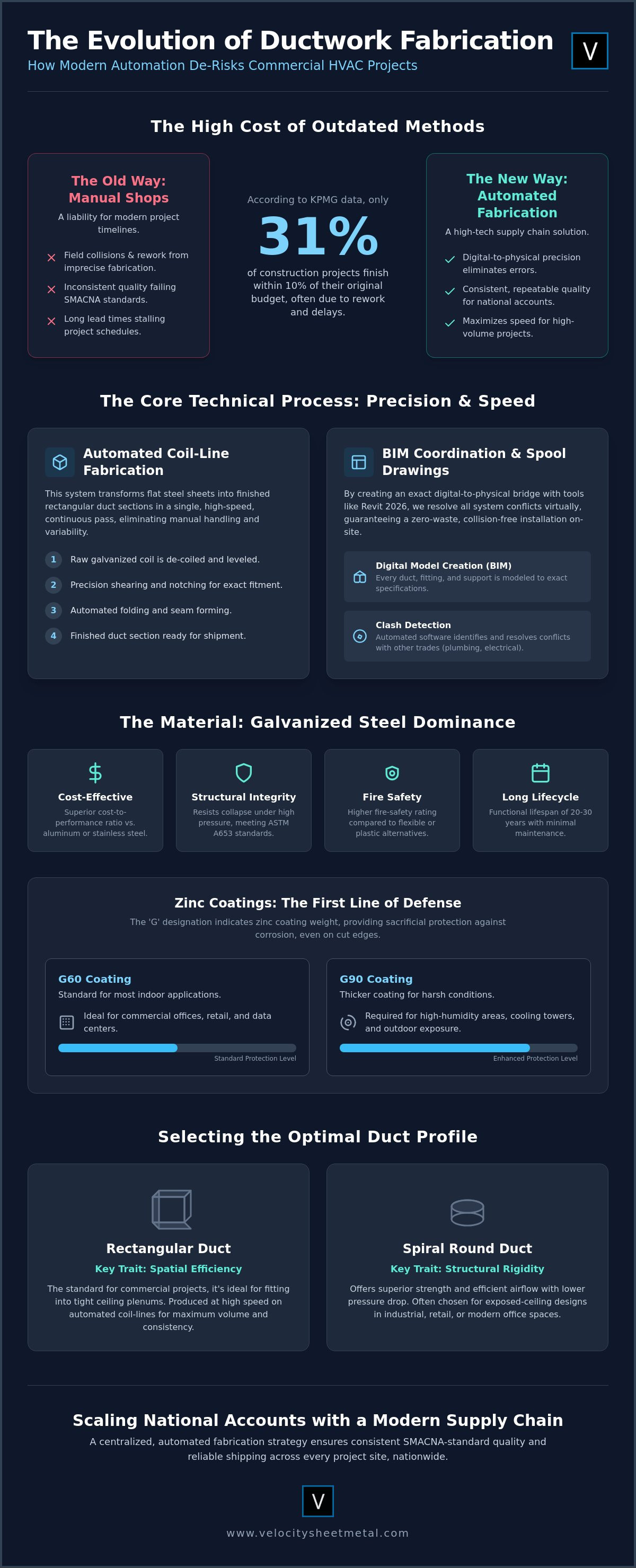
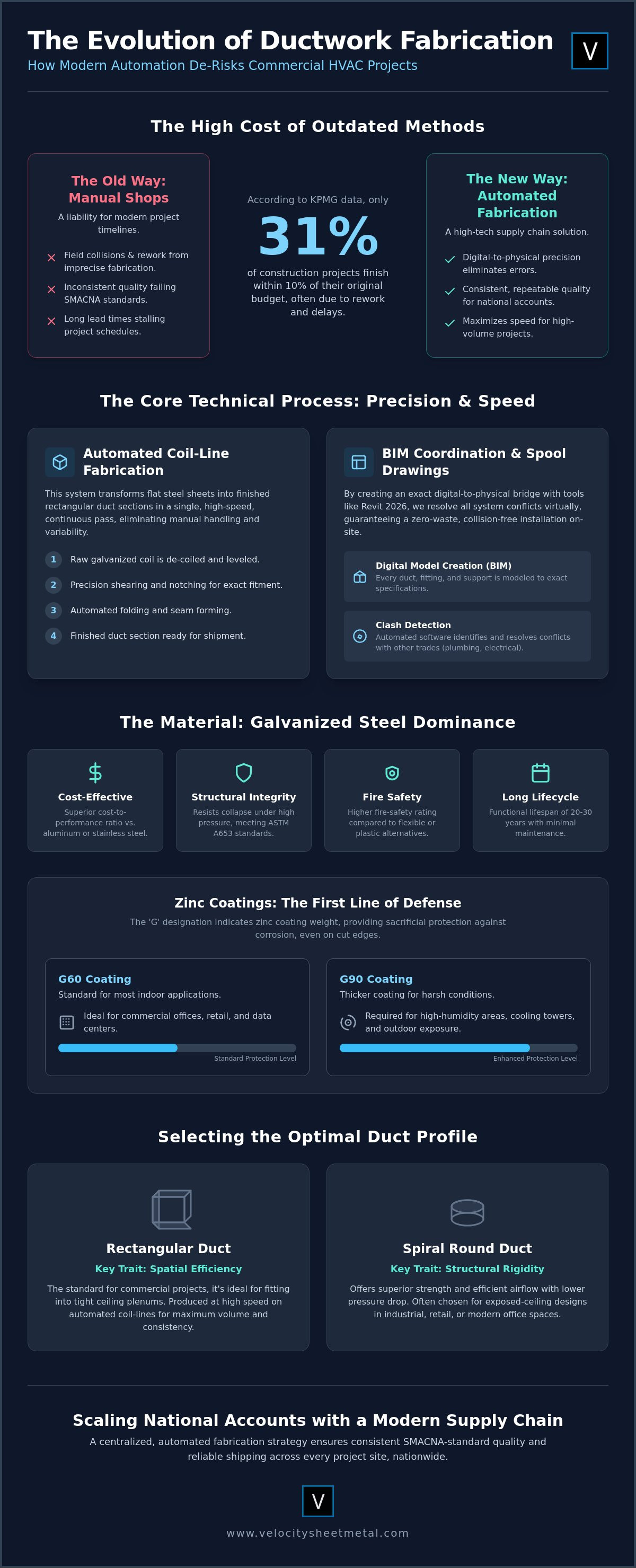
In 2026, relying on a manual local shop for your ductwork isn't just a tradition; it's a liability that puts your entire project timeline at risk. With only 31% of construction projects finishing within 10% of their original budget according to KPMG data, you can't afford the field collisions and rework caused by outdated processes. Modern galvanized steel ductwork fabrication has moved beyond the workbench. It's now a high-tech supply chain solution where digital models drive automated machinery with surgical precision.
You've likely dealt with the frustration of long lead times for custom fittings or inconsistent quality that fails to meet SMACNA standards. It's a common pain point that stalls large-scale commercial projects and eats into your margins. We understand that in a high-cost environment where steel prices are volatile, every mistake on the job site is an expensive setback that your schedule doesn't have room for.
This guide reveals how automated coil-line fabrication and BIM coordination are redefining precision, speed, and cost-efficiency in commercial HVAC. You'll learn how the "digital to physical" workflow using Revit 2026 ensures a zero-waste installation. We'll break down the technical shift toward seamless integration that delivers consistent quality across national accounts, ensuring your next project stays on track and under budget.
Key Takeaways
- Automated coil-lines transform flat sheets into finished rectangular duct in a single pass, maximizing speed for high-volume commercial projects.
- BIM coordination and spool drawings eliminate field collisions by creating an exact digital-to-physical bridge before production begins.
- Master the technical standards of galvanized steel ductwork fabrication, including how G60 and G90 zinc coatings provide essential corrosion resistance.
- Select the optimal profile for your project by comparing the spatial efficiency of rectangular duct with the structural rigidity of spiral round systems.
- Scale national accounts with a logistics strategy that ensures consistent SMACNA-standard quality and reliable shipping across every project site.
What is Galvanized Steel Ductwork Fabrication?
Galvanized steel ductwork fabrication is the high-precision process of transforming zinc-coated steel sheets into the air distribution systems that power modern infrastructure. It's the undisputed standard for commercial and industrial HVAC because it balances structural rigidity with long-term durability. While the industry once relied on manual "shop-built" methods, the 2026 landscape is defined by high-speed automation. This shift ensures that every piece of duct meets exact SMACNA specifications without the variability of hand-crafted work.
The core of this process involves selecting the right HVAC ductwork materials to match project requirements. From sprawling commercial office complexes to high-output industrial facilities, galvanized steel provides the foundational framework for air movement. It isn't just about bending metal. It's about engineering a system that resists the rigors of high-velocity airflow and environmental stress. Core markets for these systems include:
- Commercial office and retail construction
- Industrial manufacturing facilities
- Original Equipment Manufacturers (OEMs)
- Data centers and healthcare facilities
The Role of Galvanized Coatings (G60 vs. G90)
The "G" designation refers to the weight of the zinc coating applied to the steel surface. G60 is the standard for most indoor commercial applications, providing a reliable barrier against oxidation. G90 offers a significantly thicker coating. This makes it the necessary choice for high-humidity environments, cooling towers, or outdoor exposures. During galvanized steel ductwork fabrication, the zinc coating provides a unique sacrificial benefit. Even when the metal is cut or pierced, the surrounding zinc protects the exposed steel edges through a galvanic reaction. This prevents the spread of rust that would otherwise compromise the system's integrity over time.
Why Galvanized Steel Remains the 2026 Industry Standard
The dominance of galvanized steel isn't an accident. When you compare the cost-to-performance ratio against aluminum or stainless steel, galvanized options win on value every time. It offers the structural integrity needed to prevent duct collapse under high pressure, adhering to the latest ASTM A653/A653M-25a standards for metallic-coated sheet steel. It also maintains a superior fire-safety rating compared to flexible or plastic alternatives. In standard commercial environments, properly fabricated galvanized ductwork maintains a functional lifecycle of 20 to 30 years with minimal maintenance. It's a pragmatic choice for contractors who need a material that's easy to work with and proven to perform under pressure.
The Technical Process: Automated Coil-Line Fabrication
Manual fabrication can't keep pace with the aggressive construction schedules of 2026. While traditional shops rely on manual layout and hand-folding, modern galvanized steel ductwork fabrication utilizes fully automated coil-lines to move from raw material to finished product in seconds. This isn't just about speed. It's about a fundamental shift in how air distribution systems are engineered. By feeding massive steel coils directly into a multi-stage production line, we eliminate the waste and variability inherent in manual sheet handling.
High-volume commercial projects demand a level of consistency that only automation can provide. A modern coil-line performs shearing, notching, and folding in a single continuous pass. This process ensures that every joint, flange, and seam is identical. For national accounts, this means the duct delivered to a site in Texas is indistinguishable from the duct delivered to a site in New York. The result is a predictable, repeatable workflow that keeps your project on schedule and your labor costs under control.
From Raw Coil to Finished Duct
The production cycle begins at the de-coiler. This station supports the weight of the galvanized coil while feeding it into the leveling rollers. These rollers remove the "coil set," ensuring the metal is perfectly flat before it reaches the processing heads. Precision notching tools then cut the corners and V-notches required for specific fittings and transitions. This automated notching is critical for perfect fitment; it ensures that the duct folds exactly where the digital model intended. You can explore the granular details of this high-capacity workflow in our deep dive on coil line duct fabrication. Once notched, the line forms the TDF or TDC flanges directly onto the duct ends, creating a rigid, leak-resistant connection point that meets the most stringent industrial standards.
Precision and Tolerances in Automation
CNC-controlled lines maintain tolerances that are physically impossible to achieve with manual folding. While a technician might be off by a fraction of an inch, an automated line executes folds with surgical accuracy. This precision directly impacts the system's performance. Tight tolerances mean fewer gaps at the joints, which reduces air leakage and prevents static pressure loss. Adhering to these strict technical specifications for ductwork is essential for meeting the energy efficiency requirements of modern building codes. When the duct fits perfectly the first time, your field team spends less time on sealants and more time on installation. If you want to streamline your supply chain, partnering with an automated fabrication partner is the most effective way to eliminate field errors and maximize your project's ROI.
Rectangular vs. Spiral Duct: Selecting the Right Profile
Choosing between rectangular and spiral profiles is a decision driven by spatial constraints and airflow physics. In 2026, galvanized steel ductwork fabrication must account for increasingly complex building designs where every inch of plenum space is contested. Rectangular duct allows for high-aspect-ratio designs that fit into shallow ceiling cavities, while spiral duct offers superior structural integrity and lower air leakage for high-velocity runs. Velocity supports both profiles, ensuring your project has the right geometry for every zone from the mechanical room to the branch lines.
Installation labor represents a significant portion of your HVAC budget, and the profile you choose dictates your field costs. Flanged rectangular duct, utilizing TDF or TDC connections, allows for rapid assembly of large sections on the ground before hoisting. Conversely, spiral duct often uses slip-joint connections that are faster for long, straight runs but may require more frequent hangers. Adhering to DOE ductwork fabrication specifications ensures that regardless of the profile, the system meets the pressure classifications required for high-performance buildings.
When to Specify Rectangular Duct
Rectangular duct is the go-to solution for tight ceiling plenums and branch lines where vertical clearance is limited. It's the only profile that allows you to maintain air volume by increasing width when height is restricted. For complex geometry, we use precision laser cutting to create custom transitions, offsets, and elbows that fit perfectly into congested utility corridors. The integrated TDF/TDC flanges eliminate the need for separate slip-and-drive cleats in many applications, further accelerating the installation timeline.
The Case for Spiral and Round Duct
Spiral duct is the champion of airflow efficiency. Its circular cross-section minimizes friction loss and eliminates the turbulence often found in the corners of rectangular systems. It's also inherently stronger; the spiral lockseam acts as a continuous reinforcement, allowing for lighter gauges without sacrificing pressure capacity. Beyond performance, spiral duct is often selected for its industrial-chic aesthetic in exposed ceiling designs. When your design calls for complex manifolds or unique branch entries, our precision laser cutting services provide the exact tolerances needed for a seamless, high-performance fit.
BIM coordination isn't just a design tool; it's the digital backbone of modern galvanized steel ductwork fabrication. In the past, mechanical contractors relied on paper shop drawings that often failed to account for real-world field conditions. Today, we use 3D modeling to build the entire HVAC system in a virtual environment before a single piece of metal is cut. This "digital to physical" workflow ensures that the ductwork arriving at your job site fits perfectly, regardless of how congested the utility corridors might be.The Spooling Process for Mechanical Contractors
The transition from a high-level engineering model to the shop floor happens through spooling. We take complex 3D models from platforms like Autodesk Revit 2026 and break them down into fabricatable spool drawings. Each spool represents a specific section of ductwork with exact dimensions and connector types. Every piece is tagged and labeled according to the digital model. This level of organization allows your field crew to unload a truck and move directly into installation without sorting through a pile of mystery fittings. By utilizing these precise digital instructions, BIM coordination enables a zero-waste installation by eliminating the need for field-cutting and scrap generation.
Eliminating Field Rework and Collisions
Clash detection is the most powerful advantage of a BIM-driven workflow. By integrating our duct models with structural steel and piping layouts in software like Autodesk Navisworks 2026, we identify interferences weeks before they become expensive field problems. You don't have to worry about a main trunk line hitting a plumbing stack or a structural beam. We solve those collisions in the digital environment, adjusting the galvanized steel ductwork fabrication plan to navigate obstacles seamlessly.
The impact on your bottom line is immediate. Install-ready ductwork requires zero field modification, which slashes your on-site labor costs and keeps your project on its critical path. We act as your technical partner, providing the precision needed to bridge the gap between a digital file and a tangible product. If you're ready to eliminate field errors and maximize efficiency, partner with Velocity for your next BIM-coordinated project.
Sourcing and Logistics: National Fabrication Solutions
Managing a multi-state commercial rollout requires a level of consistency that local, manual shops simply cannot provide. When you rely on decentralized vendors, you risk varying quality levels and conflicting lead times that can derail a national schedule. Centralized galvanized steel ductwork fabrication eliminates these variables. By utilizing a single, automated production source, we ensure that every piece of ductwork meets the same SMACNA-standard quality, whether your project is in Seattle or Miami. This unified approach provides national accounts with a predictable supply chain and a single point of technical accountability.
A centralized, automated shop outperforms decentralized manual vendors through sheer scalability and precision. While a local shop might struggle with a sudden high-volume order, our coil-line and laser-cutting systems are built for continuous, high-speed output. We move your project from digital spool drawings to physical delivery with a level of industrial efficiency that manual shops can't match. This isn't just about making duct; it's about providing a tech-driven logistics solution that supports your entire construction timeline.
National Shipping and Logistics Management
Shipping large-scale rectangular and spiral ductwork nationwide requires more than just a freight carrier. It requires a strategic approach to packaging and crating to prevent damage during transit. We use specific crating standards and nesting techniques to maximize truck space and protect the integrity of TDF/TDC flanges. Every shipment is organized and labeled according to your BIM model. This allows your field team to offload the truck and move directly to the installation zone. By standardizing our logistics process, we ensure your ductwork arrives on-site undamaged, organized, and ready for immediate hanging.
Partnering with Velocity for High-Volume OEM Needs
Beyond standard HVAC runs, we provide specialized support for Original Equipment Manufacturers (OEMs) requiring non-standard components. Our facility utilizes custom laser cutting and CNC press brake bending to produce precision parts with tight tolerances. We handle everything from initial prototypes to full-scale production runs, providing the same "straight-talk" pragmatism on every job. We don't hide behind administrative delays; we give you clear answers on capacity and lead times so you can plan your production with confidence. We act as the essential bridge between your digital design files and a tangible, perfectly-fitting product. Ready to streamline your project? Get a precision quote from Velocity Sheet Metal.
Modernize Your HVAC Supply Chain
The industrial landscape of 2026 demands more than just bent metal; it requires a tech-driven bridge from digital design to physical reality. You've seen how automated coil-lines and BIM coordination eliminate the field errors that traditionally drain project budgets. By shifting to a centralized, precision-focused workflow, you gain the speed and consistency needed for large-scale commercial success. High-performance galvanized steel ductwork fabrication is now a logistics solution that rewards accuracy and speed over manual guesswork.
Velocity Sheet Metal brings over 50 years of combined industry experience to every project. We offer full BIM and spooling integration to ensure your installation is zero-waste and collision-free. Whether you need high-volume rectangular duct or custom OEM components, our nationwide shipping and scalability keep your projects moving across the country. We act as the essential partner that turns complex digital files into tangible, perfectly-fitting products.
It's time to leave the delays of manual fabrication behind. Secure the accuracy and speed your next mechanical project deserves. Request an Automated Ductwork Quote and experience the efficiency of modern manufacturing. We're ready to get to work on your next build.
Frequently Asked Questions
What is the standard gauge for galvanized steel ductwork?
Standard gauges typically range from 26 to 18 depending on duct size and pressure classification. Larger ductwork or high-pressure systems require thicker 18 or 20-gauge steel to prevent wall deflection during operation. Smaller branch lines often utilize 24 or 26-gauge sheets. We strictly adhere to SMACNA gauge tables to ensure structural integrity and code compliance across every commercial project we fabricate.
How does automated coil-line fabrication improve duct quality?
Automated coil-line fabrication eliminates the variability and human error inherent in manual shop-built methods. The CNC-controlled process ensures that every shear, notch, and fold is executed with mathematical precision. This results in perfectly square duct sections and consistent TDF or TDC flanges. High-precision manufacturing leads to tighter joints, reduced air leakage, and faster field assembly for your mechanical team.
Can Velocity Sheet Metal ship large ductwork orders nationwide?
Yes, we provide nationwide shipping for high-volume commercial and industrial projects. Our logistics team uses specialized crating and nesting strategies to protect ductwork from damage while maximizing truck capacity. This centralized approach ensures that national accounts receive consistent, high-quality galvanized steel ductwork fabrication regardless of the project's geographic location. We manage the entire freight process to keep your schedule on track.
What is the difference between G60 and G90 galvanized coatings?
The primary difference lies in the weight of the zinc coating applied to the steel surface. G60 contains 0.60 ounces of zinc per square foot, making it the standard for most indoor commercial HVAC applications. G90 features 0.90 ounces of zinc, providing enhanced corrosion resistance for high-humidity environments or outdoor exposures. Specifying G90 is critical for cooling towers or rooftop units to ensure a 20 to 30-year functional lifecycle.
How does BIM coordination reduce HVAC installation costs?
BIM coordination reduces costs by identifying and resolving utility collisions in a digital environment before production begins. By detecting clashes with structural steel or plumbing early, we eliminate expensive field rework and material waste. This "measure twice, cut once" approach ensures that ductwork arrives install-ready. Contractors save significantly on field labor because the components fit perfectly into the designated plenum space without any on-site modification.
Does Velocity provide custom laser-cut fittings for rectangular duct?
Yes, we utilize high-precision laser cutting to produce custom fittings and complex transitions for rectangular duct systems. This technology allows us to fabricate offsets, elbows, and branch entries with tighter tolerances than traditional plasma cutters. Our laser-cut components integrate seamlessly with coil-line produced duct, ensuring that even the most difficult geometry fits correctly on the first try without field adjustments.
What are the SMACNA standards for rectangular duct fabrication?
We fabricate all rectangular duct according to the SMACNA HVAC Duct Construction Standards, 4th Edition. These standards dictate the requirements for metal gauges, reinforcement spacing, and joint types based on the system's operating pressure. Adhering to these benchmarks ensures that the galvanized steel ductwork fabrication can handle specified air velocities without vibrating, leaking, or collapsing. This compliance is essential for the safety and efficiency of the HVAC system.
How do spool drawings help mechanical contractors on-site?
Spool drawings act as a detailed roadmap for field installation by breaking down complex systems into manageable, labeled sections. Each piece of duct is tagged to match the digital model, allowing your crew to unload and stage materials with surgical efficiency. These drawings eliminate guesswork and sorting time, enabling your team to move directly into hanging the ductwork. This level of organization is essential for maintaining aggressive construction timelines.