Forming Aluminum Sheet Metal Parts: A 2026 Technical Guide to Heavy Gauge Bending
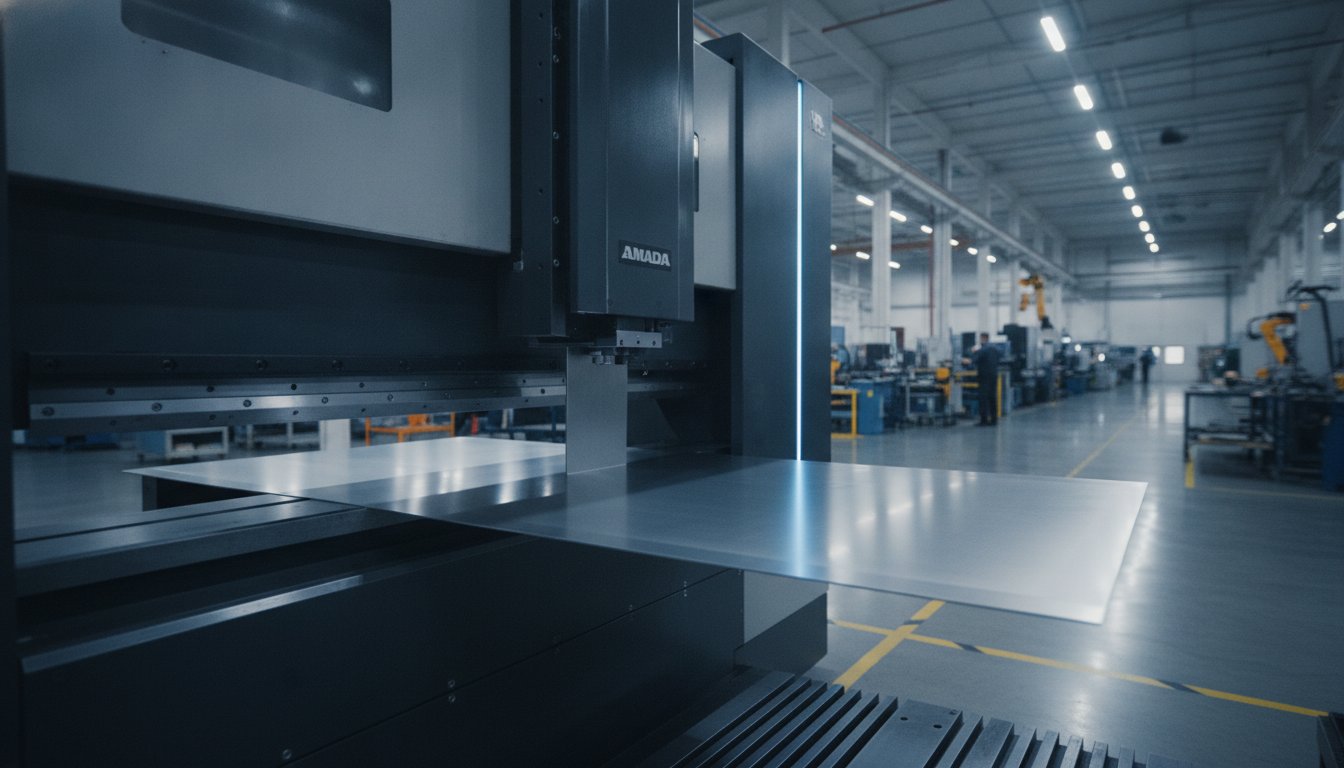
If your heavy gauge aluminum part cracks at the bend line, it isn't just a design flaw. It's a failure to account for the specific metallurgical physics of modern alloys. You're likely tired of fighting inconsistent springback that ruins assembly tolerances or searching for shops that actually have the tonnage to handle thick plate. Precision forming aluminum sheet metal parts requires a surgical approach to bend radii and grain orientation. It's the difference between a repeatable production run and a bin full of expensive scrap.
We understand the pressure to move quickly from a digital design to a finished physical product. This 2026 technical guide provides the exact specifications you need to optimize heavy gauge CNC workflows and slash your scrap rates. You'll learn how to navigate ASTM B209 tolerances and set up your press brake for success. We're covering the essential math for bend allowances and the practical limits of high-tonnage equipment to ensure your parts are manufacturable every single time.
Key Takeaways
- Calculate the Minimum Bend Radius (MBR) accurately to eliminate material cracking and ensure structural integrity in every part.
- Identify the critical relationship between laser-cut edge quality and successful forming to prevent split bends in complex geometries.
- Master the high-tonnage requirements for forming aluminum sheet metal parts in heavy gauges exceeding 3/16 of an inch.
- Reduce production scrap by implementing advanced CNC springback compensation techniques that ensure consistent part assembly.
- Accelerate your production timeline from digital BIM model to physical component using an integrated, automated fabrication workflow.
Understanding Material Properties in Forming Aluminum Sheet Metal Parts
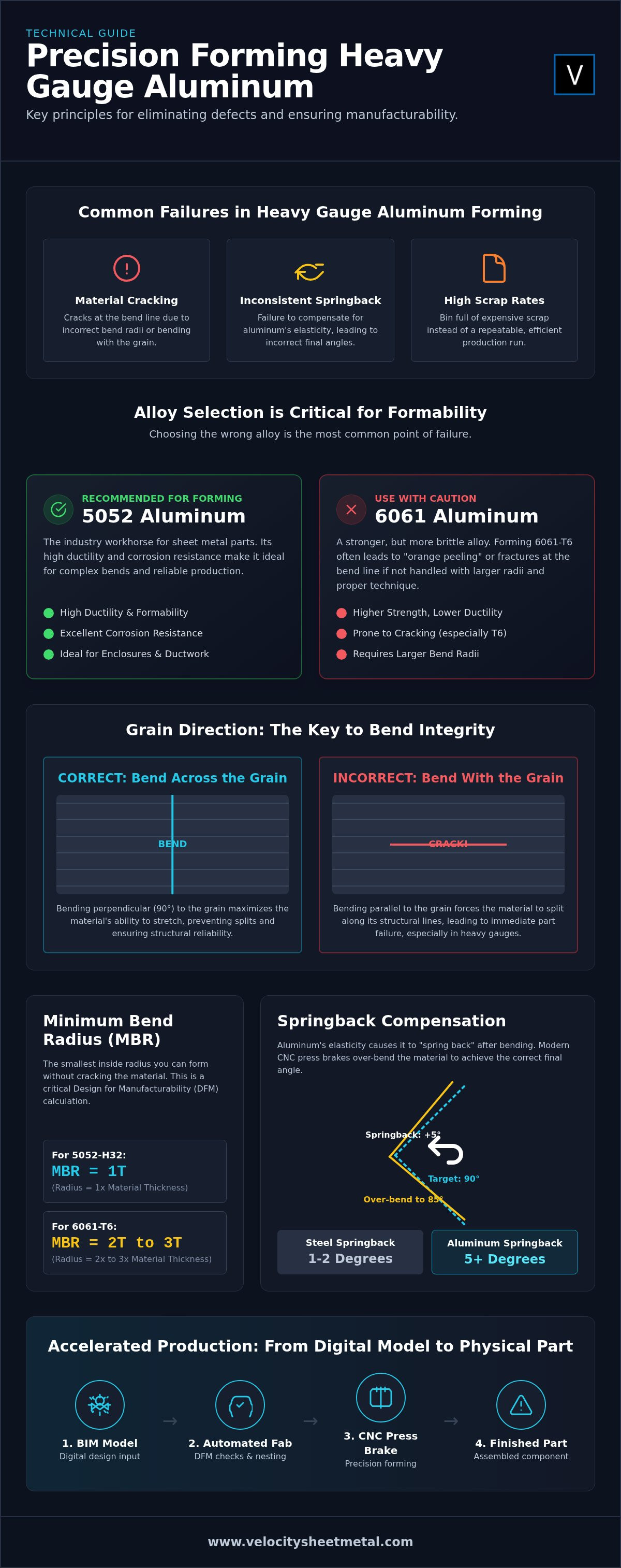
Aluminum forming is the permanent, controlled deformation of alloys into precise 3D shapes. It's a high-stakes calculation of physics. You must push the material past its yield point to achieve a permanent set, but stop before reaching the ultimate tensile strength where the material fractures. Most industrial workflows utilize cold forming. It's fast, efficient, and cost-effective. However, high-strength alloys or extreme thicknesses sometimes require heated forming to increase ductility and lower the tonnage required for the bend.
Aluminum is not carbon steel. It demands a unique handling strategy. It has a lower modulus of elasticity, which results in more significant springback after the load is released. If you don't account for this, your assembly tolerances will fail. The material is also more sensitive to surface damage. Standard steel tooling can easily mar or "gall" the surface of an aluminum part. Successful Bending (metalworking) requires polished dies or protective films to maintain a clean finish. We balance yield strength against ductility to ensure the part remains structural without cracking during the transition from a flat pattern to a finished component.
Alloy Selection: 5052 vs. 6061 for Part Production
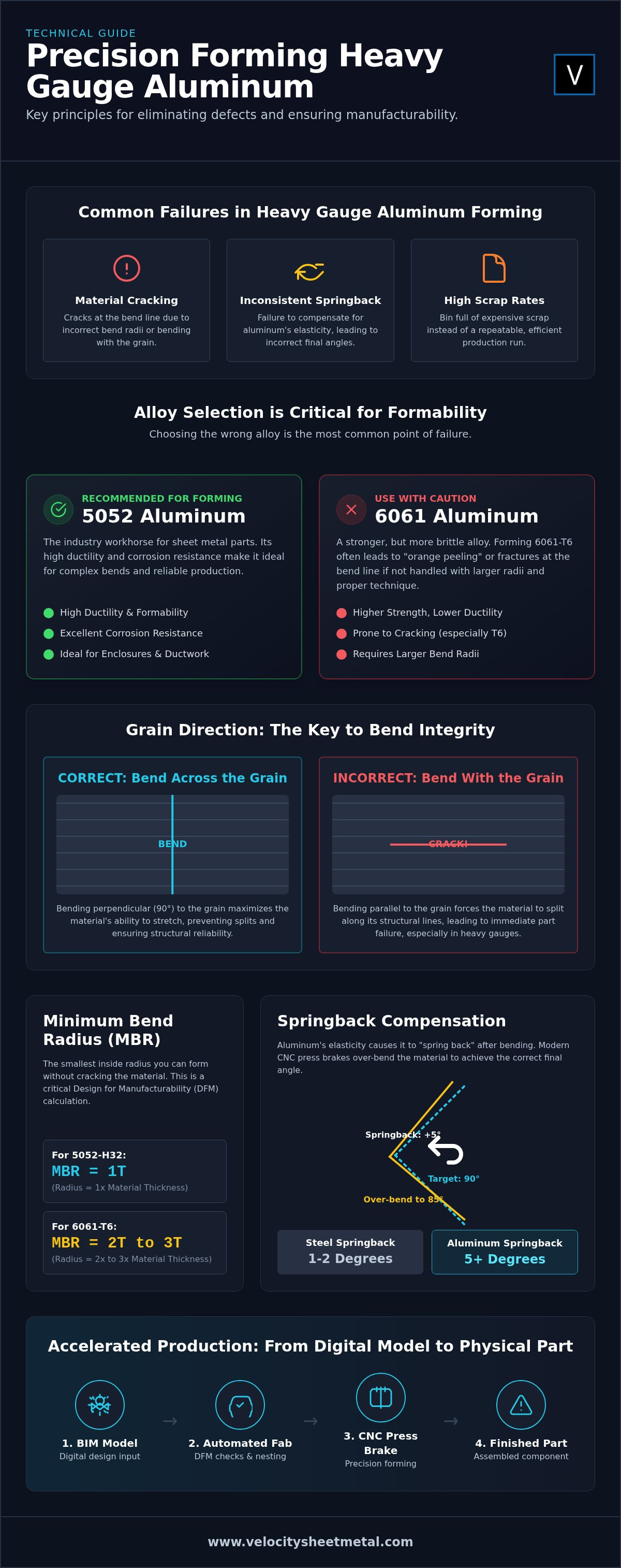
Choosing the wrong alloy will ruin your production run. 5052 is the industry workhorse for forming aluminum sheet metal parts. It's highly ductile and resists corrosion, making it ideal for everything from ductwork to enclosures. 6061 is a different beast. While it's stronger, it's also more brittle. Forming 6061-T6 often results in "orange peeling" or total fracture at the bend line. If your design requires the strength of 6061, you must use larger bend radii or specify a T4 temper to allow for the necessary deformation without structural failure.
The Impact of Grain Direction on Bend Integrity
The rolling process at the mill creates a distinct grain structure in every sheet. Think of it like a piece of timber. If you bend "with the grain" (longitudinal), the material is prone to splitting, especially in heavy gauges. For industrial reliability, you must bend perpendicular to the grain. We use advanced nesting software to orient parts so that primary bends cross the grain at a 90-degree angle. This maximizes the material's ability to stretch on the outer radius and significantly reduces your scrap rate during high-volume production.
Calculating Minimum Bend Radius and Managing Springback
Precision is not a suggestion. It's a requirement. Minimum Bend Radius (MBR) marks the boundary between a functional part and a structural failure. When forming aluminum sheet metal parts, the relationship between thickness (T) and radius (R) is your primary constraint. If you push the material beyond its physical limit, the outer fibers will stretch until they fracture. This doesn't just create a cosmetic defect; it compromises the entire part's load-bearing capacity. You must calculate the MBR based on the specific alloy, temper, and thickness before the job hits the floor.
Aluminum has a "memory" problem. It's more elastic than carbon steel. This means it exhibits significantly more springback after the press brake ram releases. While a steel part might spring back one or two degrees, aluminum can easily snap back five degrees or more depending on the alloy. Modern CNC press brakes manage this through automated over-bending. The controller calculates the exact depth needed to push the material past the target angle so it "settles" into the correct position. Our CNC press brake bending team uses these precise calculations to deliver high-accuracy components without the trial-and-error scrap of traditional shops.
Formula for Success: Determining MBR for Aluminum
For standard 5052-H32, a common rule of thumb is an inside radius equal to the material thickness (1T). However, if you're working with 6061-T6, you'll likely need to increase that to 2T or 3T to prevent cracking. Heavy gauge plate, specifically material exceeding 0.250 inches, requires even more conservative ratios to maintain integrity. Success starts with design for manufacturability sheet metal principles. These standards ensure your radii are compatible with the material's elongation limits before the first flat pattern is cut.
Factors Influencing Springback in 2026 Manufacturing
Alloy temper is your biggest variable. A T6 temper is harder and more resilient, leading to more aggressive springback than a softer H32 temper. Tooling selection also plays a critical role. A wider V-die reduces the tonnage required for the bend, but it also increases the radius and the resulting springback variance. We utilize digital angle-tracking sensors on our CNC brakes to monitor the bend in real time. This technology adjusts the ram depth on the fly, ensuring that every part in a large production run remains consistent regardless of minor variations in the material batch.
Preparing Aluminum Parts: The Role of Precision Laser Cutting
Precision starts at the edge. The success of forming aluminum sheet metal parts depends entirely on the quality of the flat pattern before it ever reaches the press brake. While mechanical shearing might seem like a cost-effective shortcut for simple shapes, it introduces micro-fractures along the cut line. These tiny defects act as stress concentrators. When you subject a sheared heavy gauge plate to high-tonnage bending, those micro-fractures propagate into visible cracks, leading to immediate part failure. Laser cutting eliminates this risk by providing a clean, thermally controlled edge that maintains the material's structural integrity.
Modern fiber lasers are the 2026 industry standard for aluminum preparation. Unlike older CO2 systems, fiber lasers utilize a wavelength that aluminum absorbs more efficiently. This results in a narrower Heat-Affected Zone (HAZ). Because aluminum has high thermal conductivity, a wide HAZ can locally alter the temper of the alloy, creating inconsistent ductility across the bend line. Precision laser cutting keeps the heat localized. This ensures the material behaves predictably during the forming process, allowing for tighter tolerances and better hole alignment in the final 3D geometry.
Edge Quality and Fracture Prevention
Fiber laser technology produces square, smooth edges that are essential for heavy gauge applications. In materials exceeding 0.1875 inches, any irregularity on the edge can lead to a "split" during the stretching phase of a bend. We prioritize high-speed fiber cutting to minimize dross and ensure a clean surface. For high-stress industrial components, deburring the edges after laser cutting is a non-negotiable step. Removing even microscopic burrs significantly improves the material's ability to withstand the extreme elongation required for tight-radius forming.
Laser-Cut Relief Notches for Complex Bends
Complex geometries often require multiple bends to meet at a single corner. Without proper relief notches, the material will "bunch" or bulge, preventing the part from seating correctly in an assembly. Automated laser cutting allows us to integrate precise circular or rectangular notches into the flat pattern with sub-millimeter accuracy. These notches provide a path for the material to flow during deformation. You can optimize your part geometry for these processes by consulting our guide on precision laser cutting services, which details how to balance notch depth with structural requirements.
Heavy Gauge Sheet Metal Bending: Overcoming Industrial Challenges
Heavy gauge aluminum fabrication begins where standard sheet metal shops reach their limit. We define heavy gauge as material exceeding 3/16 of an inch or 1/4 of an inch in thickness. At these dimensions, the physics of forming aluminum sheet metal parts shifts from simple bending to high-tonnage material displacement. While aluminum is generally more pliable than steel, the sheer volume of material in a 1/4-inch plate requires massive force. If your shop lacks the tonnage capacity, you'll see inconsistent angles and excessive machine strain.
The risk of "orange peeling" increases as the material gets thicker. This surface roughening occurs when the outer grain structure of the aluminum is stretched near its elastic limit. If ignored, these micro-textures turn into deep surface cracks that compromise the part's structural integrity. To maintain precision, follow this checklist to avoid common press brake forming defects:
- Validate actual material thickness against the CNC program; plate variations alter the final angle.
- Confirm the bend is perpendicular to the rolling grain to prevent splitting.
- Inspect laser-cut edges for dross or micro-cracks before loading the brake.
- Match the V-die opening to at least 8 to 12 times the material thickness.
If you need a partner with the capacity for these high-tonnage requirements, contact our CNC press brake bending team for a technical review of your project.
Tooling and Die Selection for Heavy Gauge Aluminum
Standard tooling won't cut it for thick plate. You need large V-die openings to reduce the required tonnage and prevent material binding. Using a radius punch is equally critical. A sharp punch concentrates stress in a tiny area, leading to immediate fracture in heavy sections. We use radius punches that spread the load across a wider surface area. For parts with aesthetic requirements, we utilize urethane die inserts or protective tapes. This prevents the "die marking" that occurs when high-tonnage pressure forces aluminum into hardened steel dies.
Preventing Structural Failure in High-Stress Bends
Air bending is the standard for heavy gauge aluminum. It provides flexibility and requires significantly less tonnage than bottoming. Bottoming thick aluminum plate is risky; the force required can easily exceed tool limits and lead to catastrophic part failure. During the first production run, we monitor for stress fractures immediately after the stroke. Consistent material thickness is vital. We verify all incoming stock against ASTM B209 standards to ensure thickness variations don't cause unpredictable springback or ram over-travel.
Velocity’s Workflow: Integrating BIM and CNC for National OEM Production
Velocity translates digital complexity into physical precision. Our workflow for forming aluminum sheet metal parts starts in the virtual environment. We move from a 3D BIM model to a laser-cut flat pattern and finally to a CNC-formed component with surgical accuracy. This integrated approach eliminates the administrative delays and technical errors common in fragmented supply chains. By housing both custom laser cutting and CNC press brake bending under one roof, we ensure that the technical requirements established during the design phase are maintained throughout the production run. We act as the essential bridge between your digital file and a tangible, high-performance product.
The transition from design to delivery is fast-paced and methodical. We don't just bend metal; we execute a data-driven fabrication strategy. By utilizing current CAM software like RhinoCAM 2026, we integrate real-time material data into our bending sequences. This ensures that the springback and MBR calculations performed earlier in this guide are applied consistently across every part in your order. It's a "can-do" attitude grounded in modern manufacturing reality, designed to get your components from the digital screen to the shipping dock without the typical industrial friction.
BIM Coordination and Spooling for Formed Parts
3D modeling allows us to predict material interference before the material ever touches the shop floor. We generate detailed spool drawings that act as a roadmap for our operators and your field teams. This digital-to-physical workflow uses precise forming simulations to account for the metallurgical properties of specific alloys. It reduces waste. It ensures that every part is field-ready. Mechanical contractors rely on this level of BIM coordination to avoid costly on-site adjustments, moving quickly from the digital concept to the final physical result.
Scalable Production and National Shipping Logistics
Scaling production for national OEM accounts requires more than just high-tonnage equipment. It requires standardized quality controls and robust logistics. We manage high-volume orders with the same precision as a single prototype. Our team utilizes standardized packaging protocols to protect formed aluminum parts from surface damage during transit. Whether you're shipping to a single facility or multi-state project sites, our OEM sheet metal fabrication services provide a reliable, scalable partnership. We act as an extension of your manufacturing floor, delivering consistent tolerances and national shipping capabilities that keep your production schedules on track.
Mastering the Future of Industrial Aluminum Fabrication
Precision forming aluminum sheet metal parts is a science of defined limits. You now understand that successful heavy gauge bending depends on the surgical calculation of minimum bend radii and the strategic management of material springback. It's clear that edge quality from fiber laser cutting isn't just a preference; it's a structural requirement to prevent fractures in high-stress applications. By integrating these technical standards with a digital-to-physical workflow, you can eliminate the trial-and-error scrap that plagues traditional production runs.
Velocity Sheet Metal brings 50+ years of combined management experience to your most complex projects. We provide a BIM-integrated fabrication workflow and national OEM shipping capabilities to ensure your parts arrive field-ready and on schedule. We have the high-tonnage capacity and technical expertise to handle the thickest aluminum plate with repeatable accuracy. Let's get to work on your next production run. Request a Precision Fabrication Quote from Velocity Sheet Metal today. Your complex designs are ready for a partner who can deliver them with industrial precision.
Frequently Asked Questions
How do you prevent aluminum from cracking during the forming process?
Prevent cracking by strictly adhering to the minimum bend radius and bending perpendicular to the material grain. Using a radius punch instead of a sharp punch distributes stress across a larger surface area, which is vital for heavy gauges. You must also ensure that the flat pattern edges are clean and free of micro-fractures from mechanical shearing before the bend begins.
What is the best aluminum alloy for heavy gauge bending?
5052-H32 is the industry standard for forming aluminum sheet metal parts in heavy gauges. It offers excellent ductility and resists cracking even at tighter radii. While 6061-T6 is stronger, it's significantly more brittle and typically requires much larger bend radii or specialized heat treatments to avoid structural failure during the forming process.
How does grain direction affect the strength of a formed aluminum part?
Bending perpendicular to the grain maximizes the material's ability to stretch without splitting. If you bend parallel to the grain, the internal fibers pull apart, leading to immediate fractures or long-term structural weakness. We utilize advanced nesting software to ensure that all critical bends cross the grain at a 90-degree angle for maximum part integrity.
What is the minimum bend radius for 1/4 inch aluminum sheet?
The minimum bend radius for 1/4 inch (0.250") 5052-H32 aluminum is generally 1T, or 0.250 inches. For 6061-T6 plate of the same thickness, the radius should increase to at least 2T or 3T (0.500" to 0.750"). Always check the specific mill test report for your batch, as temper variations can slightly shift these requirements.
Why is springback more significant in aluminum than in stainless steel?
Aluminum has a much lower modulus of elasticity than stainless steel, which causes it to store more elastic energy during a bend. When the press brake ram releases, this energy forces the material to snap back toward its original flat shape more aggressively. This physical property requires the CNC controller to calculate precise over-bending to achieve the final target angle.
Can you laser cut aluminum parts before they are formed on a press brake?
Yes, laser cutting is the superior method for preparing parts before they hit the press brake. Fiber lasers provide a clean, thermally controlled edge that is essential for forming aluminum sheet metal parts without cracks. This process is much more accurate than mechanical shearing and allows for the integration of relief notches and mounting holes in the flat pattern.
What are the benefits of using CNC press brakes for heavy gauge aluminum?
CNC press brakes offer automated tonnage control and digital angle-tracking sensors that compensate for springback in real time. These machines handle the massive force required for thick plate while maintaining sub-millimeter precision. This technology eliminates the manual trial-and-error process, reducing scrap rates and ensuring that every part in a high-volume OEM run is identical.
How does BIM coordination improve the accuracy of formed sheet metal parts?
BIM coordination allows us to simulate the entire forming process in a 3D environment before the first piece of metal is cut. This digital-to-physical workflow identifies potential interference issues and ensures that complex geometries will fit perfectly on the job site. It provides mechanical contractors with field-ready parts and precise spool drawings, cutting down on expensive on-site modifications.