Fast Turnaround Sheet Metal Fabrication: Technology, Speed, and Precision
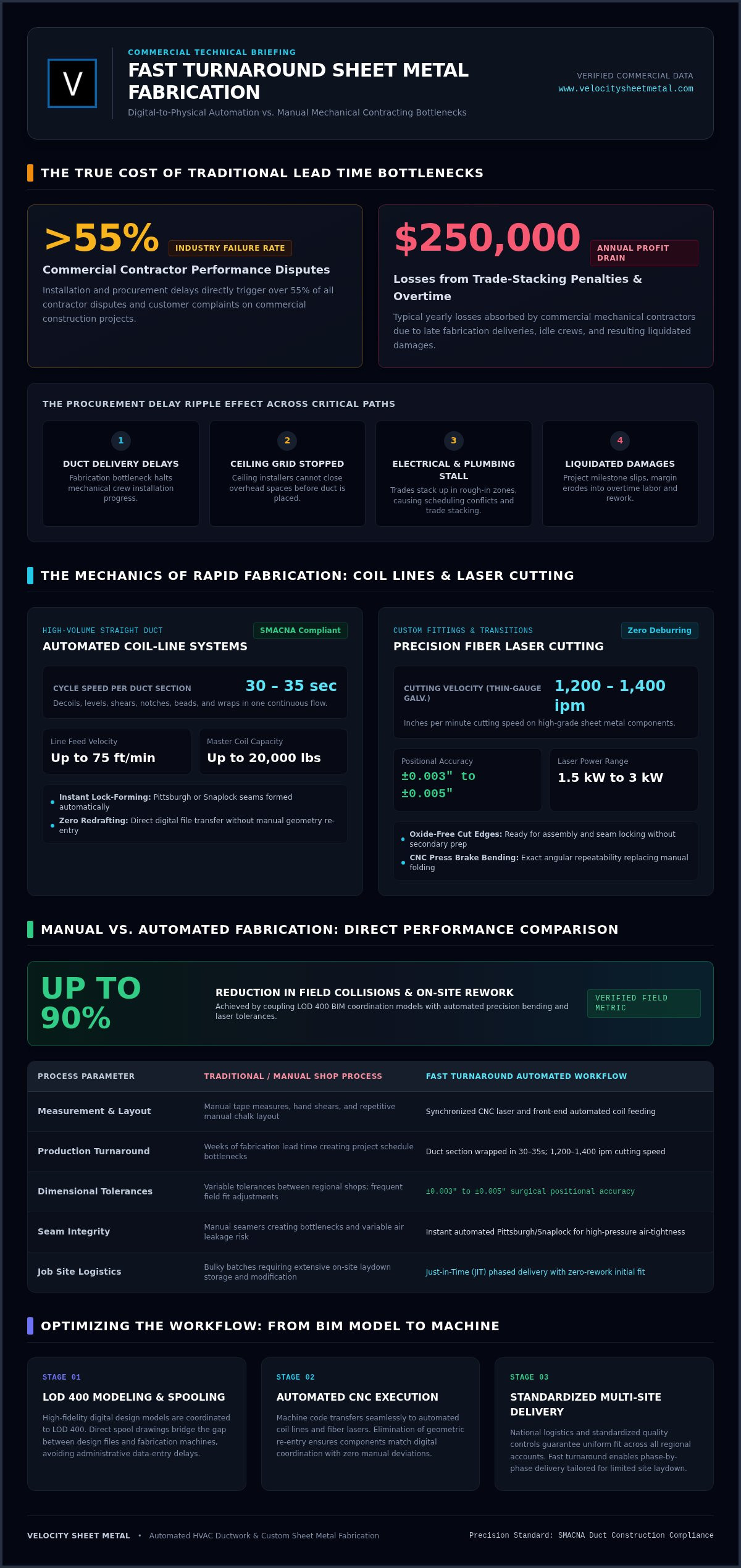
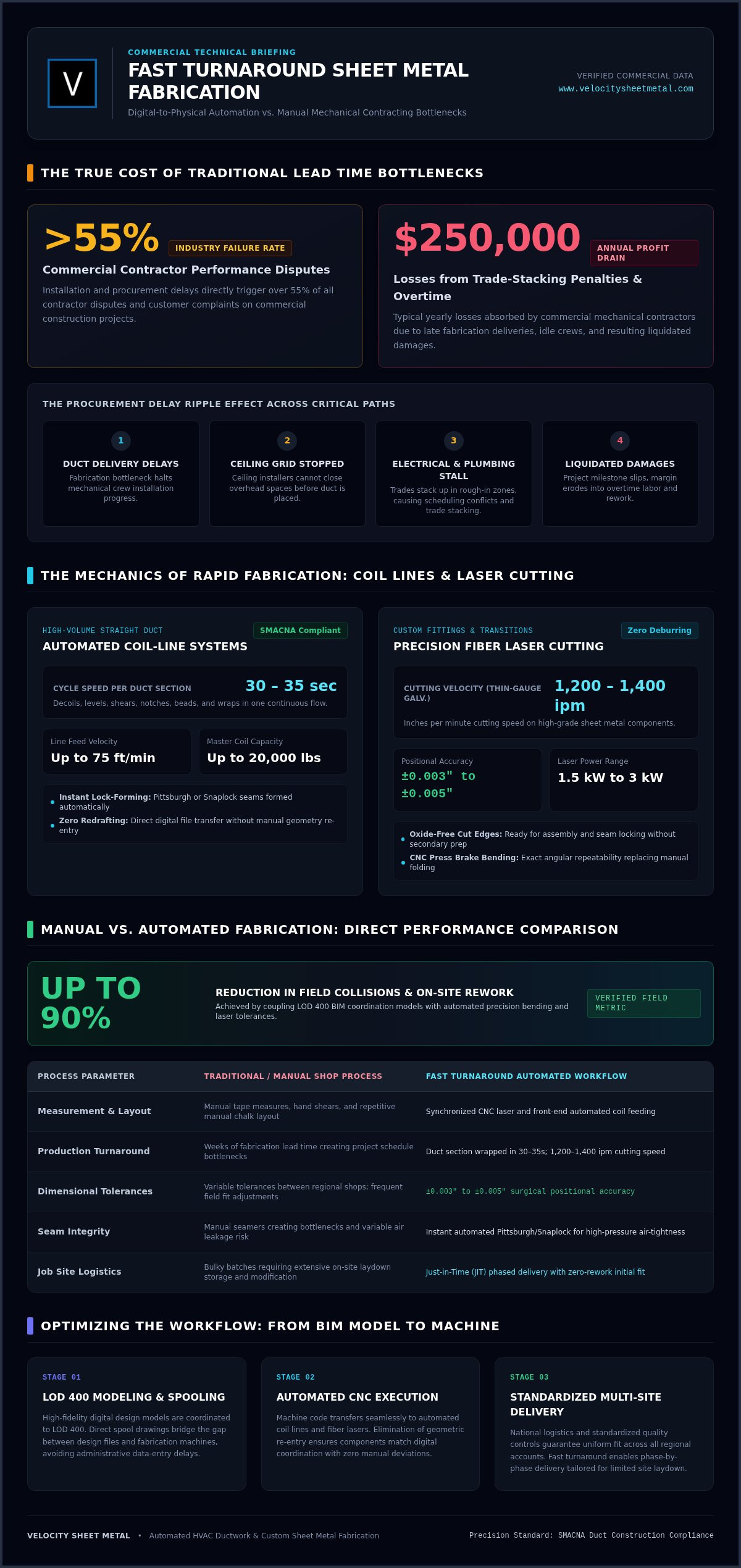
Performance disputes haunt over 55% of commercial contractors, often resulting in $250,000 in annual losses from trade-stacking penalties and overtime labor. Most of these delays originate in the shop, where manual processes fail to provide the fast turnaround sheet metal fabrication required for modern construction schedules. You know the drill; a late duct delivery stops the ceiling grid installers, which stops the electricians, and suddenly your profit margin disappears into rework and liquidated damages.
It doesn't have to be this way. You're about to see how automated coil lines, BIM integration, and precision laser cutting can eliminate these bottlenecks for national commercial projects. We'll explore the technical workflow that turns a digital file into a tangible product with surgical precision. From LOD 400 modeling to national logistics, this is how you achieve predictable delivery and standardized quality across all your national accounts.
Key Takeaways
- Learn how to protect project ROI by identifying and eliminating the hidden costs and trade-stacking penalties associated with traditional fabrication lead times.
- Discover how automated coil lines and precision laser cutting provide fast turnaround sheet metal fabrication, producing finished components in a fraction of the time required by manual shops.
- Compare manual layout to digital workflows to see how automated bending and precision cutting reduce field collisions and on-site rework by up to 90%.
- Understand the role of BIM coordination and spool drawings in bridging the gap between digital design files and tangible, high-precision products.
- See how standardized quality control and national distribution networks support the scale and consistency required for multi-site commercial accounts.
The Critical Impact of Lead Times on Commercial HVAC ROI
In commercial construction, time is the only resource you can't buy back. Traditional fabrication lead times often stretch for weeks, creating the primary bottleneck in modern project schedules. When ductwork isn't on-site, the job stops. This isn't just an inconvenience. It's a direct hit to your bottom line. Investing in fast turnaround sheet metal fabrication is the most effective way to protect your project ROI and maintain your critical path.
The True Cost of Procurement Delays
A stalled mechanical crew represents a massive daily burn rate. When ductwork is late, you aren't just paying for idle HVAC installers. You're paying for the ripple effect across the entire site. Electrical, plumbing, and ceiling grid trades often can't finalize their work until the duct is hung. Research indicates that installation delays contribute to over 55% of contractor performance disputes and customer complaints. These delays often result in trade-stacking penalties and liquidated damages that can cost commercial contractors an estimated $250,000 annually. A "cheap" fabrication bid becomes an expensive mistake when it delays project closeout by even a few days.
Standardization as a Speed Multiplier
National accounts require consistency to move at scale. Traditional sheet metal fabrication processes often vary between regional shops, leading to inconsistent quality and field collisions. By utilizing automated HVAC ductwork fabrication, we ensure every component meets the same precision standard across all your projects. This level of standardization reduces administrative friction and allows for a seamless transition from a digital BIM file to a physical product.
- Just-in-Time Delivery: Fast turnaround enables you to order only what you need for the current phase, which is critical for job sites with limited storage.
- Zero-Rework Installations: Automated precision ensures parts fit the first time, eliminating the need for field modifications.
- Proactive Partnership: Moving away from reactive procurement allows you to treat fabrication as a predictable, tech-driven extension of your own team.
By integrating these automated workflows, you transform fabrication from a variable risk into a reliable asset. This proactive approach keeps project momentum high and ensures that your national accounts receive the same high-quality results, regardless of the project location. It's about bridging the gap between a digital design and a tangible result without the administrative delays that plague manual shops.
The Mechanics of Rapid Fabrication: Coil Lines and Laser Cutting
Speed isn't about working harder; it's about eliminating manual touchpoints through digital-to-physical automation. Fast turnaround sheet metal fabrication replaces tape measures and hand shears with synchronized CNC machinery. Where manual shops rely on guesswork and repetitive layout, we utilize a streamlined workflow that moves from a digital file to a finished product in minutes. This level of technical integration ensures that project schedules remain intact, even when design changes occur at the last minute.
Coil-Line Technology: From Raw Steel to Rectangular Duct
The process begins with master coils weighing up to 20,000 lbs. An automated front-end coil line handles decoiling, leveling, and shearing in a single continuous flow. Modern systems produce a fully wrapped, notched, and beaded duct section in approximately 30 to 35 seconds. This speed ensures compliance with SMACNA duct construction standards while maintaining a line feed of up to 75 feet per minute. Automated Pittsburgh or Snaplock seam forming happens instantly. This eliminates the bottleneck of manual seamers and ensures air-tight integrity for high-pressure systems. Zero manual redrafting. Zero geometric re-entry.
Precision Laser Cutting for Custom Components
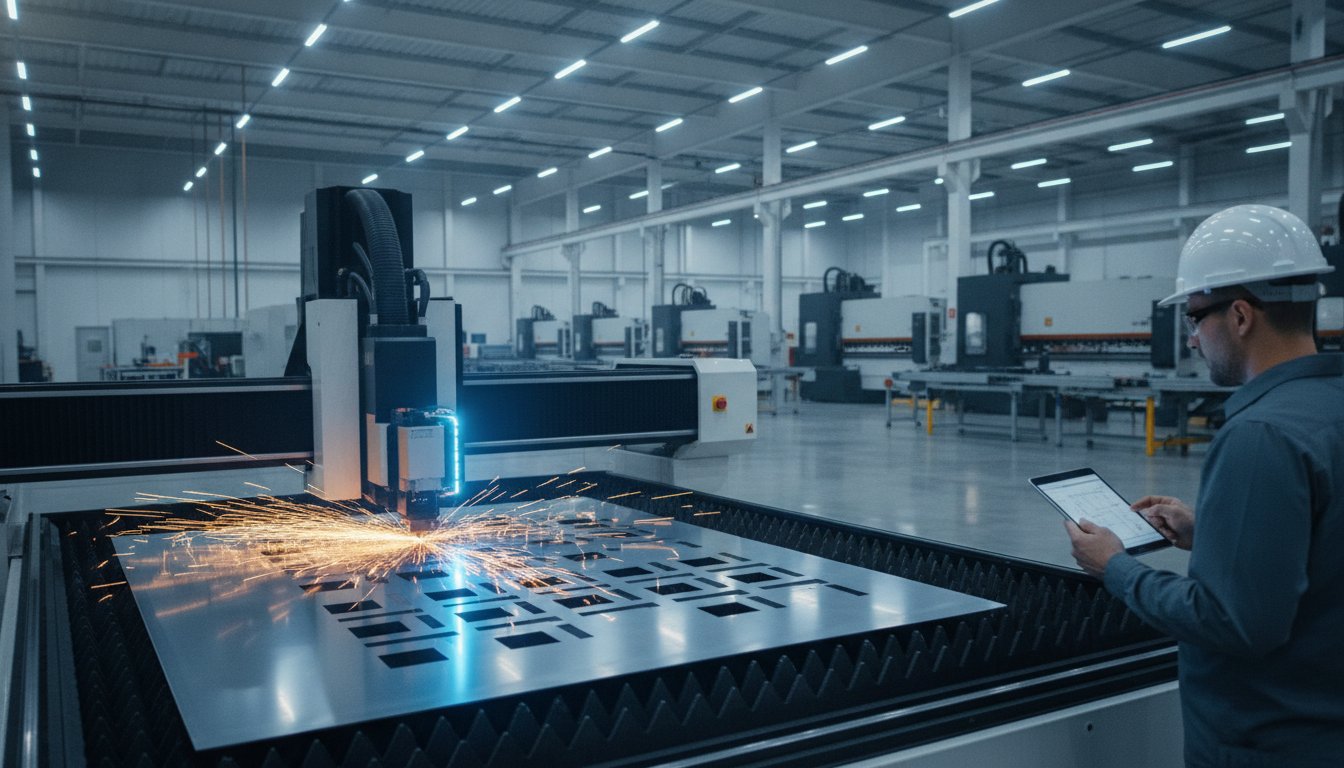
Standard duct is only half the battle. Custom fittings and transitions often stall production. Fiber laser systems, ranging from 1.5 kW to 3 kW, solve this by achieving cutting speeds of 1,200 to 1,400 inches per minute on thin-gauge galvanized steel. These machines operate with a positional accuracy within ±0.003″ to ±0.005″. This precision means parts arrive oxide-free and ready for assembly without secondary deburring. Unlike plasma tables, fiber lasers produce clean edges that allow for instant lock-forming. You get complex geometries without the need for custom tooling or dies.
CNC press brake bending completes the workflow by providing the repeatability that manual folding simply cannot match. By utilizing automated CAD/CAM nesting algorithms, we reduce material scrap to 8% or 10%, compared to the 20% to 30% seen in manual shops. This efficiency allows us to offer high-capacity production that keeps national accounts on schedule. We move from a digital concept to a physical product with surgical precision, ensuring that what you designed is exactly what arrives on the job site.
Manual vs. Automated Fabrication: A Performance Comparison
The performance gap between manual layout and automated production isn't just about speed. It's about the fundamental difference between a craftsman with a tape measure and a digital thread for manufacturing that links design directly to machine. In manual shops, every fitting requires a human to interpret a drawing, mark the metal, and guide the cut. This process is inherently slow and prone to variation. Fast turnaround sheet metal fabrication relies on direct-to-machine digital workflows that eliminate these manual touchpoints entirely.
Data shows that automated systems reduce labor touchpoints by 60% to 75%. While a manual operator might spend hours on complex fitting layouts, a CNC laser or coil line processes the same work in seconds. Material efficiency also shifts dramatically. Manual shops typically see scrap rates between 20% and 30%. Our automated nesting algorithms reduce that drop scrap to just 8% or 10%. This efficiency ensures that part #100 is an exact clone of part #1, providing the consistency national accounts require for multi-site rollouts.
Eliminating the 'Human Error' Variable
Manual brake operation is a primary source of project delays. Even a slight over-bend or under-bend can lead to field-fit issues that require on-site rework. By utilizing CNC metal forming services, you remove the variability of human fatigue and judgment. Automation addresses common press brake forming defects that plague manual shops, such as inconsistent flange lengths or improper bend radii. These precision improvements contribute to a 90% reduction in field-fit collisions, ensuring that duct segments slide together without the need for forced adjustments or sealant patches.
Scalability for Large Scale Projects
Manual shops often hit a ceiling during peak seasonal demand or when faced with massive commercial builds. They struggle to manage high-volume rectangular duct orders because their throughput is tied to their headcount. Automated shops decouple production from labor availability. For a 50,000 sq. ft. commercial project, an automated coil line can produce the entire rectangular duct package in a fraction of the time a manual crew would require. This scalability allows us to maintain predictable delivery schedules even when national accounts accelerate their timelines. You get industrial-grade volume without sacrificing the surgical precision of the final product.
Optimizing the Workflow: From BIM Model to Machine
True speed in the shop begins long before the first coil of steel is loaded. It starts in the digital environment. By establishing a seamless bridge between your design files and our automated machinery, we eliminate the administrative lag that defines manual fabrication. This digital-to-physical pipeline is the engine behind fast turnaround sheet metal fabrication, transforming high-level designs into tangible components with surgical precision.
The Role of BIM Coordination in Speed
Coordination is the ultimate bottleneck remover. Utilizing BIM clash detection for HVAC fabrication allows us to identify and resolve geometric conflicts in the virtual world rather than on the job site. We detail models to Level of Development (LOD) 400, ensuring every duct segment and fitting is accounted for before production begins. This accuracy slashes the Request for Information (RFI) cycle, preventing the mid-project pauses that derail construction schedules. When your digital model is precise, your physical delivery is predictable.
Our workflow follows a methodical, three-step sequence designed for maximum efficiency:
- Step 1: Digital Intake and DFM Analysis. You upload your CAD or BIM files for immediate technical review. We perform a Design for Manufacturing (DFM) analysis to ensure every part is optimized for our automated lines.
- Step 2: Spool Drawing Generation. We transform complex designs into actionable spool drawings. These drawings contain the precise data required to drive CNC machines without manual intervention or geometric re-entry.
- Step 3: Direct-to-Machine Production. We export files directly into Autodesk Fabrication CAMduct 2026. This bypasses traditional shop floor paperwork, moving data straight to the coil line and laser tables.
Mechanical Spooling and Shop Drawings
Mechanical spooling services act as the final filter for quality. We break down large-scale systems into manageable, labeled spools that are ready for rapid on-site assembly. This process ensures that every component, from standard rectangular duct to custom curb adapters, is sized correctly the first time. By delivering pre-coordinated, tagged segments, we help mechanical contractors reduce staging clutter and on-site labor hours. You don't just get parts; you get a pre-engineered kit of parts ready for installation. To start your next project with a tech-forward partner, upload your BIM files for a technical review.
National Distribution and Standardized Quality Control
Scaling a commercial project across multiple states often exposes the weaknesses of fragmented, local sourcing. When you rely on different regional shops, you inherit different quality standards and varying lead times. Fast turnaround sheet metal fabrication at a national level requires a centralized, tech-driven approach. This ensures that every fitting, duct segment, and curb adapter meets the same rigorous specifications, regardless of the final destination. We bridge the gap between your digital design and a tangible product that arrives on-site ready for installation.
Standardizing Production for National Accounts
Centralized fabrication eliminates the quality variance that plagues multi-site rollouts. We implement a unified quality management system that ensures every component is tracked from the master coil to the shipping crate. For national procurement teams, this means a single point of contact and a single standard of excellence. You no longer have to manage dozens of vendor relationships or worry about regional shops lacking the capacity for high-volume orders. By positioning Velocity as the essential partner for HVAC duct fabrication for mechanical contractors, we provide the predictability that national accounts demand. Consistency is the foundation of speed.
Logistics and On-Demand Delivery
Shipping high-volume ductwork nationwide requires more than just a truck. It requires a methodical packaging strategy to prevent transit damage and ensure organized offloading. We utilize custom crating and tagging systems that correspond directly to your spool drawings. This allows your on-site team to identify and stage components immediately upon arrival, reducing staging clutter and labor hours.
Coordinating delivery with project milestones is critical. Our logistics team works backward from your installation dates to ensure that fast turnaround sheet metal fabrication translates into on-time site arrival. Whether it is a dedicated truckload of rectangular duct or a crate of precision laser-cut parts, we manage the transit to avoid job site delays. Centralized production from a high-capacity hub often beats fragmented local sourcing by providing better volume pricing and superior dimensional accuracy. You get a kit of parts that fits perfectly, every time, shipped anywhere in the US. This is how we move your project from a digital concept to a physical result without the traditional administrative delays.
Secure Your Project Schedule with Precision Fabrication
Precision in the shop translates directly to profitability on the job site. You've seen how integrating a BIM-integrated digital workflow with automated coil-line technology eliminates the traditional bottlenecks that stall commercial HVAC projects. Moving from manual layout to direct-to-machine production reduces field collisions and protects your critical path. It's the difference between reactive procurement and proactive, tech-driven execution.
Investing in fast turnaround sheet metal fabrication isn't just about speed; it's about establishing a predictable, standardized supply chain for your national accounts. With over 50 years of combined industry expertise, we act as the essential bridge between your digital files and a tangible, high-quality product. We ensure that every component, from standard duct to custom fittings, arrives on-site ready for immediate assembly.
Don't let fabrication delays dictate your project closeout. Take control of your delivery schedule with a partner that values your time as much as your precision. Get an instant quote for your next high-speed fabrication project and keep your momentum moving forward.
Frequently Asked Questions
What is the typical turnaround time for custom sheet metal parts?
Turnaround times depend on project scale and complexity, but our automated workflows significantly reduce the traditional lead times found in manual shops. For example, our coil lines process master coils into finished duct segments in approximately 30 to 35 seconds. This high-speed production allows us to provide fast turnaround sheet metal fabrication for both small custom orders and large-scale commercial duct packages, ensuring your project stays on schedule.
How does BIM coordination speed up the fabrication process?
BIM coordination speeds up fabrication by identifying and resolving geometric conflicts in a virtual environment before a single piece of metal is cut. We detail models to Level of Development (LOD) 400, which allows for direct-to-machine production. This eliminates the need for manual redrafting or field-fit adjustments. By resolving clashes early, we reduce the RFI cycle and prevent the mid-project pauses that typically derail construction timelines.
Can you ship high-volume rectangular ductwork nationwide?
Yes, we offer comprehensive national shipping capabilities for high-volume rectangular ductwork and custom components. Our logistics team coordinates delivery schedules to align with your project milestones, ensuring that materials arrive exactly when needed. We utilize specialized packaging and tagging systems that correspond with your spool drawings to prevent transit damage and facilitate rapid offloading. Centralized shipping from our automated hub ensures consistent quality across all your regional project sites.
What tolerances can be achieved with custom laser cutting?
Our fiber laser cutting systems achieve tight positional accuracy within ±0.003″ to ±0.005″ on thin-gauge galvanized steel. These high-speed lasers operate at 1,200 to 1,400 inches per minute, producing clean, oxide-free edges that don't require secondary deburring. This level of precision is essential for custom HVAC transition fittings, OEM parts, and specialized mechanical components. It ensures every part fits perfectly during assembly, eliminating the need for forced field modifications.
Do you provide spool drawings for mechanical contractors?
We provide detailed spool drawings and mechanical coordination services for contractors and engineers. These drawings transform complex mechanical designs into actionable fabrication data that drives our automated machinery with surgical precision. Each spool is clearly labeled and tagged to facilitate faster on-site assembly. This pre-engineered approach allows mechanical contractors to reduce staging clutter and on-site labor hours, as every segment is sized correctly before it leaves our facility.
How do automated coil lines differ from manual duct fabrication?
Automated coil lines differ from manual fabrication by replacing hand shears and tape measures with synchronized CNC technology. While a manual shop relies on interpretative layout and marking, our automated systems decoil, level, and shear in one continuous flow. This reduces labor touchpoints by 60% to 75% and ensures air-tight integrity for high-pressure systems. Automation also lowers material scrap rates to 8% or 10%, providing a more efficient, repeatable production process.
What materials are compatible with your CNC press brake services?
Our CNC press brake bending services are compatible with a wide range of materials, including G60 and G90 galvanized steel, stainless steel, and aluminum. We specialize in precision forming for HVAC components, custom curb adapters, and specialized mechanical parts. The use of CNC technology ensures that bend radii and flange lengths remain identical across every piece. This repeatability is critical for national accounts that require standardized quality for large-scale multi-site rollouts.
How do you ensure quality consistency for national accounts?
We ensure quality consistency for national accounts through a unified quality management system and centralized fabrication. By producing all components from a single automated hub, we eliminate the variance inherent in using multiple regional shops. Every project, regardless of its location in the US, receives components that meet the same rigorous production standards. This centralized approach provides national procurement teams with a single point of contact and predictable results for every fast turnaround sheet metal fabrication order.