Double Wall Spiral Duct: The 2026 Technical Guide to Performance and Fabrication

Traditional insulation methods aren't just bulky; they're often the primary source of field coordination errors that stall massive commercial projects. You've likely dealt with the frustration of external wrap tearing during install or the sheer volume of space wasted by rectangular configurations. In an industry where energy efficiency standards like ASHRAE 62.1-2025 are now the baseline, the margin for error has disappeared. You need a system that delivers thermal integrity without the logistical nightmare of on-site modifications.
This guide helps you master the technical specifications of double wall spiral duct to eliminate those pains. We'll break down how to achieve superior acoustic attenuation and high R-value performance through precision manufacturing. From the initial BIM coordination to the final spool drawing, you'll learn how automated fabrication streamlines the transition from digital model to physical ductwork. We are covering everything from 2026 SMACNA leakage rates to the specific thermal advantages required for large-scale commercial HVAC projects. Get ready to move from complex design hurdles to a seamless, high-performance install that arrives on-site ready to work.
Key Takeaways
- Learn how double wall spiral duct integrates an inner liner and insulation to maximize thermal R-value and provide superior acoustic attenuation.
- Understand why spiral geometry outperforms rectangular configurations by reducing static pressure loss and minimizing raw material usage for the same cross-sectional area.
- Discover how BIM-driven clash detection prevents high-cost failure points by ensuring precision fabrication before components reach the site.
- Streamline procurement by utilizing automated production lines that move your project from digital concept to physical delivery with surgical precision.
Understanding Double Wall Spiral Duct: Thermal Efficiency and Acoustic Control
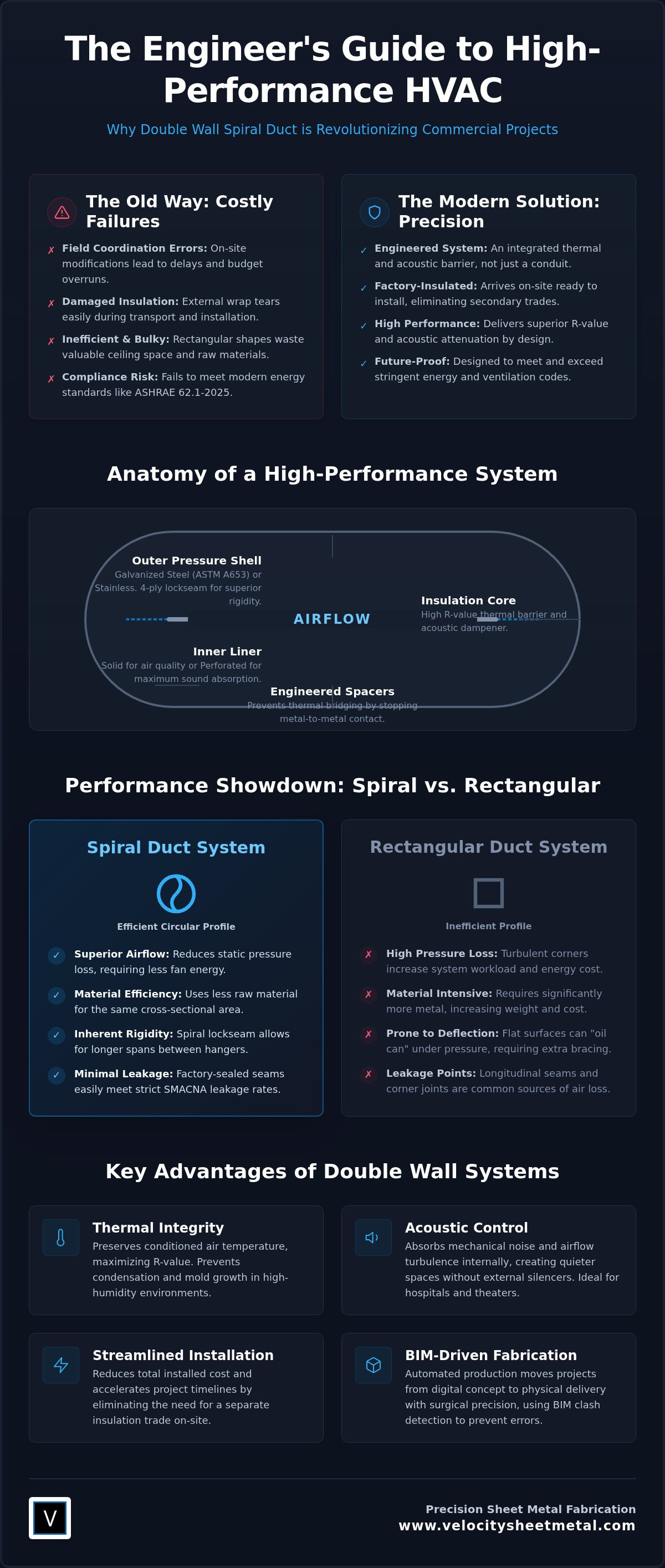
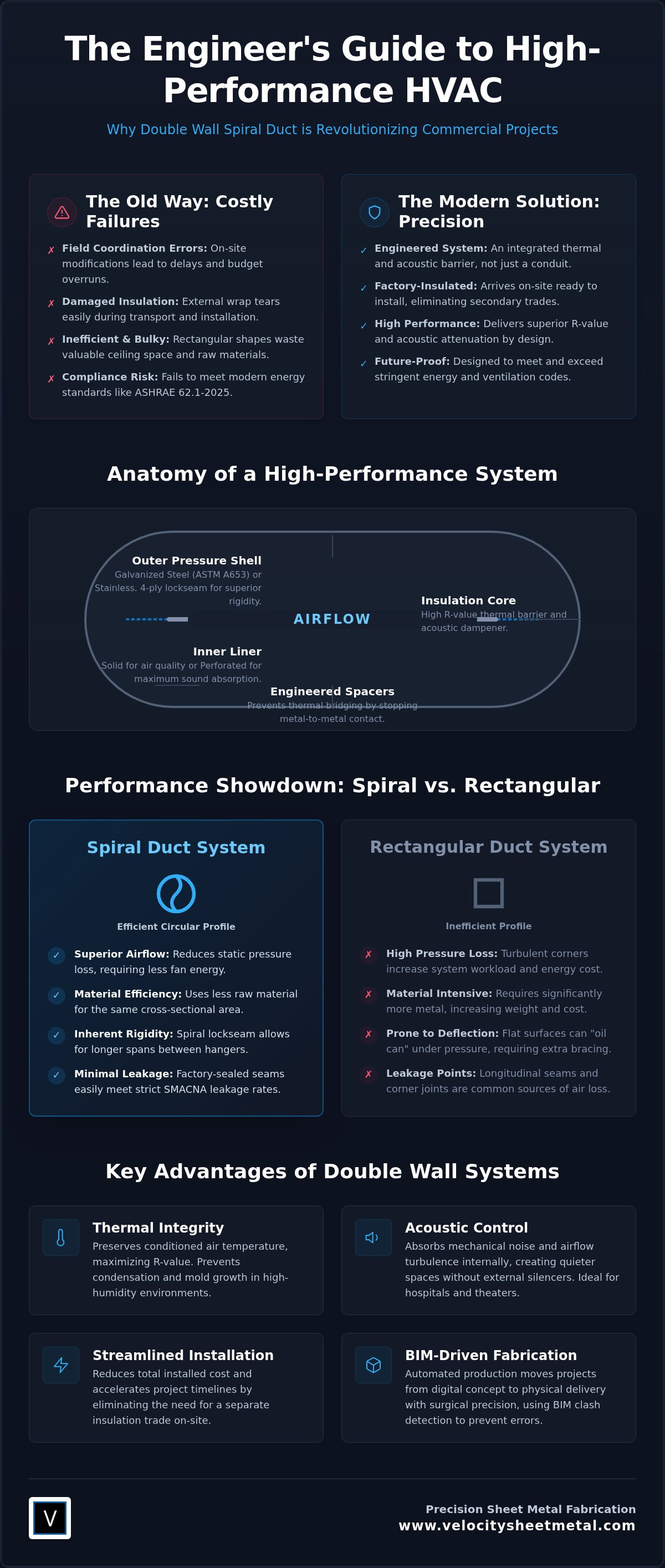
High-performance HVAC duct systems demand more than a simple metal conduit. A double wall spiral duct functions as a fully integrated assembly. It consists of a primary outer pressure shell, a specialized inner liner, and a thick layer of insulation sandwiched between them. This isn't just a component; it's a precision-engineered thermal and acoustic barrier designed for the most demanding environments. It bridges the gap between raw air transport and total environmental control.
Engineers prioritize this configuration for two critical reasons: thermal R-value preservation and acoustic attenuation. You aren't just moving air; you're protecting the energy used to condition it. In 2026, commercial HVAC systems must strictly adhere to the thermal performance and ventilation requirements found in the ANSI/ASHRAE Standard 62.1-2025 and the 2024 ASHRAE Handbook. This compliance is mandatory for modern high-efficiency building certifications.
Traditional external duct wrap is a liability on modern job sites. It's prone to tearing, requires massive amounts of field labor, and often fails to provide a consistent thermal seal around complex fittings. By switching to double wall systems, you eliminate the need for secondary insulation trades. The duct arrives on-site ready for installation. This transition significantly reduces the total installed cost while accelerating project timelines. It's a cleaner, faster, and more reliable way to build.
Acoustic Performance in Sensitive Environments
Breakout noise is a deal-breaker in hospitals, theaters, and high-end office spaces. Double wall construction stops this noise at the source. The insulation layer dampens mechanical vibrations and smooths out airflow turbulence. Unlike external wrap, which only muffles sound after it has vibrated through the metal, internal insulation absorbs acoustic energy before it can escape the duct wall. This results in a significantly quieter environment without the need for bulky, expensive sound attenuators later in the line.
Thermal Integrity and Condensation Prevention
Humidity and temperature differentials create the perfect conditions for condensation. In high-humidity environments, uninsulated or poorly wrapped ducts "sweat," leading to mold growth and structural damage. Double wall spiral duct prevents this through precision-engineered spacers that maintain a consistent insulation gap. These spacers stop thermal bridging by preventing direct metal-to-metal contact between the inner and outer shells. This keeps the outer shell dry and protects the long-term lifespan of the air handling units. Efficient thermal management directly impacts the bottom line by reducing the load on chillers and heaters. When the system doesn't have to fight energy loss through the duct walls, it runs less frequently and requires fewer repairs over its operational life.
The Anatomy of High-Performance Spiral Systems: Liners, Insulation, and Gauges
A double wall spiral duct is only as reliable as its weakest layer. The outer pressure shell provides the structural foundation for the entire assembly. Most commercial projects utilize galvanized steel meeting the ASTM A653/A653M-2023 standard. However, corrosive environments or specific architectural requirements might call for 304 or 316 stainless steel or lightweight aluminum. The 4-ply spiral lockseam creates a continuous reinforcement rib around the exterior. It provides superior rigidity compared to longitudinal seams. This allows for longer spans between hangers and reduces the risk of duct wall deflection under high static pressure.
Industrial systems operating at high pressures require specific gauge thicknesses to prevent "oil canning" or structural failure. Typically, outer shells range from 18 to 26 gauge depending on the diameter and pressure class. When you are designing these systems, selecting the right spiral and round duct and fittings ensures the assembly maintains its integrity from the fan to the diffuser.
Solid vs. Perforated Inner Liners
Selecting the right liner is a functional decision based on the air being moved. Solid liners are the standard for supply air where indoor air quality is the priority. They prevent insulation fibers from entering the airstream and provide a smooth, non-porous surface that resists particulate buildup. Perforated liners serve a different purpose. They feature thousands of small, precision-punched holes that allow sound waves to pass into the insulation layer. This makes them ideal for return air systems or mechanical rooms where noise reduction is critical. You trade a slight increase in airflow friction for a massive gain in acoustic control.
Insulation Thickness and R-Value Specifications
Thermal performance depends on the core material and its density. Fiberglass remains the industry standard for cost-effective thermal resistance. Closed-cell foam is a frequent choice for 2026 projects due to its moisture resistance and fiber-free nature. Mineral wool is the preferred option for high-temperature or fire-rated applications. Standard configurations include:
- 1-inch insulation: Provides basic thermal protection and condensation control for most conditioned spaces.
- 2-inch insulation: Necessary for high R-value requirements in unconditioned spaces or exterior runs.
The density of these materials affects both weight and performance. Higher density insulation improves acoustic damping but adds load to the support structure. SMACNA standards for double wall systems require that the insulation is fully contained and protected from erosion by the inner liner. This ensures the R-value remains consistent over the decades-long lifespan of the building.
Double Wall Spiral vs. Rectangular Duct: A Comparative Performance Analysis
Choosing between configurations is a matter of physics and labor economics. While rectangular duct is often the default for tight ceiling plenums, double wall spiral duct offers superior performance in almost every technical metric. The primary advantage is the reduction in static pressure loss. Rectangular ducts suffer from air turbulence at every 90-degree corner. Spiral geometry allows for a laminar flow pattern that reduces the workload on the air handling unit. This isn't just a design preference; it's an operational cost saving that accumulates every hour the system runs.
Material efficiency is equally stark. A circular cross-section requires significantly less metal than a rectangular one to move the same volume of air. This reduction in surface area means less metal to fabricate and less insulation to buy. For mechanical contractors, this efficiency is a key part of modern HVAC duct fabrication for mechanical contractors. When you factor in installation speed, the gap widens. Spiral runs typically utilize single-point suspension systems. Rectangular setups require multi-hanger trapeze assemblies that take twice as long to install in the field.
Leakage Rates and Airflow Efficiency
System-wide leakage is the silent killer of energy efficiency. Traditional rectangular duct relies on longitudinal seams and complex corner joints that are notorious for air loss. Spiral duct features a continuous lockseam that is inherently more airtight. When combined with modern gasketed joints, these systems meet the most stringent 2026 SMACNA leakage standards. Over a 10-year operational lifecycle, the energy savings from reduced air loss and lower fan pressure can offset the initial material investment. You're building for a decade of performance, not just the day of inspection.
Weight and Support Requirements
Double wall systems introduce a weight penalty that engineers must account for. You're effectively hanging two ducts and a layer of insulation. Structural considerations for suspended runs or roof-mounted units are critical. However, automated production lines mitigate this by using precision-calculated gauges. Instead of over-engineering with heavy sheet metal, automated fabrication uses the exact gauge required for the pressure class. This optimizes the weight-to-strength ratio without compromising the structural integrity of the double wall spiral duct. Precision in the shop means fewer headaches for the structural team on-site.
Engineering and BIM Coordination: Eliminating Field Errors in Double Wall Systems
Precision isn't a luxury for double wall systems; it's a structural requirement. Unlike single wall duct, you can't just "make it fit" when you encounter a field conflict. Every section of double wall spiral duct must be accounted for before the first piece of metal is cut. This is where BIM clash detection for HVAC fabrication becomes the essential bridge between a digital design and a physical product. It identifies conflicts with structural steel, electrical trays, or plumbing lines long before the duct arrives on-site. It turns the installation process into an assembly task rather than a fabrication struggle.
Field-cutting double wall spiral is a high-cost failure point you should avoid at all costs. When a crew attempts to trim these pieces on-site, they often compromise the inner liner and destroy the thermal seal. This leads to thermal bridging and acoustic leaks that are nearly impossible to remediate later. Spool drawings provide the exact roadmap for assembly, ensuring every offset and transition fits the designated space. Adopting these digital-to-physical workflows reduces onsite waste by 20%, keeping the job site lean and the schedule moving at full speed.
Spooling for Complex Mechanical Rooms
Mechanical rooms are the ultimate test for coordination. You're often forced to map concentric and eccentric reducers into ceiling voids that are already overcrowded. Spooling allows you to account for the total outside diameter, including the specific insulation thickness, in the digital model. This ensures that a 24-inch duct actually fits when you factor in the extra two inches of shell and insulation. We utilize factory-installed taps and take-offs to eliminate the variables of field-fitted branches. It moves the complex labor from the ladder to the controlled environment of the factory floor.
Precision Laser Cutting for Custom Fittings
Custom fittings require surgical accuracy to maintain the integrity of the double wall assembly. Our precision laser cutting services ensure that the inner liner and outer shell align perfectly every time. This is vital for multi-component elbows where tight tolerances are necessary to prevent insulation gaps. Standardizing these fittings ensures consistency across national accounts. It guarantees that the performance you expect in the design phase is exactly what you get in the physical result.
Ready to eliminate field errors and streamline your next project? Partner with Velocity Sheet Metal for BIM-coordinated fabrication that delivers on-site precision.
National Procurement and Fabrication: Why Velocity Sheet Metal is the Preferred Partner
Success in large-scale HVAC projects depends on the speed and precision of your supply chain. Velocity Sheet Metal acts as the essential bridge between your digital design files and a finished physical product. We don't just fabricate; we execute with industrial pragmatism. Our team brings over 50 years of combined management experience to the factory floor. This expertise ensures that every complex requirement for double wall spiral duct is met with surgical accuracy. We've optimized our workflow to eliminate administrative delays, moving your project quickly from the initial digital concept to the final physical result.
Our capacity for high-volume double wall spiral duct orders is powered by advanced coil line duct fabrication technology. This automation allows us to maintain strict tolerances across thousands of linear feet of ductwork. For national accounts and multi-state projects, this level of consistency is critical. We implement standardized quality control protocols that guarantee every fitting and shell matches your specifications. Whether you're managing one site or ten, the quality remains uniform. We handle the logistics of nationwide shipping, ensuring your precision-fabricated components arrive on-site exactly when the schedule demands.
Scalability for Large-Scale Commercial Projects
Aggressive timelines require a partner who can scale production without sacrificing detail. Our automated lines are built for speed. We manage large-diameter spiral requirements for industrial facilities that traditional shops simply can't handle. Beyond fabrication, we focus on the logistics of delivery. We use consolidated shipping strategies to maximize trailer space and reduce project freight costs. It's about protecting your budget as much as your schedule. From massive distribution centers to high-tech manufacturing plants, we provide the volume needed to keep your crews moving.
Partnering with Velocity for Precision Results
Unique project challenges require more than just a catalog of parts. We offer technical support that begins in the design phase and continues until final delivery. Our team understands the nuances of BIM-driven workflows and spool drawing accuracy. We provide on-demand part production for those unexpected field adjustments that threaten to stall a project. You get a tech-savvy partner obsessed with detail and delivery. Don't let fabrication delays compromise your performance. Submit your BIM files for a precision fabrication quote today and experience the efficiency of modern manufacturing.
Optimizing Your Next High-Performance Build
Mastering the technical nuances of double wall spiral duct is the difference between a project that meets 2026 energy codes and one that struggles with field errors. You've seen how integrating BIM-driven workflows and precision laser cutting eliminates the high-cost failure points of manual modifications. These systems deliver the thermal R-value and acoustic control your clients demand without the logistical drag of traditional insulation methods. It's about moving from complex design hurdles to a controlled, repeatable production process.
Velocity Sheet Metal provides the essential bridge between your digital models and physical results. We leverage a BIM-integrated digital-to-physical workflow and national shipping capabilities to serve commercial accounts across the country. Our automated production lines ensure every fitting meets high-tolerance standards for a seamless installation. It's time to move your project forward with surgical precision. Get a Precision Fabrication Quote for Your Next Project. Let's build a more efficient system together.
Frequently Asked Questions
What is the standard R-value for double wall spiral duct insulation?
Standard R-values for double wall spiral duct depend on the insulation thickness and material density specified. A 1-inch fiberglass layer typically provides an R-value of 4.2, while a 2-inch layer meets R-8 requirements. These specifications are critical for complying with the 2024 ASHRAE Handbook and 2026 energy codes for unconditioned spaces. Velocity Sheet Metal fabricates these systems to exact project specifications to ensure thermal integrity across the entire run.
Can double wall spiral duct be used in outdoor applications?
Double wall spiral duct is highly effective for outdoor applications when fabricated with the correct materials and sealants. Using a galvanized or stainless steel outer shell provides the necessary weather resistance to protect the internal insulation. It's essential to use high-velocity sealants and gasketed joints to prevent moisture from penetrating the outer pressure shell. This configuration maintains thermal performance even when exposed to extreme ambient temperature differentials and high humidity levels.
How does double wall spiral duct compare to internally lined rectangular duct?
Spiral geometry offers significantly lower static pressure loss and air leakage compared to internally lined rectangular duct. Rectangular systems often suffer from insulation erosion and higher friction at the corners. The continuous lockseam provides a more consistent thermal barrier and superior structural rigidity. This results in lower fan energy consumption and reduced material waste during the fabrication process, making it a more efficient long-term solution for commercial facilities.
Is a perforated liner necessary for acoustic attenuation in all systems?
A perforated liner is not always necessary and depends entirely on the engineering requirements for acoustic control. Perforated liners are ideal for return air systems where sound absorption is the priority. However, solid liners are preferred for supply air to maximize indoor air quality and prevent particulate buildup. If your project doesn't require specific decibel reductions, a solid inner liner provides a smoother airflow surface and simplifies maintenance over the building's lifecycle.
What are the typical lead times for custom double wall fittings?
Lead times for custom double wall fittings vary based on project volume and the complexity of the BIM coordination required. Velocity Sheet Metal utilizes automated fabrication and precision laser cutting to accelerate the production timeline for national accounts. Because we specialize in high-volume industrial orders, our digital-to-physical workflow minimizes the administrative delays found in traditional shops. We recommend submitting your spool drawings early to ensure a seamless transition to national shipping.
How do you handle thermal bridging in double wall spiral construction?
We eliminate thermal bridging in double wall spiral duct construction by using precision-engineered internal spacers. These standoffs maintain a consistent gap between the inner liner and the outer shell. They prevent direct metal-to-metal contact, which is the primary cause of condensation in high-humidity environments. By ensuring the insulation remains uncompressed and the shells stay separated, the system maintains its full R-value. This mechanical separation is a standard feature in our automated production process.
Does double wall spiral duct require special hangers or supports?
Double wall systems are heavier than single wall duct and require support calculations that account for the weight of the second shell and insulation core. However, the inherent rigidity of the spiral lockseam often allows for longer spans between hangers compared to rectangular alternatives. We recommend using heavy-duty ring hangers or saddle supports that distribute the load evenly around the outer pressure shell. Our BIM coordination services help identify the optimal hanger placement before the duct arrives.
Can double wall spiral be fabricated in stainless steel for lab environments?
Stainless steel fabrication is a standard option for laboratory and cleanroom environments where corrosion resistance and particulate control are mandatory. We can produce these systems using 304 or 316 stainless steel for both the inner liner and the outer shell. This configuration withstands aggressive chemical exhaust and frequent cleaning protocols. Our custom laser cutting ensures that even these harder alloys are cut to the precise tolerances required for high-performance lab HVAC systems.