Custom Sheet Metal Panels for OEMs: 2026 Engineering Guide

A single millimeter of deviation in a high-volume production run can trigger a cascade of field collisions that derail a multi-million dollar project. You've likely seen it happen; poor tolerances from a shop lacking automation lead to expensive rework and missed deadlines. When you're sourcing custom sheet metal panels for OEMs, there's no room for material inconsistency or administrative friction. It's a common frustration for engineers who need reliability, not excuses. You need a partner that bridges the gap between complex digital designs and physical reality. From the first laser cut to the final CNC bend, the process must be surgical.
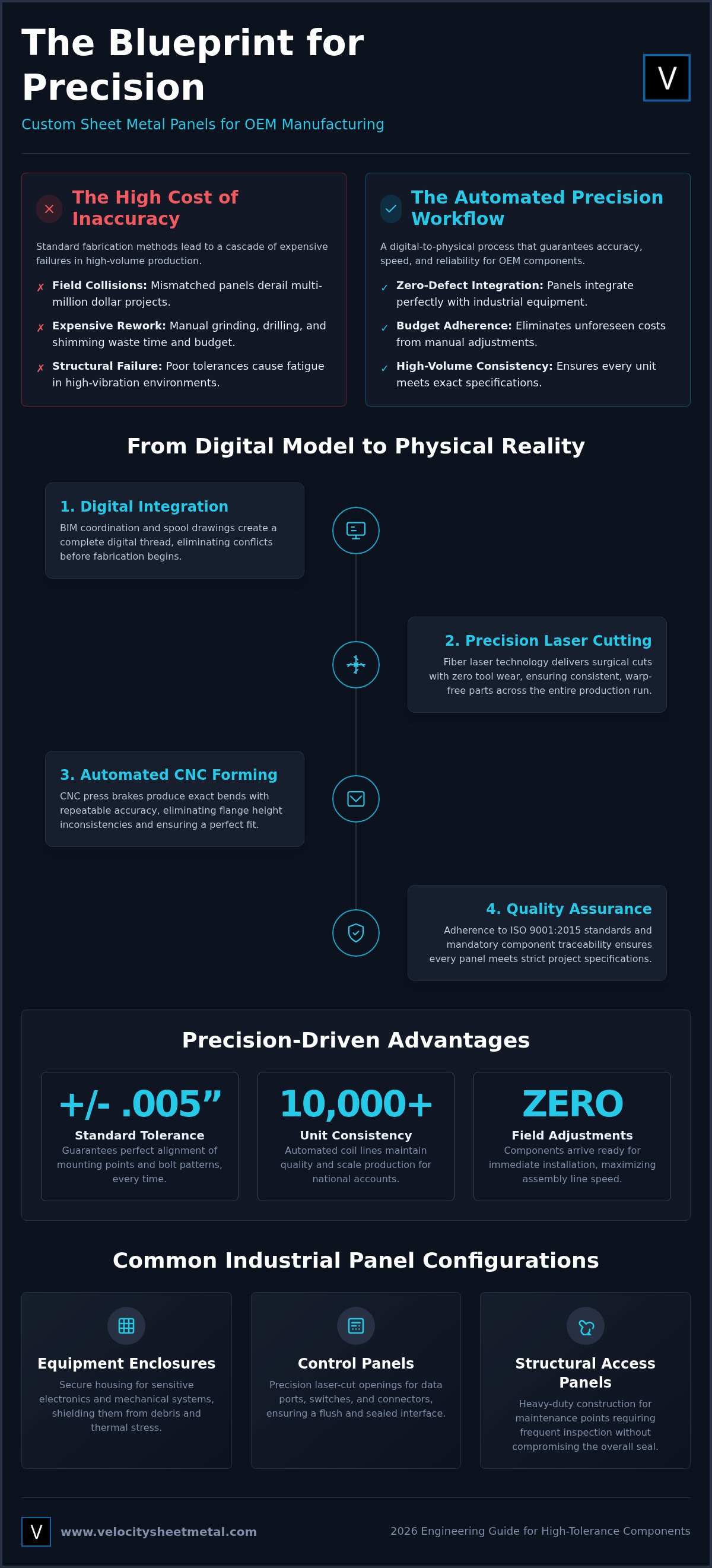
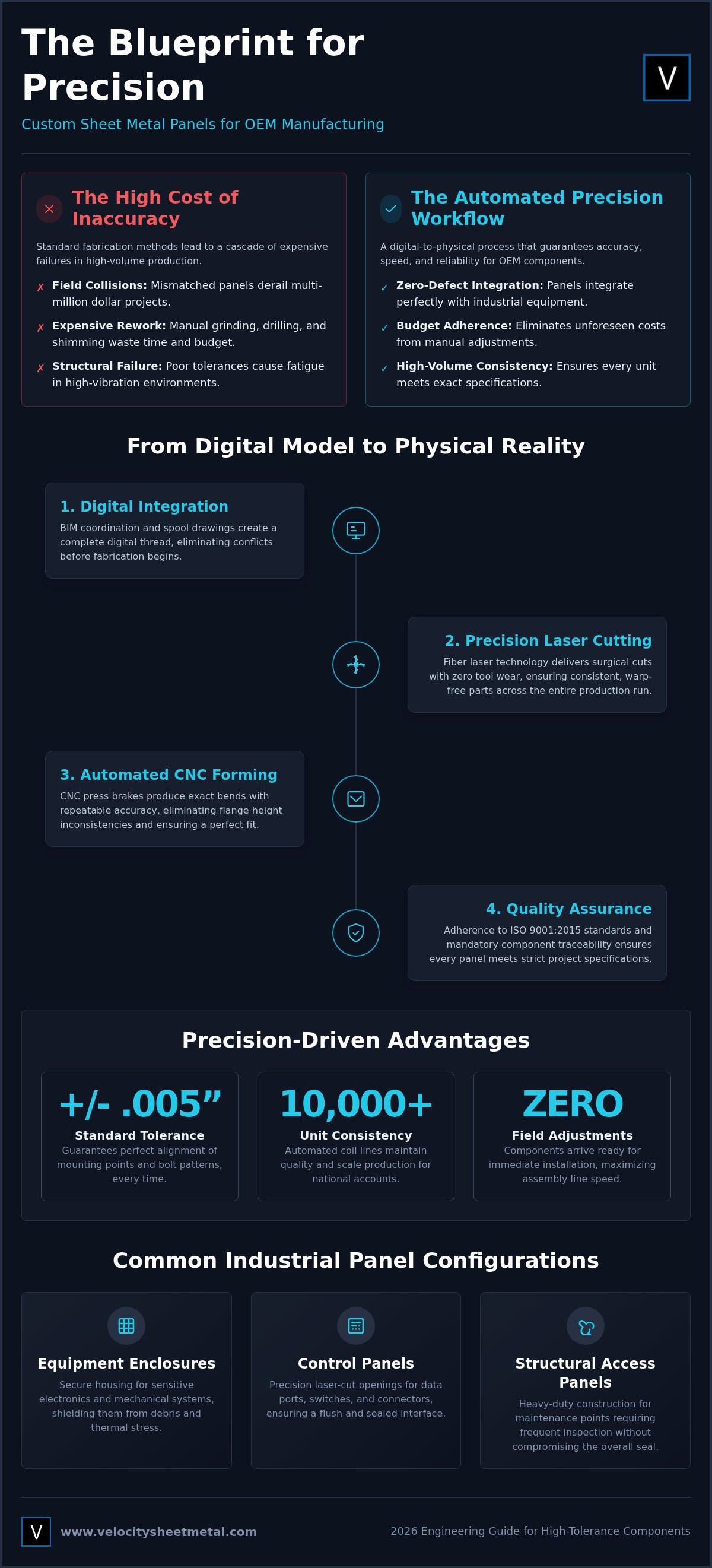
This 2026 engineering guide explores how precision laser cutting and CNC forming deliver high-tolerance components that integrate perfectly with your industrial equipment. We'll show you how to leverage BIM coordination to achieve zero-defect results and scale production for national accounts. From initial digital modeling to final national shipping, you'll discover a workflow built for speed, accuracy, and domestic compliance. We're breaking down the technical requirements for seamless digital-to-physical integration in modern manufacturing to ensure your next project stays on schedule and within spec.
Key Takeaways
- Identify why standard enclosures fail in high-vibration industrial settings and how to select alloys that balance structural integrity with corrosion resistance.
- Discover how automated laser cutting and CNC press brake bending produce high-tolerance custom sheet metal panels for OEMs with repeatable accuracy across thousands of units.
- Learn how BIM coordination and spool drawings create a digital thread that eliminates field collisions and ensures zero-defect panel integration.
- Explore the advantages of using automated coil lines to scale production and maintain consistent quality for national industrial accounts.
The Strategic Importance of Custom Sheet Metal Panels in OEM Manufacturing
Custom sheet metal panels for OEMs are more than simple covers. They represent the precision-engineered interface between internal mechanical systems and the harsh realities of industrial environments. These components function as high-performance enclosures that must maintain structural integrity under extreme conditions. Standard, off-the-shelf panels frequently fail in high-vibration or high-torque applications. They lack the specific reinforcements and material thickness required to prevent fatigue. Precision fabrication ensures these panels protect sensitive internals while serving as a rigid backbone for the entire assembly.
Modern manufacturing has shifted toward a digital-to-physical workflow. This means the accuracy of the final product must mirror the digital model exactly. There's no room for the manual shimming or grinding typical of legacy shops. Custom panels are designed to integrate seamlessly. They act as the essential bridge between an engineer's CAD file and a tangible, high-performance product on the factory floor. Adhering to ISO 9001:2015 quality standards ensures this transition happens without a loss in data or dimension.
Common Industrial Panel Configurations
Industrial applications demand specialized configurations to meet unique operational goals. These typically fall into three primary categories:
- Equipment Enclosures: These provide a secure environment for sensitive electronics and mechanical systems, shielding them from debris and thermal stress.
- Control Panels: These feature precision laser-cut openings for data ports, switches, and connectors, ensuring a flush and sealed interface.
- Structural Access Panels: Designed for heavy-duty maintenance points, these panels offer durability for components that require frequent inspection without compromising the overall seal.
Why Precision Tolerances Matter for OEMs
In high-volume production, precision is the primary driver of efficiency. Maintaining +/- .005 tolerances directly impacts assembly line speed. When mounting points and bolt patterns align perfectly every time, you eliminate the need for manual corrections. This perfect alignment reduces mechanical wear on the equipment chassis. It also prevents long-term structural fatigue caused by poorly fitted parts.
The hidden cost of field-adjusting components can destroy a project's budget. Every minute a technician spends grinding, drilling, or shimming a part that doesn't fit is a minute of lost production. Precision shop fabrication via CNC technology ensures that custom sheet metal panels for OEMs arrive ready for immediate installation. This reliability is vital for scaling production across national accounts where consistency is non-negotiable. By 2026 standards, component traceability is mandatory for many infrastructure projects, making precision fabrication a baseline requirement rather than an optional upgrade.
Precision Fabrication Workflows: Laser Cutting and CNC Forming
Precision starts with automation. Legacy fabrication methods rely on manual setups that introduce human error and slow down production. When producing custom sheet metal panels for OEMs, a fully digital workflow is required to move from design to delivery without manual intervention. This process eliminates the variation that typically causes field collisions. By removing the "human element" from the primary cutting and bending stages, we ensure that every component meets the exact specifications of the original CAD file.
The Laser Cutting Advantage for Custom Panels
Fiber laser technology is the industrial standard for 2026. It handles intricate hole patterns for data ports and cooling vents that traditional punch presses would struggle to replicate with speed. Because there's no physical tool contact, there's zero tool wear to account for. This ensures that the ten-thousandth part is as accurate as the first. Fiber laser technology minimizes heat-affected zones by concentrating energy into a surgical beam, which prevents material warping in thin-gauge enclosures. Whether you're cutting galvanized steel or high-grade aluminum, the edge quality remains consistent across the entire run.
CNC Bending: Ensuring Repeatability for Panels
Bending is the stage where many fabrication projects lose their tolerances. Large panels are prone to flange height inconsistencies if they aren't positioned with extreme care. We utilize multi-axis backgauges to lock in dimensions before the first bend is ever made. This level of control is a hallmark of professional CNC press brake services for OEMs. High-strength industrial alloys often exhibit "springback," where the metal attempts to return to its original shape after the press releases. Automated CNC systems calculate this tension in real-time, adjusting the punch depth to ensure every angle is perfect for seamless assembly.
Speed is the ultimate differentiator in modern manufacturing. Automated fabrication allows for rapid prototyping, moving your project from a digital file to a tangible part in days rather than weeks. This speed doesn't compromise safety or quality. Every panel undergoes automated deburring to ensure smooth edges. This is critical for both technician safety during assembly and the long-term adhesion of industrial coatings. If you need to scale production quickly, leveraging automated CNC technology is the only way to maintain quality at high volumes. This systematic approach ensures that every part fits the first time, every time.
Material Engineering: Selecting the Right Alloys for Industrial Panel Performance
Selecting the right substrate is a technical decision that dictates the lifespan of custom sheet metal panels for OEMs. You can't pick a material based on cost alone. You have to balance weight, structural strength, and environmental resistance. Industrial environments are unforgiving. If a panel is destined for a high-vibration chassis, it needs a different fatigue limit than a stationary enclosure. Every alloy reacts differently to thermal stress and mechanical torque, making material engineering a critical step in the "digital-to-physical" bridge.
Galvanized steel remains the workhorse for industrial HVAC support and external paneling. Its zinc coating provides a sacrificial layer that stops rust before it reaches the core. For chemical or food-processing zones, stainless steel is the standard. Specify 304 for general corrosion resistance. Upgrade to 316 when dealing with chlorides or harsh cleaning agents; the addition of molybdenum makes it essential for long-term survival in aggressive environments. For weight-sensitive equipment mounts, aluminum offers excellent heat dissipation and a high strength-to-weight ratio, making it ideal for electronic enclosures.
Corrosion Resistance and Finishing Options
Longevity depends on more than just the base alloy. You have to evaluate powder coating versus galvanized finishes based on outdoor exposure. While galvanized steel is robust, powder coating adds a thick, durable barrier that resists abrasion and chemicals. Be careful with multi-metal assemblies. Mixing stainless fasteners with aluminum panels can trigger galvanic corrosion, leading to premature failure of the mounting points. We ensure all materials meet the rigorous HVAC duct fabrication for mechanical contractors standards to guarantee compliance on industrial sites.
Strength-to-Weight Optimization for OEMs
Bulk material isn't always the answer to strength. High-strength low-alloy (HSLA) steel allows for thinner, lighter panels that maintain heavy-duty load capacities. By using precise CNC bending to create structural ribs and flanges, you can replace heavy plates with engineered geometry. This approach is vital when designing panels for coil line duct fabrication systems. It reduces the total weight of the machinery while maintaining the rigidity needed for high-speed operation. Precision laser cutting ensures these complex geometries don't add to your assembly time, keeping your production line moving at peak efficiency.
Digital Integration: Leveraging BIM and Spool Drawings for Zero-Defect Panels
Digital integration is the final safeguard against production errors. While material choice provides the foundation, Building Information Modeling (BIM) provides the roadmap. For engineers sourcing custom sheet metal panels for OEMs, the goal is a zero-defect product that fits the first time. BIM coordination allows us to identify and resolve spatial conflicts in a virtual environment. This prevents the field collisions that typically halt assembly lines. By the time a digital file reaches the shop floor, every mounting point and flange has been verified against the larger system.
The transition from a digital concept to a physical part must be seamless. We move from digital spool drawings directly to automated machine code. This eliminates manual data entry and the risks associated with it. Standardized file formats, such as STEP and DXF, are essential for this workflow. They allow for the immediate translation of engineering intent into fabrication instructions, significantly accelerating lead times for complex projects.
BIM Coordination for Industrial Panel Systems
Industrial systems are increasingly complex. Integrating custom panels into a digital twin of the mechanical system ensures that every component coexists without interference. This is where BIM clash detection for HVAC fabrication becomes invaluable for mounting systems. Spool drawings act as the bridge; they provide detailed instructions that ensure every panel is labeled and kitted correctly. This level of pre-planning reduces scrap waste and eliminates the need for expensive rework. You aren't just buying metal; you're buying a pre-verified assembly component.
Rapid Prototyping and Digital Iteration
Speed is the baseline requirement for 2026. Digital models allow us to simulate stress and fitment before the first cut is made. If a design requires adjustment, it happens digitally, which speeds up the OEM approval cycle through cloud-based reviews. This avoids the cost and delay of physical prototypes that don't fit. It's a methodical approach that prioritizes precision over guesswork.
The role of automated precision in precision laser cutting services allows for rapid iteration without the costs associated with traditional tooling. You can test multiple configurations in a single production run. Once the digital model is finalized, the move to high-volume production is seamless. This digital thread ensures that the physical part is an exact replica of the engineering intent. If you're ready to eliminate field errors and streamline your procurement, partner with Velocity Sheet Metal for BIM-integrated fabrication today.
Scaling Production: National Account Support for Custom OEM Panels
Efficiency at scale is the true test of a fabricator. When you move from a single prototype to a rollout of ten thousand units, any minor process flaw becomes a major financial liability. Sourcing custom sheet metal panels for OEMs requires a partner capable of maintaining surgical precision across massive volumes. Velocity Sheet Metal positions itself as that essential bridge. We combine automated coil lines with high-speed laser technology to ensure that volume never compromises quality. We don't just ship parts; we deliver standardized components that fit your assembly line perfectly, regardless of where your facility is located.
National accounts demand more than just fabrication. They need project certainty. Velocity Sheet Metal's straight-talk approach to engineering reviews cuts through the typical administrative delays that plague the industry. If a design choice will lead to material waste or production bottlenecks, we tell you immediately. We value your time as much as our own precision. This pragmatism allows us to hit tight project timelines that leave competitors behind. From the initial technical review to the final logistics of nationwide shipping, every step is methodical and controlled.
Standardized Quality for Large-Scale OEM Rollouts
Standardization is the bedrock of national HVAC and industrial equipment programs. Every part must meet the same rigorous tolerances, from the first prototype to part 10,000. We leverage over 50 years of combined industry experience to solve complex panel mounting and housing challenges before they reach the shop floor. By acting as a single-source fabricator, Velocity Sheet Metal eliminates the variability that comes from using multiple local shops. This ensures that a panel installed in a facility on the East Coast is identical to one used on the West Coast. Our automated systems lock in these specs, making the entire process repeatable and transparent.
Initiating Your National Fabrication Project
Starting a project should be as streamlined as the fabrication itself. You can submit your CAD files or BIM models for an immediate technical review. We transition your digital intent into automated machine code with zero data loss. This speed is a core part of the Velocity Sheet Metal commitment to industrial reliability. We aren't interested in marketing hype; we're interested in moving your project from a digital file to a tangible product. If your national procurement or engineering team needs a tech-savvy partner obsessed with detail, we're ready to get to work. Submit your files today to see how precision automation scales your production.
Standardizing Precision for Your Next Industrial Rollout
Standardizing precision across national accounts requires more than just machinery; it requires a documented process that eliminates human error at every stage. We've explored how the integration of BIM coordination and fiber laser technology ensures that custom sheet metal panels for OEMs remain consistent across every delivery. This digital thread turns an engineer's design into a repeatable, high-performance industrial component that fits the first time. It moves your project beyond the limitations of manual fabrication into a realm of automated certainty.
Velocity Sheet Metal brings over 50 years of combined industry experience to your production line. Our automated fabrication workflows and CNC precision solve the logistical headaches of large-scale, multi-site projects. We manage the technical review, fabrication, and nationwide shipping so your engineering team can focus on final assembly and delivery. It's industrial reliability, delivered with surgical accuracy. We're ready to act as the essential bridge between your digital files and your finished physical products.
Request a Precision Fabrication Quote for Your National Project
Let's get to work on your next high-tolerance rollout.
Frequently Asked Questions
What materials are best for outdoor industrial mounting panels?
Galvanized steel and 316-grade stainless steel are the industry standards for outdoor longevity. Galvanized steel provides a sacrificial zinc layer that prevents oxidation in standard environments. For coastal or high-salinity zones, 316 stainless steel is required due to its molybdenum content. Aluminum with a powder-coated finish is a viable alternative for weight-sensitive applications. These materials ensure your custom sheet metal panels for OEMs survive harsh exposure without structural degradation or rust.
How does BIM coordination improve the custom panel fabrication process?
BIM coordination identifies spatial clashes in a virtual environment before a single piece of metal is cut. It allows engineers to integrate panel designs into a digital twin of the entire mechanical system. This process eliminates field collisions and reduces scrap material by ensuring 100% fitment accuracy. By moving from a digital model to automated machine code, we maintain a digital thread that guarantees every physical part matches your engineering intent.
Can you fabricate custom panels from a hand-drawn sketch?
We require digital files to ensure precision, but we can translate your technical sketches into CAD models through our engineering review process. Hand-drawn sketches lack the dimensional metadata needed for automated laser cutting and CNC bending. Our team bridges this gap by creating precise spool drawings from your initial concepts. This transition from a rough idea to a verified digital file is essential for achieving the high tolerances required for industrial equipment.
What are the standard tolerances for custom laser-cut metal panels?
Standard industrial tolerances for laser-cut components typically range from +/- .005 to +/- .010 inches. Fiber laser technology allows for surgical precision that remains consistent across thousands of units. These tight tolerances are critical for ensuring that mounting holes and data port cutouts align perfectly with internal electronics. Maintaining these specs across high-volume production runs is a baseline requirement for modern OEM manufacturing and seamless assembly line integration without manual rework.
Do you provide national shipping for high-volume OEM panel orders?
Yes, we provide nationwide shipping for all high-volume production runs and standardized industrial components. Our logistics network is built to handle the delivery of custom sheet metal panels for OEMs across the United States. We ensure every shipment is kitted and labeled according to your spool drawings for rapid deployment. This allows national accounts to maintain consistent quality and schedule certainty across multiple project sites or manufacturing facilities simultaneously.
What is the difference between a structural panel and a cosmetic enclosure?
Structural panels are load-bearing components designed to support internal weights or provide rigidity to a chassis. They often utilize high-strength low-alloy (HSLA) steel and feature complex CNC-formed ribs for added strength. Cosmetic enclosures focus on environmental protection and aesthetics, shielding internals from debris or thermal stress. While both require precision laser cutting, structural panels demand a deeper focus on material fatigue limits and mechanical torque resistance during the initial design and engineering phase.
How do custom curb adapters differ from standard mounting panels?
Custom curb adapters are specialized transition components designed to bridge the gap between existing roof curbs and new industrial HVAC units. Unlike standard mounting panels, which are typically flat or feature simple flanges, curb adapters require complex geometries to manage airflow and weight distribution. We utilize automated coil lines and CNC bending to fabricate these adapters to exact specifications. This ensures a watertight seal and structural integrity for heavy-duty rooftop equipment during equipment upgrades.
What file formats are required for custom laser cutting and CNC bending?
We prefer STEP, IGES, or DXF files for all custom fabrication projects. These formats allow our automated systems to read dimensional data directly, which accelerates lead times and eliminates manual entry errors. STEP files are particularly useful for CNC press brake bending because they contain the 3D geometry needed to calculate springback and flange heights accurately. Providing standardized digital files is the fastest way to move your project from technical review to the production line.