Custom Rectangular Ductwork Fabrication: The 2026 Procurement Guide

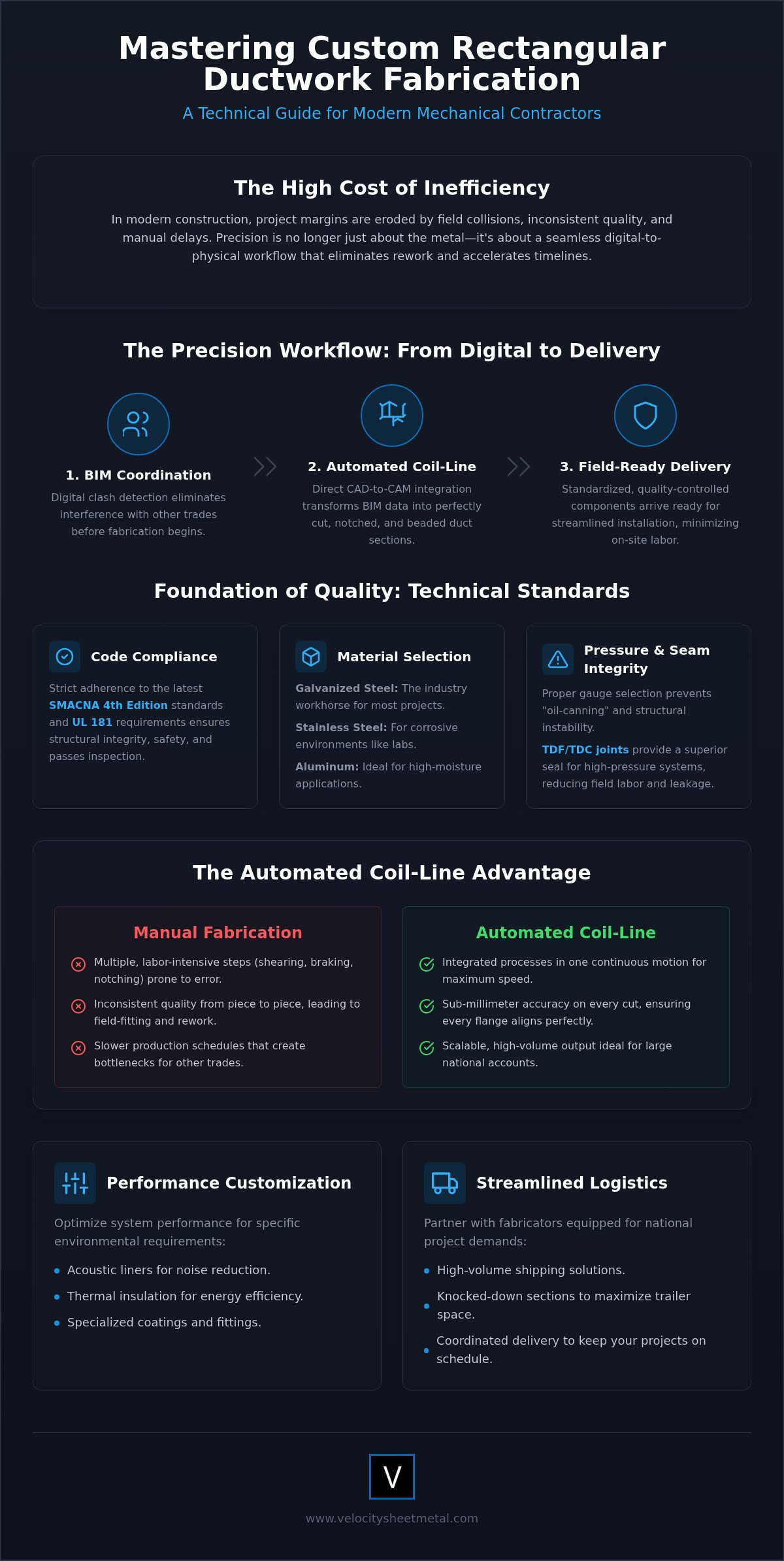
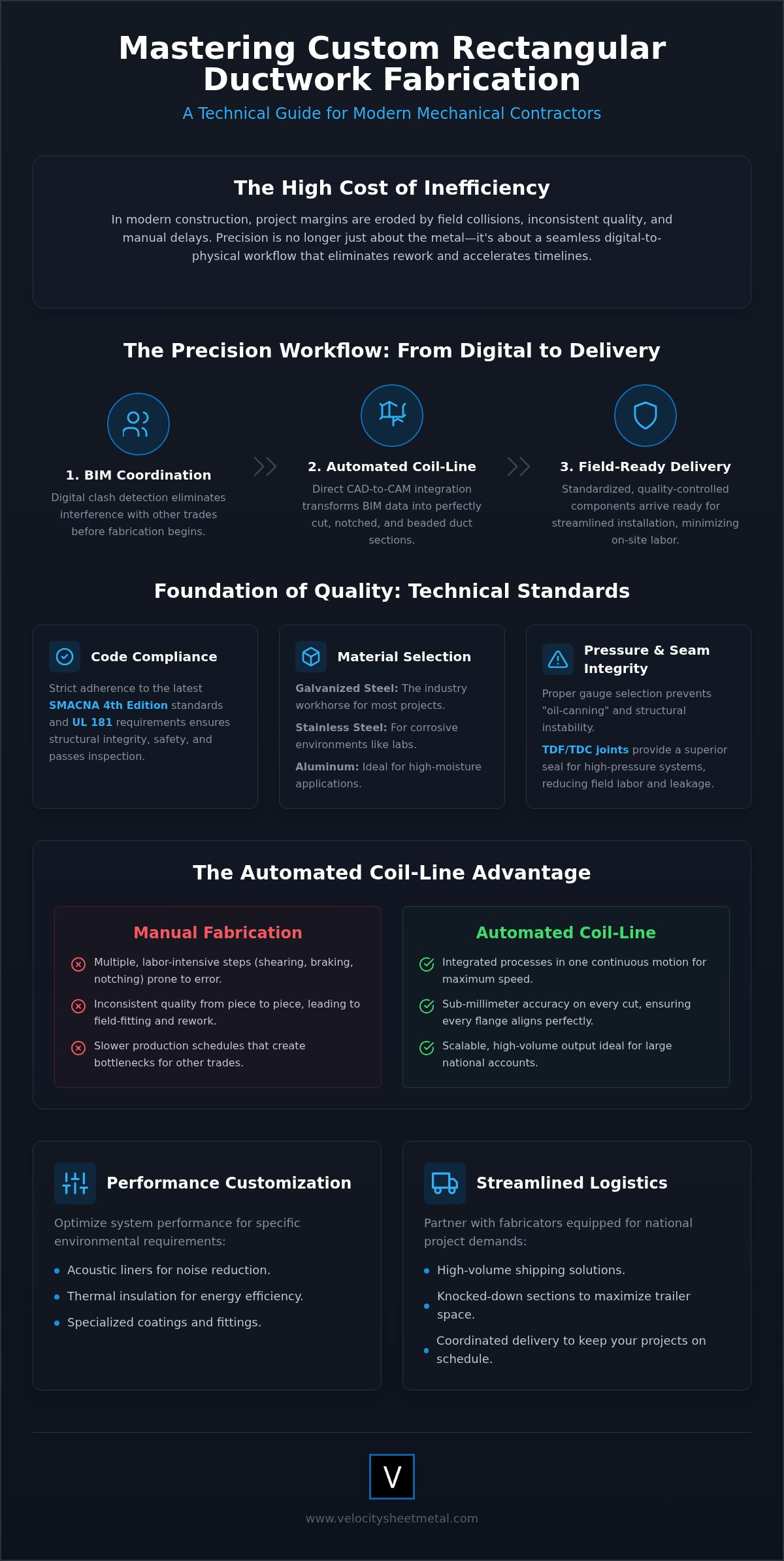
In 2026, a single field collision costs more than just lost hours; it erodes your entire project margin before the first hanger is even set. You've likely dealt with the frustration of inconsistent quality and manual delays during custom rectangular ductwork fabrication. It's a bottleneck that modern mechanical contractors can't afford. Precision today isn't just about the metal. It's about the digital-to-physical workflow that eliminates rework.
We understand that you need reliability at scale. This guide provides the technical roadmap to master procurement for high-volume, precision-engineered projects. You'll learn how to secure standardized quality for national accounts while cutting lead times through automated coil-line production. We're moving from the initial BIM file to the final physical delivery with surgical precision.
We'll explore the latest SMACNA 4th Edition standards and UL 181 compliance requirements. You'll also see how Revit 2025 and Trimble SysQue integration are transforming procurement from a guessing game into a streamlined manufacturing process. Let's get to work.
Key Takeaways
- Ensure structural integrity and code compliance by strictly adhering to the latest SMACNA standards for high-volume commercial air distribution.
- Leverage automated coil-line technology to accelerate custom rectangular ductwork fabrication while eliminating manual layout errors through direct CAD-to-CAM integration.
- Utilize BIM coordination and clash detection to identify interference with other trades digitally before physical production ever begins.
- Optimize system performance with specialized customization options, including acoustic liners and thermal insulation tailored for specific environmental requirements.
- Streamline national project logistics by partnering with fabricators who provide high-volume shipping solutions like knocked-down sections to maximize trailer space.
Technical Standards for Custom Rectangular Ductwork Fabrication
High-performance commercial buildings demand maximum airflow within increasingly tight ceiling cavities. While round or spiral options work for open aesthetics, custom rectangular ductwork fabrication remains the industry standard for high-volume air distribution in space-constrained builds. It offers the flexibility to hug structural beams and fit into low-profile plenums where other shapes fail. To ensure these systems perform over the long term, every component must align with the 4th Edition SMACNA standards. This isn't just about passing inspection; it's about preventing system failure under peak loads.
Modern HVAC duct systems rely on a strategic mix of materials. Galvanized steel is the workhorse for most 2026 projects, but specialized environments require more. We see a consistent shift toward stainless steel for laboratory exhaust and aluminum for high-moisture areas. Choosing the right material at the procurement stage prevents premature corrosion and avoids costly field replacements later in the project lifecycle.
Pressure Class and Gauge Specifications
Static pressure is the primary driver for metal thickness. If the gauge is too light for the pressure class, the duct walls will flex and vibrate. This leads to "oil-canning," a loud, metallic popping sound that signals structural instability and creates immediate noise complaints. We standardize gauges across large-scale projects to maintain consistent airflow performance and simplify the installation workflow. Balancing metal weight against cost is critical, especially with galvanized steel prices trending upward in mid-2026. Precision engineering ensures you don't over-specify and waste material, yet never under-specify and risk structural integrity.
Joint and Seam Integrity
The connection method defines the leakage class of the system. We compare TDF/TDC (Transverse Duct Flange/Connector) versus traditional S-and-Drive connections based on the project's pressure requirements. TDF/TDC joints provide a superior seal for high-pressure systems and significantly reduce the need for manual sealant application in the field. Automated seam sealing in the shop is critical. It ensures custom rectangular ductwork fabrication meets stringent 2026 leakage class requirements before it even arrives at the job site. This precision reduces labor costs and ensures the air reaches its intended destination. SMACNA compliance is the baseline for commercial HVAC longevity.
The Automated Coil-Line Advantage: Speed and Precision
Speed is the new currency in commercial construction. In a market where labor shortages and tight schedules are the norm, relying on manual fabrication is a strategic risk. Automated coil-line technology changes the equation. It transforms raw metal coils into finished, beaded, notched, and wrapped duct sections in one continuous movement. This transition from raw material to a staged product happens with a level of consistency that manual shops simply cannot replicate. For custom rectangular ductwork fabrication, this automation is the difference between meeting a deadline and holding up every other trade on the job site.
Digital integration is the backbone of this workflow. By using direct CAD-to-CAM software, we eliminate the traditional "telephone game" between the design office and the shop floor. The same BIM data used for coordination drives the plasma cutters and coil lines. This creates a seamless bridge from the digital file to the tangible product. Every piece is identical. Every flange aligns. This level of precision ensures that assembly on the job site is a matter of simple logistics rather than field-fitting and rework.
Manual vs. Automated Fabrication Workflows
The contrast between traditional methods and modern automation is stark. Manual fabrication requires multiple handoffs: shearing, braking, notching, and insulating are often separate, labor-intensive steps. Automated coil lines integrate these processes into a single machine. This consolidation allows us to cut production schedules significantly. While manual shops struggle with complex transitions, automation achieves sub-millimeter accuracy on every cut. We move your project from the shop floor to the trailer faster, ensuring your crew stays productive. If you need to scale quickly, our coil-line automated rectangular duct solutions provide the high-volume output necessary for national accounts.
Cost-Efficiency in High-Volume Production
Automation isn't just about speed; it's about maximizing every square inch of material. Advanced nesting patterns in our software minimize scrap, which is vital as galvanized steel prices remain volatile in 2026. By reducing material waste and labor hours, we lower the "per-foot" cost for large-scale industrial and commercial projects. This efficiency directly impacts your project ROI. Getting the building conditioned faster allows for earlier occupancy and fewer carrying costs. We focus on the industrial pragmatism of your bottom line, delivering a product that fits perfectly the first time, every time.
- Direct CAD-to-CAM integration eliminates manual layout errors.
- Continuous coil processing reduces production time by nearly half compared to manual methods.
- Optimized nesting patterns significantly lower material waste and overall project costs.
- Standardized output ensures seamless field assembly for national accounts.
BIM Coordination: Eliminating Field Collisions
Digital precision is the only way to safeguard your schedule against field collisions. BIM (Building Information Modeling) allows us to "build it twice" by constructing the entire system digitally before a single sheet of metal enters the coil line. This proactive strategy identifies interference with plumbing, electrical, and structural elements before fabrication starts. For custom rectangular ductwork fabrication, this means every transition and offset is verified against the actual building constraints. Identifying a clash in the model costs minutes; identifying it in the field costs thousands of dollars and days of delay.
The digital-to-physical workflow ensures that what is modeled is exactly what is manufactured. We use industry-leading software to create manufacturing-specific content that drives our automated equipment. This eliminates the traditional "telephone game" between the design office and the shop floor. The model isn't just a guide; it's the direct source of truth for the production line. This level of coordination is essential for 2026 projects that demand high energy efficiency and minimal air leakage, as it ensures every joint and seam aligns perfectly with the design intent.
The Role of Spool Drawings in Modern Fabrication
Mechanical spooling services streamline the handoff from engineering to the shop floor. By breaking down complex models into manageable, shippable sections, we simplify the entire logistics chain. These spool drawings provide a clear map for our shop team and your field crew. Every section comes pre-labeled and sequenced for installation. This organization improves installation speed and reduces the cognitive load on your field technicians. You can read more about BIM for sheet metal fabrication and how it optimizes the digital-to-physical workflow.
Reducing On-Site Rework and Waste
Field modifications are a project killer. The hidden cost of "making it fit" on-site includes wasted labor, material scrap, and potential damage to other trades' work. 3D coordination ensures that your ductwork clears structural obstructions without the need for a Sawzall or a hammer. We provide precision fabrication for mechanical contractors who value a "first-time-right" installation. By shifting the problem-solving phase to the design office, we eliminate the need for costly field rework. This methodical approach keeps your project on track and your margins intact even when facing the labor shortages common in the 2026 construction market.
Customization Options: Liners, Coatings, and Fittings
High-performance builds require more than basic sheet metal. custom rectangular ductwork fabrication allows for a level of customization that transforms a standard air path into a specialized mechanical asset. We focus on additions that enhance durability, acoustics, and thermal retention. These choices are critical for meeting 2026 energy codes and indoor air quality (IAQ) requirements.
Insulation and Acoustic Liner Selection
Internal liners serve two primary functions: thermal resistance and sound attenuation. Fiberglass is the traditional choice for budget-conscious projects needing reliable thermal protection. For environments where air purity is paramount, such as schools or medical offices, we recommend elastomeric foam. This fiber-free material prevents particulates from shedding into the airstream. Double-wall construction offers the highest level of protection. By sandwiching insulation between an inner and outer metal shell, we protect the liner from high-velocity air erosion. This setup is ideal for laboratory exhaust or high-pressure commercial systems. Balancing sound attenuation with budget constraints is essential for maintaining comfort in modern commercial office spaces.
Complex Fittings and Curb Adapters
Standard fittings rarely suffice in modern retrofit or high-density builds. Custom plenum boxes and intricate transitions are necessary to navigate tight mechanical rooms. Precision laser cutting allows us to manufacture these components with surgical accuracy. This is especially vital for curb adapters during RTU replacements. These adapters must match the existing roof footprint while aligning perfectly with new equipment inlets. A precise fit prevents air bypass and water infiltration. Our shop uses advanced CNC technology to ensure every fitting meets SMACNA 4th Edition standards.
You can learn more about how we scale this process through coil line duct fabrication for high-volume fitting production. If your next project requires specialized coatings or complex geometry, request a fabrication quote from Velocity Sheet Metal to review your specifications and secure your production slot.
Healthcare and laboratory environments often demand anti-microbial coatings. These specialized finishes are applied to the interior surfaces of the duct to inhibit the growth of bacteria and mold. It's a proactive measure that supports long-term facility health and meets stringent clinical standards. We provide these coatings as part of our comprehensive fabrication service, ensuring your ductwork is ready for installation upon delivery. This straight-talk approach to customization ensures your project stays on schedule and within technical compliance.
Sourcing and Logistics for National HVAC Projects
Managing a national HVAC rollout requires more than a local sheet metal shop. It demands a partner capable of maintaining standardized quality control across multiple regional job sites. When you centralize your custom rectangular ductwork fabrication, you eliminate the variability that plagues regional sourcing. One set of technical specifications. One consistent quality standard. One reliable point of contact. This industrial pragmatism ensures that whether your project is in a coastal city or a landlocked industrial park, the product arriving on-site matches your BIM model exactly. We act as the essential bridge between your digital design and a tangible, high-performance product.
Strategic procurement is about more than just the price per pound of steel. It is about the reliability of the supply chain. National accounts require a fabricator that understands the urgency of construction schedules. On-demand production schedules allow us to provide just-in-time delivery, which is a massive advantage in congested urban environments where on-site storage is non-existent. We align our production line with your installation sequence, ensuring that the metal arrives exactly when your crew is ready to hang it.
National Shipping and Distribution Strategy
Shipping large rectangular sections often means paying to move air. We solve this through high-density logistics management. By shipping sections as "knocked-down" or L-Vee components, we maximize trailer space and significantly reduce transit costs. This approach allows for high-volume loads that are easily assembled once they reach the destination. We employ specific packaging and crating techniques to prevent transit damage to custom rectangular sections, ensuring that flanges and seams remain pristine. Every delivery is tightly coordinated with your crane schedules and site readiness. We understand that a missed delivery window can stall an entire project, so we prioritize logistical precision as much as manufacturing accuracy.
Partnering for Success
Modern mechanical contractors and engineers are increasingly moving toward outsourced fabrication for OEMs to maintain their focus on installation and system design. This partnership model leverages our 50+ years of combined industry experience to solve complex design challenges before they reach the shop floor. We don't just take orders; we act as a technical guide to help you optimize your procurement strategy. Our team is equally comfortable in high-level design meetings and on the factory floor, providing a "straight-talk" approach to your fabrication needs. Contact Velocity Sheet Metal for a precision fabrication quote to discuss your national account requirements and secure your production slot. Our goal is to cut through administrative delays and get your project moving immediately.
Secure Your Project Timeline with Precision Fabrication
High-stakes commercial projects in 2026 leave no room for field-fitting errors or manufacturing delays. Success relies on a seamless transition from a digital BIM file to a physical product that fits perfectly upon arrival. By integrating automated coil-line production with full BIM coordination services, you eliminate the traditional bottlenecks of manual fabrication. This methodical approach ensures standardized quality and structural integrity across every section of your build. It's about moving your project from the design phase to the staging area with surgical precision.
Whether you're managing a single facility or a national account, the right partner for custom rectangular ductwork fabrication acts as a technical guide through the complexities of SMACNA compliance and logistics. We provide the speed of automated manufacturing and the reliability of national shipping to keep your mechanical teams productive. Ready to eliminate field collisions and accelerate your installation schedule? Request a Quote for Custom Rectangular Ductwork and let's get to work. We're ready to bridge the gap between your design and a tangible, high-performance result.
Frequently Asked Questions
What is the standard lead time for custom rectangular ductwork in 2026?
Lead times depend on project scale and current material availability. Automated shops like ours generally provide faster turnaround than traditional manual shops by using continuous coil processing. We focus on a just-in-time delivery model to align with your installation schedule and reduce on-site storage needs. Since we serve national accounts, we coordinate production slots to ensure your timeline remains intact despite the labor shortages currently impacting the construction industry.
Can custom rectangular ductwork be shipped pre-assembled?
Yes, we ship ductwork in the configuration that best suits your site logistics. You can choose pre-assembled sections for immediate installation or "knocked-down" L-Vee sections to maximize trailer space. Pre-assembled units reduce your on-site labor hours but require more shipping volume. We coordinate with your team to determine the most cost-effective shipping strategy based on your specific mechanical room constraints and available crane schedules at the job site.
What are the benefits of using an automated coil line for duct fabrication?
An automated coil line significantly accelerates custom rectangular ductwork fabrication by consolidating shearing, notching, and bending into one continuous process. This eliminates manual layout errors and ensures sub-millimeter precision across high-volume orders. You benefit from standardized quality that manual shops cannot replicate. Automation also optimizes material nesting, which reduces scrap waste and helps stabilize your per-foot costs during periods of steel price volatility in the 2026 market.
How does BIM coordination reduce the overall cost of HVAC projects?
BIM coordination identifies structural and trade interferences digitally before any metal enters production. This "build it twice" strategy prevents the hidden costs of field modifications and material waste. By using spool drawings and pre-sequenced labeling, your field crew spends less time solving problems and more time installing. Shifting the coordination phase to the design office protects your project margins from the high labor costs associated with on-site rework.
What materials are best for rectangular ductwork in high-moisture environments?
Aluminum and stainless steel are the preferred choices for high-moisture or corrosive environments. While galvanized steel is the workhorse for most commercial builds, it can fail prematurely in pools, laboratories, or industrial processing areas. Aluminum offers excellent corrosion resistance and a lighter weight for easier hanging. Stainless steel provides maximum durability for chemical exhaust. We help you select the material gauge and type that balances longevity with your system's static pressure requirements.
Does Velocity Sheet Metal provide SMACNA-compliant ductwork?
Yes, we manufacture all products to meet or exceed the latest SMACNA 4th Edition standards. Adherence to these benchmarks is our baseline for structural integrity and airflow performance. Our management team brings 50+ years of industry experience to every project, ensuring that your custom rectangular ductwork fabrication passes inspections and meets the rigorous safety requirements of commercial building codes. We prioritize technical compliance to ensure long-term system reliability for all national accounts.
How do I calculate the gauge requirements for my custom duct project?
Gauge requirements are determined by the duct’s dimensions and the system's static pressure class. Higher pressure systems or wider duct spans require thicker metal to prevent structural failure and noise issues like "oil-canning." We reference SMACNA tables to match the specific pressure requirements of your design with the appropriate metal thickness. Standardizing these gauges across your project ensures consistent performance and simplifies the procurement process for your engineering team during the design phase.
What is the difference between TDF and TDC duct connections?
TDF (Transverse Duct Flange) and TDC (Transverse Duct Connector) are both flange-style connections formed directly on the duct wall. The primary difference lies in the specific profile and the machinery used to create the flange. Both provide a superior seal for high-pressure systems compared to traditional S-and-Drive connections. TDF and TDC reduce the need for manual sealing in the field, which lowers your labor costs and improves the overall leakage class of your HVAC system.