Custom Mounting Brackets for Industrial Equipment: The 2026 Manufacturing Guide
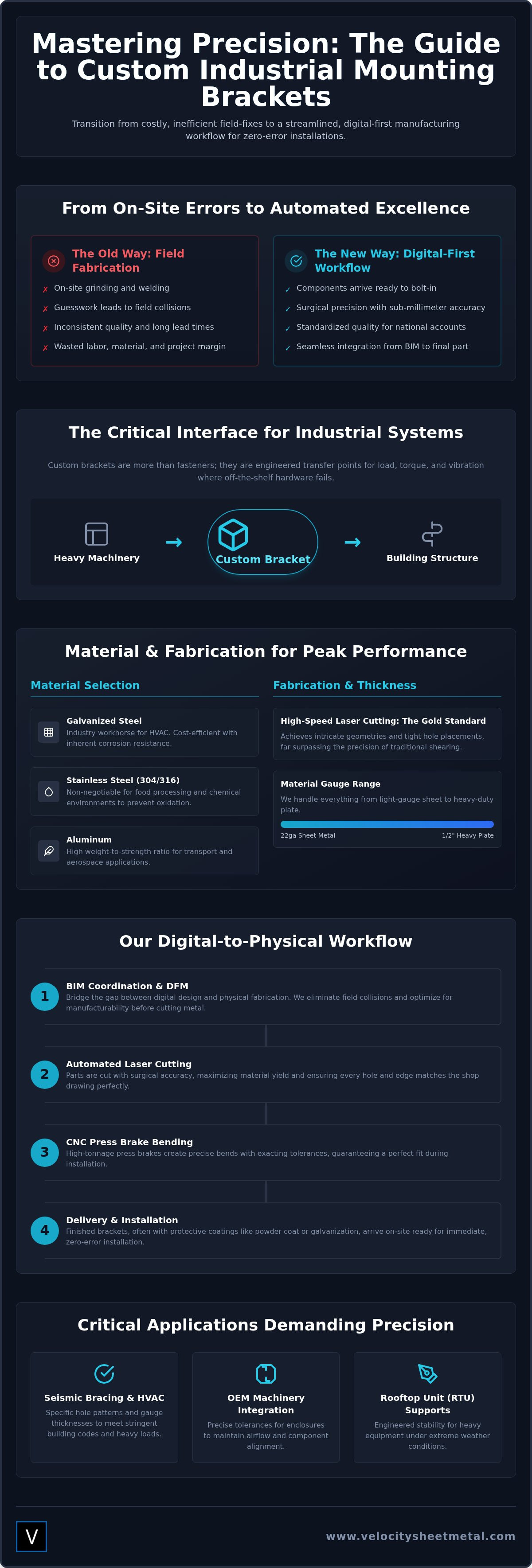
A field-fix is a failure of design. If your team is still grinding and welding on-site to make components fit, you're losing margin to avoidable inefficiency. Procuring custom mounting brackets for industrial equipment shouldn't involve guesswork or the long lead times that typically stall a project. You need components that arrive ready to bolt in, backed by the surgical precision of a digital-first manufacturing workflow. From the initial digital concept to the final physical result, the goal is a seamless integration that keeps your timeline moving.
We know that field collisions in tight mechanical rooms and inconsistent quality across sites are your biggest headaches. This guide will help you master the process of designing and procuring precision-engineered brackets using automated laser cutting, CNC bending, and BIM coordination. You'll learn how to bridge the gap between a digital model and a tangible product to achieve zero-error field installations. We'll break down the transition from manual fabrication to a streamlined, DFM-focused approach that reduces material waste and standardizes quality for your national accounts.
Key Takeaways
- Understand why custom mounting brackets for industrial equipment are the critical interface for heavy-load systems where standard hardware fails.
- Select the ideal material and gauge, from 22ga to 1/2" plate, to ensure your brackets meet structural requirements and environmental conditions.
- Use BIM coordination to bridge the gap between digital design and physical fabrication, eliminating field collisions before they happen.
- Optimize your workflow through automated laser cutting and CNC bending to maximize material yield and ensure precision tolerances.
- Scale your operations by standardizing bracket quality across national accounts, ensuring consistent parts arrive on-site and on-time.
The Role of Custom Mounting Brackets in Industrial Mechanical Systems
In industrial mechanical systems, custom mounting brackets for industrial equipment serve as the critical interface between heavy machinery and the building's structural frame. They are more than simple fasteners; they are engineered transfer points for load, torque, and vibration. Off-the-shelf hardware often fails in high-vibration or heavy-load environments because it lacks the specific geometry and material thickness required to maintain long-term structural integrity. When a generic bracket shears or deforms, the resulting downtime and equipment damage far outweigh the initial cost of a precision-engineered part.
The financial impact of a precision-fit bracket is felt most acutely in total project labor costs. Field-fixing a mismatched bracket consumes hours of skilled labor that should be spent on system commissioning. By adopting custom fabrication, OEMs and contractors support the industry-wide shift toward industrialized construction. This approach prioritizes pre-fabrication and digital-to-physical workflows, ensuring that every component is ready for immediate installation upon arrival. We move the process from a digital BIM file to a physical component with sub-millimeter accuracy, creating a reliable bridge between design intent and field reality.
Critical Applications for Custom Fabricated Brackets
Industrial systems demand specialized support that standard catalogs cannot provide. Seismic bracing and heavy equipment mounts for HVAC systems require specific hole patterns and gauge thicknesses to meet stringent building codes. For OEM machinery, these brackets often integrate directly into enclosures. This requires precise tolerances to maintain airflow and component alignment. Custom rooftop unit (RTU) supports and curb adapter integration ensure that heavy equipment remains stable under extreme weather conditions. This moves the project from a state of site-specific uncertainty to one of engineered predictability.
The Move from Field-Fabricated to Shop-Automated Parts
The traditional "measure-cut-weld" cycle on the job site is a relic of inefficient construction. Modern manufacturing replaces this with shop-automated production. Procuring custom mounting brackets for industrial equipment through an automated facility ensures that every part matches the engineered shop drawing with surgical accuracy. By utilizing BIM coordination and spool drawings, we eliminate the guesswork that leads to field collisions. Automated laser cutting and CNC press brake bending allow us to maximize material yield and reduce scrap. This shift doesn't just speed up installation; it reduces material waste and ensures consistent load-bearing capacity across every project site.
Selecting Materials and Fabrication Methods for Industrial Brackets
Material selection isn't just a line item; it's the primary factor in your system's long-term survivability. When specifying custom mounting brackets for industrial equipment, you must balance mechanical strength against the realities of the installation environment. Galvanized steel remains the industry workhorse for HVAC supports due to its cost-efficiency and inherent corrosion resistance. For food processing or chemical-heavy environments, 304 or 316 stainless steel is non-negotiable to prevent oxidation. Aluminum offers a high weight-to-strength ratio for specialized transport or aerospace applications where every ounce matters. We move from these base metal choices to the specific gauge thickness required for the load.
The fabrication method is dictated by the material gauge, which can range from 22ga sheet metal to 1/2" heavy plate. While traditional mechanical shearing works for simple, straight cuts, it lacks the precision required for modern industrial tolerances. High-speed laser cutting has become the 2026 gold standard for achieving intricate geometries and tight hole placements. Once the parts are cut, selecting an industrial finish provides the final layer of protection. Whether it's powder coating for aesthetic durability, hot-dip galvanization for maximum outdoor life, or a simple mill finish for internal components, the coating must match the site conditions. For projects requiring rapid turnaround on complex geometries, our custom laser cutting capabilities deliver parts that meet these rigorous standards without delay.
Material Performance Standards for Industrial Environments
Industrial sites don't forgive poor material choices. Corrosion resistance is the top priority for outdoor rooftop units or coastal installations. Weight-to-strength ratios become critical when mounting equipment to existing structures with limited load capacities. Compliance with OSHA and ANSI safety standards ensures that mounting distances and structural loads remain within legal and safe limits. For high-volume HVAC projects, galvanized steel provides the best cost-benefit ratio while maintaining the structural integrity required by national building codes.
Laser Cutting vs. Traditional Mechanical Shearing
Automated laser cutting is the only way to ensure 2026 manufacturing standards are met. Unlike mechanical shearing, which can deform the edge of the metal, laser cutting maintains a clean, square edge with a tolerance of +/- 0.005 inches. This precision is vital when working with stainless steel, as it minimizes the heat-affected zone (HAZ) and prevents the material's grain structure from becoming brittle. Laser cutting precision serves as the essential foundation for zero-error assembly in complex mechanical systems. It allows for the creation of nested parts that maximize material yield, directly reducing your scrap costs and total project spend.
Design for Manufacturability (DFM) and BIM Coordination
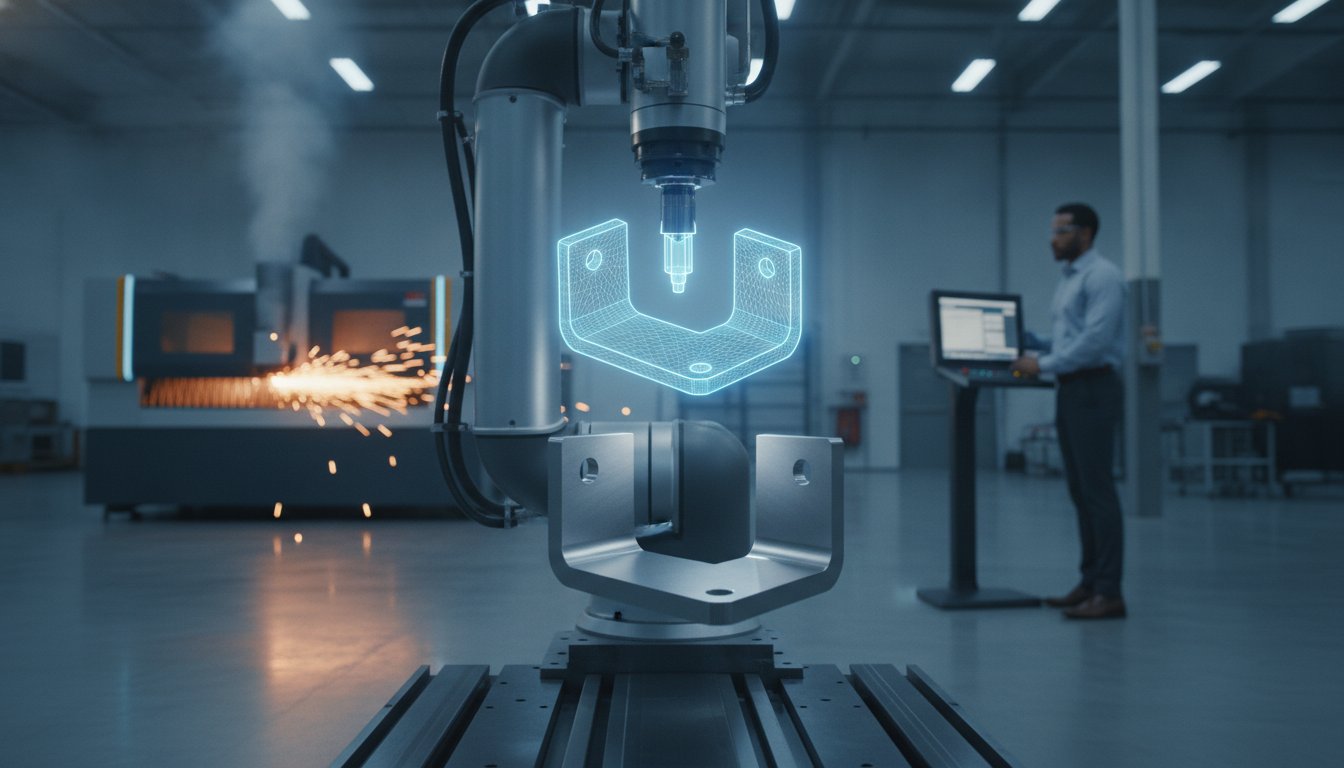
Digital precision prevents physical waste. The 2026 digital-to-physical workflow has eliminated the gap between engineering and the factory floor. When designing custom mounting brackets for industrial equipment, the process begins long before the laser touches the metal. It starts in a BIM (Building Information Modeling) environment where every bracket is treated as a critical node in a larger mechanical system. This integration allows the BIM model to drive the CNC machine directly. It ensures that the physical output is a literal translation of the digital file. By utilizing industry-standard formats like STEP, DXF, and DWG, we remove the manual re-entry errors that often plague traditional fabrication.
BIM coordination is your primary defense against field collisions. In crowded mechanical rooms, a bracket that's off by half an inch can force a complete redesign of surrounding ductwork or piping. By coordinating these components in a 3D environment, we identify and resolve spatial conflicts before parts reach the job site. This proactive approach ensures that every bracket fits perfectly into the specified zone. It maintains the integrity of the overall system layout and prevents the dreaded "field-fix" that kills project margins.
Initial design phases must account for the physical properties of the metal. Factoring in bend deductions and K-factors is essential for precision. A flat part grows when it's bent. If your CAD model doesn't account for this elongation, the final hole placement will be incorrect. We apply these technical specifications during the DFM review to ensure that the finished product matches your assembly requirements with surgical accuracy. This isn't just about making a part; it's about making a part that works within a complex assembly.
BIM Integration for Mechanical and HVAC Contractors
Spool drawings are the tactical output of a well-coordinated BIM model. They allow for the automated production of custom mounting brackets for industrial equipment alongside ductwork fabrication. This synchronized approach reduces overall project waste by ensuring that support systems are manufactured in parallel with the equipment they hold. For a deeper dive into these processes, see our guide on BIM for Sheet Metal Fabrication: The 2026 Guide to Digital-to-Physical Workflows. Mechanical BIM services act as the essential bridge between a digital file and a tangible, high-performance product.
DFM Checklist for Precision Brackets
Don't design in a vacuum. Follow these DFM principles to ensure your brackets are optimized for automated production:
- Hole Placement: Maintain a minimum hole-to-edge distance of at least 1.5 times the material thickness to prevent tearing during the CNC bending process.
- Standardize Radii: Use consistent bend radii across all parts to reduce tooling changes and lower production costs.
- Hardware Clearances: Always account for fastener head heights and tool access in your 3D model to ensure easy field installation.
- Material Yield: Design part geometries that allow for tight nesting on a standard sheet to maximize material utilization.

The Manufacturing Process: From Laser Blanking to CNC Bending
Precision manufacturing is a methodical sequence that transforms raw data into physical components. It begins with digital nesting to maximize material yield and slash scrap costs. Our software analyzes the 2D profiles of your custom mounting brackets for industrial equipment to pack them onto standard sheet sizes with surgical efficiency. This optimization ensures you're paying for product, not waste. Once the nest is finalized, we move to high-speed laser cutting. This stage delivers precise hole placement and superior edge quality with tolerances of +/- 0.005 inches. We then transition to CNC press brake bending for repeatable accuracy across large batches. The process concludes with a rigorous quality control inspection. We use digital templates and calibrated hardware to verify that every dimension matches the original BIM model exactly.
This four-step workflow is designed to eliminate the variables that cause field errors. By moving directly from a digital file to a physical part, we maintain the integrity of the design throughout the production line. There's no room for manual interpretation or "close enough" measurements. Each step is documented and controlled, ensuring that the first bracket in a production run is identical to the thousandth. This level of control is what allows us to act as a reliable bridge between your design intent and the final installation on the factory floor.
Automated Laser Cutting for Rapid Part Production
Automation allows for 24/7 production cycles on high-volume orders of custom mounting brackets for industrial equipment. This speed is essential for maintaining aggressive project timelines without sacrificing quality. High-quality fiber laser optics provide a clean, square cut that significantly reduces the need for secondary deburring. This keeps the workflow moving and ensures parts are ready for the next stage of production immediately. For a detailed breakdown of how to specify these requirements, read our Precision Laser Cutting Services: The 2026 Buyer’s Guide for Industrial Parts. This digital-to-physical transition is the backbone of modern industrial fabrication.
Consistency in CNC Press Brake Bending
Multi-bend industrial brackets require programmable back-gauging to maintain repeatable accuracy across every part. CNC press brake bending allows us to hold tight tolerances across different material batches and gauge thicknesses. This consistency is what makes a zero-error field installation possible. Whether you're ordering ten parts or ten thousand, the geometry remains identical. Automated bending is the only way to maintain the lead times required by national accounts and large-scale OEM operations. It removes the human error associated with manual setups and ensures your assembly lines never stop. If you need parts that fit the first time, request a quote for CNC bending today.
Scaling Production: Why National Accounts Prioritize Automated Fabrication
National accounts don't have time for regional inconsistency. When managing projects across multiple states, the logistics of national shipping become as critical as the fabrication itself. Centralizing the production of custom mounting brackets for industrial equipment ensures that every part arrives on-site, on-time, and built to the exact same specification. This eliminates the risk of varied quality between local vendors. Standardizing part quality ensures compliance with national building codes and OEM specifications across your entire portfolio. It moves your procurement strategy from a fragmented local model to a streamlined national engine.
Outsourcing to specialized, automated shops offers significant financial benefits. You shift the overhead of equipment maintenance and skilled labor to a partner focused entirely on production efficiency. High-volume shops are built for on-demand production. They can handle rapid project pivots that would cripple a smaller operation. This agility allows you to respond to field changes without blowing your schedule or your budget. The ROI is found in the speed of delivery and the total elimination of field-level troubleshooting. Precision isn't a luxury; it's a requirement for scaling.
Standardization Across Large-Scale Project Sites
Regional fabrication quality variations are a hidden project killer. Centralized automated production removes this variable entirely. By using the same digital files and automated equipment, we provide simplified procurement for national mechanical contractors and industrial engineers. This level of consistency is the same philosophy we apply to our coil line duct fabrication services. It ensures that every component, from the largest duct to the smallest bracket, meets the same high-performance standard regardless of the project destination. One set of drawings. One standard of quality. Zero field surprises.
Future-Proofing Manufacturing with Automated Workflows
The role of advanced robotics and AI in 2026 sheet metal fabrication is defined by predictive precision. These tools allow us to anticipate production bottlenecks and optimize machine uptime. Speed and precision aren't just technical goals; they are the primary drivers of manufacturing ROI. In a market where lead times are shrinking, the ability to bridge the gap between a digital file and a physical product instantly is your competitive advantage. We act as the essential bridge between your engineering team and the physical hardware required for system success. Ready to streamline your next project? Contact Velocity Sheet Metal for a quote on your custom bracket project.
Advancing Toward Zero-Error Industrial Installation
Modern manufacturing has moved beyond the site-specific "field fix." By leveraging a BIM-to-physical workflow, you ensure that every component fits the first time. Automated laser cutting and CNC bending have replaced manual fabrication, delivering tolerances that meet the most rigorous 2026 standards. This shift doesn't just save time; it eliminates the material waste and labor overruns that often stall large-scale projects. You're no longer guessing in the field; you're executing a digital plan with surgical precision.
Standardizing quality across national accounts is now a baseline requirement for competitive OEMs and contractors. With our automated high-volume production and national shipping capabilities, you can maintain consistent quality from site to site without regional variation. Procuring custom mounting brackets for industrial equipment has evolved into a streamlined, digital process where precision is guaranteed. It's time to bridge the gap between your 3D model and the physical product. Get an Instant Quote on Custom Metal Brackets to keep your next project moving at peak efficiency. We're ready to get to work on your next build.
Frequently Asked Questions
What is the typical lead time for custom industrial bracket manufacturing?
Lead times vary based on order volume and material availability, but automated shops prioritize speed. Most standardized bracket orders move from digital approval to the shipping dock in two to three weeks. For national accounts with recurring needs, on-demand production cycles can compress these timelines even further. We value your schedule as much as our own precision.
Can you manufacture brackets directly from BIM or spool drawings?
We manufacture components directly from BIM models and spool drawings. This digital-to-physical workflow is the core of our operation. It eliminates manual transcription errors. It ensures your physical hardware matches the coordinated model with surgical accuracy. By using spool drawings, we can automate the production of custom mounting brackets for industrial equipment in parallel with other mechanical systems.
What are the most common materials used for industrial mounting brackets?
The most common materials include galvanized steel, stainless steel, and aluminum. Galvanized steel is the industrial workhorse for HVAC supports because it's cost-effective. Stainless steel, specifically 304 or 316, is necessary for corrosive or chemical-heavy sites. Aluminum is the choice for weight-sensitive applications. We match the material gauge, ranging from 22ga to 1/2" plate, to your specific load requirements.
Do you offer nationwide shipping for large-scale bracket orders?
We offer nationwide shipping for all large-scale bracket orders. This supports standardized project quality across all your sites. Our logistics network handles high-volume deliveries to ensure components arrive on-time. Centralizing your fabrication with a single automated partner removes the quality variations often found with local vendors. It's the most efficient way to manage national mechanical accounts.
What is the maximum metal gauge thickness for CNC press brake bending?
Our CNC press brake bending equipment handles materials from 22ga sheet metal up to 1/2" heavy plate. The specific limit depends on the material type and the desired bend radius. We use programmable back-gauging to maintain repeatable accuracy across every part. This ensures that even the heaviest brackets meet the tight tolerances required for zero-error field installation.
How do I ensure my bracket design is cost-effective for high-volume production?
Focus on Design for Manufacturability (DFM) to keep high-volume costs low. Standardize your bend radii and hole diameters to minimize tooling changes on the factory floor. Designing geometries that allow for tight digital nesting on standard sheets will maximize material yield. This reduces scrap costs. It's the fastest way to improve your manufacturing ROI without sacrificing structural integrity.
Is laser cutting better than waterjet for custom industrial brackets?
Laser cutting is the gold standard for speed and edge quality in 2026. While waterjet is useful for extremely thick materials, fiber lasers are significantly faster for the gauges typically used in custom mounting brackets for industrial equipment. Laser cutting provides a clean, square edge with a tolerance of +/- 0.005 inches. This precision reduces the need for secondary deburring and keeps your production timeline moving.
What CAD file formats are required for a manufacturing quote?
We require industry-standard CAD file formats for all manufacturing quotes. STEP files are the preferred choice for 3D models. DXF and DWG formats are essential for 2D laser blanking profiles. Providing clean, properly scaled files allows our engineering team to move quickly. It ensures a seamless transition from your digital concept to a tangible physical product on our production line.