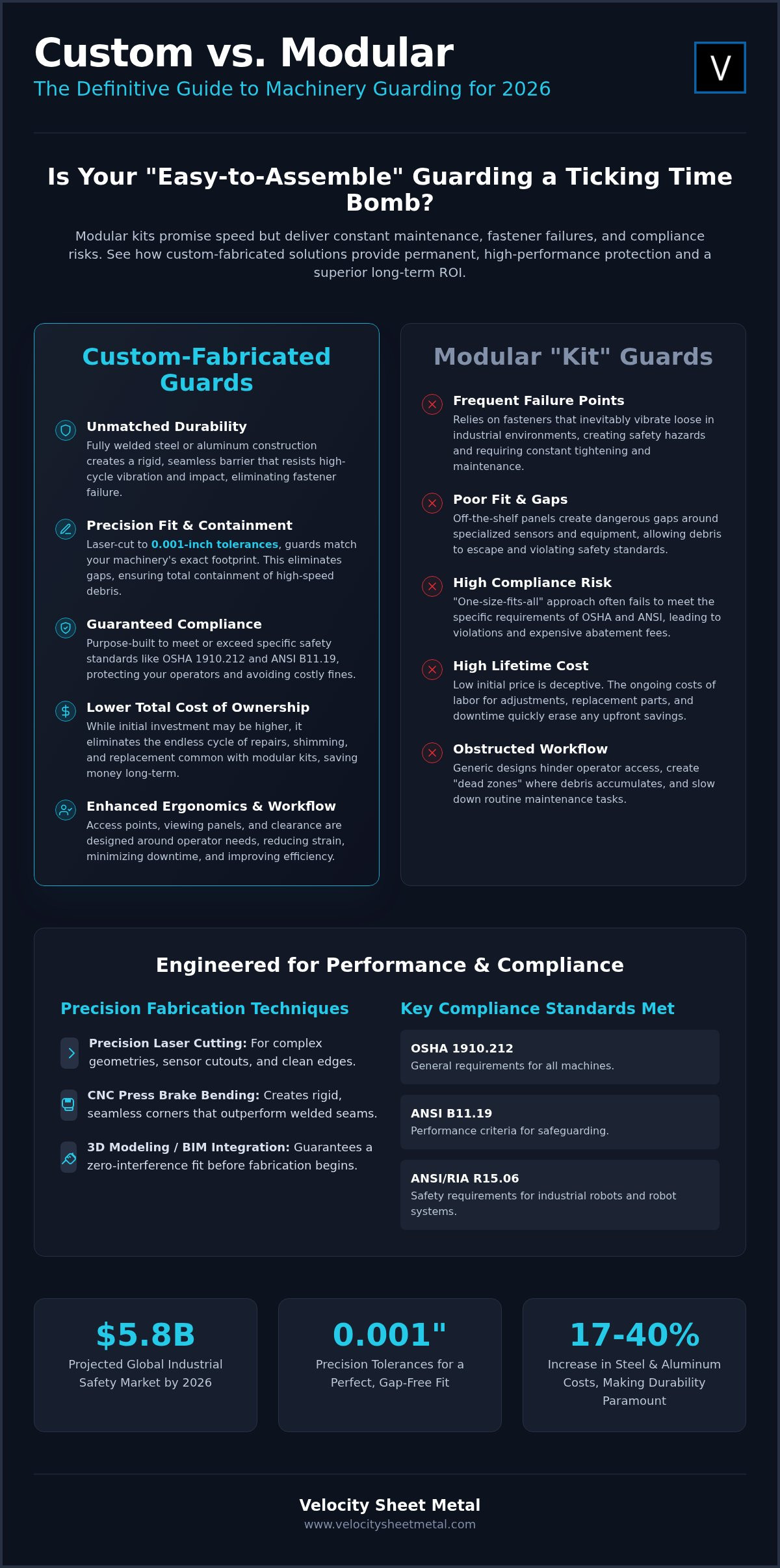
Custom Machinery Guards and Enclosures: A 2026 Industrial Guide
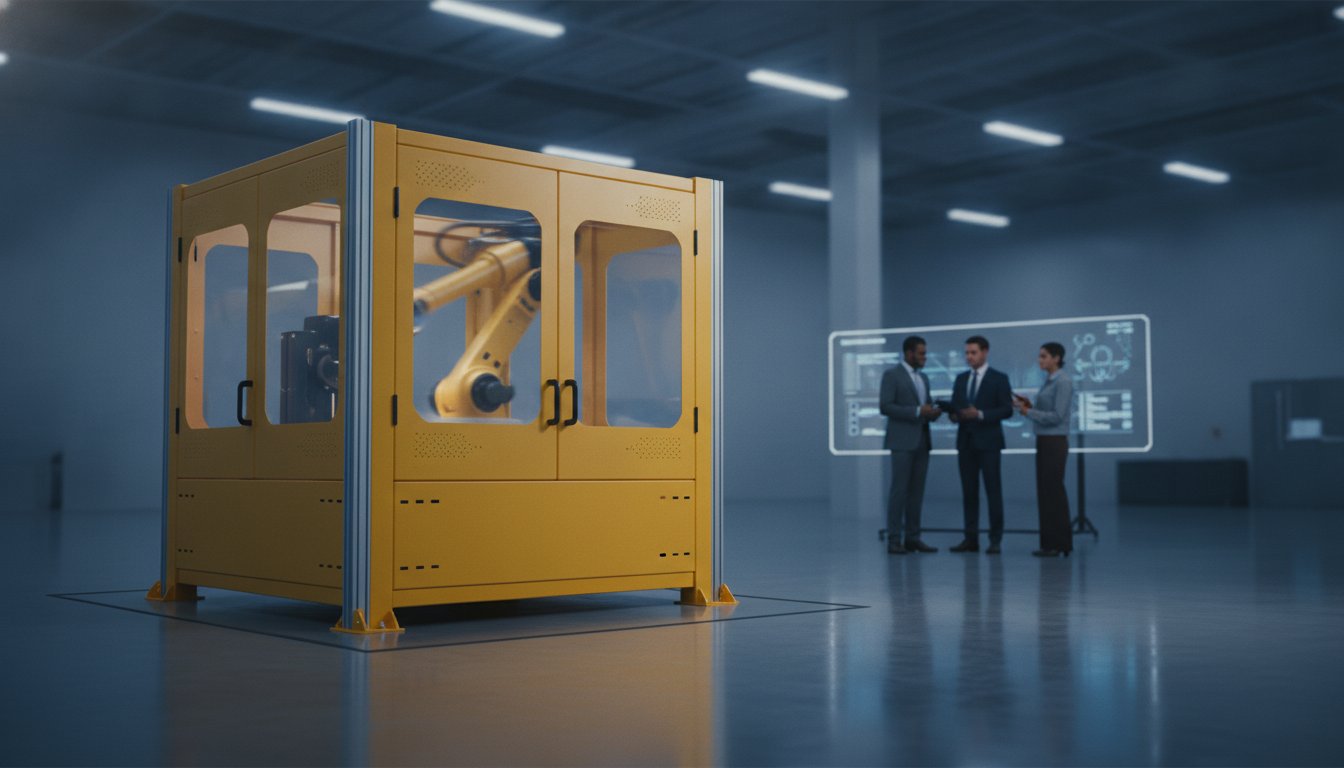
That "easy-to-assemble" modular guarding kit is likely the most expensive safety mistake on your factory floor. You've seen it happen. You install a kit to save time, but within months, the fasteners vibrate loose and the off-the-shelf panels don't quite clear your specialized sensors. It's a cycle of constant shimming and worrying if your custom machinery guards and enclosures actually meet OSHA 1910.212 standards. You need gear that works as hard as your machinery does.
This 2026 guide shows you how custom-fabricated sheet metal outperforms modular kits in every metric that matters: durability, compliance, and long-term industrial ROI. We'll move from the technical requirements of ANSI B11.19 to the practical benefits of CNC press brake bending and laser-cut steel. You'll learn how precision fabrication eliminates debris-related downtime and provides a scalable safety solution for your entire national operation. We're breaking down the shift from temporary fixes to permanent, high-performance protection that stays tight and keeps your facility compliant.
Key Takeaways
- Identify why welded custom machinery guards and enclosures provide a lower total cost of ownership by eliminating the fastener failure common in modular kits.
- Discover how precision laser cutting and 0.001-inch tolerances ensure safety barriers fit specialized equipment perfectly without the need for on-site modifications.
- Master the 2026 compliance requirements for OSHA 1910.212 and ANSI B11 to protect operators and avoid costly abatement fees.
- Learn how centralized, automated fabrication supports national OEM operations by ensuring consistent quality and reduced logistics friction across every facility.
What are Custom Machinery Guards and Enclosures?
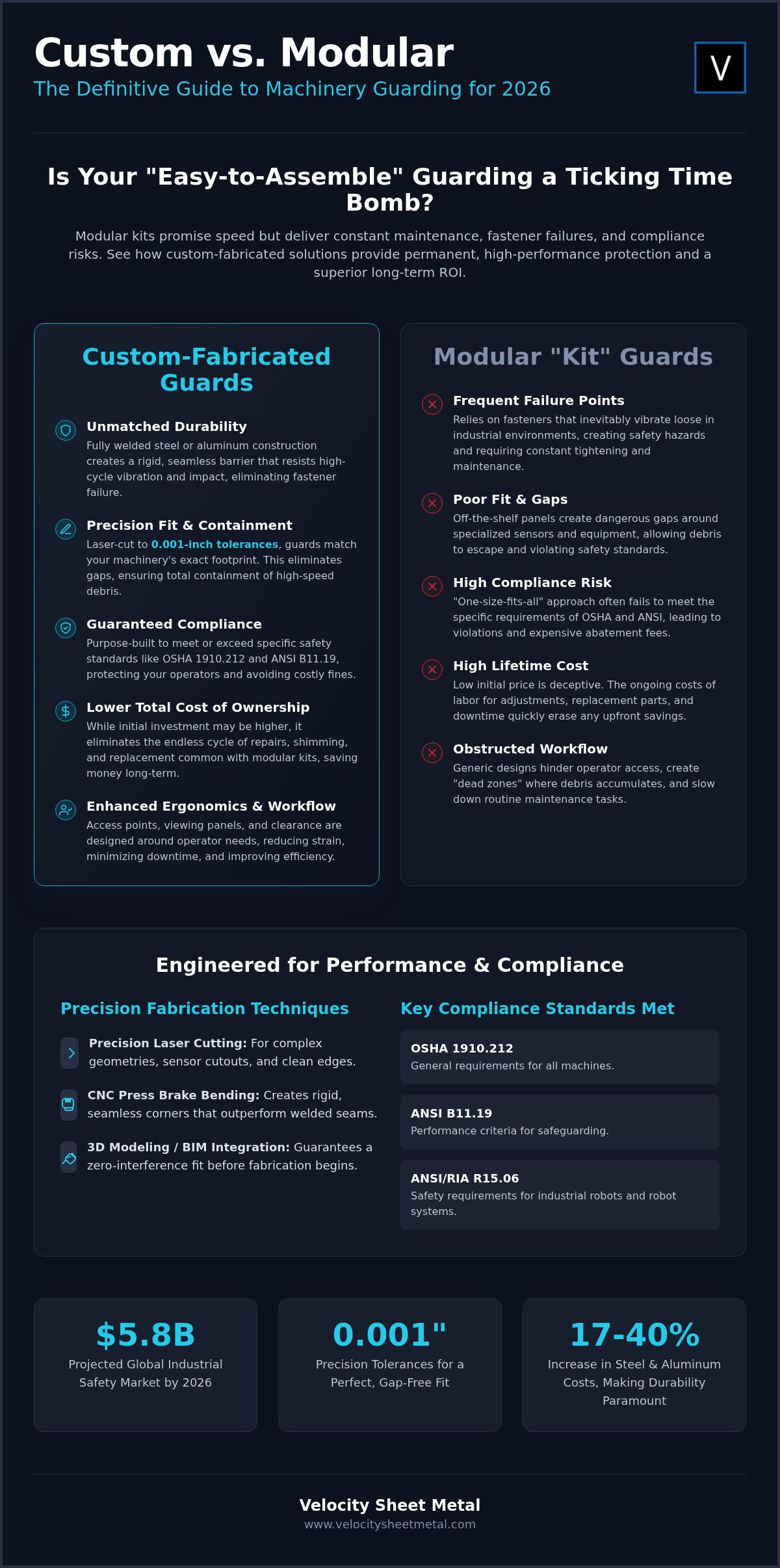
Custom machinery guards and enclosures are precision-engineered physical barriers designed to isolate industrial hazards and protect your workforce. They aren't just generic fences. These are application-specific systems built to contain high-speed debris, dampen acoustic noise, and prevent accidental contact with moving parts. By 2026, the global industrial safety market has climbed to USD 5.8 billion. This growth is fueled by a massive shift away from generic shielding. Modern facilities don't settle for kits that vibrate loose. They demand enclosures that integrate seamlessly with their specific production technology.
Generic machinery guards fail because they ignore the unique geometry of specialized machinery. A gap of just a few inches can lead to OSHA violations or allow dangerous metal shards to escape. Professional custom machinery guards and enclosures solve this by matching the machine's exact footprint. This ensures total containment without compromising operational speed. When you're running high-precision lines, the guard must be as accurate as the machine it protects.
Key Components of a Modern Safety Enclosure
A professional-grade enclosure relies on three primary elements. First is the structural framing. In 2026, domestic steel and aluminum prices have increased 17-40 percent due to tariffs. While steel offers a lower initial material cost, aluminum is often more economical over the total lifespan because it requires less maintenance. Second, viewing panels must use impact-rated polycarbonate or integrated mesh to allow visibility without sacrificing safety. Finally, every access point must be functional. This includes sliding doors and hinged panels equipped with safety-rated interlocked doors. These are mandatory for robotic cells under ANSI/RIA R15.06 standards. Leveraging precision laser cutting services allows for the 0.001-inch tolerances needed for these components to fit perfectly.
The Role of Customization in Operator Ergonomics
Safety shouldn't slow down production. Custom designs place access points exactly where operators need them for routine checks. This reduces physical strain. It keeps the workflow moving. We eliminate "dead zones" by shaping the enclosure to match the machine's movement. This prevents debris from accumulating in hard-to-reach corners. It reduces cleaning time and equipment downtime. Integrated lighting and tool-less maintenance panels further reduce operator fatigue. When the guard is built for the human as much as the machine, compliance becomes the path of least resistance.
Engineering the Enclosure: Precision Fabrication Techniques
Precision isn't a luxury in safety engineering. It's a requirement. When you're dealing with high-speed rotors or robotic arms, a fraction of an inch matters. We target 0.001-inch tolerances to ensure every component of your custom machinery guards and enclosures fits exactly as designed. This level of accuracy prevents the structural gaps that lead to safety citations or equipment failure. It ensures that the guard becomes a part of the machine, not an obstacle to it.
Achieving this requires precision laser cutting services. Laser technology handles complex geometries with ease, creating clean edges that don't require secondary finishing. It allows for specialized cutouts for sensors and cooling vents without compromising the shield's integrity. Material choice further refines the build. We use stainless steel for wash-down environments and heavy-gauge carbon steel for high-impact containment. These materials are formed using CNC press brakes to create rigid, seamless corners. These bends resist vibration better than traditional welded seams, extending the life of the enclosure in high-cycle environments.
Digital-to-Physical Integration with BIM
We bring the same precision to guarding that we use for BIM clash detection for HVAC fabrication. This digital-first approach ensures zero-interference fitment with your existing facility infrastructure. We map out electrical lines, plumbing, and structural columns in the virtual space. 3D modeling eliminates the need for expensive field modifications by identifying and resolving conflicts before the first piece of metal is cut. It's the only way to guarantee a perfect fit on the first try.
Advanced Forming for Structural Integrity
Structural failure isn't an option for safety-critical parts. We focus on avoiding common press brake forming defects such as over-bending or material thinning at the radius. Single-piece bends provide superior strength compared to multiple welded segments. They distribute kinetic energy more effectively during an impact. By standardizing mounting brackets across all designs, we ensure your team can perform rapid, consistent installations across the plant floor. If you need a partner who understands the bridge between digital design and physical delivery, explore our custom fabrication capabilities today.
Sheet Metal vs. Modular Aluminum: The Durability Debate
Modular aluminum kits are often sold as the fast, convenient choice for safety. They arrive in boxes and assemble with T-slot fasteners. However, in a high-vibration industrial environment, that convenience carries a hidden expiration date. T-slot hardware is notorious for vibrating loose under the constant harmonic stress of heavy machinery. Once a fastener slips, the entire frame loses its structural integrity. Custom machinery guards and enclosures made from welded steel or CNC-bent sheet metal eliminate this failure point entirely. By creating a unified, rigid structure, we ensure the guard remains as stable on year five as it was on day one.
Impact capacity is the second major differentiator. When a component fails at high RPM, the resulting kinetic energy must be absorbed instantly. Fabricated steel enclosures offer superior energy dissipation compared to bolted aluminum frames. A welded seam distributes the force across the entire panel; a bolted joint concentrates it on a single fastener. Furthermore, sheet metal allows for superior space optimization. We use CNC press brakes to follow the machine's specific contours. This "hugging" effect saves valuable floor space and prevents the boxy, intrusive footprint typical of modular kits.
Long-Term ROI of Fabricated Guards
The initial price tag of a modular kit might look attractive, but the replacement cycle tells a different story. Industrial operators often find themselves rebuilding modular guards every 18 to 24 months due to structural fatigue. Fabricated guards are a permanent investment. They reduce the hidden costs of modular downtime, such as the man-hours spent retightening hardware or shimming misaligned panels. Beyond safety, custom enclosures improve machine uptime by containing coolant and chips more effectively. This keeps the surrounding facility cleaner and prevents abrasive debris from reaching sensitive electronic components.
Environmental Considerations
Your facility's environment dictates your material requirements. For food processing or pharmaceutical lines, we utilize stainless steel to withstand aggressive wash-down cycles that would corrode standard aluminum. For high-heat applications, we integrate precision-cut ventilation patterns that allow heat to escape without creating a reach-through hazard. We also offer professional powder coating services. This provides a durable, chemical-resistant finish that can be matched to your corporate branding, ensuring your safety systems look as professional as the machines they protect. From heavy-duty containment to aesthetic consistency, fabricated solutions outperform kits in every industrial category.
The Procurement Roadmap: Compliance and Standards
Procurement for safety systems is a high-stakes process. A failure in compliance leads to more than just fines; it leads to downtime and injury. OSHA 1910.212 mandates that every machine has physical guarding to prevent operator contact with hazards like ingoing nip points and rotating parts. While OSHA sets the performance requirement, ANSI B11 standards provide the technical specifics for metalworking and power press safety. Custom machinery guards and enclosures offer a level of traceability that catalog parts simply can't match. Every unit can be serialized and matched to a digital twin for simplified maintenance and inspection records across your entire facility.
Managing lead times is critical for national operations. We bridge the gap between design and delivery by using automated fabrication lines that move your project from a 3D model to a physical product in a fraction of the time required by traditional shops. This digital-to-physical workflow ensures that the guard you approve in the design phase is exactly what arrives at your loading dock. You don't have to choose between speed and precision when you work with a partner who prioritizes automated quality control.
Developing a Design Specification
You must identify hazards at both the point of operation and along power transmission routes like belts and pulleys. Calculating safety distance is a function of the opening size in your guard. Reach-over safety logic focuses on the vertical height of the barrier to prevent access, while reach-through logic limits opening sizes based on the distance to the hazard. Getting these calculations wrong results in a guard that looks safe but fails an inspection. Professional fabrication ensures these openings are laser-cut to exact safety specifications every time.
Partnering with the Right Fabricator
Your fabrication partner must have the technical depth to handle national accounts. Check their CNC press brake services for OEMs to verify they can handle high-volume part production with consistent quality. They should understand BIM workflows to ensure the guarding doesn't clash with existing facility infrastructure or electrical runs. If you're ready to secure your production line with precision-engineered solutions, contact our fabrication team to review your specifications and get a quote.
Scalable Guarding Solutions for National OEM Accounts
Standardizing safety across a national footprint requires more than just a good design; it requires a repeatable manufacturing process. When you manage multiple facilities, you can't afford the variation that comes with local, manual fabrication. Custom machinery guards and enclosures must be identical across every site to ensure training and maintenance protocols remain consistent. Automated production is the only way to achieve this level of national quality. By centralizing fabrication in our high-capacity facility, we eliminate the logistics friction of managing dozens of local vendors. We ship nationwide, moving your operation from expensive storage models to a lean, just-in-time delivery system.
This approach leverages the Velocity Advantage. We apply 50+ years of combined industrial management experience to your fleet. We treat your safety barriers as critical components, not afterthoughts. Our facility is built for the speed and precision that national OEMs demand, bridging the gap between a digital file and a tangible, facility-ready product. We don't just build parts; we build scalable safety infrastructure that grows with your operation.
Streamlining Large-Scale Rollouts
Successful rollouts start with a master design. We create a digital twin of your machinery and its environment to identify every potential clash before production starts. This master file then drives our automated production lines. We apply the same efficiency found in high-volume coil line duct fabrication to your safety enclosures. This allows for rapid batch production while maintaining the ability to serialize individual units. Whether you need ten guards or five hundred, the tolerances remain locked at 0.001 inches across the entire run.
Finalizing the Safety Strategy
Before mass production begins, we conduct a final technical review to ensure every safety distance and access point meets your specific workflow needs. We also integrate modern tracking solutions like RFID or QR codes directly into the metal panels. This allows your maintenance teams to scan the guard and instantly access inspection logs or replacement part numbers. It turns a passive safety barrier into an active part of your facility management system. It's time to move beyond modular kits that fail and embrace a partner that delivers. Consult with Velocity for your national guarding requirements today to secure your facilities with precision-engineered solutions.
Standardize Your Safety with Precision Fabrication
The industrial landscape of 2026 demands more than just basic shielding. You've seen why modular kits fail under high vibration and why precision-fabricated steel is the only way to ensure long-term ROI. By moving from generic catalog parts to application-specific custom machinery guards and enclosures, you eliminate the risks of non-compliance and unexpected downtime. You gain a safety system that fits perfectly, contains hazards effectively, and survives the rigors of high-volume production.
Velocity Sheet Metal acts as the essential bridge between your digital design files and tangible facility products. We apply 50+ years of manufacturing expertise to every project, ensuring precision laser-cut accuracy that modular kits can't match. Our national shipping capabilities and dedicated OEM support make us the ideal partner for large-scale industrial rollouts. We standardize your safety operations with a process that is controlled, transparent, and repeatable.
Take the first step toward a more reliable, compliant factory floor today. Request a quote for custom machinery guards from Velocity Sheet Metal and see how our expert operators can streamline your next rollout. We're ready to get to work immediately.
Frequently Asked Questions
Are custom machinery guards OSHA compliant?
Yes, provided they meet OSHA 1910.212 performance standards. Unlike modular kits that often leave dangerous gaps, custom guards are designed to your machine's exact geometry to prevent reach-through or reach-over hazards. We ensure all openings and safety distances align with ANSI B11 specifications. This eliminates the risk of safety citations and ensures maximum operator protection during high-speed production cycles.
What is the best material for high-impact machine enclosures?
Heavy-gauge carbon steel is the industry standard for high-impact containment. It offers superior kinetic energy absorption compared to aluminum, which can crack or shear under sudden stress. For environments involving high-speed rotors or flying debris, we utilize welded steel panels to distribute impact forces across the entire structure. This prevents the localized fastener failures that are common in bolted modular systems.
How much does a custom machinery guard cost compared to a modular kit?
Custom machinery guards and enclosures typically require a higher initial investment than off-the-shelf kits. However, the total cost of ownership is lower because you avoid the frequent replacement and maintenance cycles associated with modular hardware. Kits often vibrate loose and require constant retightening. A fabricated steel guard is a permanent solution that reduces long-term labor costs and equipment downtime.
Can you retrofit custom enclosures onto older machinery?
Yes, we specialize in retrofitting custom enclosures onto legacy equipment. Older machines often lack integrated safety features, making them a high risk for OSHA violations. We use 3D modeling and BIM coordination to map the machine's footprint and existing obstructions. This ensures a perfect fit without interfering with legacy controls, manual operation points, or existing facility infrastructure.
What are the lead times for custom-fabricated safety guards?
Lead times vary based on design complexity and current shop capacity. Our automated production workflow, including high-speed laser cutting and CNC bending, significantly reduces traditional fabrication delays. We prioritize getting your facility compliant as quickly as possible. Most projects move from design approval to national shipping within a streamlined timeframe that supports your specific production schedule and rollout requirements.
Do you provide CAD or BIM files for the enclosures before fabrication?
Yes, we provide detailed digital files for technical review before any metal is cut. This digital-to-physical integration allows your engineering team to verify fitment and identify potential clashes with facility infrastructure. We use BIM coordination to ensure the enclosure integrates seamlessly with electrical runs and HVAC systems. This process eliminates expensive field modifications and ensures a zero-interference installation on your floor.
Is stainless steel necessary for all industrial guards?
No, stainless steel is primarily reserved for specialized environments. It's necessary for food processing, pharmaceutical, or chemical facilities that require aggressive wash-down cycles. For standard industrial applications, heavy-gauge carbon steel with a durable powder coating provides excellent protection at a lower material cost. We select the material based on your specific environmental exposure and chemical resistance requirements.
How do I measure my machine for a custom enclosure?
You should provide a 3D CAD model or a detailed sketch of the machine's footprint and critical hazard zones. Focus on measuring the maximum reach of moving parts and the location of all operator interface points. We use this data to calculate the required safety distances under ANSI standards. Our team can assist with the technical review to ensure your measurements translate into a compliant design.