Custom Laser Cutting Cost Per Hour: 2026 Industrial Pricing Guide
The hourly rate on a laser-cutting quote can be the least useful number on the page. The custom laser cutting cost per hour depends on more than machine time, which is why similar designs can receive different quotes. Setup, material handling, assist gas, and file preparation may also affect the total.
That uncertainty is frustrating when you need to compare bids and plan a project budget. This guide explains the factors behind industrial laser-cutting rates in 2026, what to check in a quote, and how to prepare a project for efficient production.
We’ll look at machine utilization, material and thickness, cut length, pierces, setup, gas, file preparation, and order quantity. You’ll also find practical ways to reduce avoidable machine time through simpler geometry, efficient nesting, and clear digital files. A useful estimate accounts for both the cutting cycle and the preparation required before the sheet reaches the table.
Key Takeaways
- The custom laser cutting cost per hour reflects machine use and operating inputs, so the hourly figure alone may not explain a quote.
- Material, thickness, cut length, pierces, and nesting can all affect how efficiently a job runs.
- Clarify whether assist gas, electricity, setup, and file preparation are included or itemized separately.
- Clean CAD files and an optimized part layout can help avoid unnecessary machine movement and wasted cutting time.
- For national production, digital coordination and complete project files can help align fabrication with downstream requirements and reduce avoidable rework.
What Determines Custom Laser Cutting Cost Per Hour?
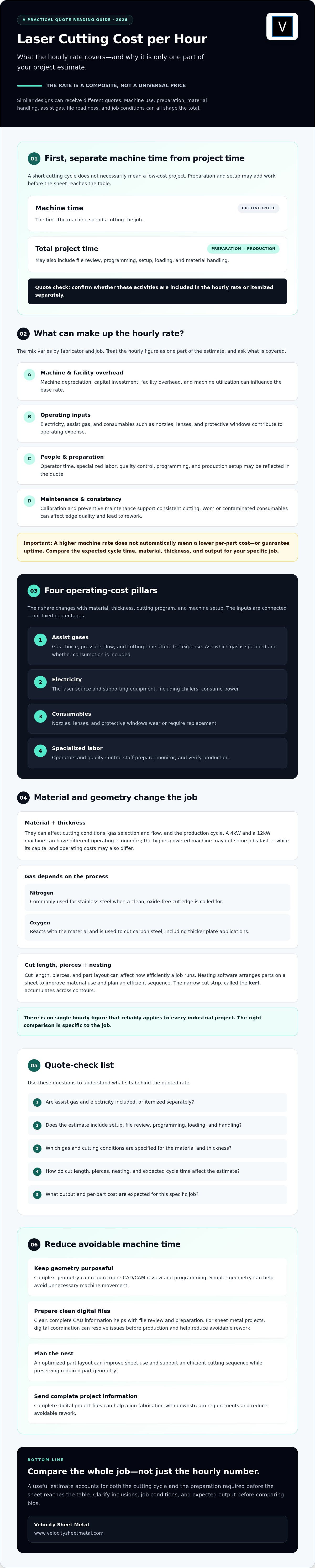
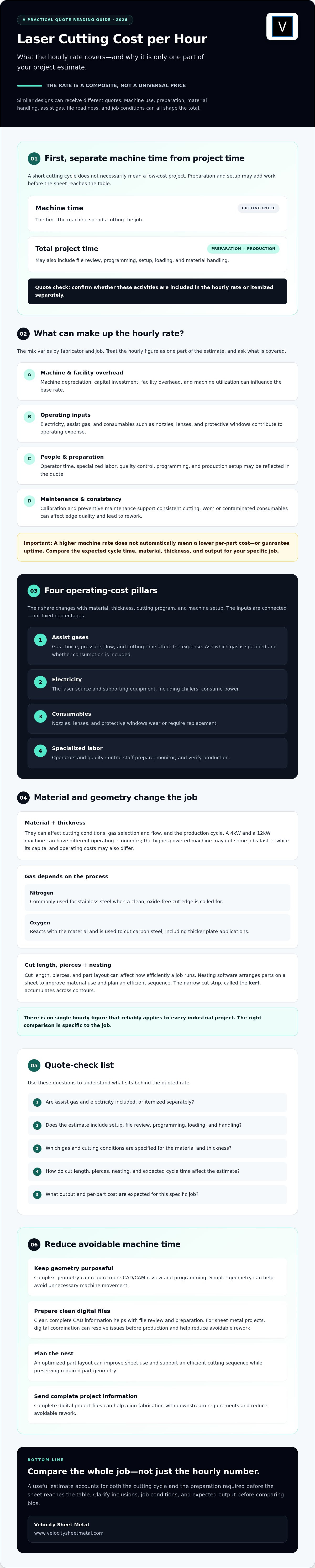
The custom laser cutting cost per hour is a composite rate, not simply the cost of running a laser. It may account for machine depreciation, maintenance, electricity, assist gas, operator time, facility overhead, and production setup. The mix varies by fabricator and job, so no single hourly figure reliably applies to every industrial project. Treat the rate as one part of the estimate and confirm what it includes before comparing bids.
Separate machine time from total project time. Machine time covers the cutting cycle. Total project time may also include file review, programming, setup, loading, and handling. A short cutting cycle does not necessarily mean a low-cost project if preparation or setup takes substantial effort. Ask whether these activities are included in the rate or itemized separately.
The process itself helps explain the cost structure. Laser beam machining uses focused energy to cut material, removing a narrow strip called the kerf. Kerf is small, but it accumulates across many contours. Nesting parts with suitable spacing helps manage material yield while preserving the required part geometry.
Machine Overhead and Capital Depreciation
High-wattage fiber lasers require substantial capital investment. A fabricator’s hourly machine rate helps recover that investment over the equipment’s productive life, along with maintenance and other operating overhead. Depreciation and machine utilization therefore influence the base rate passed through to customers.
A 4kW and a 12kW machine can have different operating economics. The higher-powered machine may cut some jobs faster, but its capital and operating costs may also differ. The lowest machine rate is not automatically the lowest per-part cost. Compare expected cycle time, material, thickness, and output for your specific job.
The Role of Setup and Programming Time
Complex geometry can require more CAD/CAM review and programming before cutting begins. Nesting software arranges parts on a sheet to improve material use and plan an efficient cutting sequence. Fewer unnecessary movements and better sheet utilization can help the machine produce more usable parts during a run.
For sheet-metal projects, BIM for sheet metal fabrication can help resolve coordination issues before production. Clear digital information can reduce avoidable preparation and rework, helping protect machine time. When assessing a quote, ask how file readiness, setup, and nesting affect the estimated production cycle.
The Four Pillars of Laser Cutting Operational Costs
A laser’s hourly operating cost comes from more than electricity. Assist gas, consumables, skilled labor, and maintenance all contribute, but their share changes with the material, thickness, cutting program, and machine setup. A useful custom laser cutting cost per hour estimate should explain what drives the rate, not just present a single number.
Four cost areas shape the production picture:
- Assist gases: Gas choice and flow support the cut and affect operating expense.
- Electricity: The laser source and supporting equipment, including chillers, consume power.
- Consumables: Nozzles, lenses, and protective windows wear or require replacement.
- Specialized labor: Operators and quality-control staff prepare, monitor, and verify production.
These inputs are interdependent. Material and cut conditions influence gas selection and flow, while machine settings and maintenance affect cutting consistency. The educational resource on laser cutting provides background on the process and material challenges behind these operating choices.
Assist Gas: Nitrogen vs. Oxygen Cost Dynamics
Nitrogen is commonly used for stainless steel when the application calls for a clean, oxide-free cut edge. Oxygen reacts with the material and is used to cut carbon steel, including thicker plate applications. Gas cost depends on the selected process, pressure, flow rate, and time spent cutting. Flow can be a meaningful hourly expense, but its share varies by job, so do not treat a fixed percentage as universal. Ask which gas is specified and whether its consumption is included in the quote.
Maintenance and Technical Support
Calibration and preventive maintenance help keep the beam path and cutting parameters consistent. Worn or contaminated consumables can affect edge quality and lead to rework, while equipment downtime can disrupt schedules. A supplier’s rate may reflect its maintenance practices and production capacity. Ask how the quote accounts for these factors rather than assuming a higher rate guarantees uptime.
Automation can reduce manual handling between production steps. Velocity Sheet Metal offers custom laser cutting as well as automated coil-line rectangular duct production. For projects that involve digital coordination and fabrication, explore precision laser cutting services or learn more about Velocity’s custom laser cutting.
How Material Selection Impacts Your Hourly Rate
Material affects both how long a part occupies the laser and how efficiently a sheet becomes usable components. A 16-gauge sheet and a 1/2-inch plate may share the same hourly machine rate, but the thicker plate generally requires a slower cut and more time per part. That increases the cutting portion of the quote even when the posted rate stays flat.
Material handling matters, too. Heavy plate can take more effort and equipment to load, position, and unload than thin sheet. Ask whether handling is included in the machine rate or treated as a separate production step. The factors that affect laser cutting cost include material, thickness, and design, all of which shape actual run time and yield.
Sheet yield is another cost lever. Parts need spacing for the cut path and safe separation, but excessive gaps leave more unused material. A well-planned nest balances part spacing, cut sequence, and material utilization. Share the full part set and material requirements with the fabricator so nesting can be assessed across the job, not one component at a time.
Steel vs. Aluminum: A Speed and Cost Comparison
Carbon steel, aluminum, and stainless steel do not cut identically. Cutting speed depends on the alloy, thickness, machine capability, and required edge quality. Aluminum’s high thermal conductivity carries heat away from the cut zone, so the process must be matched to the material and equipment. Stainless may require nitrogen for a clean, oxide-free edge, adding gas use to the production calculation. Confirm material grade, thickness, finish requirements, and gas assumptions when comparing quotes.
Copper and brass are reflective metals, which can require suitable equipment and carefully matched process settings. Their material behavior and cutting requirements can affect cycle time, setup, and the final estimate. Do not assume one machine rate translates into the same cost per part across metals.
Heavy Gauge Components and Feed Rates
As thickness increases, cutting speed generally decreases. That means a longer cycle for the same cut length and a higher cost per inch at an unchanged hourly rate. Geometry matters as well: long contours, tight details, and many starts can add time. When the design also requires bends, treat cutting and forming as separate operations in the estimate. Velocity Sheet Metal offers CNC press brake bending for components that need formed features.
To tighten your estimate, provide the exact material and thickness, finished-part requirements, and complete CAD geometry. Then ask how the quote accounts for handling, nesting, gas, and cutting time. This makes material-driven differences visible before production starts.
Strategies to Lower Your Custom Laser Cutting Costs
Lowering the custom laser cutting cost per hour often starts before production. A clean, production-ready CAD file, a practical material choice, and a coordinated part layout can reduce programming effort, avoid unnecessary cutting, and improve sheet yield. Focus on the work the machine and production team must perform, not just the hourly rate.
- Clean up CAD files: Remove duplicate lines, confirm units, and provide complete, current geometry to limit file review and avoid extra pierces or head travel.
- Review common-line cutting: Where part geometry and quality requirements allow, adjacent parts may share a cut path, reducing repeated cutting.
- Standardize material: Using a consistent grade and thickness across a production run can simplify setup and may help the fabricator plan material purchasing more efficiently.
- Coordinate before cutting: BIM clash detection can identify fit or coordination issues before parts reach production, helping prevent avoidable rework.
Design for Manufacturing Principles
Intricate details, tight contours, and closely spaced features can slow the cutting sequence. Simplify geometry where function allows, and avoid adding detail that the finished part does not need. Small components may also need tabs to stay stable as the surrounding material is cut. Have the fabricator review tab placement and spacing to reduce the risk of parts tipping up and interfering with the cutting head.
Share coordinated files, not just a drawing export. BIM clash detection can help teams resolve conflicts in the digital model before fabrication, reducing the chance that a cut part needs correction because of a coordination issue.
Batching and National Account Scaling
Setup and programming effort is spread across the parts in a production run. Combining compatible parts or repeat orders into a planned batch can therefore reduce the setup burden per part. Confirm that the batch shares material, thickness, and process requirements. Mixing incompatible jobs may add changeovers instead of saving time.
For mechanical contractors managing projects across the country, nationwide shipping can simplify supply coordination. Velocity Sheet Metal offers automated coil-line rectangular duct production alongside custom laser cutting, so contractors can discuss distinct fabrication requirements with one manufacturer. Learn how automated HVAC ductwork supports high-volume production.
To assess a project, prepare the latest CAD files, identify repeat quantities and material requirements, and flag coordination constraints. Discuss your laser-cutting project with Velocity Sheet Metal to explore a production approach suited to your parts and requirements.
Partnering with Velocity Sheet Metal for National Production
A useful production partnership makes the path from approved digital files to finished parts clear. Velocity Sheet Metal provides custom laser cutting, BIM coordination and spool drawings, and nationwide shipping. Its team brings more than 50 years of combined industry experience and supports fabrication needs for OEMs and contractors.
Pricing transparency starts with a quote that spells out the job’s scope. Share the material and thickness, part quantities, file status, and any finishing or forming requirements. Then confirm what the estimate includes, such as programming, setup, gas, handling, and shipping. Those details make it easier to compare offers and understand how project requirements affect the custom laser cutting cost per hour.
From Digital Concept to National Delivery
Begin with current BIM or CAD files and clear part requirements. A production-readiness review can identify missing details or coordination questions before fabrication begins. BIM coordination can also help detect clashes that might otherwise lead to rework. Once the scope is aligned, nationwide shipping helps move finished components to projects across the country. Reducing avoidable file revisions and production waste can protect both time and budget.
Velocity’s fabrication capabilities can support different project needs, from custom-cut parts to HVAC components. For context on duct procurement and production requirements, see this guide to HVAC duct fabrication. Share related requirements early so the team can understand the scope and how the work fits together.
Prepare Your Files for a More Useful Quote
For a precise cost analysis, submit the latest available CAD files and include material grade, thickness, quantity, critical dimensions, and delivery destination. Flag any forming needs, project coordination constraints, or repeat-order plans. Confirm applicable file formats and project details during submission.
Before approving a quote, review its assumptions and ask which cost elements are included or itemized. This can surface setup, material, handling, or freight differences before production starts. For OEM and construction projects with nationwide delivery needs, a clearly defined digital-to-physical workflow helps keep engineering, fabrication, and logistics aligned. Submit your project details to Velocity Sheet Metal to request a quote and discuss the production requirements.
Move Your Project from File to Fabrication
A useful estimate is built around the real work: preparing the files, cutting the selected material, and coordinating parts for production. The custom laser cutting cost per hour is only one part of the decision. Clear project information and a capable fabrication partner help you evaluate the full scope with confidence.
Velocity Sheet Metal combines more than 50 years of combined industry experience with BIM coordination, fabrication, and nationwide shipping. For OEMs and contractors, that means a partner equipped to coordinate digital requirements with production and ship projects across the United States.
Ready to move from planning to a project-specific estimate? Share your part files and requirements with Velocity Sheet Metal.
Request a precision quote from Velocity Sheet Metal to take the next step toward a well-coordinated production run.
Frequently Asked Questions
What is the average hourly rate for laser cutting in 2026?
There is no dependable average that applies to every industrial laser-cutting job. Rates vary with machine capacity, material, thickness, cutting time, setup, assist gas, and what the fabricator includes in the quote. Request a project-specific estimate rather than relying on a broad benchmark. To compare estimates, check whether programming, setup, handling, and gas are included or listed separately.
Does the type of gas used affect the hourly laser cutting cost?
Yes. Assist gas affects operating costs, and the process, material, and required edge quality determine which gas is appropriate. Nitrogen is commonly used when cutting stainless steel for an oxide-free edge, while oxygen is used as a reactive assist gas for carbon steel. Gas flow and cutting time influence consumption. Ask whether the quote includes gas and which process assumptions it uses, especially when comparing estimates for different materials.
Why is there a setup fee for custom laser cutting projects?
A setup charge can cover work required before the laser starts cutting, such as reviewing files, programming the cutting sequence, nesting parts, and preparing the machine for the specified material. Complex contours or incomplete drawings can require additional preparation. Ask what the fee covers and whether it applies once per order or per setup. Supplying clear, final CAD files and grouping compatible parts can help limit avoidable preparation work.
How does material thickness change the cost per hour?
Thickness often changes the time needed to cut a part, not necessarily the machine’s posted hourly rate. A thicker plate generally requires slower cutting than thinner sheet, so the laser runs longer for the same cut path. That can raise the cost per part even if the hourly rate stays constant. Share the exact material and thickness, then compare estimated cycle time and any handling requirements in the quote.
Can BIM coordination actually reduce my fabrication costs?
It can help control avoidable costs by identifying clashes or missing coordination details before fabrication. Resolving a conflict digitally may prevent parts from needing correction or replacement after cutting. BIM coordination is especially useful when components must fit into a wider building or mechanical design. Provide current, coordinated project information and clarify how the fabricator reviews it. The potential savings depend on the project and issues caught before production.
Is laser cutting more cost-effective than waterjet for thin metals?
It depends on the material, thickness, edge requirements, geometry, and production quantity. Laser cutting may be efficient for some thin-metal jobs, while waterjet can suit different material or edge requirements. Compare complete quotes for the same drawing and specifications, including setup, cutting time, material use, and any secondary work. Do not choose by process name alone. Ask each fabricator to explain how its proposed method meets your part requirements.
How do I reduce the number of pierces in my design to save money?
Review the CAD geometry for unnecessary holes, duplicate contours, and details that do not affect part function. Each separate cut start can require a pierce, so consolidating features where the design allows may reduce machine actions and cycle time. Ask the fabricator to review the file before changing critical geometry. Also confirm that tabs or other part-retention features are appropriate, since small parts must remain stable during cutting.
Does Velocity Sheet Metal offer discounts for high-volume national accounts?
Do not assume a specific discount applies. Velocity Sheet Metal supports national accounts and ships nationwide. For a clear answer, provide expected quantities, repeat-order frequency, material specifications, and delivery requirements when requesting a quote. That information helps the team assess the production scope and explain applicable pricing terms without relying on a general rate or unverified discount claim.
Need a project-specific estimate? Send your files and requirements to Velocity Sheet Metal to discuss your custom laser-cutting project.