Custom Laser Cutting Cost Per Hour: 2026 Design & Pricing Guide
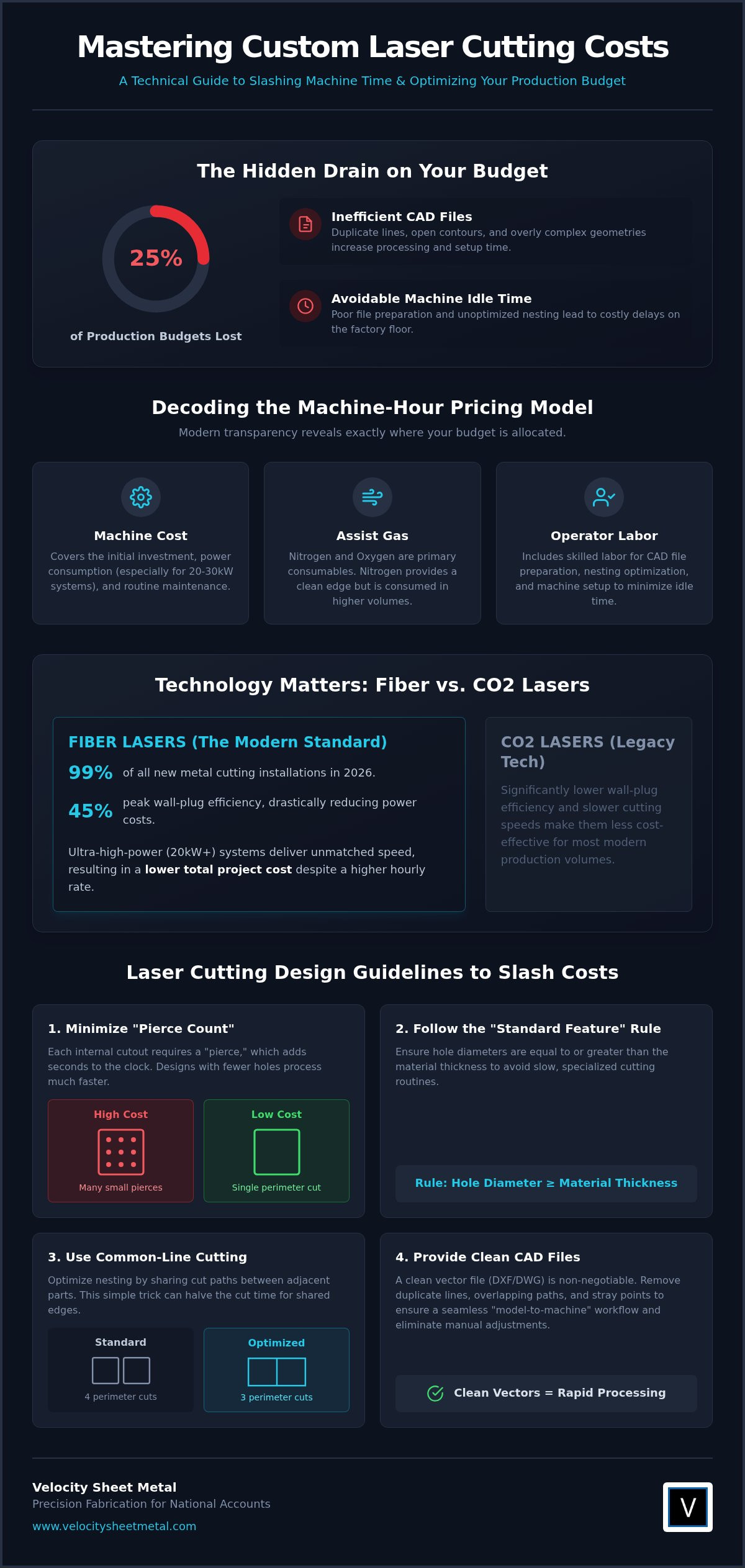
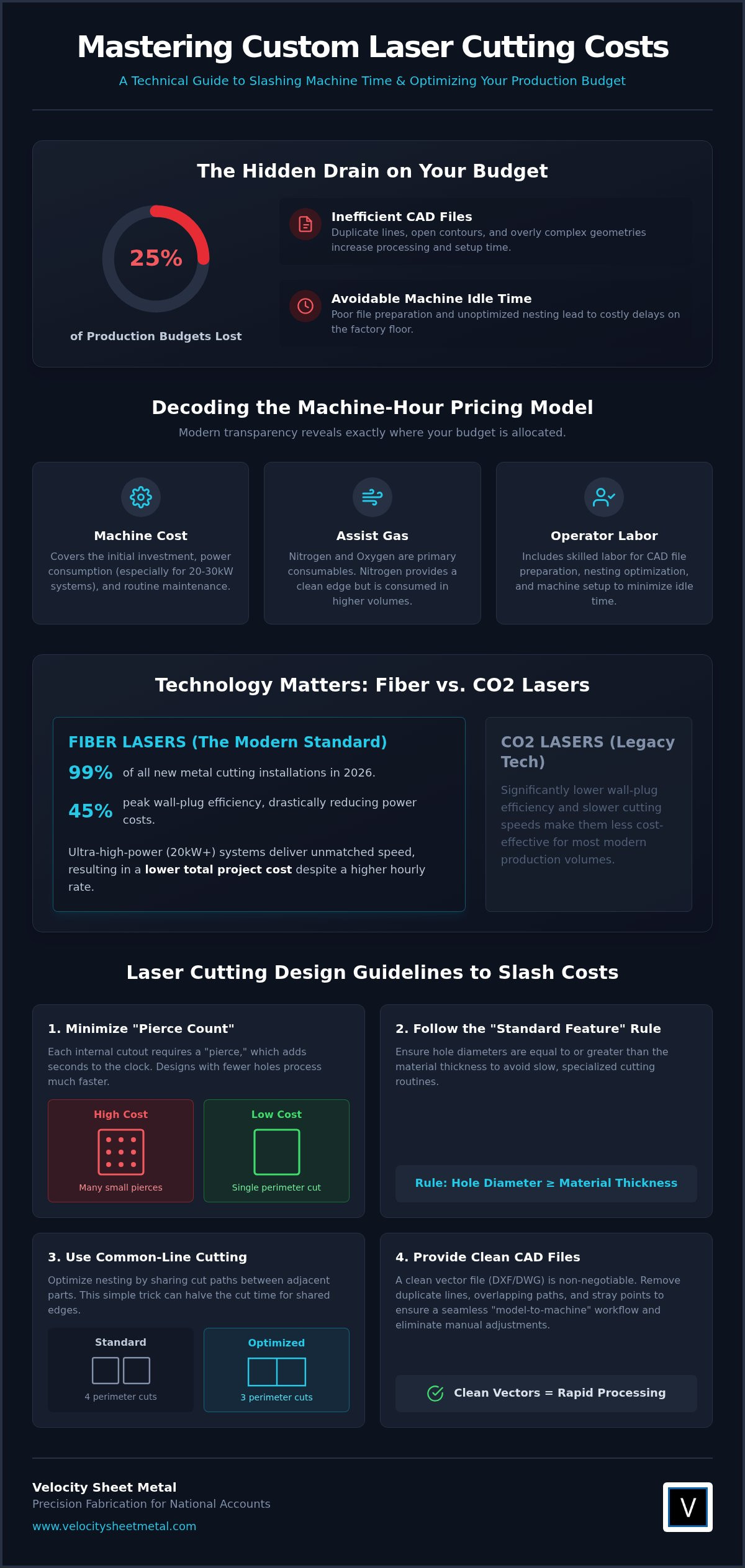
In 2026, fiber lasers account for 99% of all new metal cutting installations, yet many manufacturers still lose over 25% of their production budget to inefficient CAD files and avoidable machine idle time. You know that custom laser cutting is the fastest path from a digital concept to a physical part. However, hidden setup fees and unexpected material waste often turn a lean project into a financial burden. It's frustrating to watch lead times stretch because of poor file preparation or unoptimized nesting. We understand that your time is as valuable as the precision of the cut.
This guide helps you master the technical variables that dictate hourly rates. We provide the specific laser cutting design guidelines you need to slash machine time and optimize every dollar of your production budget. You will gain a transparent understanding of pricing variables, from the impact of 30kW ultra-high-power systems to the industry shift toward "price per part" metrics. We're here to act as the essential bridge between your digital file and a tangible, high-quality product ready for national-scale distribution. Let's get to work on refining your process.
Key Takeaways
- Decode the machine-hour pricing model to identify exactly where your budget goes, from gas consumption to operator labor.
- Implement technical laser cutting design guidelines to minimize machine time and prevent thermal distortion in complex geometries.
- Compare fiber and CO2 technology to select the highest ROI for your specific material thickness and production volume.
- Master the total cost estimation formula and nesting strategies to eliminate hidden material waste and setup fees.
- Streamline national-scale production by partnering with an expert operator capable of rapid, precision-cut delivery across the US.
Understanding the Custom Laser Cutting Cost Per Hour Model
The manufacturing industry is moving away from opaque "price per part" quotes. Modern procurement teams now demand machine-hour transparency. This model provides a clear breakdown of how your CAD file translates into machine time, assist gas consumption, and operator labor. By understanding these variables, you can apply specific laser cutting design guidelines to squeeze more value out of every second the beam is active. Transparency allows you to see exactly where your budget goes, from the initial digital review to the final physical part.
The hourly rate isn't a static number. It's a calculation of the machine's operational cost, including the initial investment of high-end fiber systems. In 2026, fiber lasers dominate the market because they offer a wall-plug efficiency of 30% to 45%. This is significantly higher than older CO2 technology. While a 20kW or 30kW machine commands a higher hourly fee due to its power and maintenance requirements, its speed often results in a lower total cost for the project. Laser cutting technology has evolved to prioritize throughput. This means the actual cost for each completed part has dropped as automation handles more of the heavy lifting. Rapid part production is now the standard, not the exception.
Fixed vs. Variable Costs in Laser Fabrication
Your hourly rate is heavily influenced by consumables and maintenance. Nitrogen and Oxygen are the primary assist gases used to clear molten metal from the kerf. Nitrogen provides a clean, oxide-free edge but consumes more volume, driving up the variable cost. Some shops are shifting to high-pressure air cutting to mitigate these expenses, especially for thicker materials where nitrogen becomes prohibitively expensive. High-wattage machines also require more electricity and frequent nozzle inspections. Labor remains a critical factor. Complex nesting and file preparation require skilled operators to ensure the machine doesn't sit idle. Efficiency starts before the laser even fires. A well-prepared file reduces the setup time, which is usually the first line item on your invoice.
The "Pierce Count" Factor
Every internal cutout requires a "pierce" where the laser burns through the material before beginning the path. A design with hundreds of small holes will take significantly longer to process than a single long perimeter cut. These seconds add up. Each pierce adds to the cumulative machine time, directly increasing your quote. To optimize your budget, follow laser cutting design guidelines that prioritize fewer internal cutouts and simplified geometries. Reducing the pierce count is the fastest way to lower the effective hourly rate on a complex job. Fewer stops and starts mean the machine maintains its maximum feed rate for longer durations, maximizing your production budget.
Laser Cutting Design Guidelines to Reduce Hourly Rates
Efficient fabrication starts with the CAD file. If you want to lower your project's hourly impact, you must follow strict laser cutting design guidelines that respect the physical limits of the machine. The "Standard Feature" rule is your first priority. Ensure all hole diameters are equal to or greater than the material thickness. Attempting sub-thickness holes forces the laser to slow down or use specialized pulsing. This spikes machine time. Clean geometry ensures the beam moves at its maximum rated speed without interruption.
Spacing is equally critical. Keep a minimum distance between parts to prevent thermal distortion. In thin sheets, heat buildup can cause parts to warp or "tip up." This creates a collision risk for the cutting head. Such events lead to machine downtime and wasted material. We recommend sharing paths through common-line cutting whenever possible. This technique allows one cut to serve two parts. It effectively halves the cut time for those shared edges. Optimizing lead-ins and lead-outs also streamlines the path. This prevents the laser from lingering too long at a single point, which reduces the risk of blowouts.
CAD File Preparation for Rapid Processing
Your machine-hour rate includes the time spent processing your data. Clean vectors are non-negotiable. Remove duplicate lines, overlapping paths, and stray points that confuse the CAM software. We prefer standardized DXF or DWG formats for seamless integration. When you leverage BIM coordination for sheet metal fabrication, you ensure "model-to-machine" accuracy. This digital-to-physical workflow eliminates manual adjustments at the factory floor. It moves your project quickly from the initial digital concept to the final physical result.
Material Selection and its Impact on Machine Time
Material choice dictates the speed of the beam. Reflective metals like aluminum and copper require specialized fiber lasers to prevent back-reflection damage. While modern fiber systems handle these with ease, the thickness of the gauge still determines the feed rate. As thickness increases, cutting speed drops exponentially. For a deep dive into specific parameters, reference our 2026 Technical Engineering Guide for Aluminum.
Choosing the right technology is also a factor in ROI. While fiber lasers are often three times faster on thin gauges, understanding Fiber vs. CO2 Technology helps you decide which method offers the best return for your specific project scale. If you are ready to optimize your next production run, our team can help you refine your custom laser cutting specifications for maximum efficiency. Precision matters. Speed delivers.
Fiber vs. CO2: Which Technology Offers Better ROI?
Fiber lasers have redefined the economics of metal fabrication. In 2026, they account for 99% of all new cutting installations for a simple reason: throughput. The industry is shifting from 6kW standards to 20kW and 30kW systems that process thin-gauge materials up to three times faster than older CO2 technology. This speed doesn't just shorten lead times. It drastically lowers the machine-hour burden on your production budget. While CO2 lasers are still utilized for specific thick-plate or non-metal jobs, high-wattage fiber is the undisputed leader for precision sheet metal work.
The "wall-plug" efficiency of these machines provides another layer of ROI. Fiber lasers operate at a 30% to 45% efficiency rate. CO2 systems lag behind at roughly 8% to 15%. This means less energy is wasted as heat, resulting in lower power costs per hour. Maintenance also impacts the bottom line. Fiber sources last over 100,000 hours. They don't require the complex mirror alignments or bellows maintenance associated with CO2. Lower overhead for the fabricator translates into more transparent, predictable pricing for the customer. It's about moving from a digital file to a physical part with the least amount of friction possible.
Speed vs. Accuracy Trade-offs
Modern fiber machines use "Fly Cutting" to maximize efficiency. This technology allows the laser to cut an array of features without the head coming to a full stop between pierces. It's a massive time-saver for perforated patterns. However, high-speed output must be balanced with precision. For high-tolerance mechanical components, we often reduce feed rates to maintain superior beam stability. Adhering to technical laser cutting design guidelines helps us determine the optimal balance between rapid production and geometric accuracy. We prioritize the edge finish that your specific application demands to ensure every part is ready for the assembly line.
Assist Gas Selection for Edge Quality
The gas that clears the molten metal is a major factor in both cost and quality. Nitrogen is the premium choice. It produces an oxide-free edge that is ready for immediate paint or powder coating. If you use Oxygen, you gain speed in thick carbon steel, but you'll deal with a residual oxide layer that requires secondary cleaning. For projects where cost is the primary driver, high-pressure compressed air is an effective alternative. It significantly reduces the consumable cost within the hourly rate calculation. We help you select the right gas to bridge the gap between your budget and your technical requirements. Selecting the right assist gas is as vital as the cut itself.
Calculating the Total Cost: The Estimation Formula
Precision budgeting requires more than a ballpark figure. To accurately forecast your production spend, you must understand the four-part formula that fabricators use to generate quotes. The standard calculation is: (Machine Rate x Cut Time) + (Setup Fee) + (Material Cost x Markup). While the machine rate is often fixed based on the technology used, the cut time is highly variable. This is where your adherence to laser cutting design guidelines becomes the primary driver of cost. By minimizing pierce counts and optimizing the cutting path, you directly reduce the machine-hour burden.
Nesting efficiency is the secret to lowering material waste. Modern CAM software arranges parts to maximize sheet utilization, but the software can only do so much with inefficient geometries. If your parts don't nest tightly, you're paying for "skeleton" waste. We also account for secondary operations like deburring or CNC press brake bending. These add labor-intensive steps to the process. Over-engineering is another common budget killer. Specifying a +/- .001 tolerance on a non-critical bracket forces the machine to run at slower, more precise speeds. Match your tolerances to the actual mechanical requirements to keep the hourly rate in check.
The Impact of Volume on Hourly Pricing
Volume shifts the weight of the setup fee. For a single prototype, a setup fee of $65 to $200 represents a massive percentage of the total cost. When you scale for national accounts, that fixed fee is amortized across thousands of units, making it negligible. Standardizing parts for high-volume runs allows for continuous automated production. Our Precision Laser Cutting Services leverage these economies of scale to deliver lower per-unit costs for large-scale industrial projects. It's about moving from a high-cost digital concept to a low-cost physical reality through volume.
Managing Lead Times and Rush Fees
On-demand production changes the pricing dynamic. If you need a 24-hour turnaround, expect a premium for the disruption of the existing production schedule. Material availability also plays a role. In a fluctuating market, stocking common gauges of stainless or carbon steel helps us mitigate price spikes. To reduce turnaround without paying rush fees, submit clean, ready-to-cut files that follow established laser cutting design guidelines. This prevents the administrative delays of back-and-forth technical reviews. If you're ready to secure a reliable partner for your next high-volume project, contact Velocity Sheet Metal today. We prioritize speed, precision, and transparent delivery.
Velocity Sheet Metal: Precision Fabrication for National Accounts
Velocity Sheet Metal operates as the essential bridge between a digital CAD file and a tangible, high-performance product. We are the Authoritative Expert Operator for national accounts that require precision without the typical administrative delays of the industry. Our workflow is designed for speed and reliability. Whether you are an OEM requiring thousands of standardized parts or a large-scale HVAC contractor managing complex installations, we provide the technical capability to meet your deadlines. Our facility integrates BIM coordination and spool drawings to eliminate field collisions before the first piece of metal is even cut. This digital-first approach ensures that every component fits perfectly the first time.
We offer nationwide shipping for all custom laser-cut components. This allows us to deliver precision-cut parts to your facility anywhere in the US with consistent quality standards. By strictly following laser cutting design guidelines during the technical review phase, we ensure your project moves through our shop with surgical precision. We value your time as much as our own. We don't just cut metal; we provide a controlled, transparent, and repeatable production line for your most critical assets. Our "can-do" attitude is grounded in modern manufacturing reality, not marketing hype.
From CAD to Coil-Line: Our Full-Service Capabilities
Our capabilities extend far beyond basic cutting. We operate an automated coil-line for high-volume rectangular ductwork and provide precision CNC press brake bending for complex geometries. This breadth of service allows us to handle your entire production process from start to finish. Our 50+ years of combined industry experience translates to lower costs and higher reliability for our partners. We understand the modern manufacturing reality. We have embraced the latest automated technology to solve traditional industrial problems, moving your project quickly from initial digital concepts to final physical results. We act as a partner who is ready to get to work immediately.
Get Started with On-Demand Part Production
Efficiency starts with direct access to engineering support. Our team provides the straight-talk guidance you need to optimize your CAD files and refine your laser cutting design guidelines for maximum throughput. We act as a tech-savvy partner obsessed with detail and delivery. You don't have to navigate the complexities of machine-hour rates alone. We provide fast quoting and rapid part production to keep your projects on schedule. If you are ready to streamline your supply chain and reduce your production budget, Request a Precision Laser Cutting Quote today. We are ready to deliver the results you expect.
Optimize Your Fabrication Workflow for 2026
Mastering the variables of machine-hour pricing is the only way to maintain a lean production budget in a competitive market. By implementing precise laser cutting design guidelines, you eliminate the technical friction that leads to wasted time and material. You've seen how fiber laser efficiency and strategic nesting transform digital files into high-margin physical products. It's about more than just a cut; it's about a controlled, repeatable process that respects your timeline and your precision requirements.
Velocity Sheet Metal brings 50+ years of combined manufacturing expertise to every project. We provide BIM-integrated fabrication to ensure zero-error production from the very first cut. Our facility supports national accounts with reliable, nationwide shipping. We act as the authoritative bridge between your complex CAD data and a finished product delivered directly to your facility. Ready to maximize your throughput and eliminate administrative delays? Streamline your production with Velocity Precision Laser Cutting. We are ready to get to work on your next high-volume run.
Frequently Asked Questions
What is the average hourly rate for custom laser cutting in 2026?
The cost to run a laser cutting machine in 2026 typically ranges from $60 to $120 per hour. A fully burdened fiber laser machine rate sits between $100 and $175 per hour, while CO2 systems range from $75 to $130 per hour. These rates reflect the machine's energy efficiency, maintenance requirements, and the initial capital investment of high-wattage systems.
How does material thickness affect the laser cutting cost per hour?
Material thickness dictates the maximum feed rate of the beam. As the gauge increases, the laser must move slower to ensure a clean cut, which exponentially increases the machine time required for each part. Thicker materials also demand higher wattage and increased assist gas pressure, both of which drive up the variable operational costs within the hourly rate.
Why is Nitrogen assist gas more expensive than Oxygen?
Nitrogen is more expensive because it requires significantly higher pressure and volume to clear molten metal without oxidation. Unlike Oxygen, which creates an exothermic reaction that aids the cutting process, Nitrogen acts as a cooling agent. This inert process uses more gas to achieve the clean, paint-ready edge required for high-end industrial components.
Can I reduce my laser cutting costs by changing my CAD design?
Yes, applying specific laser cutting design guidelines is the most effective way to lower your project costs. Reducing the pierce count by simplifying internal cutouts and sharing paths through common-line cutting directly cuts machine time. Clean vectors and optimized nesting also prevent material waste and reduce the labor involved in file preparation.
What is the difference between a setup fee and an hourly machine rate?
A setup fee is a fixed cost, often ranging from $65 to $200, that covers administrative tasks, CAD file programming, and machine configuration. The hourly machine rate is a variable fee based on the actual time the laser is active. For large production runs, the setup fee becomes negligible as it is spread across thousands of units.
Does Velocity Sheet Metal offer nationwide shipping for custom parts?
Velocity Sheet Metal provides nationwide shipping for all custom laser-cut components across the United States. We serve national accounts by delivering precision-cut parts directly to your facility or job site. Our logistics network ensures that your production schedule stays on track regardless of your location, from the initial digital concept to final delivery.
How does BIM coordination improve the accuracy of laser-cut HVAC components?
BIM coordination allows us to identify and resolve field collisions in a digital environment before fabrication begins. By integrating these models into our laser cutting design guidelines, we achieve zero-error fabrication for complex HVAC components. This digital-to-physical workflow ensures that every part fits perfectly during on-site assembly, eliminating the need for costly field adjustments.