Complex Metal Bending Services: A 2026 Buyer’s Guide
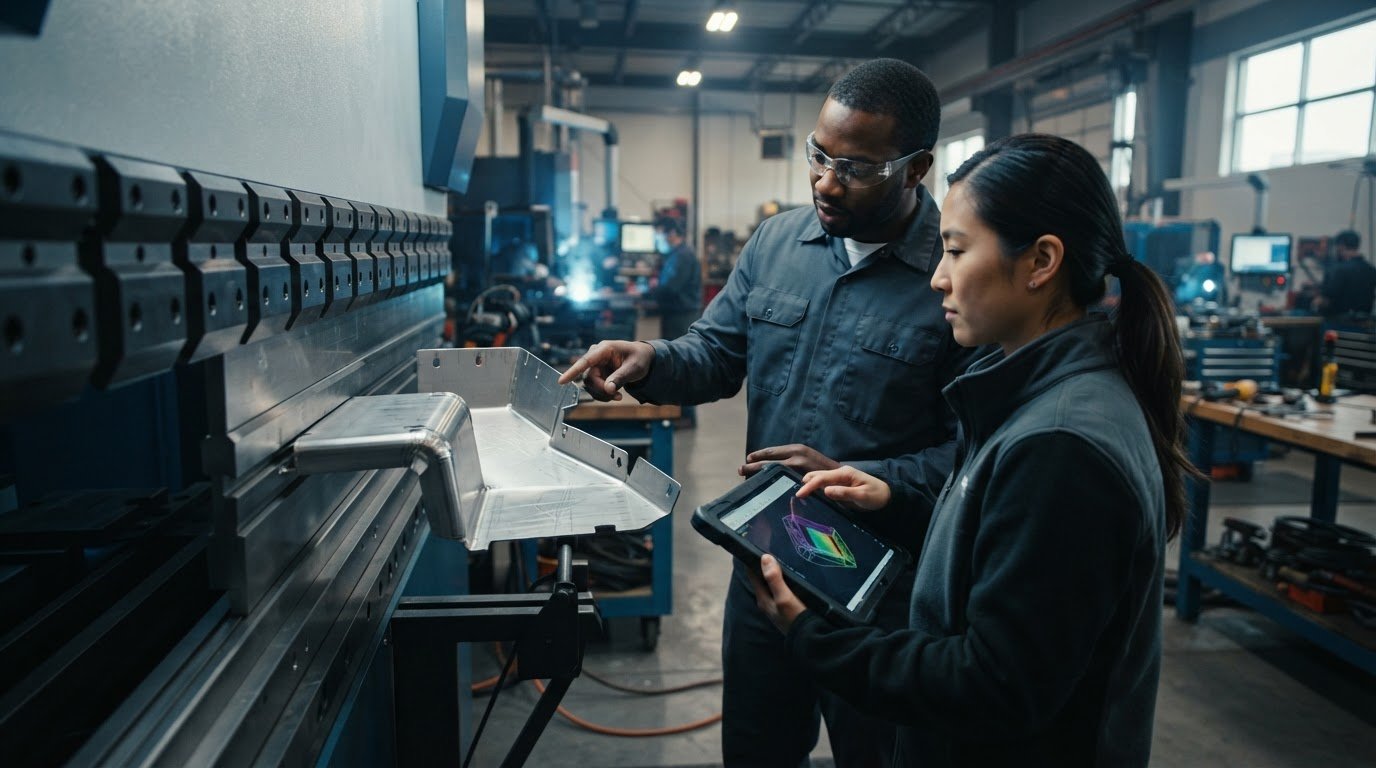
What if a part meets every dimension on the drawing but still won’t fit the assembly? Complex metal bending services must account for more than bend angles. Material behavior, forming sequence, and tool access can all affect the finished part, and a missed detail can carry through to downstream assembly.
A capability list alone won’t show how a fabricator will handle a demanding part. You need to understand how design intent connects to the forming plan, production process, and final fit. This guide explains which geometry and material details make bending more challenging, how to evaluate a fabrication partner, and what to include in a production handoff.
We’ll cover the engineering questions behind complex bends, the production criteria that matter for repeatability, and the information that helps move a part from digital design to physical production. Velocity Sheet Metal provides CNC press brake bending alongside custom laser cutting and BIM coordination, connecting design information with precision fabrication.
Key Takeaways
- Complex metal bending services require evaluating geometry, bend sequence, and final fit together, not simply counting bends.
- Account for material behavior, thickness, grain direction, and bend radius when translating design intent into a formed part.
- Evaluate fabrication capabilities by looking for clear drawing review, bend planning, repeatability, and production coordination.
- Prepare a stronger production handoff with a current drawing or 3D model, material specification, quantity, and revision identifier.
- CNC press brake bending can connect with laser cutting, BIM coordination, and on-demand production in a coordinated fabrication workflow.
What Makes Complex Metal Bending Services Different from Standard Forming?
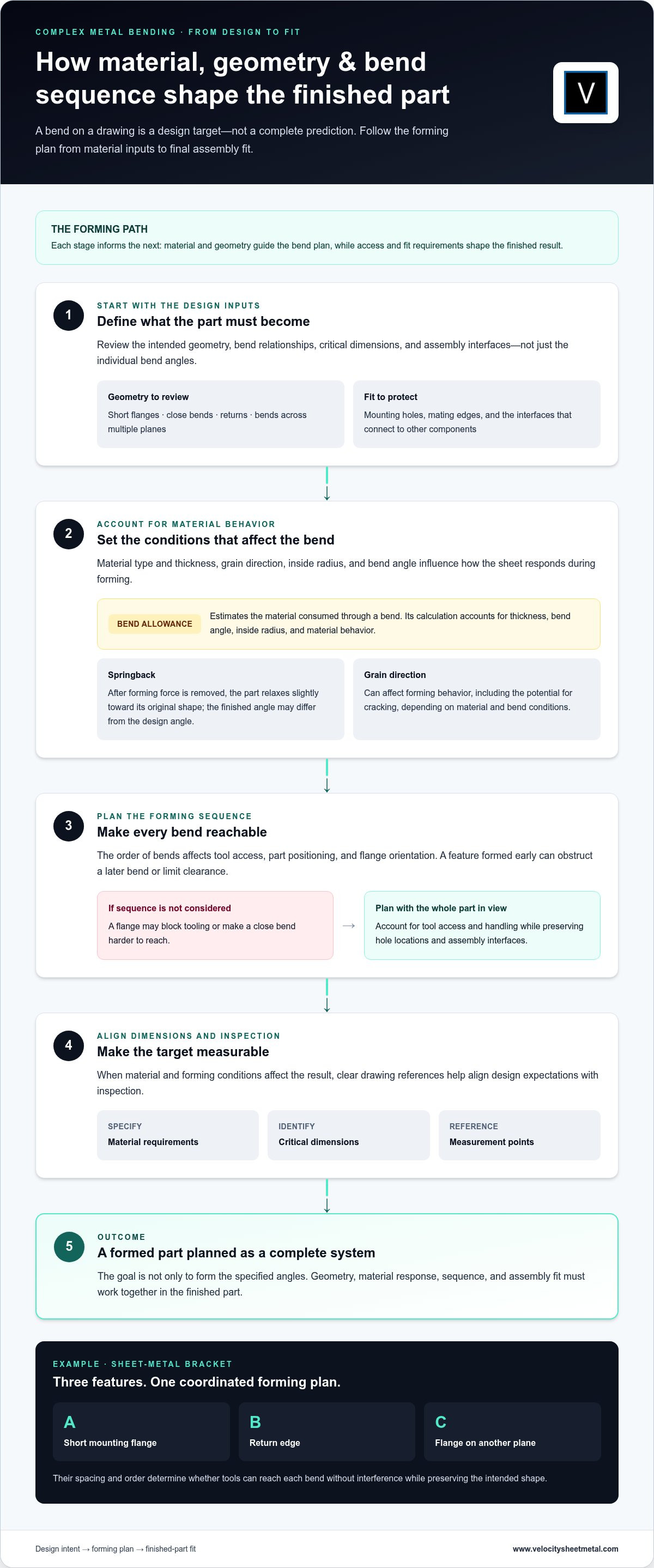
Complex metal bending involves parts whose geometry, bend sequence, assembly fit, or repeatability requirements interact. The challenge isn’t simply how many bends appear on a drawing. It’s whether the features can be formed in a workable order and whether the finished part will match its intended geometry and fit its mating components.
A part with several open, accessible bends may be straightforward to form. A part with fewer bends can be more demanding if one flange blocks access to another, a return feature limits tool clearance, or closely spaced bends create a precise assembly interface. This distinction matters when evaluating complex metal bending services: design complexity describes the part and its production requirements, while machine capability describes the equipment and process used to form it.
Which part features increase bending complexity?
Short flanges, close bends, returns, and bends across multiple planes can constrain the forming sequence. A flange formed early may obstruct the tool or machine structure needed for a later bend. Features also interact, so evaluating each bend on its own can miss a collision or access problem that appears only after earlier bends are formed.
Consider a hypothetical sheet-metal bracket with a short mounting flange, a return edge, and a second flange on another plane. The number of bends is only part of the question. Their spacing and order determine whether the forming tools can reach each bend without interference while preserving the intended shape.
Why does complexity matter beyond the bend itself?
The formed part has to work in the assembly, not just look right on a flat drawing. A flange that shifts a mounting hole or mating edge can affect fit with connected components. The intended final geometry, bend relationships, and assembly interfaces should therefore guide production planning.
Material response matters too. During bending, metal can spring back slightly after the forming force is removed, so the finished angle may differ from the angle applied during forming. Tool access and material behavior both influence how a design translates into a physical part. For an overview of the basic process and common methods, see Bending (metalworking).
Complex geometry isn’t automatically impossible or unreliable. It calls for a coordinated review of the design, forming sequence, and fit requirements. With that context, the part can be assessed as a complete system rather than as a series of isolated bends.
How Material, Geometry, and Bend Sequence Shape the Finished Part
A bend on a drawing is a design target, not a complete prediction of the formed part. Material type and thickness, grain direction, inside radius, and bend order all influence how sheet metal responds. Considering these variables together helps connect the digital design to parts that fit and can be produced consistently.
Bend allowance estimates how much material is consumed through a bend. Its calculation accounts for thickness, bend angle, inside radius, and material behavior. If those inputs don’t match the actual forming conditions, the finished part’s dimensions can shift.
How do bend radius and springback affect part dimensions?
The inside bend radius is the curved distance from the inside surface of a bend to its center point. Material type and thickness influence the radius it can form and how it responds. Grain direction can also affect forming behavior, including the potential for cracking, depending on the material and bend conditions. NIST research on deformation-induced surface morphologies examines how steel sheet surfaces change during deformation.
Springback is the small amount a part relaxes toward its original shape after the forming force is removed. The formed angle may therefore differ from the angle specified as design intent. There’s no single adjustment that applies to every material and geometry. Identify the material specification, critical dimensions, and measurement references on the drawing. Clear references help align design expectations with inspection.
How does bend sequence affect complex formed parts?
The order of bends affects access to later features. A flange formed early may obstruct the tooling or limit how the sheet can be positioned for a close bend. A return feature or a bend on another plane can further restrict clearance. The sequence must account for tool access, part handling, and flange orientation, not just the final shape shown in a model.
For example, forming a mounting flange before a nearby return could make the return harder to reach or position. Changing the order may improve access, but it also needs to preserve the hole locations and interfaces used in final assembly. This is why complex metal bending services consider the part as a sequence of operations, not a collection of unrelated angles.
For examples of issues that can arise during forming, see common press brake forming defects. To connect design information with CNC press brake production, explore Velocity Sheet Metal’s fabrication capabilities.
How to Evaluate Complex Metal Bending Services Before You Buy
Evaluate complex metal bending services by the production plan behind the part, not just a list of machine features. CNC press brake capability matters, but it doesn’t explain how drawing intent, material requirements, bend sequence, inspection, and downstream assembly fit will come together. Look for project-specific information rather than broad claims such as “precision” or “advanced equipment.”
What should a buyer look for in a bending partner?
Use consistent criteria to assess fabrication capabilities. Focus on how design details connect to forming and production, and how critical requirements are communicated at each stage.
| Evaluation area | What to look for |
|---|---|
| Drawing review | How design intent, revision status, and critical dimensions are identified before production. |
| Material understanding | How the material specification informs forming decisions and expected part geometry. |
| Bend planning | How bend order, tool access, and nearby features are considered together. |
| Repeatability | How production standards and inspection references support consistency across repeat orders. |
| Delivery coordination | How formed parts align with connected components, assembly needs, and project requirements. |
Define quality expectations through critical dimensions and clear measurement references. A claim about precision is difficult to evaluate on its own. A drawing that identifies the features that control fit gives production and inspection a shared target. For recurring or distributed projects, consistent production standards help maintain that target across orders.
How do press brake services fit complex part production?
A CNC press brake forms sheet metal through controlled, programmed bending. Machine capability alone doesn’t establish that a complex part will fit or repeat as intended. Consider how the forming work connects with drawings, related fabrication steps, inspection criteria, and final assembly requirements.
Velocity Sheet Metal provides CNC press brake bending as part of its precision sheet metal fabrication offering. Its services also include custom laser cutting, BIM coordination, spool drawings, and on-demand part production. These capabilities support a coordinated workflow for projects that require them. For broader guidance on evaluating this capability, see CNC press brake services for OEMs.
That integrated view moves the decision beyond equipment claims. Explore Velocity Sheet Metal’s fabrication services to see how digital design information can connect to formed parts and downstream production.
How to Prepare a Complex Metal Bending Project for Production
A complete project package gives engineering and production a shared reference, from digital design to the formed part. For complex metal bending services, missing material details, unclear revision status, or undefined fit-critical dimensions can leave room for avoidable interpretation. Use this handoff checklist to make requirements clear before production begins.
What drawings and specifications should the project package include?
Provide a current 2D drawing, 3D model, or both. A drawing can define dimensions and inspection references; a 3D model can clarify the overall formed shape and how features relate. Together, they communicate design intent more clearly than either file alone.
- Design files: Include the current drawing or model, plus a clear revision identifier.
- Material: Specify material type and thickness. Include grain direction when it matters to forming or part function.
- Critical geometry: Identify bend angles, inside radii if specified, datums, tolerances, and dimensions that control fit.
- Interfaces: Show mating-part details or assembly context for features that must align with other components.
- Finish and inspection: State applicable finish requirements and how critical dimensions should be measured or reviewed.
Complete, revision-controlled files reduce interpretation gaps by making the approved geometry and requirements clear to everyone working from the package.
How should engineering changes and production requirements be communicated?
Keep revisions explicit. Replace outdated files rather than sending multiple versions without direction, and summarize what changed, such as a shifted hole, revised flange, or updated bend angle. Mark critical-to-function dimensions separately from reference dimensions so review and inspection can focus on what controls fit and performance.
Close the handoff with production and delivery inputs:
- Quantity: State the initial order quantity and expected repeat-order needs, if known.
- Packaging: Describe any requirements that help protect or organize parts for handling and assembly.
- Destination: Provide the delivery destination for planning and coordination.
- Open questions: Flag unresolved design details instead of leaving assumptions buried in notes or email threads.
Clear inputs connect engineering intent to a controlled production handoff. Prepare your bending project for production with coordinated fabrication support.
Complex CNC Press Brake Bending with Velocity Sheet Metal
Complex metal bending services work best as part of a production workflow that connects design information to the finished component. Velocity Sheet Metal provides CNC press brake bending within its precision sheet metal fabrication offering. Its services also include custom laser cutting, BIM coordination, spool drawings, and on-demand part production, connecting digital design information with physical production.
From digital design intent to formed sheet metal
Drawings and models communicate more than shape. They define the dimensions, interfaces, and formed geometry that production needs to preserve. Aligning those requirements with the bending plan helps keep the intended part connected to its downstream use, whether it fits into an assembly or supports a coordinated project. Velocity Sheet Metal’s management team brings more than 50 years of combined industry experience.
Coordination is especially useful when cut features, bends, and assembly relationships need to work together. BIM coordination and spool drawings support the exchange of digital project information, while custom laser cutting and CNC press brake bending connect design details with fabrication. The right combination depends on the part and project requirements.
Choose a practical next step for your bending project
Before a production discussion, organize the current drawing or 3D model, material specification, quantity, revision identifier, and any fit-critical dimensions or inspection references. Note expected repeat orders and include assembly context where it clarifies how the formed part must fit. A concise, controlled package gives the project team a common starting point.
Velocity Sheet Metal ships nationwide and supports national accounts with standardized quality and production standards. This coordination supports projects with distributed production needs while keeping requirements clear across orders. Bring your project information together and Explore Velocity Sheet Metal’s fabrication capabilities.
Move Your Bending Project Toward Production
Complex metal bending services deliver stronger results when material behavior, forming sequence, and assembly fit are considered together. A production-ready package makes those requirements clear: provide current drawings or a 3D model, identify critical dimensions and interfaces, and keep material details and revisions aligned.
Velocity Sheet Metal provides CNC press brake bending as part of its precision sheet metal fabrication offering. Its management team brings more than 50 years of combined industry experience, and coordinated fabrication support can connect bending with other project needs. Nationwide shipping and standardized production support for national accounts serve projects with distributed operations.
Start with a clear project package and a defined picture of the finished part. Then take the next step: Explore Velocity Sheet Metal’s CNC press brake bending capabilities. With the right information in hand, your team can move from design intent toward production with greater clarity and confidence.
Frequently Asked Questions
What makes a metal bending project complex?
A project is complex when its bends, material behavior, access constraints, or assembly requirements interact. A part with several widely spaced, accessible bends may be straightforward, while a part with fewer bends can be demanding if a flange blocks a later operation or a formed edge must align with a mating component. The key is how geometry, bend sequence, and downstream fit combine. Clear drawings and defined critical dimensions help communicate those requirements.
Can a CNC press brake form parts with multiple bends?
Yes, CNC press brakes can form many sheet metal parts with multiple bends, but the design and forming plan determine the approach. Material, tooling access, and bend order all matter. For example, an early flange may restrict access to a nearby feature that must be formed later. Providing the full part geometry and identifying fit-critical features helps align the forming plan with the finished part’s requirements.
How do I choose complex metal bending services for an OEM part?
Evaluate how complex metal bending services connect drawing review, bend planning, production, and inspection. Look for a clear method for accounting for mating parts, revision control, critical dimensions, and repeat orders, rather than relying on broad claims about precision or equipment. Focus on how design intent becomes a forming plan and how requirements stay consistent through production. This helps distinguish a process-ready workflow from a capability list.
What files should I provide for a complex sheet metal bending quote?
Provide the latest part drawing and, when it clarifies the formed geometry, a 3D CAD model. Include the revision identifier, material type and thickness, quantity, finish, bend angles, and critical dimensions with their tolerances. Add assembly interfaces or mating-part context when fit depends on other components. These details give the manufacturing team a clear basis for interpreting the design and assessing production requirements without relying on assumptions.
How does material affect complex metal bending?
Material affects how a part deforms during bending and the geometry it retains afterward. Material properties, thickness, grain direction, and inside bend radius can influence springback and finished dimensions. Include the intended material and relevant geometry in the drawing, especially when the part must fit an assembly or meet critical dimensional requirements. Considering these inputs together supports a forming plan based on the actual design rather than a generic assumption.
What happens if a bent metal part does not fit its assembly?
Start by comparing the part with the correct drawing revision, datums, and critical dimensions. Check the measurement references, then review whether the mismatch could relate to material response, bend sequence, feature interference, or an unclear requirement. Assembly context can help locate the source of the fit issue. If the design needs a correction, record it in the controlled drawing or model so future production uses the approved geometry.
Is CNC press brake bending suitable for repeat production?
CNC press brake bending can support repeat production when part requirements and production references are clearly controlled. Repeatability depends on the full process, including consistent material inputs, forming requirements, revision control, and inspection references, not just CNC equipment. Define the dimensions that matter for function and keep approved design files aligned across orders. Velocity Sheet Metal provides CNC press brake bending and supports national accounts with standardized production standards.