Common Press Brake Forming Defects: A 2026 Guide to Precision CNC Bending
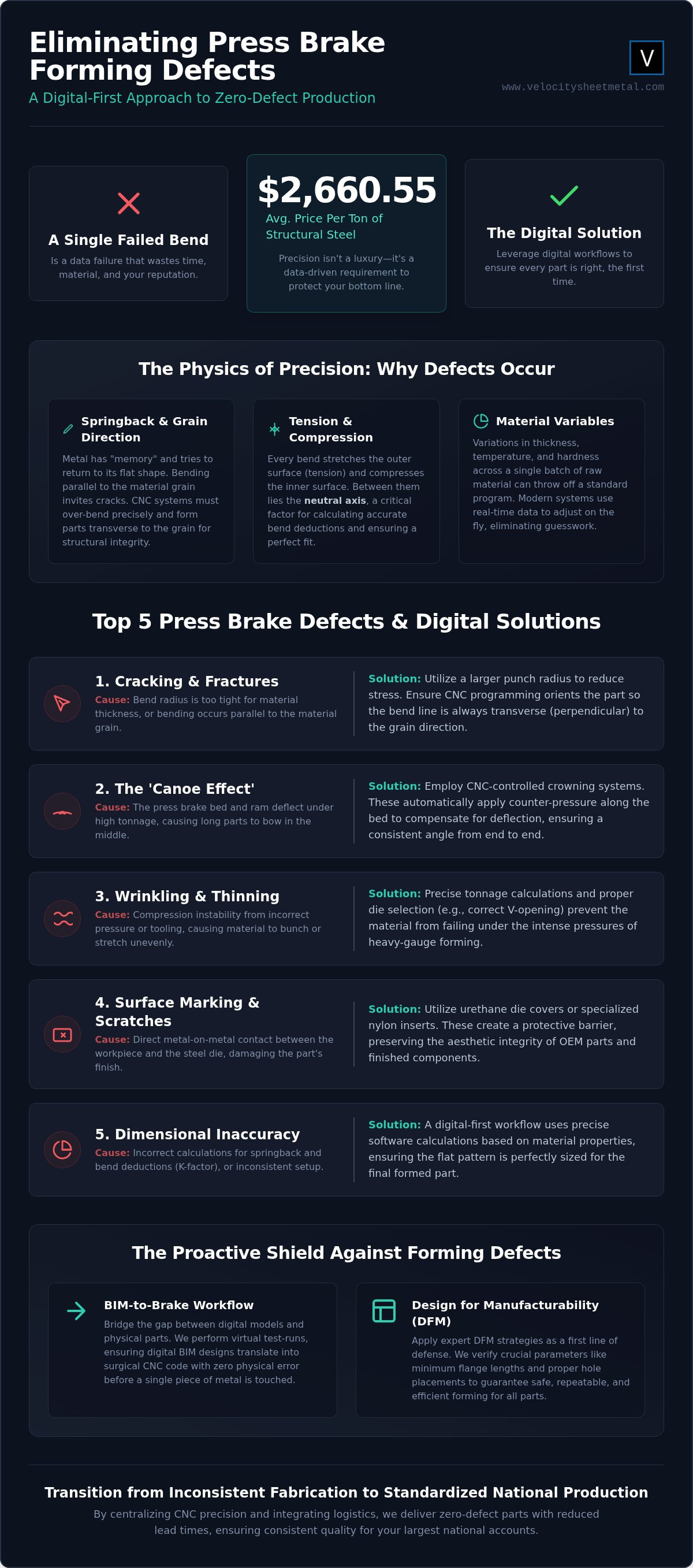
In 2026, a single failed bend isn't just a workshop error. It's a data failure that threatens your bottom line, especially with structural steel prices averaging $2,660.55 per ton. When common press brake forming defects like material cracking or unpredictable springback occur, the ripple effect reaches from the factory floor to the job site. You've likely dealt with the headache of field collisions in HVAC ductwork or inconsistent tolerances that stall high-volume production runs. It's a waste of time, material, and reputation that modern manufacturing shouldn't tolerate.
We're here to bridge the gap between your digital BIM models and physical parts. This guide identifies the root causes of bending failures and provides actionable strategies to eliminate them through digital-first CNC workflows. You'll learn how to leverage expert Design for Manufacturability (DFM) to ensure every part is right the first time. We'll preview the automated precision techniques that reduce lead times and help you achieve zero-defect production for your largest national accounts. Precision is no longer a physical uncertainty; it's a data-driven requirement.
Key Takeaways
- Master the physics of material memory and yield strength to proactively mitigate common press brake forming defects before they reach the production floor.
- Implement specific technical solutions for cracking and the "canoe effect" using advanced crowning compensation and precision material orientation.
- Leverage BIM-to-Brake workflows to perform virtual test-runs, ensuring digital designs translate into surgical CNC code with zero physical error.
- Apply expert Design for Manufacturability (DFM) strategies, such as verifying minimum flange lengths, to guarantee safe and repeatable forming for heavy-gauge parts.
- Transition from inconsistent local fabrication to standardized national production through centralized CNC precision and integrated logistics.
The Physics of Precision: Why Common Press Brake Forming Defects Occur
Press brake defects aren't random accidents. They're measurable deviations from design specifications. These errors usually stem from three sources: unpredictable material behavior, improper tooling selection, or fundamental setup errors. In the world of high-volume CNC bending, understanding the mechanics of Bending (metalworking) is the only way to ensure repeatability. Metal isn't a static medium. It's a dynamic material with its own "memory" dictated by yield strength and elasticity. If you don't account for these physical properties, you'll see common press brake forming defects like inconsistent angles and structural fractures across your production run.
Grain direction dynamics are often overlooked but remain a primary cause of structural failure. During the milling process, metal develops a longitudinal grain. Bending parallel to this grain is a recipe for disaster; the material is more likely to crack or split under tension. Precision metal forming services prioritize bending transverse to the grain to maintain integrity. This is especially critical for heavy-gauge components used in industrial HVAC systems. Then there's the "springback" phenomenon. Because all metal has a degree of elasticity, it attempts to return to its original flat shape once the punch retracts. Modern CNC systems calculate this return precisely, over-bending the part just enough to hit the target angle after the material relaxes.
Tension, Compression, and the Neutral Axis
Every bend creates a battle within the metal. The outer fibers of the bend undergo intense tension, stretching to accommodate the new shape. Simultaneously, the inner fibers experience compression, bunching together as they're pushed inward. Between these two opposing forces lies the neutral axis, an area where no stretching or compressing occurs. As the bend radius tightens, this neutral axis shifts toward the inside of the bend. This shift is critical for calculating accurate bend deductions. The K-factor is the ratio of the neutral axis position to the material thickness, and getting this value right is the difference between a perfect fit and a field collision.
Material Variables in Heavy-Gauge Forming
Raw stock is rarely perfect. Thickness tolerances in a single batch of steel can vary enough to throw off a standard CNC program. A few thousandths of an inch might seem negligible, but in heavy-gauge forming, that variance changes the resistance the machine encounters. Temperature and material hardness also impact repeatability. Cold steel behaves differently than steel in a climate-controlled facility. For national HVAC projects, where parts must fit together seamlessly across different job sites, standardized quality control is the only way to manage these variables. We eliminate the guesswork by using real-time data to adjust for these material inconsistencies on the fly.
Top 5 Common Press Brake Forming Defects and Their Solutions
Precision requires more than luck. It demands a systematic approach to identifying and correcting the physical failures that occur when metal meets the die. Solving common press brake forming defects requires a shift from manual guesswork to automated oversight. In high-volume production, these five issues represent the most frequent threats to your margin and project timeline.
- Cracking and Fractures: This usually happens when the bend radius is too tight for the material thickness or when bending parallel to the grain. We solve this by utilizing a larger punch radius and ensuring the grain orientation is transverse to the bend line.
- The 'Canoe Effect' (Bed Deflection): Long workpieces often bow in the middle because the machine bed flexes under high tonnage. We eliminate this through CNC-controlled crowning, which applies counter-pressure to keep the bend angle consistent from end to end.
- Wrinkling and Thinning: Compression instability causes the material to bunch or stretch unevenly. Proper die selection and tonnage calculation prevent the material from failing under the intense pressure of heavy-gauge forming.
- Surface Marking and Die Scratches: OEM parts often require a flawless finish. We use urethane die covers or specialized nylon inserts to prevent metal-on-metal contact, preserving the aesthetic integrity of the component.
- Dimensional Inaccuracy: Misaligned back-gauges or worn tooling lead to parts that don't fit. We maintain 2026 industrial tolerances of +/- 0.005 inches through rigorous calibration and real-time CNC monitoring.
Technical experts often categorize these as common bending defects that stem from a lack of design-to-production synchronization. If you're seeing these issues in your current supply chain, it's time to partner with an expert operator at Velocity Sheet Metal.
Eliminating Springback with CNC Intelligence
Springback is a physical reality, but it doesn't have to be a defect. While manual operators waste time with trial-and-error "bump" bends, modern CNC systems use real-time angle sensors to measure the part during the stroke. We prefer air bending over traditional coining because it allows the controller to adjust the depth dynamically, accounting for the metal's elastic return on the fly. High-quality output starts before the press; our precision laser cutting services ensure that every blank is dimensionally perfect, providing a clean edge for the back-gauge to grip.
Preventing Hole Distortion Near Bend Lines
Holes located too close to a bend line will inevitably stretch into ovals. To prevent this, we maintain a minimum distance of 2.5 times the material thickness between the hole edge and the bend. When design constraints require closer proximity, we utilize relief notches to isolate the stress. This level of detail is vital when fabricating custom mounting brackets for industrial equipment, where hole alignment determines the success of the final assembly.
The BIM-to-Brake Workflow: Eliminating Errors Before Fabrication
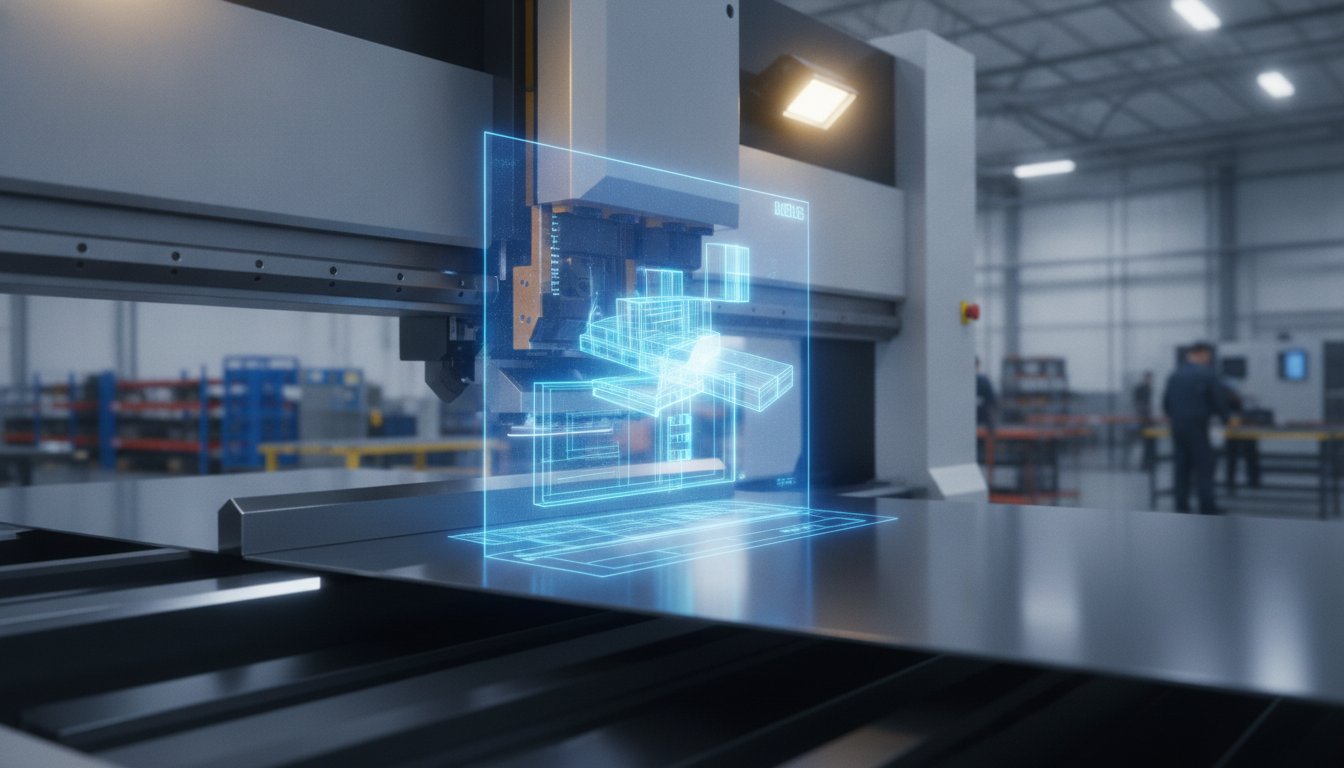
In traditional manufacturing, a defect is often discovered only after a part fails on the shop floor. This reactive approach is a waste of time and high-priced structural steel. We've shifted the diagnostic process upstream. By utilizing BIM for sheet metal fabrication, we perform a virtual test-run of every bend before the first blank is ever cut. This digital twin approach identifies forming impossibilities and potential common press brake forming defects during the design phase, not during the production run. We simulate material behavior, elasticity, and springback in a 3D environment to ensure the digital file is physically achievable.
Our workflow translates mechanical spool drawings directly into surgical CNC code. This direct digital-to-physical bridge eliminates the manual data entry that often leads to common press brake mistakes. BIM clash detection allows us to see if a flange will collide with the tooling or if a complex geometry is structurally unsound. We solve the physics on a screen so we don't have to solve them through scrap on the floor. It's about moving from a "guess and check" mentality to a "simulate and execute" reality.
Digital Precision in HVAC Ductwork
For large-scale mechanical projects, precision is the difference between a fast install and a costly delay. We integrate our CNC press brake forming with automated coil line duct fabrication to create seamless assemblies. Automated rectangular duct production requires significantly higher precision than traditional manual methods. By using BIM-coordinated spool drawings, we reduce field collisions in HVAC ductwork. Every fitting and flange is designed to snap together, ensuring that the airflow and structural integrity of the system remain intact from the digital model to the final rooftop unit.
Repeatability for National Accounts
Scaling production for national accounts requires absolute consistency across every shipping zone. Digital workflows ensure the 1,000th part is identical to the first. We standardize our production files, meaning a part fabricated today will match a part ordered six months from now with surgical accuracy. Our role as an Authoritative Expert Operator is to oversee these automated systems, ensuring the bridge between the digital design and the physical product remains unshakeable. We provide the reliability that national OEMs and contractors demand, delivering precision that local job shops simply cannot match.
Design for Manufacturability (DFM): A Shield Against Forming Defects
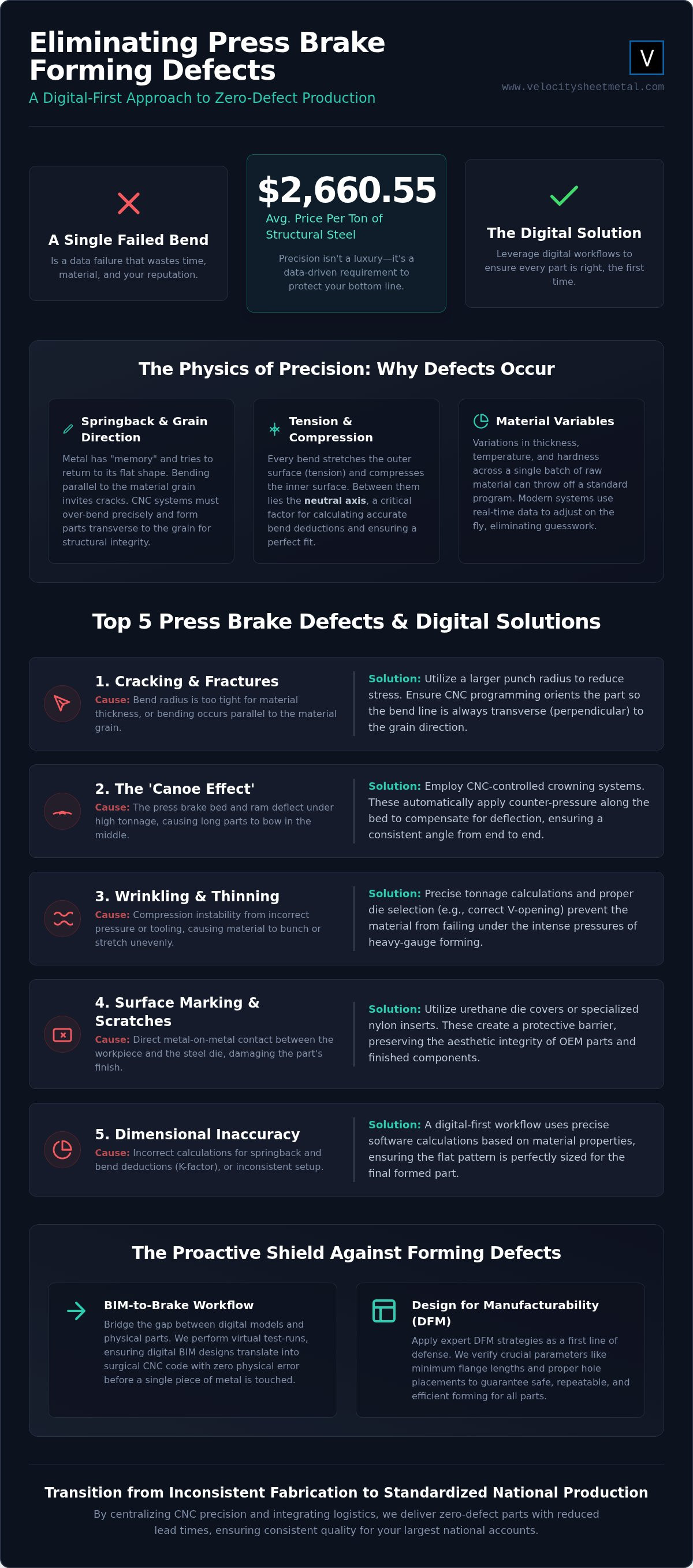
Precision is a choice made during the design phase. Adopting Design for Manufacturability (DFM) for sheet metal is the most cost-effective way to improve quality and eliminate errors before they reach the shop floor. By following standardized DFM rules, you create a shield against common press brake forming defects that typically plague unoptimized designs. When geometry is designed with the machine's physical limits in mind, production becomes faster, safer, and significantly more reliable.
Minimum flange length is the first line of defense. If a flange is too short, the material won't span the V-die opening, causing it to slip into the die during the stroke. This leads to inaccurate angles and potential safety hazards. Similarly, the inside bend radius must be carefully calculated. We recommend matching the inside radius to the material thickness at a minimum. Sharp radii create excessive stress on the outer fibers of the metal, which is the primary cause of cracking and structural failure in heavy-duty components. Relief cuts are another essential DFM tool. By strategically placing notches at the intersection of two bends, you allow the material to move freely, preventing the bunching and tearing that often ruins complex enclosures.
DFM Rules for Heavy-Gauge Plate
Heavy-gauge plate requires a different set of rules than thin-gauge sheet. The tonnage requirements are much higher; the material is far less forgiving. As the V-die width decreases, the required tonnage to form the part increases exponentially. We prioritize edge preparation to ensure success. Laser-cut edges are superior to sheared edges because they reduce the micro-fractures that can expand into full cracks during the forming process. In 2026, managing these heavy-gauge variables is about balancing die selection with the physical properties of the stock to ensure repeatable accuracy across every part.
Streamlining OEM Production Partnerships
Success for national accounts depends on seamless collaboration. We work closely with OEM sheet metal fabrication services during the prototyping phase to refine designs for high-volume production. Standardized DFM rules allow us to reduce lead times for national procurement managers by eliminating the "back-and-forth" typical of unrefined files. We also optimize flat-pattern nesting to reduce material waste, ensuring your project remains on budget despite fluctuating steel prices. If you want to harden your supply chain against production errors, partner with Velocity Sheet Metal for expert DFM review and surgical CNC execution.
Scaling Quality: National Distribution and Standardized Production
The manufacturing landscape in 2026 has moved beyond the limitations of the local job shop. For national accounts, relying on fragmented regional suppliers often leads to a lack of uniformity. This inconsistency is where common press brake forming defects thrive, as different shops use varying levels of technology and quality control. We've centralized the process. By acting as a national fabrication partner, we ensure that every component meets a single, rigorous standard. Whether your project is in Seattle or Miami, the physical tolerances remain identical. This standardized approach is the only way to manage large-scale industrial rollouts without the risk of assembly failures on-site.
Logistics play a critical role in maintaining precision. Shipping heavy-gauge components across shipping zones requires more than just a pallet and a truck. It requires a methodical approach to packaging and handling that protects the integrity of every bend. We maintain 2026 industrial tolerances of +/- 0.005 inches from the moment the part leaves the CNC press brake until it arrives at your facility. Our "can-do" attitude isn't just a slogan. It's a commitment to using tech-forward solutions to solve the logistical and technical challenges that traditional shops often ignore. We treat the delivery process with the same surgical precision as the forming process itself.
On-Demand Part Production for National Accounts
Inventory management has evolved. We help our partners move from "just-in-case" stockpiling to "just-in-time" national shipping. This shift reduces your overhead and eliminates the waste associated with outdated stock. Our CNC automation allows us to scale production rapidly, making us the ideal partner for high-volume HVAC rollouts. By serving as a single-source partner, we provide centralized quality control that local vendors can't match. You get one point of contact, one standard of excellence, and a supply chain that moves as fast as your project demands. It's about reliability that scales.
The Essential Bridge: Digital File to Tangible Product
Velocity Sheet Metal is the essential bridge between your digital design and the physical world. Engineers and contractors choose us because we understand that a BIM model is only as good as the final part it produces. Our process follows a methodical progression. We start with BIM coordination and spool drawings, move through surgical CNC forming, and end with precision-timed delivery. We don't just bend metal; we execute a data-driven workflow that eliminates common press brake forming defects before they can impact your timeline. When you're ready to move from a digital concept to a tangible result, we're ready to get to work.
Request a Quote for National CNC Metal Forming Services
Secure Your Supply Chain with Zero-Error CNC Precision
Precision in 2026 isn't a matter of luck; it's the result of surgical CNC execution and integrated BIM coordination. By addressing the root causes of common press brake forming defects during the design phase, we move your project from a digital file to a tangible product with unmatched speed. You've seen how expert DFM rules and real-time CNC monitoring eliminate the physical failures that stall national HVAC and industrial rollouts. It's time to stop reacting to errors and start preventing them through data-driven fabrication.
We bring 50+ years of combined industry experience to every bend, ensuring your 1,000th part is as accurate as your first. Our full BIM and spooling integration provides the bridge you need for a seamless digital-to-physical workflow. With our national shipping capacity, we deliver standardized quality to every job site in the country. Partner with Velocity Sheet Metal for Precision CNC Bending and secure a supply chain built on industrial pragmatism and tech-forward accuracy. We're ready to get to work immediately.
Frequently Asked Questions
What are the most common causes of cracking in heavy-gauge metal bending?
Cracking in heavy-gauge metal usually results from a bend radius that is too sharp for the material thickness. When the outer fibers of the plate are stretched beyond their tensile limit, fractures occur. Bending parallel to the longitudinal grain of the metal also increases the risk of structural failure. We mitigate these common press brake forming defects by using larger punch radii and ensuring all bends are transverse to the grain direction.
How does springback affect the accuracy of press brake forming?
Springback occurs when the metal’s elastic memory causes it to partially return to its original shape after the punch releases. This recovery changes the final angle of the part, which can lead to fitment issues in complex assemblies. Modern CNC press brakes use real-time angle sensors to measure the part during the stroke. The machine then over-bends the material by a precise amount to account for this elastic return.
What is the difference between air bending and coining in CNC metal forming?
Air bending is a three-point forming process where the material only touches the punch tip and the two edges of the V-die. It allows for multiple angles with a single tool set and requires less tonnage. Coining involves the punch bottoming out into the die, forcing the material into a specific shape. While coining offers high repeatability, it requires significantly more tonnage and lacks the flexibility of CNC-controlled air bending.
How can BIM coordination prevent press brake defects?
BIM coordination prevents common press brake forming defects by allowing for a virtual simulation of the entire fabrication process before production begins. This digital-first approach identifies forming impossibilities and tooling collisions that wouldn't be caught in 2D drawings. By integrating BIM models with CNC programming, we ensure that every flange and hole location is physically achievable. This reduces material waste and prevents field collisions in HVAC ductwork.
What is the minimum flange length required for a safe press brake bend?
The minimum flange length is typically calculated as 2.5 to 4 times the material thickness, depending on the V-die opening used. If a flange is too short, it will slip into the die during the forming process. This results in an inaccurate bend or a safety hazard. We verify these dimensions during the technical review phase to ensure the press brake has enough material to grip securely for a surgical bend.
How does material grain direction impact the strength of a formed part?
Material grain direction dictates how much stress a bend can withstand without failing. Metal is strongest when bent perpendicular to the grain, as the fibers are better able to distribute the tension. Bending along the grain line often results in the material splitting or losing its structural integrity. Standardizing grain orientation across all production files is a key step in ensuring the durability of heavy-gauge industrial components.
Can CNC press brakes automatically compensate for bed deflection?
Yes, modern CNC press brakes utilize automated crowning systems to compensate for bed deflection. When high tonnage is applied to long workpieces, the center of the machine bed can flex. This leads to an inconsistent bend angle across the part. CNC crowning applies counter-pressure to the center of the bed in real-time. This ensures every part maintains surgical precision across its entire length, regardless of the tonnage applied.
How do I ship precision-formed metal parts nationwide without damage?
Shipping precision components nationwide requires a methodical approach to packaging and logistics. We use custom crating and reinforced palletizing to prevent shifting and impact damage during transit. By centralizing production and using standardized quality controls, we ensure parts arrive at any US shipping zone with their tolerances intact. This logistical precision is essential for national accounts that require just-in-time delivery for large-scale mechanical rollouts.