
Commercial Spiral Ductwork Applications: Efficiency and Performance Standards

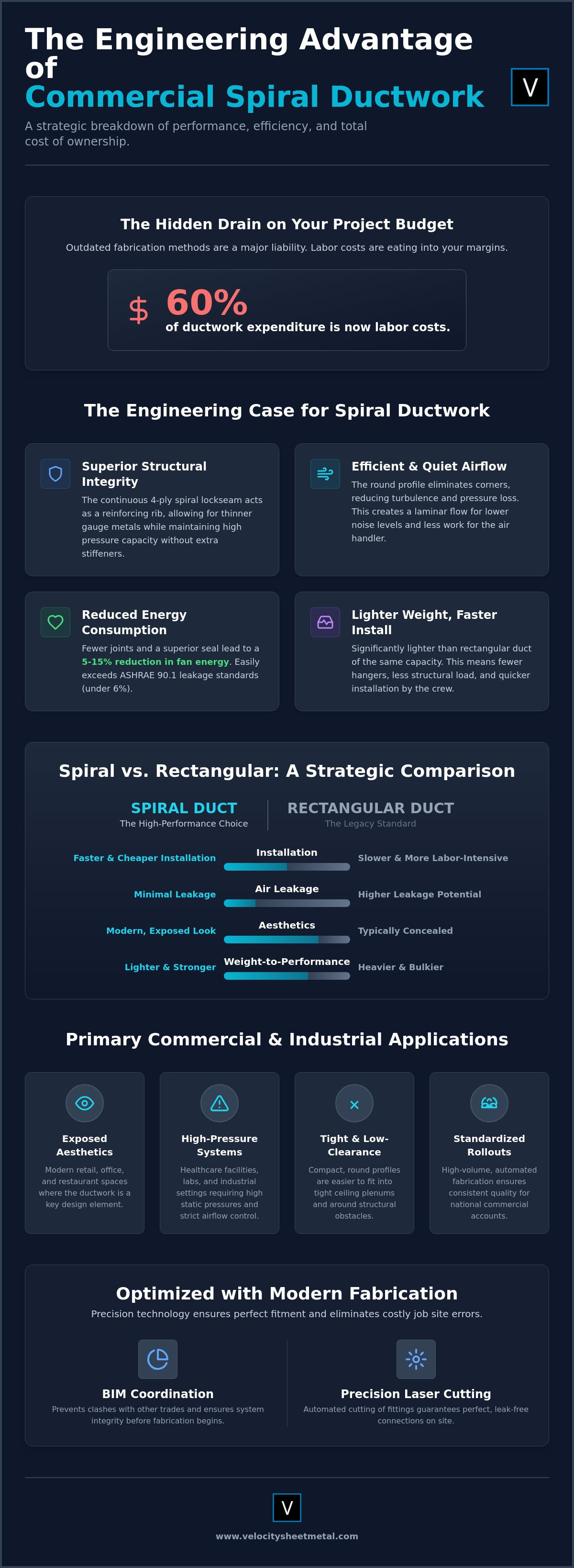
Did you know that labor costs now account for approximately 60% of your total commercial ductwork expenditure? In an industry where every hour on the job site eats into your margin, relying on outdated, labor-intensive fabrication methods is a liability. You are likely facing the dual headaches of energy loss from air leakage and the constant struggle to fit bulky systems into tight, low-clearance spaces. It is a frustrating bottleneck that compromises both system performance and your bottom line.
We understand that you need a solution that balances technical precision with rapid field execution. This article explores the most effective commercial spiral ductwork applications to help you reclaim those lost hours and kilowatts. Discover why spiral ductwork is the preferred choice for high-performance commercial HVAC systems and how precision fabrication optimizes industrial airflow. We will break down how to achieve a modern industrial aesthetic, ensure strict SMACNA compliance, and use BIM coordination to streamline your next installation from the shop floor to the final bolt.
Key Takeaways
- Understand how the spiral lockseam creates superior structural integrity, allowing for higher pressure capacities with thinner gauge metals.
- Compare the total cost of ownership between spiral and rectangular systems, focusing on how reduced weight leads to fewer hangers and faster installation.
- Identify specific commercial spiral ductwork applications where exposed aesthetics or high-pressure healthcare standards are non-negotiable.
- Learn how BIM coordination and precision laser cutting eliminate job site collisions and ensure perfect fitment for every fitting.
- Discover the logistics of sourcing standardized, high-volume ductwork for national rollouts through automated fabrication and nationwide shipping.
The Engineering Case for Commercial Spiral Ductwork
Spiral ductwork is a precision-engineered alternative to traditional rectangular systems. It represents a shift from bulky, labor-intensive fabrication toward streamlined, high-performance air distribution. This design is the standard for modern Ductwork environments where airflow efficiency isn't just a preference; it's a technical requirement. By utilizing a continuous round profile, these systems eliminate the structural and aerodynamic weaknesses inherent in flat-sided metal boxes.
The core of this strength lies in the spiral lockseam. This continuous, four-ply mechanical lock creates a rigid, reinforcing rib along the entire length of the tube. It transforms thin-gauge metal into a structurally superior component. Rectangular duct often requires external stiffeners or "cross-breaking" to prevent oil-canning and vibration. Spiral duct is inherently stable. It maintains its shape under high static pressures without the need for additional, heavy reinforcement.
Airflow physics favor the round profile. In rectangular systems, air hits sharp corners, creating dead zones and significant turbulence. This resistance forces the air handling unit to work harder. Spiral duct eliminates these high-drag areas, allowing for a laminar flow that reduces Noise Reduction (NR) levels. It’s the difference between a quiet, efficient system and one that hums and rattles under pressure. For commercial spiral ductwork applications, this means a more comfortable environment and a more reliable mechanical system.
Much like the precision required in modern HVAC systems, specialized flight training also demands a focus on advanced technology and performance. For those who value engineering excellence, you can visit Vision Aviation to explore their fleet of aircraft featuring advanced Garmin avionics.
Air Leakage and Energy Efficiency Standards
Energy efficiency starts with a superior seal. Most commercial spiral ductwork applications achieve a 5-15% reduction in fan energy consumption compared to rectangular alternatives. This happens because round duct has fewer longitudinal joints and a smaller surface area per volume. According to ASHRAE Standard 90.1, duct leakage must be at or below 6% of total airflow. Spiral systems typically exceed these benchmarks with ease. Fewer joints mean fewer points of failure. Lower leakage translates directly to lower monthly operating costs for the building owner over the life of the system.
Material Durability and Pressure Ratings
Material choice dictates the longevity of the installation. We fabricate using galvanized steel, aluminum, and stainless steel to meet specific environmental needs. The spiral reinforcement allows us to use thinner gauges while maintaining high-pressure ratings. This reduces the total weight of the system, making it easier to hang and support. For projects requiring thermal control, dual-wall insulated spiral duct is the standard. It features a perforated inner liner and a layer of insulation to provide a high-performance barrier against heat loss. By integrating BIM for sheet metal fabrication, we ensure these complex, dual-wall components fit perfectly on the first try.
Spiral vs. Rectangular Duct: A Strategic Comparison
Choosing between spiral and rectangular duct isn't just about the shape. It's a strategic decision that impacts the entire project lifecycle. While rectangular duct is the legacy choice for large trunk lines, spiral duct often wins on total cost of ownership. The decision comes down to balancing material costs against field labor and long-term performance. In many commercial spiral ductwork applications, the initial material investment is quickly offset by the speed of installation and reduced support requirements.
Weight-to-performance ratio is a critical differentiator. Spiral duct is significantly lighter than its rectangular counterparts. The continuous lockseam provides such high structural integrity that engineers can often specify a thinner gauge without sacrificing pressure capacity. This aligns with high-efficiency DOE Ductwork Specifications for modern builds. Lighter duct means your crew needs fewer hangers and less heavy-duty support hardware. It simplifies the structural load on the building and keeps your team moving faster on the job site.
Architects frequently specify spiral duct for its "aesthetic premium." In modern retail or office spaces, exposed ductwork is a design asset. It provides a clean, industrial finish that doesn't require the added cost of a drop ceiling. However, rectangular duct still has its place. For high-volume, standard runs where space isn't a constraint, coil line duct fabrication remains an incredibly cost-effective solution for concealed plenums. If you're unsure which profile fits your current project, consulting with a precision fabricator can clarify the best path forward.
Installation Speed and Labor Savings
Installation speed is where the margin is won or lost. Spiral systems utilize slip-fit connections that eliminate the need for complex flanging or corner gaskets. You aren't wrestling with heavy, awkward sections at the top of a lift. Precision-fabricated spiral fittings reduce field labor by allowing for a "plug-and-play" assembly that drastically cuts down on-site man-hours.
Space Utilization and Clearances
Don't believe the myth that round duct kills your ceiling height. When clearances are tight, flat oval spiral provides the airflow performance of round with the low-profile benefits of rectangular. It’s a hybrid solution that fits into tight plenums where a standard round pipe wouldn't clear. By using BIM coordination, we can map these air paths with surgical precision, ensuring that your commercial spiral ductwork applications never conflict with plumbing or electrical runs.
Primary Commercial and Industrial Applications
Different environments demand different mechanical strategies. While the physics of round duct remains constant, the specific commercial spiral ductwork applications vary wildly by industry. From high-end retail to sterile labs, the choice of material and finish defines the success of the build. We treat every sector as a unique engineering challenge, matching the fabrication method to the operational reality of the space.
For high-end retail projects, this operational reality often includes sophisticated branding and visual elements; Image Square Printing provides specialized mirror printing that integrates seamlessly into these modern industrial designs.
Healthcare facilities and laboratories operate under much stricter constraints. These spaces require absolute seal integrity and often demand stainless steel construction to prevent corrosion or microbial growth. High-pressure spiral systems are the standard here. They handle the intense filtration requirements of HEPA systems without losing static pressure. The smooth interior surfaces also minimize the buildup of dust and particulate matter, ensuring a higher standard of indoor air quality.
Data centers present a different challenge. Cooling server racks requires massive volumes of air delivered with minimal turbulence. Spiral duct's round profile minimizes friction. This allows for high-velocity delivery that keeps hardware at optimal temperatures without excessive fan energy. In industrial warehousing, the focus shifts to durability and reach. The rigid lockseam allows for longer spans between supports, which is essential in large-scale facilities where hanging points are limited by the building's structural grid. If you're coordinating a new industrial build, read more about how pre-engineered steel building systems can be designed to handle these heavy-duty mechanical requirements.
Exposed Ductwork in Architectural Design
Modern office designs have moved away from drop ceilings. They favor the transparency of exposed mechanical systems. Spiral duct provides a symmetrical, organized look that rectangular duct simply can't match. Using paint-grip galvanized steel ensures the finish lasts for years. It integrates seamlessly into the building's aesthetic. We use precision laser cutting to create custom fittings that maintain a high-end finish throughout the run. To further enhance your facility’s architectural style with high-quality metalwork, check out Iron Guys for custom railings and gates.
High-Pressure and Specialized Ventilation
Specialized ventilation requires heavy-duty solutions. Commercial kitchen exhaust and grease duct applications rely on the airtight seals of spiral pipe to prevent dangerous leaks. Industrial environments use heavy-gauge spiral for dust collection and fume extraction because it stands up to abrasive materials. In high-velocity VAV systems, the reduced turbulence of a round profile prevents the whistling and rattling common in rectangular transitions.
Optimizing Fabrication with BIM and Automation
Precision modeling is the foundation of high-performance commercial spiral ductwork applications. The transition from manual layout to digital coordination has eliminated the era of "making it work" in the field. By utilizing BIM for sheet metal fabrication, we identify and resolve collisions with plumbing, electrical, and structural systems before a single piece of metal is cut. This proactive clash detection ensures that every spiral run fits the first time, preventing the costly rework that typically derails mechanical timelines.
Modern fabrication bridges the gap between a 3D model and the physical product through automated CNC plasma and laser cutting. This commitment to precision engineering is also seen in specialized manufacturing firms like Keiteq Co Ltd, which offers end-to-end solutions from R&D to mass production management. Our shop floor receives digital files directly from the coordination model. This data drives high-speed lasers to produce fittings with tolerances that manual methods simply cannot match. It's a surgical approach to manufacturing. Exact-fit fabrication drastically reduces job site waste and scrap metal, ensuring that you only pay for the material that actually ends up in the building.
Automation ensures that even the most complex commercial spiral ductwork applications remain on schedule. When the digital model is finalized, the system generates accurate mechanical spool drawings for every assembly. This level of detail allows for a controlled production environment where quality is repeatable. If you're ready to eliminate job site friction, get a precision quote from Velocity Sheet Metal to see how our automated workflow accelerates your project.
The Role of Mechanical Spooling Services
Mechanical spooling breaks down complex duct runs into manageable, installable sections. We don't just ship a pile of parts. Every spool is labeled and pre-assembled to the furthest extent possible before leaving our facility. This process transforms the job site into an assembly line rather than a fabrication shop. Contractors report significant schedule reliability because they aren't wasting hours sorting through loose fittings or correcting alignment issues on a lift.
On-Demand Part Production for Custom Fittings
Commercial HVAC systems rarely follow a straight line. Custom transitions, offsets, and plenums are necessary to navigate modern building constraints. Using precision laser cutting, we produce these complex components with zero lag time. Traditional manual layouts are slow and prone to human error. Our automated process ensures that a custom offset fits as perfectly as a standard piece of pipe. This capability is essential for maintaining high-pressure seals in specialized ventilation environments.
This degree of technical precision is also vital in other high-performance fields, where Fat Boy Design USA utilizes advanced fabrication to produce custom components for Harley Davidson motorcycles.
Sourcing Spiral Duct for National Commercial Accounts
Sourcing for national accounts requires a move away from fragmented local procurement. When managing a rollout across several states, the biggest risk is inconsistent quality. One shop might follow SMACNA standards strictly while another uses outdated manual layouts. This leads to performance gaps and field collisions that delay the entire schedule. By centralizing fabrication, you ensure that every commercial spiral ductwork applications project in your portfolio performs exactly as designed. For companies expanding their physical footprint into new territories, establishing a solid legal structure is as important as the mechanical infrastructure; Massingill Attorneys & Counselors at Law offers specialized support for business formation and corporate growth.
Centralized fabrication offers a repeatable model for national developers. You aren't just buying metal; you're buying a standardized engineering result. Automated production lines deliver a level of consistency that manual local shops cannot match. This is critical for national retail or industrial rollouts where identical HVAC performance is required at every location. A single point of contact simplifies the entire procurement chain. It moves your project from digital spool drawings to the job site with zero administrative lag; for those needing to send physical contracts or invoices, postalmethods.com further streamlines the process by automating letter mail directly from your digital files.
Standardizing Quality Across Project Portfolios
Centralized fabrication ensures that every branch or facility has identical HVAC performance. National account managers act as the essential bridge between your design team and our production floor, streamlining the procurement of high-volume orders. Automated production provides a surgical level of consistency that manual local shops simply cannot replicate across multi-state territories. This uniformity is vital for maintaining brand standards and operational efficiency across your entire project portfolio.
For organizations looking to extend these high standards into their broader marketing efforts, you can discover BRAND NEW Promotions | Top Promo Supplier in North Texas to find custom branding solutions that support your business success and growth.
Logistics and Delivery for High-Volume Projects
Shipping air is expensive unless you have a strategy. We use "nesting" techniques and optimized packaging to maximize truck space. This significantly reduces national shipping costs. It allows us to deliver high-volume ductwork orders to any job site in the country without the typical logistics premium. We focus on getting the right parts to the right place at the right time; for specialized help with time-critical cargo, you can visit ICAT Detroit to see how they manage high-value freight.
- Just-in-time delivery: Keeps job sites clear of excess inventory and reduces the risk of on-site damage.
- Standardized labeling: Ensures that your field crew knows exactly where every spool belongs according to the BIM model.
- Coordinated shipping: Aligns with your mechanical contractor’s installation phases to keep the project moving forward.
Ready to scale your next project? Request a quote for national ductwork fabrication.
Precision Fabrication for the Modern Job Site
The shift toward high-performance HVAC systems requires more than just standard materials. It demands a technical partnership that prioritizes airflow physics and schedule reliability. You've seen how the structural integrity of the spiral lockseam and the integration of BIM coordination redefine the standard for air distribution. Whether your project involves a sterile healthcare environment or a high-end retail showroom, selecting the right commercial spiral ductwork applications is the first step in reducing long-term operating costs. To maintain the same level of excellence for your high-performance vehicles, you can read more about professional automotive detailing and protection.
We bridge the gap between complex digital designs and physical reality. Our automated high-volume production ensures that every fitting meets surgical tolerances, while our nationwide shipping capability keeps your crew moving forward. You don't have to settle for the delays and inconsistencies of local shops. It's time to streamline your procurement and secure a system built for precision. Get a Precision Quote for Your National Commercial Project today and experience BIM-to-machine accuracy on your next build. We're ready to get to work.
Frequently Asked Questions
Is spiral ductwork more expensive than rectangular duct?
Spiral duct often has a lower total installed cost. While raw material prices fluctuate, the reduction in field labor and fewer required hangers typically offset any initial premium. Rectangular systems require more joints, sealants, and complex flanging that drive up the final invoice on the job site. You save money by choosing a system that installs faster and performs better over time.
What is the maximum pressure rating for standard commercial spiral duct?
Standard spiral duct handles positive pressures up to 10 inches water gauge (wg) depending on the metal gauge and pipe diameter. The continuous spiral lockseam provides superior structural rigidity compared to longitudinal seams. For high-pressure commercial spiral ductwork applications, we fabricate using heavier gauges to meet SMACNA industrial standards and ensure system integrity.
Can spiral duct be used for commercial kitchen exhaust?
Yes, spiral duct is suitable for kitchen exhaust when fabricated to liquid-tight standards. It must meet NFPA 96 requirements for grease duct systems. We typically use 18-gauge stainless steel or carbon steel with specialized high-temperature sealed joints to ensure fire safety. This prevents dangerous leaks and ensures compliance with local building codes in commercial kitchens.
How does BIM coordination improve spiral duct installation?
BIM coordination identifies physical clashes between the ductwork and other trades before fabrication begins. This digital review allows us to produce precise mechanical spools that fit perfectly upon delivery. It eliminates the need for field modifications. These adjustments are particularly difficult and time-consuming with round spiral profiles compared to rectangular duct, so getting it right in the model is essential.
What are the standard lengths for commercial spiral pipe?
Standard lengths are typically 10 feet and 20 feet. Longer lengths reduce the number of joints and couplings required, which minimizes potential leakage points and speeds up the installation process. We provide custom lengths through our automated production line to match specific project requirements. This precision reduces on-site cutting waste and keeps the job site clean.
Does spiral ductwork require specialized hangers?
Spiral duct uses round-specific hanging systems such as teardrop hangers, saddle straps, or wire cable suspensions. Because spiral pipe is lighter and more rigid than rectangular duct, it requires fewer support points per linear foot. This reduced hanger count is a primary driver of the labor savings. It allows your crew to cover more ground in less time without sacrificing structural safety.
How do I calculate the air leakage for a spiral duct system?
Air leakage is calculated using the SMACNA leakage class formula, where leakage (F) equals the leakage class (C) multiplied by the static pressure (P) raised to the 0.65 power. Most spiral systems fall into Leakage Class 3 or lower. This performance typically exceeds ASHRAE 90.1 energy standards. It ensures minimal fan energy loss and reduces long-term operating costs for the building owner.
Can spiral ductwork be painted for exposed architectural designs?
Spiral ductwork is ideal for painting in exposed architectural designs. We recommend using paint-grip galvanized steel, which undergoes a phosphate treatment to ensure superior paint adhesion. This prevents the peeling and flaking common when applying standard coatings to traditional galvanized surfaces. It's a staple in modern commercial spiral ductwork applications where aesthetics are as important as airflow.