Commercial Kitchen Ductwork Fabrication: Standards and Precision Requirements
A single pinhole leak in a grease duct isn't just a maintenance headache; it's a ticking time bomb for a catastrophic kitchen fire. You've likely dealt with the frustration of arriving on-site only to find your custom fittings won't clear the overhead plumbing because of a three-inch field collision. Precision in commercial kitchen ductwork fabrication is the only way to bridge the gap between a digital design and a safe, liquid-tight installation. We understand that in high-volume environments, you can't afford to wait on slow lead times or deal with the liability of non-compliant seams.
This guide breaks down the essential technical requirements and fabrication standards you need to ensure total compliance and maximum efficiency. You'll master the nuances of the NFPA 96 2024 edition and the International Mechanical Code (IMC) 2024 standards. We'll explore how BIM-driven spooling and automated coil-line production eliminate field labor while standardizing quality across national accounts. From initial digital coordination to the final liquid-tight weld, it's time to streamline your workflow and deliver systems that pass inspection every single time.
Key Takeaways
- Master NFPA 96 and IMC 2024 standards to ensure material selection and liquid-tight seams meet strict fire safety codes.
- Prevent expensive field collisions in crowded kitchen ceilings by using BIM coordination and spool drawings before cutting metal.
- Understand why professional commercial kitchen ductwork fabrication demands continuous external welds and zero internal fasteners to prevent grease buildup.
- Boost installation speed with automated coil-line production that provides consistent bead profiling and rapid lead times for rectangular duct.
- Standardize quality across national locations with a fabrication partner that ships precision-engineered components directly to your job site.
Commercial Kitchen Ductwork Standards and Material Requirements
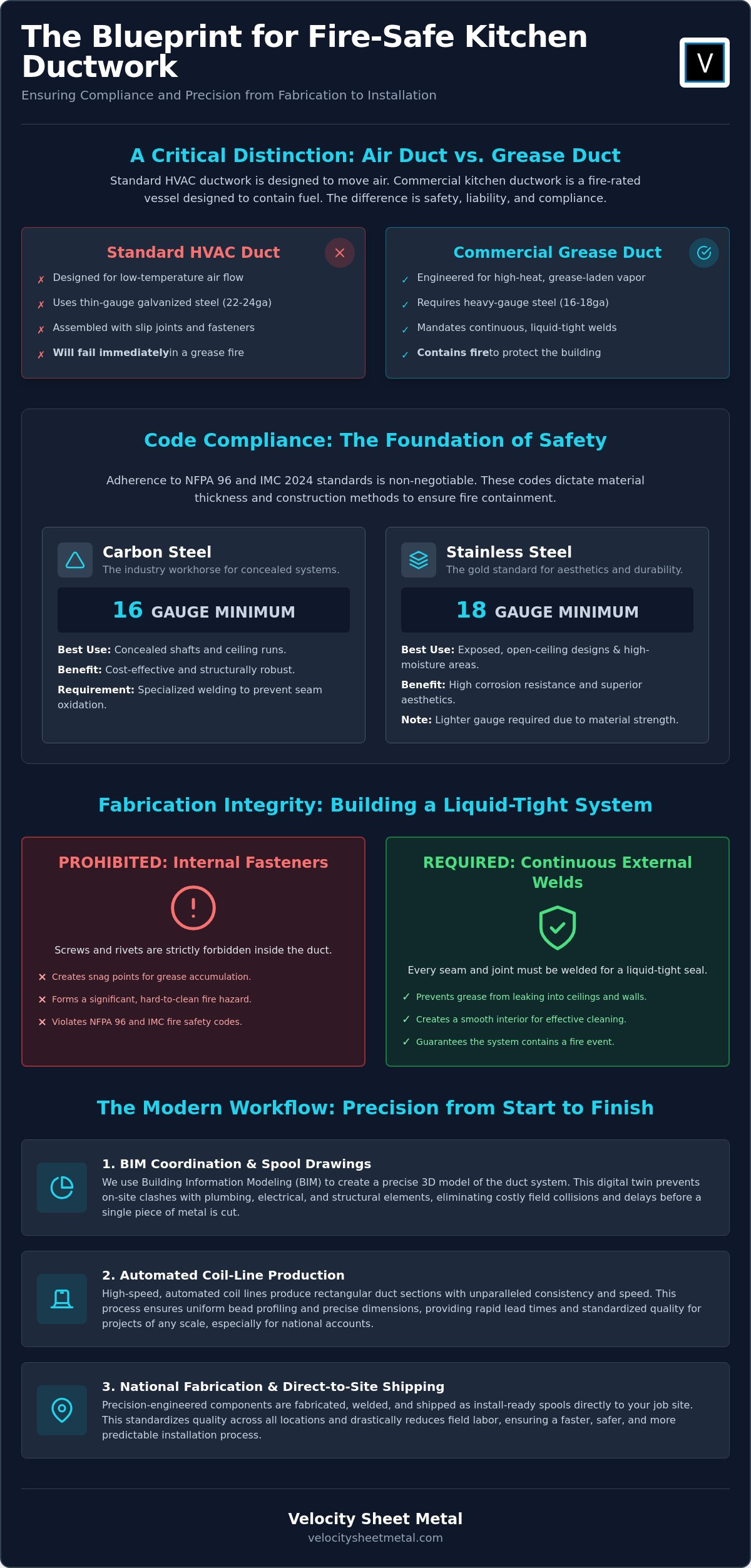
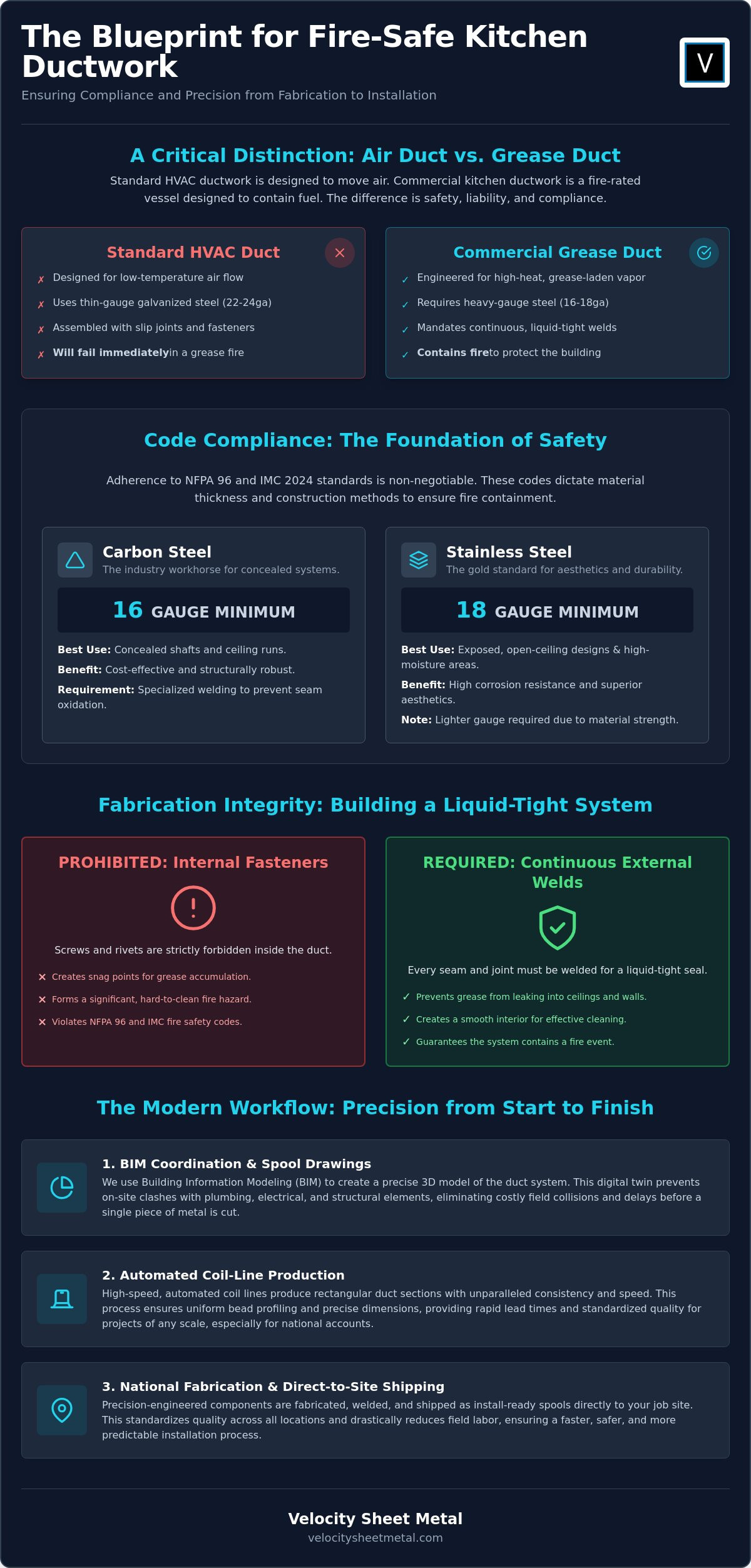
Standard HVAC ducting is designed for air; commercial kitchen systems are designed for fuel. When you're dealing with volatile grease vapors and high-heat exhaust, the margin for error is zero. Professional commercial kitchen ductwork fabrication requires a fundamental shift in mindset from comfort cooling to fire containment. It's about building a fire-rated vessel that protects the entire structure. Standard galvanized ductwork with slip-and-drive connections will fail immediately under the stress of a grease fire. These systems require heavy-gauge materials and continuous, liquid-tight welds to ensure that if a fire starts, it stays contained within the duct until the suppression system can do its job.
From the initial gauge selection to the final external weld, every decision in the fabrication process must prioritize safety. Standard ductwork is often 24 or 22 gauge; grease ducts must be significantly heavier to withstand the intense thermal expansion of a kitchen environment. Failure to meet these material standards doesn't just result in a failed inspection. It creates a liability that can lead to catastrophic property loss.
NFPA 96 and Fire Safety Compliance
The National Fire Protection Association (NFPA) 96 standard is the blueprint for safety in cooking operations. According to the 2024 edition, grease ducts must be constructed from a minimum of 16-gauge carbon steel or 18-gauge stainless steel. This thickness is non-negotiable. Thinner materials warp under heat, leading to seam failures and grease leaks. Proper Grease Duct Fire Safety mandates that every joint and seam must be liquid-tight. In a high-volume shop, this means using precision laser cutting and automated forming to ensure every edge meets perfectly for the welder. Internal fasteners like screws or rivets are strictly prohibited because they create snag points for grease accumulation.
Material Selection: Stainless Steel vs. Carbon Steel
Choosing between stainless and carbon steel is a balance of environment and budget. Stainless steel, typically Type 304 or 316, is the gold standard for exposed ductwork. It resists the corrosive effects of moisture and cleaning chemicals while providing a clean, professional look for open-ceiling designs. Carbon steel is the workhorse for concealed systems. It provides the necessary fire rating at a lower material cost, though it requires specialized welding techniques to prevent oxidation at the seams.
- Stainless Steel: Offers high corrosion resistance and superior aesthetics. It's the ideal choice for front-of-house exposure and high-moisture environments.
- Carbon Steel: Provides a cost-effective, structurally robust solution. It's best suited for shafts and concealed ceiling runs where aesthetics are secondary.
Regardless of the material, the commercial kitchen ductwork fabrication process must be surgical. Precision is the difference between a system that passes inspection and one that requires expensive field remediation. By integrating BIM coordination into the fabrication workflow, we ensure that every transition and offset is accounted for before the metal hits the floor. This eliminates the "make it fit" mentality that leads to code violations and fire hazards. We focus on delivering a product that is ready for immediate installation, moving your project from the digital concept to a physical, compliant reality without the typical administrative delays.
Precision Fabrication for Liquid-Tight Grease Duct Systems
Standard HVAC ductwork relies on slip joints and gaskets to move air. Grease ductwork is different. It's a pressurized, fire-rated vessel. In commercial kitchen ductwork fabrication, the primary goal is a liquid-tight seal. Grease is more than just a byproduct; it's a fuel source. If a fire ignites, the duct must contain it without allowing flames or liquefied grease to escape into wall cavities or ceiling plenums. This isn't just a best practice. It's a fundamental safety requirement.
This level of containment dictates a specific assembly method: continuous external welding. You can't rely on mechanical fasteners here. Screws and pop rivets are strictly prohibited inside the air stream. These small protrusions catch grease and lint, creating heavy deposits that are impossible to clean and easy to ignite. Every seam and joint must be smooth and unobstructed to ensure the system remains cleanable and safe over years of operation.
Welding Requirements for Grease-Laden Air
Welding is the backbone of a compliant system. According to the NFPA 96 Standard, all seams must be welded to prevent leakage. Manual field welding is often inconsistent and prone to porosity, especially in tight overhead spaces. We prioritize shop-welded sections to ensure deep, uniform penetration. This reduces the risk of pinhole leaks that often go unnoticed until a fire occurs. Every welded joint must be inspected for integrity, ensuring the metal can withstand the intense thermal expansion of a high-heat exhaust cycle.
Custom Transition Fittings and Plenum Boxes
Kitchen ceilings are crowded. You're fighting for space with fire sprinklers, electrical conduits, and structural beams. Transition fittings are where most systems fail. If the transition angle is too sharp, grease "drops out" of the air stream and pools in the bottom of the duct. Our commercial kitchen ductwork fabrication process uses precision laser cutting to create perfect offsets and plenums. This ensures consistent airflow velocity and prevents dangerous grease accumulation in low points.
Precision fit-up is critical for a high-quality weld. If your parts don't align perfectly, the welder has to "fill the gap," which causes heat distortion and weakens the metal. Utilizing custom laser cutting ensures every plenum box and offset fits perfectly the first time. This reduces shop labor and ensures the finished product matches your digital design with surgical accuracy.
- Continuous external welds on all longitudinal and transverse seams.
- Zero internal fasteners to prevent grease buildup.
- Transitions designed to maintain minimum exhaust velocity.
- Laser-cut accuracy to minimize heat distortion during welding.
By focusing on these precision requirements, you eliminate the "make it fit" mentality that leads to code violations. We deliver components that are ready for immediate assembly, moving your project from the shop floor to the kitchen ceiling with total confidence in the system's integrity.
BIM Coordination: Reducing Field Collisions in Kitchen Layouts
Commercial kitchen ceilings are a battlefield. Plumbing, electrical, fire suppression, and structural steel all fight for the same two-foot plenum space. Traditional methods rely on field measurements and on-site adjustments, but in a high-stakes environment, guesswork leads to collisions. These field collisions stop production. They blow budgets. Precision commercial kitchen ductwork fabrication starts long before the first sheet of metal hits the coil line. It starts in a coordinated digital environment where every trade's path is mapped and every conflict is resolved virtually.
BIM (Building Information Modeling) coordination isn't just about creating a 3D picture. It's about building a data-rich roadmap for the entire project. We use these models to perform virtual clash detection, identifying exactly where a grease duct might hit a structural beam or a sprinkler main. By solving these problems in the model, we ensure that the physical ductwork fits perfectly on the first try. This proactive approach eliminates the need for expensive field modifications and ensures your installation team isn't forced to "make it work" with hammers and snips in a tight ceiling.
The Role of Mechanical Spooling Services
Mechanical spooling turns a massive, complex duct run into a streamlined kit of parts. We break the system down into manageable, pre-fabricated sections known as spools. Each spool is engineered to fit through standard doorways and onto lifts, making logistics on-site far simpler. Every piece is labeled to match a specific location on the coordination drawing, which turns a complex installation into a fast-paced assembly process. This level of organization reduces material waste and virtually eliminates the scrap metal that usually accumulates during field-intensive jobs. Your team spends less time measuring and more time hanging duct.
Integrating Models with Fabrication Machinery
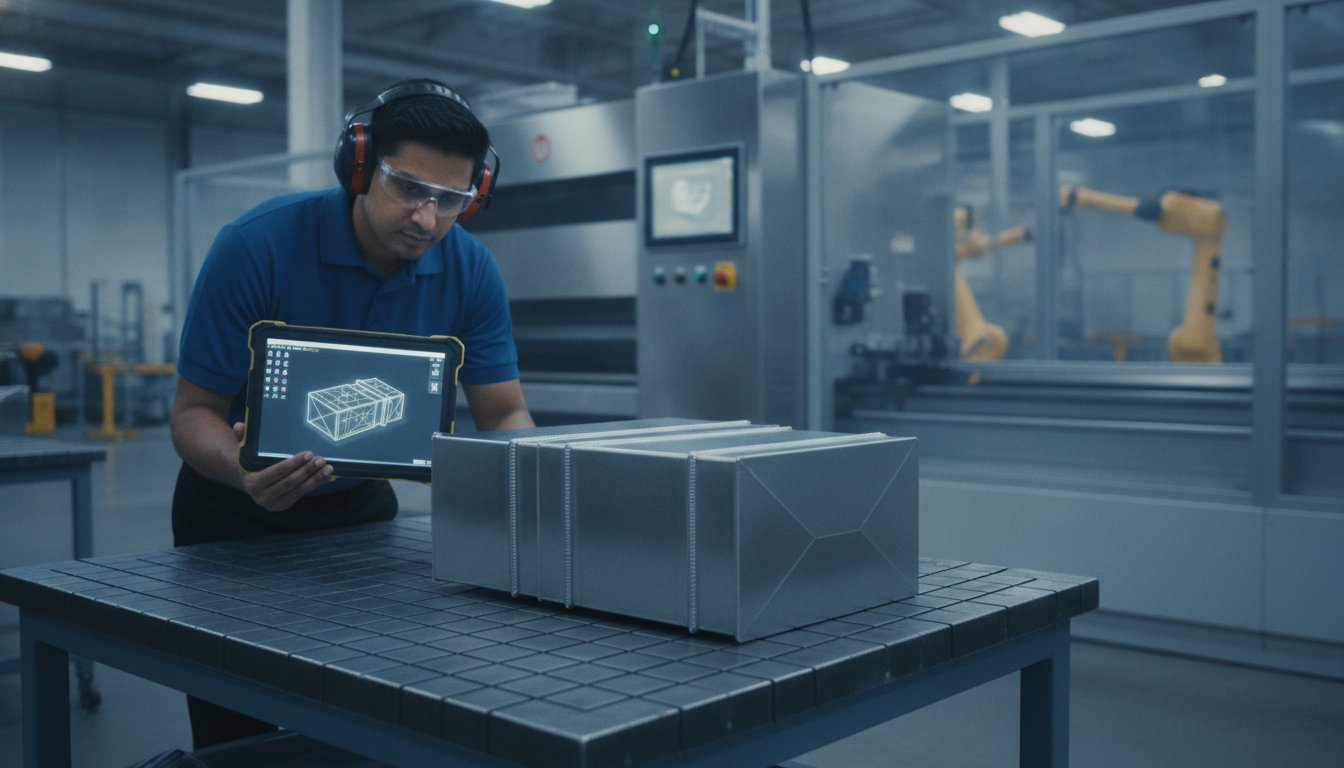
We act as the essential bridge between a digital file and a tangible product. Our BIM coordination data feeds directly into our automated fabrication machinery, including laser cutters and coil lines. This direct-to-machine workflow eliminates manual data entry and the human error that comes with it. Precision bending and cutting based on actual model data ensures sub-millimeter accuracy for every transition and fitting. This integration also allows for real-time production tracking. You don't have to guess where your order stands; the digital model provides a clear status of every spool from the shop floor to the delivery truck.
This digital-first strategy is the benchmark for modern commercial kitchen ductwork fabrication. It's about industrial pragmatism. We focus on efficiency and reliability because we know your time is as valuable as our precision. By investing in coordination upfront, you ensure a faster, cleaner installation that meets every code requirement without the typical administrative delays of the industry. We deliver a controlled, transparent, and repeatable process that moves your project from the screen to the ceiling with surgical accuracy.
High-Volume Production via Automated Coil Lines
Manual fabrication is a bottleneck. In high-stakes commercial construction, you can't rely on shops that still notch and fold by hand. Professional commercial kitchen ductwork fabrication at scale demands industrial-grade automation to meet the rigorous demands of modern fire codes and project timelines. Automated coil lines transform raw metal into finished rectangular duct sections with a speed and consistency that manual labor simply cannot replicate. Every section comes off the line with identical bead profiling and perfectly formed flanges. This ensures that the last piece of duct on a massive project fits exactly like the first, eliminating the cumulative errors that plague manual shops.
Precision is the byproduct of a controlled environment. When the machinery handles the leveling and shearing, the resulting duct is perfectly square. This squareness is vital for the liquid-tight welding discussed in previous sections. If the duct is even a fraction of an inch out of alignment, the welding process becomes a struggle against heat distortion. Automation provides the tight tolerances necessary to ensure that every seam is ready for a high-quality, compliant weld without extra shop labor. It bridges the gap between raw material and a finished, code-compliant vessel.
Efficiency in Rectangular Duct Manufacturing
The process is a model of industrial flow. A coil line automates the entire front end of production: de-coiling, leveling, and shearing sheet metal to exact specifications. Integrated notchers and folders create perfect Pittsburgh or Snaplock seams without the risk of human error. This level of automation significantly lowers the cost per foot on large-scale orders. It allows for a faster transition from raw material to a job-site-ready product. By removing manual data entry and hand-marking, the shop floor moves at the speed of the digital model, ensuring that lead times remain reliable even during peak construction seasons.
Scalability for National HVAC Projects
National accounts need a partner who can scale without sacrificing quality. Whether you're managing a ghost kitchen rollout or a multi-state restaurant chain, you need standardized quality that doesn't vary by region. Automated shops can pivot between different gauges and materials in minutes, moving from 16-gauge carbon steel to 18-gauge stainless steel with surgical precision. This flexibility is the key to maintaining aggressive project timelines across multiple states. Consistent output means your field crews know exactly what to expect when the truck arrives at any job site nationwide.
Speed and accuracy are no longer optional in this industry. Secure your project timeline with our high-volume automated rectangular duct production. We deliver the precision you need to keep your crews moving and your inspections passing on the first try.
Velocity Sheet Metal: National Fabrication and Distribution
A digital model is only as good as the shop that builds it. Velocity Sheet Metal bridges the gap between complex engineering files and physical job-site delivery. We operate with a high degree of professional confidence and industrial pragmatism. Our facility is designed to handle the most demanding commercial kitchen ductwork fabrication requirements for contractors, engineers, and OEMs nationwide. We don't just manufacture duct; we deliver a streamlined workflow that eliminates administrative delays and keeps your project moving at the speed of modern construction.
Our management team brings over 50 years of combined experience to every order. This expertise allows us to act as a firm guide through the technical complexities of high-volume production. We understand the pressure of tight project schedules. We've built our business around the "can-do" attitude required to solve traditional industrial problems with modern, automated technology. It's about delivering a product that matches your exact specifications without the typical friction of a manual shop.
Standardized Solutions for National Accounts
Consistency is the primary challenge for national accounts. If you're building a multi-site restaurant chain, you can't risk regional quality variance. We provide a standardized partner that delivers the same high-precision components to every location. By centralizing BIM coordination and fabrication, we simplify your entire procurement process. You get one point of contact, one set of standards, and one predictable result. This centralized approach reduces the risk of non-compliant ductwork and ensures that every system meets the liquid-tight requirements established in your initial design.
- Centralized BIM coordination and spool drawing services.
- Identical fabrication standards across all national projects.
- Reduced administrative overhead through standardized procurement.
- Elimination of regional quality discrepancies.
Logistics and Nationwide Shipping
Precision fabrication is worthless if the product arrives damaged. We take the logistics of delivery as seriously as the accuracy of our laser cuts. Our team uses expert crating techniques to ensure your ductwork reaches the job site in perfect condition. We ship nationwide, supporting national accounts with reliable lead times that help you manage complex construction schedules. Whether your project is in a dense urban center or a remote location, we ensure your commercial kitchen ductwork fabrication arrives on time and ready for immediate installation.
We are the bridge between your digital concept and the final physical result. Our automated processes and methodical flow reassure our partners that every order is controlled and repeatable. Contact Velocity Sheet Metal for your next high-volume project. We're ready to get to work immediately on your next precision fabrication requirement.
Streamline Your Kitchen Exhaust Projects
Compliance in the commercial kitchen isn't just about passing an inspection; it's about structural fire containment. You've seen how integrating NFPA 96 standards with liquid-tight welding ensures a safe, durable exhaust system. By leveraging BIM coordination and automated coil lines, you eliminate the field collisions and slow lead times that stall traditional projects. Precision commercial kitchen ductwork fabrication is the difference between a system that fails under pressure and one that operates with surgical efficiency for years.
Velocity Sheet Metal brings 50+ years of combined management experience to your shop drawings and production floor. Our automated coil-line production and full BIM coordination services provide the standardized quality your national accounts demand. We move your project from the initial digital concept to final delivery with the urgency your schedule requires. It's time to cut through the administrative delays and get your crew moving on-site.
Get a Precision Fabrication Quote for Your National Account today. Let's build a safer, more reliable kitchen exhaust system together.
Frequently Asked Questions
What gauge metal is required for commercial kitchen exhaust ductwork?
NFPA 96 2024 standards require a minimum of 16-gauge carbon steel or 18-gauge stainless steel for commercial kitchen ductwork fabrication. These specific thicknesses ensure the system remains structurally sound during the intense thermal expansion of a grease fire. Standard HVAC gauges are insufficient and will fail under the heat loads found in commercial cooking environments.
Does commercial grease ductwork have to be welded?
Yes, all seams and joints must be liquid-tight, which requires continuous external welds. Mechanical fasteners like screws or pop rivets are strictly prohibited because they create leak points and catch grease inside the duct. Shop-welded sections provide the most consistent penetration and significantly reduce the risk of pinhole leaks compared to manual field welding.
What is the difference between a grease duct and a standard air duct?
Standard air ducts are designed for comfort cooling and use mechanical joints; grease ducts are fire-rated vessels built to contain flammable fuel. While air ducts use lighter gauges and gaskets, grease ducts require heavy-gauge steel and fully welded seams. The grease duct's primary job is fire containment, ensuring that a kitchen fire stays inside the metal until the suppression system activates.
How does BIM coordination benefit a commercial kitchen project?
BIM coordination allows you to resolve trade collisions in a 3D model before a single piece of metal is cut. This is essential in tight kitchen ceilings where ductwork must navigate around plumbing and fire sprinklers. By identifying these clashes early, you ensure that every spool arrives on-site ready for immediate installation, which eliminates expensive field modifications.
Can you ship custom fabricated ductwork nationwide?
We provide national shipping for all custom-fabricated ductwork, fittings, and curb adapters. Our logistics team uses expert crating to prevent damage during transit, ensuring your order arrives on-site in perfect condition. We support national accounts by maintaining standardized quality across all locations, helping you manage complex construction schedules regardless of the project's destination.
What are the cleaning access requirements for kitchen ductwork?
NFPA 96 requires access panels at every change in direction and every 12 feet of horizontal run to allow for thorough grease removal. These openings must be large enough for a technician to clean the entire interior surface of the duct. All access doors must be made of the same material and thickness as the duct itself and must maintain a liquid-tight seal when closed.
What materials are best for exposed kitchen ductwork in a restaurant?
Stainless steel is the gold standard for exposed runs because it offers superior corrosion resistance and a professional, industrial look. Type 304 or 316 stainless steel stands up to harsh cleaning chemicals and moisture without rusting. Carbon steel is a more cost-effective choice for concealed runs where aesthetics aren't a priority but fire safety is still required.
How do automated coil lines improve lead times for duct fabrication?
Automated coil lines accelerate commercial kitchen ductwork fabrication by processing rectangular sections at speeds manual shops can't match. These machines handle de-coiling, leveling, and shearing in one continuous, high-precision flow. This automation ensures every section is perfectly square, which speeds up the welding process and guarantees reliable lead times for high-volume national projects.