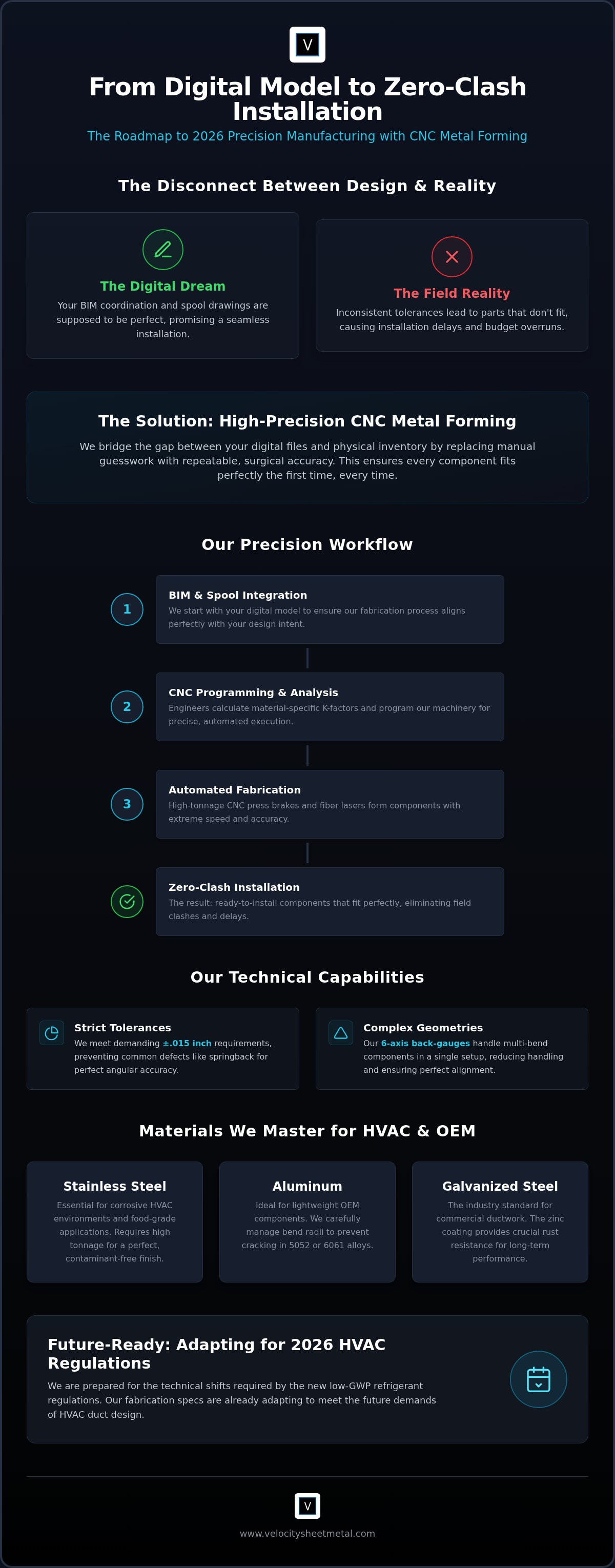
CNC Metal Forming Services: The 2026 Guide to Precision Manufacturing
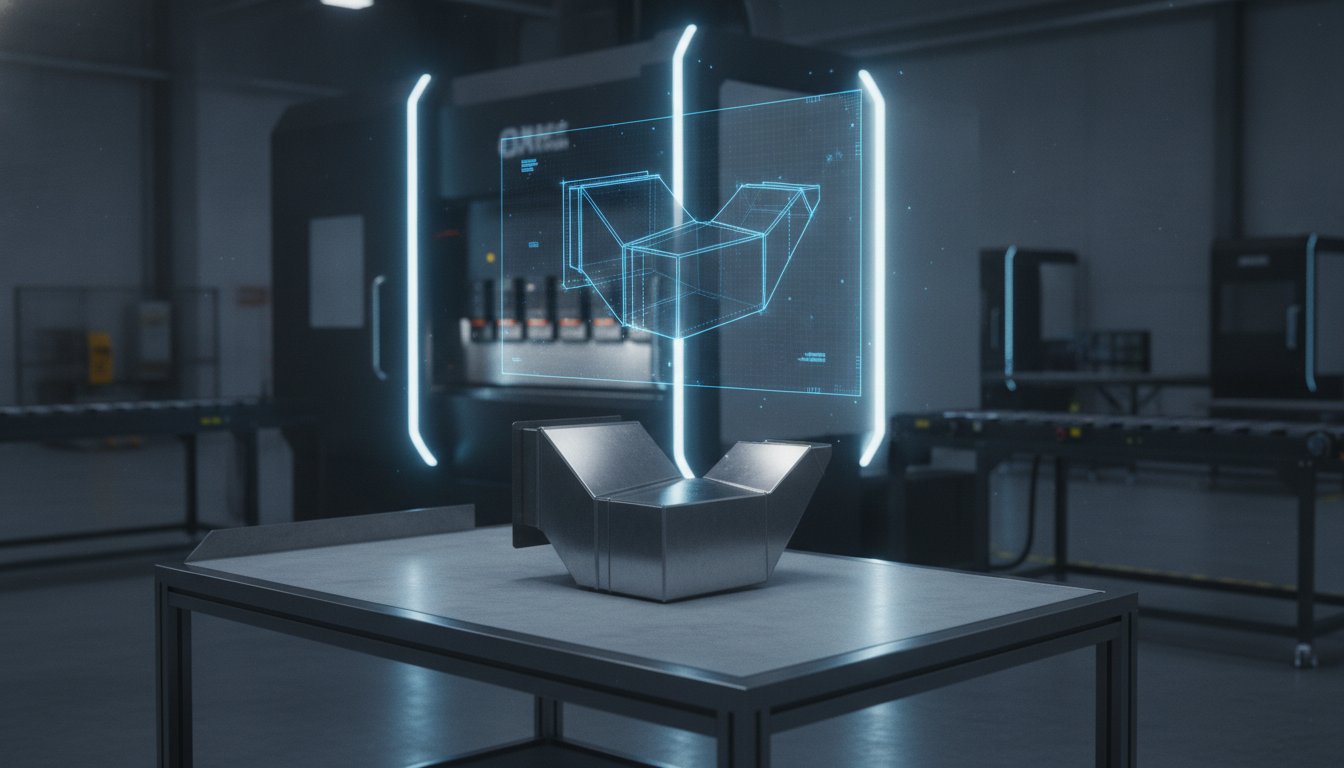
Why are your field teams still "making it fit" when your BIM coordination was supposed to be perfect? You know the frustration of opening a crate only to find that custom brackets don't align or transition fittings have drifted from the digital model. Inconsistent tolerances aren't just a nuisance. They're the primary cause of installation delays and blown budgets on national accounts. It's a common bottleneck that turns a streamlined project into a series of expensive field fixes.
Mastering modern manufacturing requires more than just raw force; it demands a surgical approach to fabrication. This guide will show you how to leverage high-precision CNC metal forming to eliminate field clashes and bridge the gap between your spool drawings and physical inventory. We'll explore the technical standards of ISO 2768, the impact of 2026's new HVAC refrigerant regulations on duct design, and how specialized custom sheet metal bending services turn complex digital files into ready-to-install components. From understanding fiber laser precision to optimizing your workflow for zero-clash installations, we're breaking down the roadmap for 2026 precision manufacturing.
Key Takeaways
- Bridge the gap between digital models and physical parts by mastering the digital-to-physical workflow of modern CNC press brake bending.
- Eliminate field installation delays through advanced BIM coordination and clash detection strategies that ensure your components fit the first time.
- Leverage high-precision custom sheet metal bending services to produce complex curb adapters and OEM components with surgical accuracy.
- Scale your national operations using automated coil-line fabrication and standardized quality protocols that maintain consistency across state lines.
- Adapt your HVAC fabrication specs to meet the technical requirements of the 2026 low-GWP refrigerant regulations.
What are CNC Metal Forming Services?
CNC metal forming is the automated process of shaping sheet metal using computer-controlled machinery. It's the bridge between a flat laser-cut blank and a finished industrial component. We use high-tonnage press brakes to apply precise force at specific coordinates, ensuring that every bend meets the exact degree required by your digital model. This technology replaces manual guesswork with repeatable, surgical accuracy. For national accounts, these custom sheet metal bending services provide a standardized output that manual shops simply can't match. Zero room for error. It's about moving from a single prototype to a full production run of 1,000 units without losing a fraction of a millimeter in tolerance.
The core of this service is the press brake. This machine transforms 2D sheets into complex 3D geometries. By integrating CNC controls, we eliminate human error and significantly reduce setup times. The foundational principles of Bending (metalworking) involve plastic deformation around a linear axis, but modern CNC systems elevate this to a high-speed industrial science. This allows for rapid scaling, moving your project from initial spool drawings to physical inventory with minimal lead time.
The Mechanics of Precision Bending
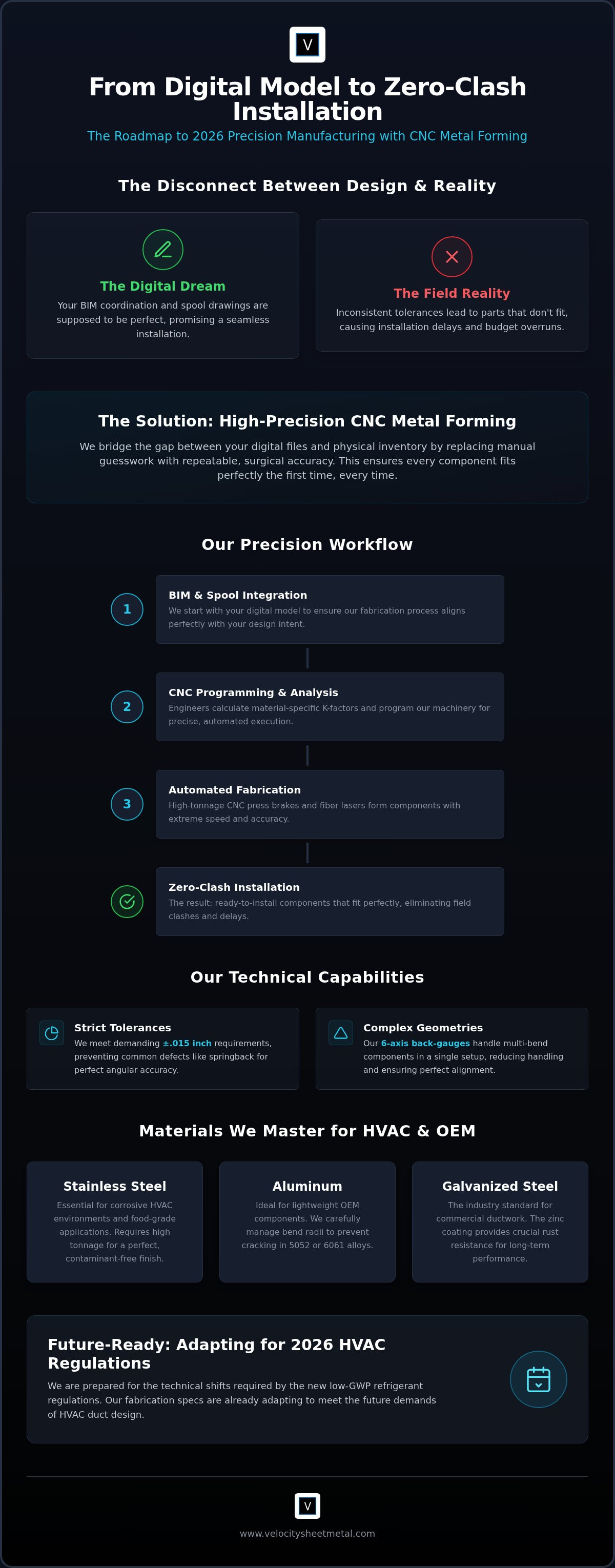
Achieving a perfect bend requires more than just pressure. It involves a deep understanding of material behavior, specifically the K-factor. This ratio represents the location of the neutral axis within the metal's thickness. Our engineers calculate this for every job to compensate for material stretching during the forming process. We utilize 6-axis back-gauges to handle complex, multi-bend geometries in a single setup. This reduces handling time and ensures that consecutive bends remain perfectly aligned. While hydraulic press brakes offer the high tonnage needed for heavy-gauge plate, electric models provide the extreme speed and precision required for thinner, high-volume components.
Materials Suitable for CNC Forming
Precision manufacturing depends on selecting the right material for the application. Our custom sheet metal bending services handle a wide range of industrial metals, each requiring specific tooling and pressure settings:
- Stainless Steel: Essential for corrosive HVAC environments or food-grade applications. It requires high tonnage and specialized dies to prevent surface contamination.
- Aluminum: Ideal for lightweight OEM components. It needs careful handling to avoid cracking along the bend line, especially with 5052 or 6061 alloys.
- Galvanized Steel: The industry standard for high-volume rectangular and spiral ductwork. Its zinc coating provides essential rust resistance for standard commercial HVAC systems.
Advanced CNC Press Brake Bending Capabilities
CNC press brakes are the workhorses of the modern shop. High-tonnage capacity allows us to form heavy-gauge materials without compromising the structural finish. This isn't just about raw power; it's about controlled force. Multi-bend setups enable us to perform complex sequences in a single operation, which drastically reduces handling time and labor costs. When you're managing national accounts, speed is as critical as accuracy. Our custom sheet metal bending services ensure that the 1,000th part is an exact replica of the first. We maintain this level of consistency by strictly adhering to OSHA Machine Guarding Standards, ensuring our operators work safely while the equipment runs at peak efficiency. This reliability is the backbone of our production line, allowing us to hit tight deadlines for OEMs and large-scale contractors without sacrificing quality.
Tolerances and Technical Specifications
Precision in mechanical engineering is defined by the numbers. We meet the strict ±.015 in. requirements that modern projects demand. CNC automation is the only way to prevent common press brake forming defects like springback, where the metal tries to return to its original shape after the punch is released. The system automatically calculates the over-bend needed based on material thickness and type. For HVAC applications, angular accuracy is the difference between a seamless duct run and a field installation nightmare. We carefully manage the relationship between material thickness and the minimum bend radius to prevent cracking in heavy-gauge components. This technical rigor ensures that every piece fits perfectly within your BIM-coordinated model, eliminating the need for on-site modifications.
Complex Geometries and Custom Tooling
Standard bends are easy. The real challenge lies in creating custom transition fittings and plenum boxes with non-standard angles. Our multi-axis control allows for tapered bends and offset geometries that manual machines can't replicate. We maintain an extensive tooling library, which helps you avoid the high costs of custom die fabrication. This flexibility is vital for OEMs who need rapid prototyping before moving into full production. By utilizing 6-axis back-gauges, we can position the part with extreme precision for every hit. This capability allows us to produce intricate components that integrate seamlessly into larger assemblies. If your current supplier is struggling with complex geometries, it might be time to review your digital-to-physical workflow or explore the capabilities of Velocity Sheet Metal for your next national project.
CNC Forming for HVAC and OEM Applications
Precision manufacturing isn't a luxury in the commercial HVAC world; it's a requirement for survival. As the industry transitions to low-GWP refrigerants like R-454B in 2026, the demand for high-performance, leak-proof systems has never been higher. Custom curb adapters represent the most critical interface between a building and its mechanical system. A curb adapter that's off by even a fraction of an inch can compromise the seal of a multi-ton rooftop unit (RTU), leading to energy loss or structural issues. Our custom sheet metal bending services focus on these high-stakes components, ensuring that every RTU fitment is seamless and secure. We bridge the gap between digital spool drawings and physical installation, providing standardized quality for national accounts that manage multiple project sites simultaneously.
Efficiency in high-volume production comes from automation. We leverage automated coil lines for rectangular duct fabrication, which allows us to maintain a fast-paced rhythm without sacrificing accuracy. According to the Fabricators & Manufacturers Association (FMA), the drive toward smart manufacturing is reshaping how industrial components are sourced. We've embraced this shift by positioning ourselves as an authoritative partner for OEMs who need more than just parts. We provide the technical expertise to move a project from the design phase to a national rollout with surgical precision.
HVAC Solutions: Beyond Standard Ductwork
Airflow optimization depends on the geometry of your transition fittings. We use CNC forming to create complex transitions that minimize turbulence and pressure drop. This is especially vital for large-scale HVAC duct fabrication where mechanical contractors need every component to align perfectly with BIM models. By utilizing automated forming, we produce durable, leak-proof rectangular systems that meet the rigorous standards of modern commercial builds. It's about moving from a digital file to a tangible, high-performance product without the delays of manual rework.
OEM and Industrial Component Manufacturing
For national equipment manufacturers, supply chain resilience is the priority. We provide on-demand production of custom metal brackets, structural supports, and heavy-duty enclosures. These components are the skeleton of industrial systems, and they must withstand corrosive environments while maintaining tight tolerances. Our CNC press brake services for OEMs streamline the procurement process by offering a reliable, tech-savvy partner for high-volume orders. Whether it's a lightweight aluminum panel or a heavy-gauge steel bracket, we ensure that every part meets your exact technical specifications, regardless of the order size.
Design for Manufacturability: BIM and Spool Integration
CNC forming shouldn't be an isolated shop service. It's the physical execution of a precise digital strategy. The digital-to-physical workflow begins with BIM coordination, where every bend and flange is mapped within a virtual model. This data informs the CNC forming process, ensuring that the final part matches the engineer's intent with surgical precision. We utilize BIM clash detection for HVAC fabrication to identify spatial conflicts before the first laser cut. Our custom sheet metal bending services rely on this data-driven approach to ensure every component aligns with the overall mechanical layout. By integrating design and manufacturing, we eliminate the guesswork that leads to field installation delays.
Mechanical spooling is the bridge between a complex 3D model and the shop floor. It translates intricate geometries into accurate flat patterns ready for laser cutting and bending. During this phase, we optimize material nesting and bend sequences to reduce waste and maximize production speed. It's a methodical process that turns a digital file into a tangible, ready-to-install part. This level of planning is what allows us to maintain standardized quality across national accounts, regardless of project complexity.
The Power of BIM Coordination
BIM coordination ensures every formed part fits into the pre-planned mechanical space before production starts. We don't wait for field measurements to begin fabrication. Real-time design adjustments allow us to move from a digital model to the machine in hours, not days. This speed is critical for maintaining momentum on large-scale national projects. BIM integration effectively eliminates the "measure twice, cut once" delays on-site. When the components arrive, they fit. No field modifications. No wasted labor. Just seamless integration of CNC-formed parts into the building's infrastructure.
Spool Drawings and Machine Accuracy
Generating accurate spool drawings is essential for a seamless shop-to-field transition. These drawings allow for the modular assembly of complex duct and pipe systems, turning the job site into an assembly point rather than a fabrication shop. We take an authoritative approach to reviewing engineer drawings for forming feasibility. If a bend radius is too tight or a flange is too short, we catch it in the digital phase. This expert review ensures that every spool is manufacturable and structurally sound. If you're ready to modernize your workflow and eliminate field clashes, partner with Velocity Sheet Metal to bridge the gap between your digital models and physical inventory.
Scaling Production with National CNC Forming Solutions
National construction projects demand more than just technical skill; they require massive throughput. Manual bending processes can't keep pace with the aggressive timelines of a multi-state rollout. As the U.S. sheet metal fabrication market is projected to grow by 5.5% in 2026, the demand for high-volume, precision components is skyrocketing. This is where coil line duct fabrication changes the equation. By automating the transition from raw coil to formed rectangular duct, we achieve a production speed that manual shops simply can't replicate. Our custom sheet metal bending services are built for this level of scale. We combine 50+ years of management experience with the latest in automated CNC technology to serve as the essential bridge between your digital spool drawings and the job site.
Consistency is the biggest hurdle for national firms. When you source from multiple local shops, you get multiple sets of standards. Velocity eliminates this variability through centralized fabrication. We partner with national accounts to ensure that every HVAC component and OEM part meets identical specs, for projects located in any region across the country. Our shop acts as a high-tech hub, maintaining standardized quality across every project site. This reliability allows you to meet the tight schedules of national construction rollouts without worrying about component drift or field installation errors. It's about delivering a predictable result every time.
Standardization for National Accounts
Standardized HVAC and part specs are non-negotiable for large-scale operations. We work directly with your engineering team to codify these requirements into our automated systems. Centralized fabrication offers the benefit of one high-tech shop serving nationwide sites, which streamlines your procurement process and reduces administrative overhead. You don't have to manage twenty different vendors; you manage one partner who understands your national standards. This approach ensures that a bracket formed in January is identical to one produced in December. We provide the reliability needed to keep your national construction rollouts on track.
Logistics and On-Demand Delivery
Precision manufacturing is useless if the parts arrive damaged. We use specialized packaging and crating techniques to ensure every custom formed part survives national transit. Our logistics team coordinates with large-scale mechanical contractors to provide "just-in-time" delivery, reducing the need for on-site storage and the risk of job site damage. Our custom sheet metal bending services offer rapid on-demand part production to handle the inevitable shifts in construction schedules. This ensures that your field teams have exactly what they need, exactly when they need it. Ready to move from BIM to physical parts? Request a Quote for National CNC Metal Forming today and see how we streamline the transition from digital model to finished product.
Execute Your National Projects with Precision
Precision manufacturing in 2026 demands a seamless transition from digital model to physical inventory. You've seen how a BIM-integrated fabrication workflow eliminates field clashes and how automated coil-line production speed keeps national rollouts on schedule. Relying on 50+ years of industrial expertise ensures every bracket, duct, and curb adapter meets the strict ±.015 in. tolerances required for modern mechanical systems. It's about moving from a spool drawing to a finished part without the friction of manual rework or administrative delays. By choosing custom sheet metal bending services that prioritize digital coordination, you secure a reliable bridge between your design team and the installation site.
The standard for industrial fabrication has shifted toward automation and data-driven accuracy. Don't let inconsistent tolerances or slow lead times compromise your project's profitability. We're ready to put our high-tonnage capabilities and technical rigor to work for your national accounts immediately. Request a Quote for National CNC Metal Forming and take the first step toward a zero-clash installation. We're ready to get to work.
Frequently Asked Questions
What is the maximum thickness your CNC metal forming services can handle?
Our high-tonnage CNC press brakes are engineered to process materials up to 1/4 inch for most standard industrial applications. The specific thickness limit depends on the material type and the required bend length. We maintain structural integrity across these gauges, ensuring that even heavy-duty brackets and structural supports meet your exact engineering specifications without surface cracking or deformation. It's about matching the right tonnage to your specific material requirements.
How does BIM coordination improve the accuracy of CNC formed HVAC parts?
BIM coordination provides the precise digital coordinates that our CNC machinery follows with surgical accuracy. By simulating the fitment in a 3D environment before fabrication begins, we identify spatial conflicts and adjust the design in the digital phase. This data is fed directly into our forming software, eliminating the risk of transcription errors and ensuring that every component integrates perfectly with other mechanical systems for a zero-clash installation.
Can you provide CNC press brake services for national OEM accounts?
We specialize in serving national OEM accounts through a centralized fabrication model that guarantees standardized quality across all your project sites. Our custom sheet metal bending services are designed to scale with your production needs, providing identical components for equipment manufacturers regardless of their final destination. This centralized approach simplifies your supply chain and ensures that every part meets your exact technical requirements, from the first prototype to the final production run.
What is the typical lead time for custom CNC formed transition fittings?
Lead times for custom CNC formed transition fittings are significantly reduced by our automated digital-to-physical workflow. While timelines vary based on order volume and material availability, our ability to translate spool drawings directly into machine code allows us to move from design to delivery in days rather than weeks. We prioritize speed to help mechanical contractors maintain momentum on tight construction schedules, ensuring that custom fittings arrive exactly when your field teams are ready.
Do you offer nationwide shipping for large rectangular and spiral duct orders?
We provide comprehensive nationwide shipping for all large rectangular and spiral duct orders. Our logistics team utilizes specialized packaging and crating techniques to protect custom formed components during transit, ensuring they arrive on-site without damage. Whether you're managing a single large-scale build or a multi-state rollout, our national shipping capabilities allow us to serve as your primary fabrication partner, delivering high-volume HVAC orders directly to your project sites or regional warehouses.
How do you ensure consistent bending tolerances across high-volume production runs?
Consistency across high-volume production runs is achieved through fully automated CNC controls and multi-axis back-gauging. These systems automatically compensate for material variations like springback, ensuring that each hit is identical to the last. By removing the variability of manual operation, our custom sheet metal bending services maintain strict ±.015 in. tolerances throughout the entire run. This repeatability is essential for national accounts that require standardized components for rapid assembly and modular construction.
What materials are best suited for precision CNC metal forming in HVAC applications?
Galvanized steel is the industry standard for high-volume rectangular and spiral ductwork due to its balance of cost and corrosion resistance. For high-performance or corrosive environments, stainless steel is preferred for its superior durability and structural integrity. Aluminum is frequently used for lightweight OEM components and specialized rooftop units. Each material requires specific CNC settings and specialized tooling to ensure tight tolerances and clean bends, particularly when meeting 2026's updated mechanical engineering standards.