Choosing a Sheet Metal Fabricator for HVAC: A 2026 Guide to Quality and Speed

In 2026, a sheet metal shop's physical location matters far less than its digital infrastructure. If your fabricator isn't speaking the same language as your Revit model, you aren't just buying duct; you're buying future field collisions. You've likely felt the sting of manual errors that force your crew to field-modify parts, dragging out schedules and burning through labor hours. It's an outdated way to build that no longer fits the speed or the tight margins of modern commercial construction.
This guide simplifies choosing a sheet metal fabricator for HVAC by focusing on the three pillars of modern production: automation, BIM integration, and national scalability. You'll learn how to vet a partner's technical stack to ensure every fitting arrives with surgical precision. We'll explore how seamless BIM-to-fabrication workflows eliminate guesswork; how automated coil lines stabilize your lead times; and why a digital-first approach is the only way to guarantee predictable results on large-scale projects. By the end, you'll know exactly how to secure a partner who acts as a bridge between your digital design and a tangible, high-performance product.
Key Takeaways
- Identify the shift from manual shops to digital automation to eliminate human error and inconsistent tolerances in your ductwork.
- Learn how BIM-integrated fabrication and precision spool drawings prevent field collisions and reduce installation labor.
- Understand why choosing a sheet metal fabricator for HVAC with automated coil-line capabilities is essential for high-volume project speed.
- Evaluate a partner's national scalability to ensure consistent quality and predictable lead times regardless of your job site’s location.
- Discover the value of a seamless production pipeline that moves your project directly from a digital file to a finished, industrial-grade part.
The Evolution of HVAC Fabrication: Why Standard Shops Aren’t Enough
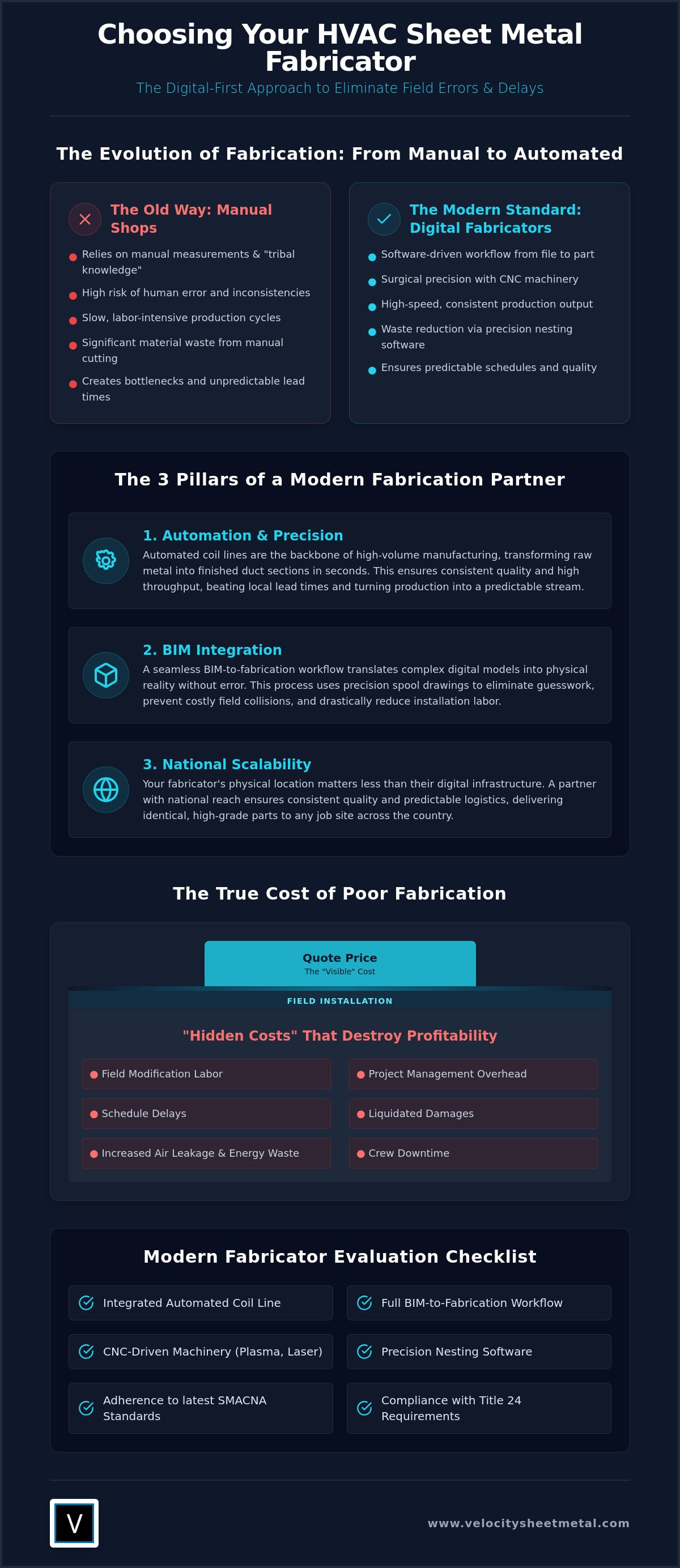
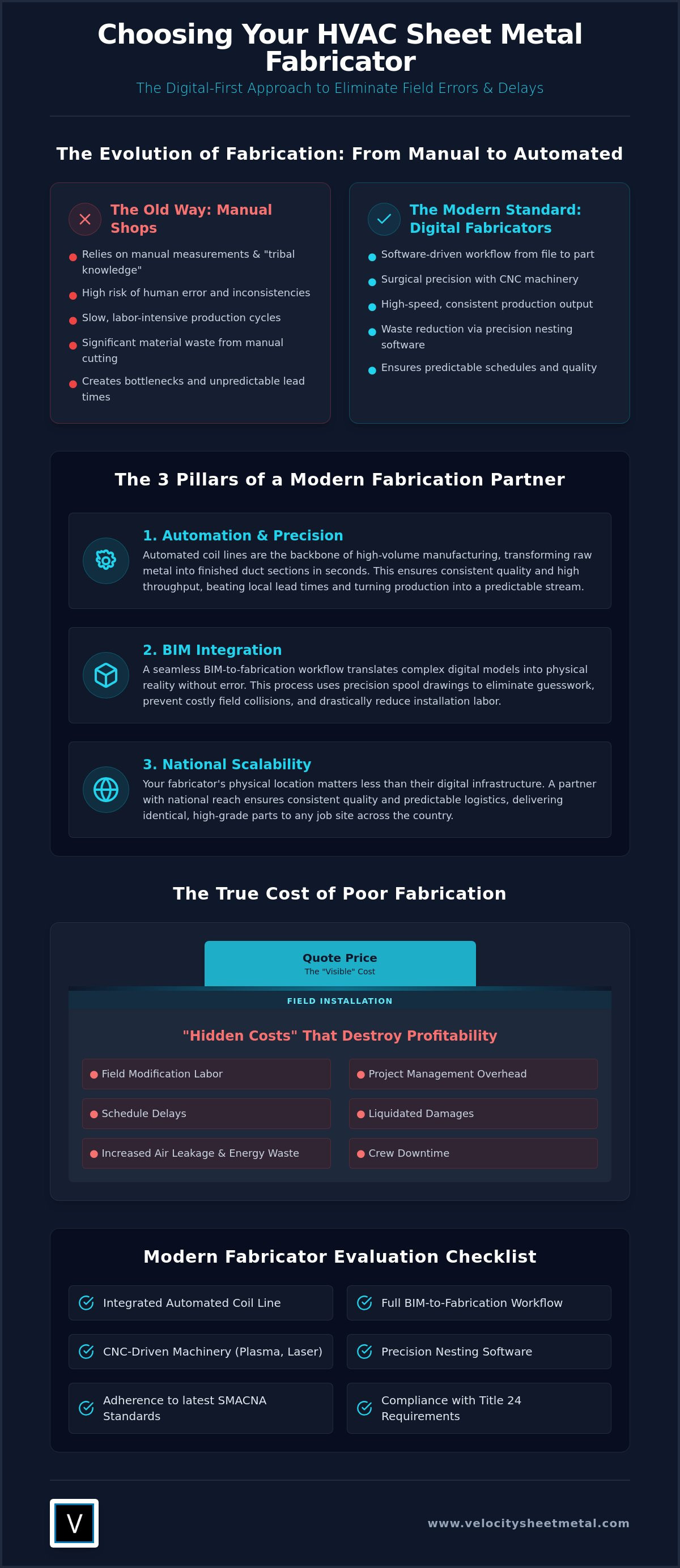
The days of relying on a local shop with a few hand brakes and a shear are over. In 2026, the mechanical contracting industry has reached a tipping point where digital precision is the only way to remain competitive. Traditional fabrication relies on manual measurements and tribal knowledge, which inevitably leads to inconsistent tolerances. When you are choosing a sheet metal fabricator for HVAC, you aren't just looking for someone to bend metal; you're looking for a technology partner who can translate complex BIM data into physical reality without losing a fraction of an inch in the process.
Modern fabrication has evolved into a high-speed, software-driven workflow. It starts with a digital file and ends with a part that fits perfectly the first time it's lifted into the hangers. Standard shops often struggle with the rigorous demands of new regulations, such as the California 2025 Title 24 Building Codes that became effective in January 2026. These updates require tighter seals and higher performance, making precision non-negotiable. Adhering to the latest SMACNA Rectangular Industrial Duct Construction Standards, specifically the 3rd Edition updated in July 2026, is now the baseline for any qualified firm. If a shop isn't utilizing automated systems to meet these benchmarks, they are a liability to your project schedule.
Manual vs. Automated Production Cycles
Manual fabrication is a bottleneck. Every time a technician touches a piece of metal to measure or notch it, the risk of error increases. These small discrepancies compound across a large project, leading to massive amounts of field adjustment labor. Automated coil lines and CNC machinery eliminate this variable. These systems use digital optimization to manage HVAC ductwork materials with surgical efficiency. By using precision nesting software, automated shops reduce material waste and move from raw coil to finished rectangular duct in a fraction of the time it takes a manual crew. This speed is what allows contractors to meet aggressive construction deadlines that would otherwise be impossible.
The High Cost of Poor Fabrication Quality
The price on a quote rarely reflects the true cost of the ductwork. Poorly fabricated parts carry "hidden costs" that eat your margins alive. When a fitting doesn't line up in the field, your high-priced installation crew stops working to become on-site fabricators. This slows down the entire job site and can trigger liquidated damages. Precision is the primary driver of mechanical contractor profitability in 2026. High-quality fabrication ensures that the system performs as designed for the long term, reducing air leakage and energy waste. When choosing a sheet metal fabricator for HVAC, focus on their ability to deliver parts that require zero field modifications. That is where the real profit is made.
Evaluating Technical Capabilities: Automation and Precision
When choosing a sheet metal fabricator for HVAC, you must look beyond the number of skilled sheet metal workers on their floor. In 2026, the real differentiator is the equipment they operate. High-volume commercial projects demand a level of repetition and speed that human hands cannot sustain. You need a partner who has replaced manual guesswork with CNC-driven accuracy. This transition from a traditional workshop to a modern factory floor ensures that every piece of ductwork meets the exact specifications of your design. Whether you are working with galvanized steel, lightweight aluminum, or high-grade stainless steel, the machinery must be capable of handling these materials at scale without compromising on quality.
The Power of the Automated Coil Line
An integrated coil line duct fabrication system is the backbone of high-volume HVAC manufacturing. It transforms raw metal coils into finished, beaded, and notched rectangular duct sections in seconds. This isn't just about raw speed; it's about consistency. When a machine handles the shearing and folding, every joint fits perfectly across thousands of feet of ductwork. This high throughput allows tech-forward shops to beat local lead times, even when shipping across the country. If your fabricator is still manually breaking every section of rectangular duct, your project is already behind schedule. Automation turns a potential bottleneck into a predictable production stream.
Custom Parts and Laser Cutting Precision
Standard duct runs are straightforward. The real test of a fabricator lies in the complex transitions and specialized fittings that connect the system. This is where precision laser cutting services become critical. Unlike traditional plasma cutters that can leave slag and heat-distorted edges, laser cutting provides a clean, burr-free finish. This level of CNC accuracy is essential for achieving tight tolerances on OEM parts and specialized HVAC components. When these custom parts arrive on-site, they snap together without the need for grinding or forcing. This saves your crew hours of field labor.
Precision doesn't stop at the cutter. For heavy-gauge mechanical components and curb adapters, CNC press brake bending is non-negotiable. It ensures that every angle is exact, preventing the slight deviations that lead to system leaks or structural issues. By combining automated production with digital bending, a modern fabricator acts as a precision bridge between your 3D model and the physical job site. If you're ready to see how this technical stack can accelerate your next project, you can view our full fabrication capabilities to see these machines in action.
The BIM Integration Factor: Preventing Field Collisions
BIM integration is the insurance policy for any commercial HVAC project. It bridges the gap between engineering intent and physical installation. When you are choosing a sheet metal fabricator for HVAC, verify that their team can handle more than just a flat PDF. You need a partner who lives in the 3D environment. This digital-first approach allows for clash detection before a single sheet of metal enters the laser cutter. By identifying where a duct run might strike structural steel or plumbing in the virtual model, you eliminate the expensive field fixes that derail construction schedules.
The "Model-to-Machine" workflow is the pinnacle of modern manufacturing. It involves taking a Revit file and converting it directly into machine code for the coil line or laser. This process removes human interpretation from the equation. It ensures that what was designed in the digital model is exactly what arrives on the flatbed. This seamless transition from engineering to production is the only way to maintain the tight tolerances required for high-performance buildings in 2026. It turns the fabrication process into a controlled, predictable part of the construction timeline rather than a source of uncertainty.
Mechanical Spooling and Drawing Accuracy
Mechanical spool drawings take complex 3D models and break them into manageable, shop-fabricated assemblies. Some industry professionals report that accurate mechanical spooling can reduce field installation labor by up to 30 percent. This efficiency is achieved by labeling every part and organizing deliveries to match the site's specific installation sequence. Each section of ductwork arrives pre-tagged and ready for immediate hanging. This level of organization turns a chaotic job site into a streamlined assembly line, allowing your crew to focus on production rather than sorting through a pile of unidentifiable fittings.
Collaborative BIM Coordination
A fabricator who speaks the language of Navisworks and Revit is a strategic asset during the design phase. They don't just take orders; they optimize HVAC layouts for better airflow and easier installation. This collaborative coordination identifies potential issues while they are still just lines on a screen. By resolving these conflicts early, the fabricator provides the best insurance policy against project cost overruns. This digital coordination ensures that the final physical product integrates perfectly with other building systems, providing a level of reliability that traditional shops simply cannot match.
Scalability and Logistics: Vetting for National Project Consistency
For major commercial developers, the local shop is often a bottleneck. When you're managing projects across state lines, geographic proximity is secondary to industrial scalability. Choosing a sheet metal fabricator for HVAC with national shipping capabilities is no longer a luxury; it's a strategic requirement for maintaining project momentum. Large-scale construction requires a partner who can absorb high-volume orders without flinching. You need to know that your tenth project will have the same precision and lead time as your first, regardless of where the job site is located.
The metal doesn't care about the miles. The project schedule does. A fabricator with a national footprint understands the urgency of commercial construction. They've built their entire workflow to support high-volume output and rapid distribution. This capability allows you to bypass the inconsistent lead times and varying quality levels of local vendors. By centralizing your fabrication, you turn a fragmented supply chain into a controlled, predictable production stream that follows your project portfolio wherever it goes.
Managing National Accounts and Standards
Developers and multi-state contractors benefit from a single-source fabrication partner. Instead of managing dozens of local vendors, a national partner provides a unified production standard. This eliminates the need to re-vet shops for every new job site. Since the same digital files are used across all locations, you guarantee that every fitting meets identical tolerances. Communication becomes streamlined through a single point of coordination. This reduces the administrative burden on your project managers and ensures that your corporate quality standards are met on every floor of every building.
Shipping and On-Site Delivery Logistics
The logistics of moving thousands of feet of ductwork require more than just a truck. Efficient packaging is an engineering task. Spiral and round ductwork are often nested to save space, while rectangular sections are stacked to prevent crushing during transit. A national distribution model often outperforms local shops on both speed and price because of high-volume production efficiencies. These fabricators utilize just-in-time delivery protocols, coordinating shop output with specific installation phases. This prevents job site clutter and ensures that the material is there exactly when the hangers are ready. It's a methodical process that treats shipping as an extension of the assembly line. If you need a partner capable of supporting your national expansion, contact us for national account support to discuss your upcoming project portfolio.
Velocity Sheet Metal: Your Partner for Automated HVAC Solutions
Choosing a sheet metal fabricator for HVAC is a decision that dictates the pace of your entire job site. At Velocity Sheet Metal, we've eliminated the friction between design and delivery. We combine over 50 years of combined industry experience with the most advanced automated technology available. This allows us to serve as the essential bridge between a digital Revit file and a tangible, precision-engineered product. We don't just fill orders; we provide the industrial-grade reliability that mechanical contractors and engineers need to hit aggressive 2026 construction targets. From initial BIM coordination to national site delivery, our pipeline is built for speed.
We support the contractor looking for installation efficiency; the engineer requiring exact tolerances; and the OEM needing on-demand part production. Our facility operates with a "can-do" attitude grounded in modern manufacturing reality. We understand that in commercial construction, time is the most expensive material on the manifest. By automating the most complex parts of the fabrication process, we ensure that your project moves from the screen to the hangers without the traditional administrative delays or manual errors that plague standard shops.
Our Core Fabrication Capabilities
Our production floor is designed for high-volume output and surgical precision. We maintain a comprehensive suite of services to ensure we can handle every aspect of your mechanical requirements. Our core offerings include:
- Automated Coil-Line Production: Rapid manufacturing of high-volume rectangular duct with consistent, repeatable quality.
- Custom Laser Cutting: High-precision cutting for complex transition fittings and specialized OEM components.
- CNC Press Brake Bending: Exacting angles for heavy-gauge parts and custom curb adapters.
- Spiral and Round Solutions: A full range of spiral duct, round duct, and matching fittings for any system layout.
- Digital Coordination: In-house BIM coordination and mechanical spool drawing services to identify collisions before production begins.
Get Started with Velocity
Ready to accelerate your production schedule? Our onboarding process is designed for speed and transparency. It begins with a technical review of your project requirements where our team analyzes your digital files or specifications. For national accounts and high-volume orders, we establish clear communication protocols and delivery phases to match your site's installation sequence. We treat every project with a sense of industrial pragmatism, focusing on the technical details that ensure your success. You can request a quote today to see how our automated pipeline can reduce your field labor and stabilize your project lead times.
Build for Speed with Precision Fabrication
Success in 2026 commercial construction depends on your ability to eliminate field variables before they reach the job site. Choosing a sheet metal fabricator for HVAC is no longer just about sourcing parts; it's about integrating a digital-first production pipeline into your workflow. By prioritizing shops that offer automated coil-line production and deep BIM coordination expertise, you ensure every fitting aligns perfectly with your design. This transition from manual bending to CNC-driven accuracy is what separates profitable projects from those bogged down by field corrections.
Velocity Sheet Metal is ready to act as your essential bridge between a Revit model and a physical product. We combine industrial-grade reliability with national shipping capabilities to support your most ambitious project portfolios. Whether you need high-volume rectangular duct or custom laser-cut fittings, our team delivers the speed and precision your schedule demands. Our process moves you quickly from an initial digital concept to a final physical result with surgical accuracy.
Request a Quote for Your High-Volume HVAC Project and experience a seamless production process built for the modern mechanical contractor. We look forward to helping you build faster.
Frequently Asked Questions
What is the difference between a standard sheet metal shop and an automated fabricator?
The primary difference is speed and repeatability. Standard shops rely on manual layout and hand breaking, which increases the risk of human error. Automated fabricators use CNC software and coil lines to turn raw metal into finished duct in seconds. This industrial approach ensures every joint fits perfectly across thousands of feet, eliminating the inconsistent tolerances common in manual workshops.
How does BIM coordination reduce the overall cost of an HVAC project?
BIM coordination eliminates field collisions and expensive rework. By identifying clashes with structural steel or plumbing in a 3D model before production begins, you avoid the high cost of field-modifying parts. This keeps your high-priced installation crew productive and prevents the project delays that trigger liquidated damages. It turns fabrication into a predictable part of the construction timeline.
Can an HVAC fabricator ship ductwork nationwide without damaging the product?
Yes, through engineered packaging and strategic nesting. Spiral and round ducts are nested to maximize truck space, while rectangular sections are stacked to prevent crushing during transit. National fabricators use dedicated logistics protocols to ensure product integrity from the factory floor to your job site. This methodical approach treats shipping as a controlled extension of the assembly line.
What are the benefits of using an automated coil line for rectangular duct?
Automated coil lines provide high throughput and consistent tolerances. The system shears, beads, and notches raw metal in one continuous, software-driven process. This is the gold standard for high-volume commercial projects where choosing a sheet metal fabricator for HVAC with industrial capacity is essential for meeting tight schedules. It provides a level of production speed that manual shops simply cannot match.
How do I know if a fabricator can handle the volume of a large commercial project?
Evaluate their equipment specs and national account history. A capable fabricator should operate an automated coil line and high-speed laser cutters to maintain high output. Ask about their daily throughput capacity and their ability to provide BIM-integrated spool drawings for complex layouts. If they can't demonstrate a digital-first workflow, they likely can't handle the scale of a major commercial build.
What information does a fabricator need to provide an accurate quote?
A fabricator needs digital design files and clear material specifications. Providing Revit models, Navisworks files, or detailed CAD drawings allows for the most accurate takeoff and identifies potential issues early. You must also specify material types, such as galvanized steel or aluminum, along with the required gauges and pressure classes to ensure the quote reflects your project's technical requirements.
Why is laser cutting preferred over plasma cutting for HVAC fittings?
Laser cutting offers superior edge quality and tighter tolerances. The process produces clean, burr-free edges without the slag or heat distortion common with plasma cutters. This CNC precision ensures that custom fittings and transitions snap together perfectly in the field. This reduces the need for grinding or forcing parts into place, which significantly lowers your on-site labor costs.
What standards should a professional HVAC sheet metal fabricator follow?
SMACNA standards are the non-negotiable benchmark for the industry. Professional fabricators must adhere to the Rectangular Industrial Duct Construction Standards, 3rd Edition, updated in July 2026. Compliance with these standards ensures the structural integrity and performance of the ductwork under specified pressure loads. It also guarantees that the fabrication meets the latest building codes, such as California's 2025 Title 24 updates.